
The pursuit of high-performance motion control in robotics, CNC machine tools, and precision pointing mechanisms has consistently driven the advancement of power transmission components. Among these, the RV reducer stands out for its unique combination of a large reduction ratio, exceptional compactness, and superior load-bearing capacity. At the heart of its performance lies its ability to transmit high torques with minimal elastic deflection, a characteristic quantified by its torsional stiffness. This property is not merely a number on a datasheet; it is the cornerstone of positional accuracy, dynamic response stability, and resistance to vibration under heavy loads. A deficiency in torsional stiffness can lead to pronounced oscillatory behavior, accelerated internal wear, and ultimately, a degradation in the operational life and reliability of the entire robotic system. Consequently, a profound understanding and accurate prediction of the torsional stiffness of an RV reducer is paramount for its design and application. While prior research has extensively modeled stiffness values, a significant gap exists in directly linking the core design parameters of its critical speed-reducing stage—the cycloidal pinwheel mechanism—to the final, measurable torsional deformation of the entire reducer assembly. This work, therefore, aims to bridge that gap by developing a comprehensive analytical model that quantifies the overall torsional compliance of an RV reducer as an elastic twist angle, explicitly incorporating the geometric, modification, and tolerance parameters of the cycloidal drive. This approach provides a more intuitive and application-oriented metric for evaluating how design choices influence the fundamental load-bearing performance of the RV reducer.
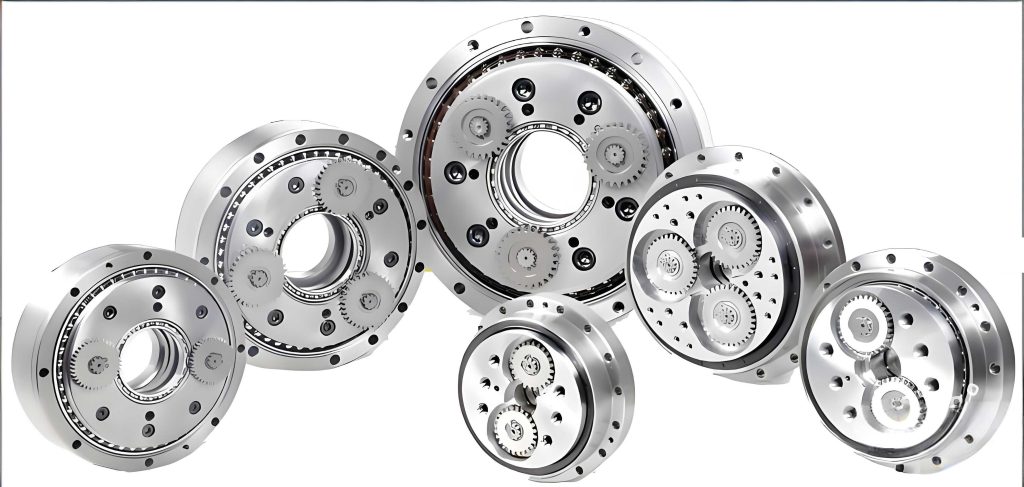
The operational principle of a standard RV reducer is based on a two-stage, closed differential gear train. The first stage is a conventional involute planetary gear set, consisting of a sun gear and multiple planetary gears. The second and most critical stage is the cycloidal-pinwheel planetary mechanism. Here, the rotation from the first stage is transferred to crankshafts, which eccentrically drive cycloidal discs. These discs mesh with a stationary ring of pins (the pinwheel). The unique lobed shape of the cycloidal disc and the differential motion result in a very high reduction ratio in this second stage. Finally, the low-speed rotation of the cycloidal discs is output through a planet carrier. The entire system’s exceptional stiffness and compactness are largely attributed to the multi-tooth, rolling-contact nature of the cycloidal meshing, where multiple pin teeth share the load simultaneously. Understanding the static force distribution within this complex system is the first step toward stiffness analysis.
The static analysis begins by establishing deformation compatibility conditions and force equilibrium equations for the entire transmission chain. For the involute stage, assuming ideal manufacturing and assembly, the deformation of the sun gear at each planetary meshing point is equal under an input torque $T_{in}$. This leads to equal reaction forces $F_{spi}$ from the planets. The equilibrium for the sun gear with $N_p$ planets is:
$$ \sum_{i=1}^{N_p} F_{spi} r_s = T_{in} $$
where $r_s$ is the pitch radius of the sun gear. For the cycloidal stage, the analysis focuses on one of the typically two phase-shifted cycloidal discs. When a load torque $T_c$ acts on the disc, it rotates by a minute angle $\beta_c$, causing elastic contact deformations $\Delta \delta_k$ at the $k$-th pin in contact. The compatibility condition relates this deformation to the lever arm $l_k$:
$$ \Delta \delta_k = l_k \beta_c $$
The force equilibrium for the cycloid disc requires that the sum of the moments from all pin contact forces $F_k$ balances the load torque:
$$ \sum_{k} F_k l_k = T_c $$
For the crankpin bearings supporting the cycloid discs on the crankshafts, under the resultant force $F_P$ from the pin contacts, the radial deformations $\delta_{Fci}$ are assumed equal for all $N_q$ crankshafts. Similarly, deformations due to the torque $\delta_{Tci}$ are equal, yielding another set of compatibility conditions. The equilibrium of the planet carrier involves the tangential forces $F_{qxjti}$ from the crankshafts balancing the output torque $T_{out}$:
$$ \sum_{i=1}^{N_q} (F_{qxjti}) a_0 = T_{out} $$
where $a_0$ is the radius of the crank circle. Finally, each crankshaft must be in equilibrium under forces from the planetary gear, the two cycloid discs, and the planet carrier at both ends, involving a system of equations for forces and moments in two planes.
The total elastic angular deflection (torsional angle) $\theta_{\Sigma}$ at the output of the RV reducer under load is the cumulative effect of elastic deformations in all its compliant components. It is the inverse representation of the overall torsional stiffness $K_{total}$, related by Hooke’s Law: $\theta_{\Sigma} = T_{out} / K_{total}$. This total angle can be decomposed into contributions from five primary subsystems:
$$ \theta_{\Sigma} = \theta_1 + \theta_2 + \theta_3 + \theta_4 + \theta_5 $$
where $\theta_1$ is from the involute gear stage, $\theta_2$ from the cycloidal-pinwheel stage, $\theta_3$ from the crankpin (turn-arm) bearings, $\theta_4$ from the crankshafts, and $\theta_5$ from the planet carrier.
The contribution of the first-stage involute gears is relatively small but non-zero. Based on elasticity theory, the mesh stiffness $k_X$ for a spur gear pair can be approximated. The equivalent torsional stiffness $K_X$ referenced to the sun gear is $K_X = k_X r_s^2$. The linear deformation along the line of action $\Delta \delta_p$ under the tangential force $F_t$ is $\Delta \delta_p = F_t / (k_X \cos \alpha’)$. Converting this to an angular deflection of the sun gear and then reducing it to the output shaft via the total reduction ratio $i_{total}$ gives:
$$ \theta_1 = \frac{180 \times 3600}{\pi} \cdot \frac{F_t}{k_X r_s i_{total}} $$
This value is typically very small compared to other components.
The analysis of the cycloidal stage’s compliance is the most complex and critical part. After profile modification (e.g., equidistant $\Delta r_p$ and moved distance $\Delta R_p$), an initial clearance $\Delta_1(\phi_k)$ exists for each pin at angle $\phi_k$. Manufacturing errors, specifically pinwheel radius error $\delta R_p$ and pin radius error $\delta r_p$, introduce an additional clearance term $\Delta_2(\phi_k)$. The total initial gap is:
$$ \Delta(\phi_k) = \Delta_1(\phi_k) – \Delta_2(\phi_k) $$
where detailed formulas exist for $\Delta_1$ and $\Delta_2$ involving the design parameters: pinwheel radius $R_p$, eccentricity $a$, number of pins $z_p$, and cycloid disc tooth count $z_c$. Under load torque $T_c$, the disc rotates, and the contact deformation at the most loaded pin is $\Delta \delta_{max}$. The deformation at the $k$-th pin is $\Delta \delta_k = l_k \Delta \delta_{max} / r’_c$, where $r’_c$ is the operating pitch radius of the cycloid. A pin comes into load-bearing contact only if $\Delta \delta_k > \Delta(\phi_k)$. The contact force $F_k$ for such a pin is proportional to its deformation beyond the initial gap:
$$ F_k = F_{max} \frac{\Delta \delta_k – \Delta(\phi_k)}{\Delta \delta_{max}} $$
Here, $F_{max}$ is the maximum force at the pin with the least clearance. The relationship between $F_{max}$ and $\Delta \delta_{max}$ is given by the non-linear Hertzian contact theory for cylinders:
$$ \Delta \delta_{max} = \frac{2 F_{max}}{\pi b} \left[ \frac{1-\nu_1^2}{E_1} \left( \frac{1}{3} + \ln \frac{4R_1}{L} \right) + \frac{1-\nu_2^2}{E_2} \left( \frac{1}{3} + \ln \frac{4R_2}{L} \right) \right] $$
with $L = 1.60 \sqrt{ \frac{F_{max}}{b} K_D \left( \frac{1-\nu_1^2}{E_1} + \frac{1-\nu_2^2}{E_2} \right) }$ and $K_D$ being the equivalent radius of curvature. The static equilibrium condition provides the other equation:
$$ T_c = \sum_{k=g}^{G} F_k l_k = \frac{F_{max}}{\Delta \delta_{max}} \sum_{k=g}^{G} \left( \frac{l_k^2}{r’_c} – l_k \frac{\Delta(\phi_k)}{\Delta \delta_{max}} \right) $$
where $g$ and $G$ are the first and last load-bearing pin indices. These two equations are solved iteratively for $F_{max}$ and $\Delta \delta_{max}$. The angular deflection of the cycloid disc is $\Delta \theta_b = \Delta \delta_{max} / R_{p1}$, and when referred to the output shaft, it becomes:
$$ \theta_2 = \frac{180 \times 3600}{\pi} \cdot \Delta \theta_b \cdot i_b $$
where $i_b$ is the reduction ratio of the cycloidal stage. The torsional stiffness of the cycloid stage $K_B$ can be derived from the mesh stiffness $k_b$ of each contact pair, which itself is based on Hertzian contact and the local curvatures:
$$ k_b = \frac{\pi b E \rho_{2k}}{4(1-\nu^2)(\rho_{2k} + 2 \sqrt{r’_p})} \quad \text{(simplified form)} $$
$$ K_B = \sum_{k=g}^{G} k_b l_k^2 $$
The crankpin bearings experience significant radial loads. Their stiffness $k_s$ is often modeled empirically. The radial load $F_s$ on each bearing is calculated from the components of the resultant pin force $F_P$ acting on the cycloid disc. The bearing deformation is $\Delta \delta_s = F_s / k_s$. This radial deflection translates to an additional rotation at the output:
$$ \theta_3 = \frac{180 \times 3600}{\pi} \cdot \frac{z_c \Delta \delta_s i_b}{z_p a_0} $$
The crankshaft undergoes both bending and torsion. The bending deflection, primarily caused by the tangential forces from the cycloid discs, is calculated using beam deflection formulas. The average deflection $f_m$ at the disc locations leads to an angular component $\Delta \theta_{s1} = f_m / a_0$. The torsional deflection $\Delta \phi_s$ across the crankshaft’s length under torque is computed from:
$$ \Delta \phi_s = \sum_{t} \frac{T_{2t} l_{2t}}{G J_{pt}} $$
This torsional twist is also converted to an output angle $\Delta \theta_{s2}$. The total crankshaft contribution is:
$$ \theta_4 = \frac{180 \times 3600}{\pi} (\Delta \theta_{s1} + \Delta \theta_{s2}) $$
The planet carrier, connecting the crankshafts to the output flange, also exhibits compliance. Under the tangential forces $F_{Pt}$ from the crankshafts, it experiences an elastic deformation $\Delta_P$. A stiffness model $k_p$ for the carrier, considering its geometry as a structure with connecting columns, yields $\Delta_P = F_{Pt} / k_p$. The corresponding twist angle is:
$$ \theta_5 = \frac{180 \times 3600}{\pi} \cdot \frac{\Delta_P}{R_n} $$
where $R_n$ is the radius to the connecting columns.
To investigate the influence of cycloidal pinwheel parameters on the RV reducer stiffness, a parametric study was conducted based on an RV-80E model. The baseline parameters include $z_c=39$, $z_p=40$, $R_p=75$ mm, $r_p=3.5$ mm, $a=1.5$ mm, and cycloid disc width $b=10$ mm. The analysis first examines the effect on the pin contact forces and mesh stiffness within the cycloid stage itself, and then evaluates the subsequent impact on the total output twist angle $\theta_{\Sigma}$.
The maximum pin force $F_{max}$ and the number of simultaneously loaded pins are sensitive to macro-geometric parameters. Increasing the pinwheel radius $R_p$ decreases $F_{max}$ but increases the number of contact pairs. Increasing the eccentricity $a$ initially reduces and then increases $F_{max}$, with the contact count decreasing after an optimum point. Increasing the cycloid disc width $b$ directly increases $F_{max}$, as the load is distributed over a larger area, but doesn’t necessarily change the contact count beyond a certain threshold.
Profile modifications are crucial for ensuring proper backlash and load distribution. Under the same designed radial clearance, different combinations of equidistant ($\Delta r_p$) and moved distance ($\Delta R_p$) modifications yield different mechanical behaviors. A “positive $\Delta r_p$ + positive $\Delta R_p$” modification results in more load-sharing pins and a lower $F_{max}$ compared to a “negative $\Delta r_p$ + negative $\Delta R_p$” modification, which leads to fewer contact pins and higher stress concentration, albeit with smaller backlash.
| Modification Combination | Equidistant $\Delta r_p$ | Moved Distance $\Delta R_p$ | Relative Number of Loaded Pins | Relative Max Pin Force |
|---|---|---|---|---|
| Positive + Positive | + | + | Highest | Lowest |
| Positive + Negative | + | – | Medium | Medium |
| Negative + Negative | – | – | Lowest | Highest |
Regarding manufacturing errors, a positive pinwheel radius error $\delta R_p$ (larger actual $R_p$) increases $F_{max}$, while a positive pin radius error $\delta r_p$ (larger actual $r_p$) decreases it. For equal magnitudes of error, $\delta R_p$ has a more pronounced effect on the force distribution than $\delta r_p$.
The mesh stiffness $k_b$ and single-pair torsional stiffness $K_k$ vary with the pin contact position. Analyzing these within a fixed contact zone reveals trends. The overall cycloid stage torsional stiffness $K_B$ tends to decrease slightly with increasing $R_p$, increases with increasing $a$, and increases strongly and linearly with increasing disc width $b$.
The ultimate metric is the total elastic twist angle $\theta_{\Sigma}$ of the RV reducer. For the baseline model, the contributions are as follows:
| Component | Twist Angle $\theta_i$ (arc-seconds) |
|---|---|
| Involute Gear Stage ($\theta_1$) | 0.23 |
| Cycloidal-Pinwheel Stage ($\theta_2$) | 19.56 |
| Crankpin Bearings ($\theta_3$) | 51.43 |
| Crankshafts ($\theta_4$) | 10.65 |
| Planet Carrier ($\theta_5$) | 22.37 |
| Total $\theta_{\Sigma}$ | 104.23 |
This breakdown shows that the crankpin bearings and the planet carrier are major contributors to the total compliance, alongside the cycloid stage itself. The involute stage’s contribution is negligible.
Parametric studies on $\theta_{\Sigma}$ reveal how design choices affect the final stiffness performance of the RV reducer:
- Pinwheel Radius ($R_p$): Increasing $R_p$ decreases $\theta_{\Sigma}$ (increases stiffness), but the effect is moderate.
- Eccentricity ($a$): Increasing $a$ significantly decreases $\theta_{\Sigma}$ (increases stiffness), making it one of the most influential parameters.
- Cycloid Disc Width ($b$): Increasing $b$ strongly decreases $\theta_{\Sigma}$ (increases stiffness), as it directly stiffens the cycloid mesh and reduces Hertzian contact deformation.
The influence of modifications and errors on $\theta_{\Sigma}$ is also critical for tolerance design. Increasing the positive equidistant modification $\Delta r_p$ increases $\theta_{\Sigma}$ (reduces stiffness), as it effectively increases clearance. Conversely, increasing the positive moved distance modification $\Delta R_p$ decreases $\theta_{\Sigma}$. For the same amount of change, the moved distance modification has a greater impact on stiffness than the equidistant modification. Concerning errors, both positive $\delta R_p$ and positive $\delta r_p$ increase $\theta_{\Sigma}$. However, the pinwheel radius error $\delta R_p$ has a more substantial detrimental effect on stiffness (higher $\theta_{\Sigma}$) compared to the pin radius error $\delta r_p$ of the same magnitude.
In conclusion, this analysis establishes a direct and quantifiable link between the design parameters of the cycloidal pinwheel mechanism and the overall torsional compliance of an RV reducer, expressed as an elastic output twist angle. The model underscores that parameters like eccentricity and cycloid disc width are powerful levers for enhancing stiffness. It also highlights the nuanced effects of profile modifications: while a “positive equidistant + positive moved distance” combination optimizes load sharing within the cycloid stage, it may introduce larger backlash. Furthermore, the analysis quantifies the sensitivity to manufacturing errors, demonstrating that controlling the pinwheel radius tolerance is more critical for stiffness performance than controlling the pin radius tolerance. These insights provide a valuable foundation for the performance-driven forward design of RV reducers, enabling engineers to make informed trade-offs between stiffness, load capacity, backlash, and manufacturability to meet specific application demands in robotics and other high-precision fields.