
In the field of precision transmission, the RV reducer stands out as a critical component due to its high efficiency, compact size, lightweight design, substantial torsional stiffness, and superior transmission accuracy. It finds extensive applications in industrial robots, CNC machine tools, medical and chemical equipment, among other areas. The design of an RV reducer involves numerous parameters, complex constraints, and coupled transmission performance metrics, making traditional design methods inadequate for achieving optimal solutions. With the maturation of optimization theory, multi-objective optimization algorithms have been increasingly applied to cycloidal reducers. However, torsional stiffness, a key performance indicator for RV reducers, has not been thoroughly addressed in optimization studies. Typically, stiffness analysis relies on numerical methods or finite element simulations, which either lack precision in capturing nonlinear relationships or are computationally prohibitive for optimization routines. To address this, I propose an integrated approach that combines a Kriging surrogate model for partial torsional stiffness with an improved Non-dominated Sorting Genetic Algorithm II (NSGA-II) to solve the multi-objective mixed-integer nonlinear programming (MOMINLP) problem inherent in RV reducer design. This method aims to enhance design efficiency, reduce computational costs, and improve overall performance metrics such as volume, torsional stiffness, and transmission efficiency.
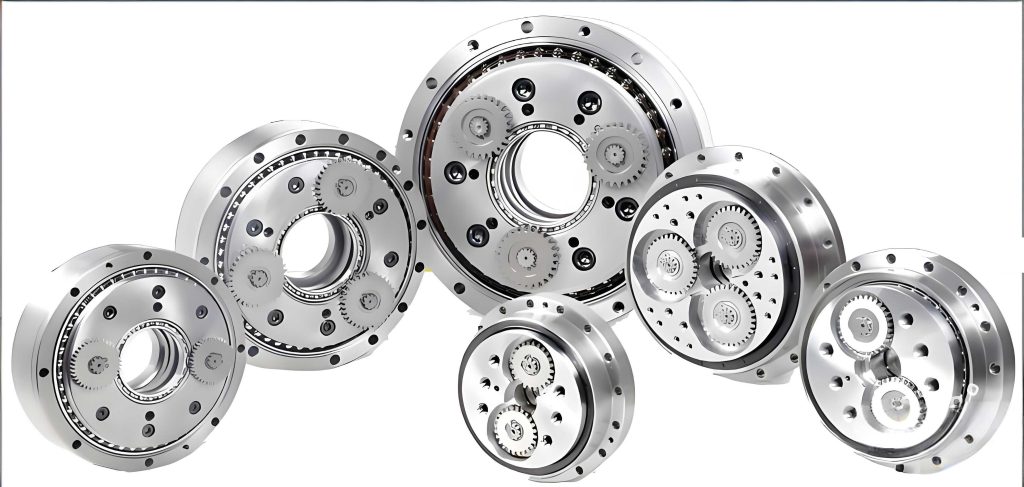
The RV reducer operates through a two-stage transmission system: the first stage consists of an involute planetary gear mechanism, and the second stage involves a cycloidal-pin gear mechanism. This dual-stage design contributes to its high reduction ratio and robustness. However, optimizing the RV reducer requires balancing multiple conflicting objectives. For instance, reducing volume often compromises torsional stiffness, while improving transmission efficiency may involve trade-offs with other parameters. To tackle this, I formulated a multi-objective optimization model with volume, torsional stiffness, and transmission efficiency as the primary goals. The design variables include geometric parameters such as gear teeth numbers, module, dimensions of bearings, and cycloidal gear properties. The constraints encompass geometric limits, stress requirements, and assembly conditions, ensuring the feasibility of the optimized design.
To construct the optimization model, I defined the design variables as a vector $\mathbf{X} = \{z_1, z_2, b, m, z_g, D_z, d_z, B, K_1, D_m, D_r, Z, L, D’_m, D’_r, Z’, L’\}^T$, where $z_1$ and $z_2$ are the tooth numbers of the sun and planet gears in the involute stage, $b$ is the planet gear width, $m$ is the module, $z_g$ is the cycloid gear tooth number, $D_z$ and $d_z$ are the pin gear center circle diameter and pin diameter, $B$ is the cycloid gear width, $K_1$ is the short amplitude coefficient, and the remaining variables relate to bearing dimensions. The basic parameters, such as input power $P$, input speed $n$, number of planet gears $n_p$, and output torque $T_2$, are given as $\mathbf{C} = \{P, n, n_p, T_2\}^T$.
The objective functions are formulated as follows. The volume $V$ of the RV reducer is approximated based on its external dimensions, considering the housing and internal components. It is expressed as:
$$ V = \frac{\pi}{4} \left[ (d_3 + 2\tau_1)^2 (h_1 + h_2 + h_3) + \left( (d_1 + 2(\tau_1 + \tau_2))^2 – (d_3 + 2\tau_1)^2 \right) h_2 + \left( (d_3 + 2(\tau_1 + \tau_2 + \tau_3))^2 – (d_3 + 2\tau_1)^2 \right) h_3 \right] $$
where $\tau_1, \tau_2, \tau_3$ are thicknesses of the pin housing parts, $h_1, h_2, h_3$ are lengths, and $d_1, d_2, d_3$ are diameters derived from gear and bearing dimensions. The torsional stiffness $K’$ is a composite measure influenced by multiple components, including the input shaft, involute gears, bearings, crank shaft, and cycloid-pin transmission. The total stiffness is calculated as the reciprocal of the sum of elastic angles from each component under the output torque $T_2$:
$$ K’ = \frac{T_2}{\sum_{i=1}^{6} \theta_i} $$
where $\theta_i$ represents the elastic angle contributed by the $i$-th component. For instance, the elastic angle due to the input shaft is $\theta_1 = \theta_{si} / i_{516}$, with $\theta_{si} = T_1 \sum_{i=1}^{3} (l_i / (G I_P))$, where $T_1$ is the input torque, $l_i$ are shaft lengths, $G$ is the shear modulus, and $I_P$ is the polar moment of inertia. The transmission efficiency $\eta$ accounts for losses from gear meshing and bearing friction, given by:
$$ \eta = \eta_{16} \eta_B $$
where $\eta_{16}$ is the efficiency of the closed differential gear transmission, and $\eta_B$ is the total bearing efficiency. The efficiency $\eta_{16}$ is derived from the involute and cycloid stages, involving parameters like tooth numbers and friction coefficients.
The constraints are numerous and include inequalities and equalities to ensure proper operation. For the involute planetary transmission, constraints cover gear mesh interference, assembly conditions, and bending and contact stress limits. For example, the gear mesh interference constraint is:
$$ (m z_1 + m z_2) \sin\left(\frac{\pi}{n_p}\right) > m z_2 + 2 h_a^* m $$
where $h_a^*$ is the addendum coefficient. The bending stress constraint is:
$$ \sigma_F = \frac{K F_t Y_{Fa} Y_{Sa}}{b m} \leq [\sigma_F] $$
where $K$ is the load factor, $F_t$ is the tangential force, $Y_{Fa}$ and $Y_{Sa}$ are form and stress correction factors, and $[\sigma_F]$ is the allowable bending stress. For the cycloid-pin transmission, constraints include limits on pin gear diameter, cycloid gear non-undercutting, and contact strength. The non-undercutting condition is:
$$ \frac{d_z}{D_z} < \frac{2^{7} z_g (1 – K_1^2)^{1/2}}{(z_g + 2)^{3/2}} $$
Additionally, overall constraints ensure size balance between stages and torque capacity. All these constraints are integrated into the optimization model to guide the search towards feasible designs.
To handle the computational complexity of evaluating torsional stiffness, I employed a Kriging surrogate model for the cycloid-pin transmission stiffness $K”$. This component significantly impacts the overall stiffness but requires finite element analysis (FEA) for accurate computation. Using Latin Hypercube Sampling (LHS), I generated 32 sample points across the design variables $\{z_g, D_z, d_z, K_1, B\}^T$. For each sample, I automated FEA via Abaqus Python scripting to compute $K”$ under the rated torque. The Kriging model predicts the response as:
$$ y(\mathbf{x}) = F(\boldsymbol{\beta}, \mathbf{x}) + z(\mathbf{x}) $$
where $F(\boldsymbol{\beta}, \mathbf{x})$ is a global model, and $z(\mathbf{x})$ is a Gaussian process with zero mean and variance $\sigma^2_z$. The correlation function uses a Gaussian model:
$$ R(\mathbf{x}_i, \mathbf{x}_j) = \exp\left( -\sum_{k=1}^{n_v} \theta_k |x_{ki} – x_{kj}|^2 \right) $$
The model’s accuracy was validated with a coefficient of determination $R^2 = 0.9208$, indicating sufficient precision for optimization. This surrogate model drastically reduces computational time compared to direct FEA calls during optimization iterations.
For solving the MOMINLP problem, I developed an enhanced algorithm termed Mixed Population NSGA-II (MP-NSGA-II). Traditional NSGA-II handles continuous variables well but struggles with discrete and integer variables common in RV reducer design (e.g., tooth numbers are integers, module is discrete). MP-NSGA-II extends NSGA-II by incorporating specialized encoding and operators for mixed variables. The design variables are categorized into continuous, integer, and discrete types. Continuous variables like $b, D_z, d_z$ are encoded directly as real numbers. Integer variables like $z_1, z_2$ are encoded as integers using rounding techniques. Discrete variables like $z_g, m$ are handled via an array-index encoding scheme, where possible values are stored in an array, and indices are used in the optimization.
The algorithm flow includes initialization, crossover, and mutation adapted for mixed populations. Crossover uses two-point crossover on combined encodings, while mutation applies Gaussian mutation to continuous variables and integer-specific mutation to others. To maintain population diversity, crowding distance is computed based on normalized objective offsets:
$$ d_c = \frac{f(\mathbf{x}_j) – f(\mathbf{x}_i)}{f(\mathbf{x})_{\text{max}} – f(\mathbf{x})_{\text{min}}} $$
where $f(\mathbf{x})$ is an objective value. This ensures a well-distributed Pareto front. The algorithm was tested on standard MINLP benchmarks, improving three known solutions and demonstrating effectiveness for complex problems.
In the optimization process, I integrated the Kriging model with MP-NSGA-II. The surrogate model is updated iteratively using a dual-point criterion: points with high mean squared error (MSE) and points from the Pareto front are added to refine the model. The number of added points per iteration is adjusted based on the current iteration count to balance exploration and exploitation. This adaptive updating enhances model accuracy throughout the optimization.
After optimization, a Pareto front of non-dominated solutions is obtained. To select an ideal solution, I applied the entropy weight method, an objective weighting technique. For each performance indicator in the Pareto set, the entropy $H_p$ is calculated as:
$$ H_p = -k_j \sum_{q=1}^{j} f_{pq} \ln f_{pq} $$
where $f_{pq} = r_{pq} / \sum_{q=1}^{j} r_{pq}$, $r_{pq}$ is the normalized value, and $k_j = 1 / \ln j$. The weight $w_p$ is then:
$$ w_p = \frac{1 – H_p}{\sum_{p=1}^{i} (1 – H_p)} $$
Solutions are scored based on these weights, and the highest-scoring design is chosen for implementation.
I implemented this methodology in a unified RV reducer design software using PySide2 for the graphical interface. The software allows users to input basic parameters, set variable ranges, and run the optimization. It automates CAD modeling via NX Open C++ and FEA via Abaqus Python, streamlining the design process. The optimization results were compared with the baseline BAJ-25E RV reducer to validate improvements.
The optimization yielded significant enhancements. For the selected design, transmission efficiency increased by 1.24%, volume decreased by 1.69%, and torsional stiffness improved by 53.83% compared to the initial values. The table below summarizes the key parameter changes and their sensitivity on torsional stiffness for a ±1% variation in continuous variables, highlighting critical parameters like $D_z$, $K_1$, $L$, and $L’$.
| Variable | Initial Value | Optimized Value | Sensitivity on $K’$ for -1% | Sensitivity on $K’$ for +1% |
|---|---|---|---|---|
| $z_1$ | 19 | 22 | N/A | N/A |
| $z_2$ | 57 | 59 | N/A | N/A |
| $b$ (mm) | 10 | 8 | -0.004% | 0.004% |
| $m$ | 1.25 | 1.25 | N/A | N/A |
| $z_g$ | 39 | 41 | N/A | N/A |
| $D_z$ (mm) | 165 | 163.06 | -0.373% | 0.366% |
| $d_z$ (mm) | 7 | 10 | 0.040% | -0.040% |
| $B$ (mm) | 14 | 12.62 | -0.042% | 0.041% |
| $K_1$ | 0.7273 | 0.8000 | -0.549% | 0.541% |
| $D_m$ (mm) | 41.2 | 47.04 | 0% | 0% |
| $D’_m$ (mm) | 36 | 41.95 | -0.064% | 0.061% |
| $D_r$ (mm) | 8 | 6.80 | 0% | 0% |
| $D’_r$ (mm) | 11 | 8.12 | 0.006% | -0.006% |
| $Z$ | 15 | 20 | N/A | N/A |
| $Z’$ | 9 | 15 | N/A | N/A |
| $L$ (mm) | 12 | 12.06 | -0.442% | 0.438% |
| $L’$ (mm) | 13.5 | 11.53 | -0.271% | 0.267% |
| $\eta$ (%) | 84.37 | 85.42 | N/A | N/A |
| $V$ (m³) | 0.002165225 | 0.002128625 | N/A | N/A |
| $K’$ (N·m/rad) | 2,021,947.04 | 3,110,304.3125 | N/A | N/A |
| $i_{516}$ | 121 | 113.64 | N/A | N/A |
The Pareto front analysis revealed coupling relationships among the objectives. For instance, volume and torsional stiffness showed a strong positive correlation, meaning improvements in stiffness often come at the cost of larger volume. In contrast, transmission efficiency remained relatively stable across variations, indicating weaker coupling with the other objectives. This insight helps designers prioritize trade-offs based on application requirements.
In conclusion, the integration of Kriging surrogate modeling and MP-NSGA-II algorithm provides a robust framework for optimizing RV reducers. The method efficiently handles mixed-variable, multi-objective problems while reducing computational burdens. The optimized RV reducer demonstrates superior performance in key metrics, validating the approach. Future work could extend this methodology to dynamic performance optimization or incorporate real-world manufacturing tolerances more comprehensively. This research contributes to advancing precision transmission design, offering a scalable tool for engineers seeking high-performance RV reducers in robotic and industrial applications.