
In the field of industrial robotics, the RV reducer plays a critical role due to its lightweight design, high stiffness, and superior transmission accuracy. As a researcher focused on mechanical systems, I have extensively studied the core components of the RV reducer, particularly the main bearing, which supports the entire external load and directly influences the reducer’s rotational precision, load-bearing capacity, and service life. The main bearing in an RV reducer is typically a non-standard angular contact ball bearing assembled in a back-to-back configuration between the pin gear housing and the planetary carrier. Given its significance, optimizing the structural parameters of this bearing to enhance fatigue life is a key engineering challenge. In this study, I propose an optimization framework based on genetic algorithms, supplemented by full factorial methods and sensitivity analysis, to maximize the basic rated life of the main bearing. Through this work, I aim to provide reliable theoretical foundations and practical guidance for the design and improvement of RV reducers.
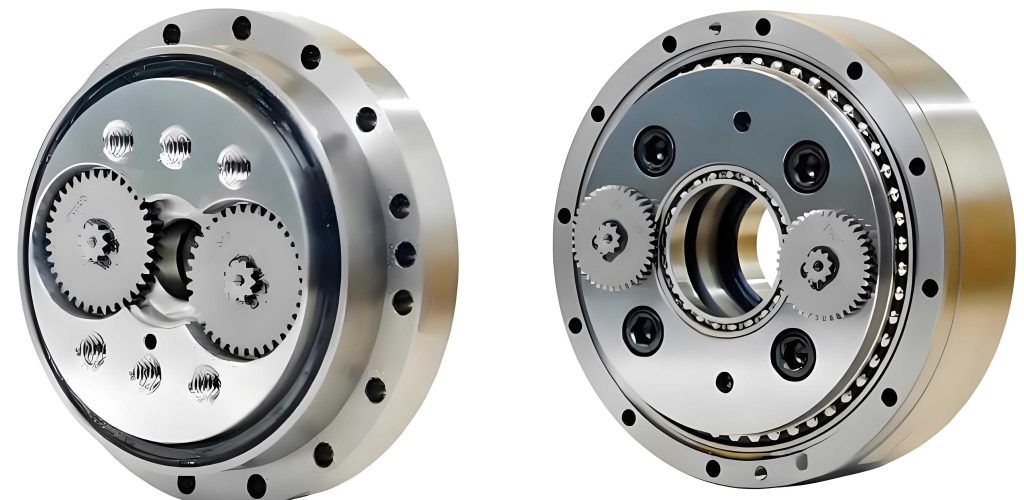
The optimization of the RV reducer main bearing involves several complex factors, including geometric constraints and operational conditions. I begin by establishing a mathematical model that defines the objective function, design variables, and constraints. The goal is to maximize the basic rated life, which is fundamentally linked to the basic dynamic load rating of the bearing. According to the L-P theory, the fatigue life for ball bearings can be expressed as:
$$ L_{10} = \left( \frac{C}{P} \right)^3 $$
where $C$ is the basic dynamic load rating and $P$ is the equivalent dynamic load. For bearings with ball diameters less than 25.4 mm, the basic dynamic load rating is given by:
$$ C = b_m f_c (i Z)^{0.7} D_w^{1.8} \cos(\alpha_0) $$
In this equation, $b_m$ is a material and processing coefficient (taken as 1.8 for angular contact ball bearings), $f_c$ is a coefficient dependent on bearing structure, manufacturing, and material, $i$ is the number of bearing rows, $Z$ is the number of balls, $D_w$ is the ball diameter, and $\alpha_0$ is the nominal contact angle. The coefficient $f_c$ is calculated as:
$$ f_c = \left\{ \frac{1.72}{1.04} \left[ 1 + \left( \frac{1 – \gamma}{1 + \gamma} \right)^{1.72} \left( \frac{f_o (2 f_i – 1)}{f_i (2 f_o – 1)} \right)^{0.41} \right] \right\}^{0.3} \times \left( \frac{\gamma^{0.3} (1 – \gamma)^{1.39}}{(1 + \gamma)^{1/3}} \right) \left( \frac{2 f_i}{2 f_i – 1} \right)^{0.41} $$
where $\gamma = \frac{D_w \cos(\alpha_0)}{d_m}$, with $d_m$ being the pitch circle diameter, and $f_i$ and $f_o$ are the curvature radius coefficients for the inner and outer raceways, respectively. Thus, the objective function for optimization is set to maximize $C$, as it directly correlates with extended fatigue life in the RV reducer.
For the design variables, I select five key parameters that significantly impact the basic dynamic load rating: the inner raceway curvature radius coefficient $f_i$, the outer raceway curvature radius coefficient $f_o$, the ball diameter $D_w$, the pitch circle diameter $d_m$, and the number of balls $Z$. These are represented as:
$$ X = (x_1, x_2, x_3, x_4, x_5) = (f_i, f_o, D_w, d_m, Z) $$
However, since the external dimensions of the RV reducer main bearing are fixed by the internal structure of the reducer, constraints must be applied to these variables. I define the constraints as follows:
- Raceway curvature radius constraints: The curvature radii must ensure proper ball movement and contact. For the inner raceway curvature radius $r_i$ and outer raceway curvature radius $r_o$, with $r_o$ slightly larger than $r_i$:
$$ g_1(X) = r_i \leq 5.144 \quad \text{and} \quad r_i \geq 4.905 $$
$$ g_2(X) = r_o \leq 5.144 \quad \text{and} \quad r_o \geq 4.905 $$
$$ g_3(X) = r_i \leq r_o $$
- Ball diameter constraint: The ball diameter must fall within a practical range relative to the bearing geometry:
$$ g_4(X) = 0.5(D – d) K_{D,\min} \leq D_w \leq 0.5(D – d) K_{D,\max} $$
where $D$ is the outer raceway diameter, $d$ is the inner raceway diameter, $K_{D,\min} = 0.54$, and $K_{D,\max} = 0.67$.
- Pitch circle diameter constraint: This diameter should be close to the average bearing diameter:
$$ g_5(X) = 0.5(D + d) \leq d_m \leq 0.5(D + d) + e $$
where $e$ is a small tolerance value based on design standards.
- Number of balls constraint: To maintain multiple rolling elements for the RV reducer, the number of balls must not be too low, and the gap between balls must exceed a minimum allowable value:
$$ g_6(X) = Z_{\min} \leq Z \quad \text{and} \quad \pi d_m – Z D_w \geq c_{w,\min} $$
with $Z_{\min} = 31$ and $c_{w,\min} = 0.1 D_w$.
With this mathematical model, I proceed to the optimization phase. I employ a genetic algorithm to search for the optimal structural parameters that maximize the basic rated life. The genetic algorithm operates by evaluating candidate solutions based on a scoring system, where a lower nominal score indicates that the candidate’s fatigue life is closer to the target value. The scoring function is defined as:
$$ S = Q \times |T – O| $$
where $S$ is the score, $Q$ is the weight, $T$ is the target value, and $O$ is the obtained value. Candidates with basic rated life below the nominal life are penalized with a high score (e.g., 10000) to discard inferior designs.
The initial structural and operational parameters for the RV reducer main bearing are summarized in Table 1. These parameters serve as the baseline for comparison.
| Parameter | Value |
|---|---|
| Inner raceway diameter, $D_i$ (mm) | 115 |
| Outer raceway diameter, $D_o$ (mm) | 145 |
| Inner raceway curvature radius, $r_i$ (mm) | 4.905 |
| Outer raceway curvature radius, $r_o$ (mm) | 5.001 |
| Ball diameter, $D_w$ (mm) | 9.525 |
| Number of balls, $Z$ | 37 |
| Pitch circle diameter, $d_m$ (mm) | 130 |
| Axial force (kN) | 6 |
| Radial force (kN) | 3.5 |
| Rotational speed, $n$ (rpm) | 1000 |
Using the genetic algorithm, I generate multiple candidate designs and evaluate their scores and basic rated lives. The relationship between candidate designs, nominal scores, and basic rated lives is illustrated in the optimization process. After iterative selection, crossover, and mutation, the genetic algorithm converges to an optimal set of parameters. The results show that the optimal design significantly improves the basic rated life compared to the initial configuration. Specifically, with the optimized parameters, the basic rated life increases by 54.6%, reaching approximately 9554.3 hours. The optimized parameters are: $D_w = 10.05$ mm, $Z = 39$, $d_m = 130.45$ mm, $r_i = 5.038$ mm, and $r_o = 5.051$ mm. This enhancement is primarily due to increased ball diameter and number, which reduce contact stress and extend fatigue life in the RV reducer.
To validate the genetic algorithm results, I conduct a full factorial optimization. Unlike the genetic algorithm, which stochastically searches the design space, the full factorial method systematically evaluates all possible combinations of design variables at predefined levels. For this RV reducer study, I define five factors: ball diameter $D_w$, number of balls $Z$, pitch circle diameter $d_m$, inner raceway curvature radius coefficient $f_i$, and outer raceway curvature radius coefficient $f_o$. Each factor is assigned five levels, as shown in Table 2. Since lubricant height $h$ does not affect the basic rated life value but is required for calculation, it is included with only two levels to reduce computational cost.
| Level | $h$ (mm) | $D_w$ (mm) | $Z$ | $d_m$ (mm) | $f_i$ | $f_o$ |
|---|---|---|---|---|---|---|
| 1 | 1000 | 8.1 | 35 | 130 | 4.905 | 4.905 |
| 2 | 1001 | 8.588 | 36 | 130.65 | 4.965 | 4.965 |
| 3 | – | 9.075 | 37 | 131.3 | 5.025 | 5.025 |
| 4 | – | 9.563 | 38 | 131.95 | 5.084 | 5.084 |
| 5 | – | 10.05 | 39 | 132.6 | 5.144 | 5.144 |
This setup results in 6000 experimental runs. For each combination, I compute the basic rated life and assign a nominal score based on proximity to the target life. The candidate designs with the lowest scores represent the best optimizations. Table 3 lists the top 10 candidate designs from the full factorial method, ranked by their nominal scores.
| Candidate | $h$ (mm) | $d_m$ (mm) | $D_w$ (mm) | $r_i$ (mm) | $r_o$ (mm) | $Z$ | Basic Rated Life (h) | Score |
|---|---|---|---|---|---|---|---|---|
| 600 | 1000 | 130 | 10.05 | 5.084 | 5.144 | 39 | 9580.2904 | 1.0419 |
| 3725 | 1001 | 130 | 10.05 | 5.084 | 5.144 | 39 | 9580.2904 | 1.0419 |
| 1250 | 1000 | 130.65 | 10.05 | 5.144 | 5.144 | 39 | 9544.2194 | 1.0455 |
| 4375 | 1001 | 130.65 | 10.05 | 5.144 | 5.144 | 39 | 9544.2194 | 1.0455 |
| 1220 | 1000 | 130.65 | 10.05 | 5.084 | 5.084 | 39 | 9543.1219 | 1.0456 |
| 4345 | 1001 | 130.65 | 10.05 | 5.084 | 5.084 | 39 | 9543.1219 | 1.0456 |
| 1245 | 1000 | 130.65 | 10.05 | 5.144 | 5.084 | 39 | 9541.8301 | 1.0458 |
| 4370 | 1001 | 130.65 | 10.05 | 5.144 | 5.084 | 39 | 9541.8301 | 1.0458 |
| 1225 | 1000 | 130.65 | 10.05 | 5.084 | 5.144 | 39 | 9541.8272 | 1.0458 |
| 4350 | 1001 | 130.65 | 10.05 | 5.084 | 5.144 | 39 | 9541.8272 | 1.0458 |
The optimal combination from the full factorial method is $d_m = 130$ mm, $D_w = 10.05$ mm, $r_i = 5.084$ mm, $r_o = 5.144$ mm, and $Z = 39$, yielding a basic rated life of 9580.2904 hours. This represents a 55% improvement over the initial life of 6179.91 hours. Comparing this with the genetic algorithm results, as shown in Table 4, the two methods produce highly consistent outcomes, with only a 0.4% difference in life improvement. The main discrepancy lies in the raceway curvature radii, suggesting that this parameter has a lesser impact on fatigue life in the RV reducer.
| Optimization Method | Structural Parameters | Optimization Result |
|---|---|---|
| Initial Design | $D_w = 9.525$ mm, $Z = 37$, $d_m = 130$ mm, $r_i = 4.905$ mm, $r_o = 5.001$ mm | $L_{10} = 6179.9$ h |
| Genetic Algorithm | $D_w = 10.05$ mm, $Z = 39$, $d_m = 130.45$ mm, $r_i = 5.038$ mm, $r_o = 5.051$ mm | $L_{10} = 9554.3$ h (54.6% improvement) |
| Full Factorial Method | $D_w = 10.05$ mm, $Z = 39$, $d_m = 130$ mm, $r_i = 5.084$ mm, $r_o = 5.144$ mm | $L_{10} = 9580.2904$ h (55% improvement) |
To further understand the influence of each design variable on the basic rated life, I perform a sensitivity analysis. This analysis evaluates how changes in individual variables affect the objective, without considering interactions between variables. For each variable, I create candidate designs where only that variable is set to its minimum or maximum value, while others remain at their nominal values. Since there are five design variables (excluding lubricant height, which has no effect), this generates 10 candidate designs (as some minima are nominal values). The scoring system is applied, with higher scores indicating greater sensitivity. The results are presented in Table 5.
| Candidate | $h$ (mm) | $d_m$ (mm) | $D_w$ (mm) | $r_i$ (mm) | $r_o$ (mm) | $Z$ | Basic Rated Life (h) | Score |
|---|---|---|---|---|---|---|---|---|
| 1 | 1000 | 130 | 9.525 | 4.905 | 5.001 | 37 | 6179.91 | 0 |
| 3 | 1001 | 130 | 9.525 | 4.905 | 5.001 | 37 | 6179.91 | 0 |
| 9 | 1000 | 130 | 9.525 | 5.144 | 5.001 | 37 | 6180.56 | 0.6442 |
| 10 | 1000 | 130 | 9.525 | 4.905 | 4.905 | 37 | 6180.56 | 0.6503 |
| 11 | 1000 | 130 | 9.525 | 4.905 | 5.144 | 37 | 6178.51 | 1.4045 |
| 5 | 1000 | 131.5 | 9.525 | 4.905 | 5.001 | 37 | 6122.23 | 57.6852 |
| 13 | 1000 | 130 | 9.525 | 4.905 | 5.001 | 39 | 6865.92 | 686.0069 |
| 7 | 1000 | 130 | 9.8 | 4.905 | 5.001 | 37 | 7375.44 | 1195.5284 |
| 12 | 1000 | 130 | 9.525 | 4.905 | 5.001 | 32 | 4622.93 | 1556.9844 |
| 6 | 1000 | 130 | 8.1 | 4.905 | 5.001 | 37 | 2252.16 | 3927.7549 |
The sensitivity analysis reveals that lubricant height $h$ has no impact on basic rated life, as seen in candidates 1 and 3 with scores of 0. Among the variables, ball diameter $D_w$ exhibits the highest sensitivity, with candidate 6 (minimum $D_w$) showing a drastic life reduction and a high score of 3927.7549. This is followed by the number of balls $Z$, where candidate 12 (minimum $Z$) also significantly lowers life. The pitch circle diameter $d_m$ has a moderate effect, while raceway curvature radii $r_i$ and $r_o$ show minimal influence, with scores below 1.5. Therefore, the order of influence on basic rated life in the RV reducer is: ball diameter (most influential), number of balls, pitch circle diameter, outer raceway curvature radius, inner raceway curvature radius, and lubricant height (least influential).
In conclusion, this study demonstrates the effectiveness of using genetic algorithms for optimizing the main bearing in an RV reducer. Through mathematical modeling, I established an objective function to maximize basic rated life, with key design variables including raceway curvature radii, ball diameter, pitch circle diameter, and number of balls. The genetic algorithm optimization improved life by 54.6%, and validation via full factorial method showed a 55% improvement, with negligible difference between methods. Sensitivity analysis further highlighted that ball diameter and number are the most critical parameters, while raceway curvature radii have minimal impact. These findings provide valuable insights for engineers designing RV reducers, emphasizing the importance of rolling element selection to enhance bearing performance and longevity. Future work could explore dynamic load conditions or incorporate multi-objective optimization to balance life with other factors like friction torque or cost in RV reducer applications.