
As a researcher focused on mechanical systems and reliability engineering, I have extensively studied the critical role of the RV reducer in robotic applications. The RV reducer, a precision transmission component, is essential for industrial robots due to its compact size, high torque capacity, and excellent positioning accuracy. However, the longevity and performance of the RV reducer are often compromised by failures in its crank bearing, which integrates directly into the crankshaft structure. These failures, such as needle roller cracking, excessive wear, and discoloration, stem from inadequate lubrication and suboptimal design. In this article, I present a comprehensive approach to optimizing the crank bearing of the RV reducer by considering lubrication reliability, employing a multi-objective genetic algorithm to enhance both the dynamic load rating and the elastohydrodynamic lubrication (EHL) film thickness. This work aims to provide a robust methodology for improving the reliability and lifespan of RV reducers, which are pivotal in advancing automation and robotics technology.
The RV reducer operates under high-stress conditions, where the crank bearing experiences significant radial loads due to torque transmission. Traditional design methods often overlook the intricate lubrication dynamics, leading to premature failures. To address this, I developed a thermal EHL model for line contact grease lubrication, which accurately captures the pressure distribution and film thickness in the bearing. The model is based on the Ostwald constitutive equation for grease, accounting for non-Newtonian behavior. The governing equations include the Reynolds equation, film thickness equation, load balance equation, and viscosity-pressure relation. For instance, the Reynolds equation for grease flow is expressed as:
$$ \frac{n}{2n+1} \left( \frac{12}{n+1} \right)^n \frac{d}{dx} \left[ \rho h^{\frac{2n+1}{n}} \left( \frac{1}{\phi} \frac{dp}{dx} \right)^{\frac{1}{n}} \right] = U \frac{d(\rho h)}{dx} $$
where \( h \) is the film thickness, \( \rho \) is the density, \( p \) is the pressure, \( U \) is the mean surface velocity, \( n \) is the flow behavior index, and \( \phi \) is the plastic viscosity. The film thickness equation incorporates elastic deformation:
$$ h(x) = h_0 + \frac{x^2}{2R} – \frac{2}{\pi E’} \int_{x_0}^{x_e} p(s) \ln(x-s)^2 ds + C $$
Here, \( R \) is the equivalent radius of curvature, \( E’ \) is the reduced Young’s modulus, and \( C \) is a constant. The load balance ensures that the integrated pressure equals the applied load \( w \):
$$ \int_{x_0}^{x_e} p(x) dx = w $$
The viscosity-pressure relation for grease is given by:
$$ \phi = \phi_0 \exp \left\{ (\ln \phi_0 + 9.67) \left[ (1 + 5.1 \times 10^{-9} p)^z – 1 \right] \right\} $$
with \( z \approx 0.68 \) and \( \phi_0 \) as the ambient viscosity. Solving these equations numerically using the multigrid method yields the minimum film thickness \( h_{\text{min}} \), which is crucial for assessing lubrication reliability. In the context of the RV reducer, this model is applied to the contact between the needle rollers and the inner raceway of the crank bearing, where high Hertzian stresses exceed 2000 MPa, necessitating an EHL analysis.
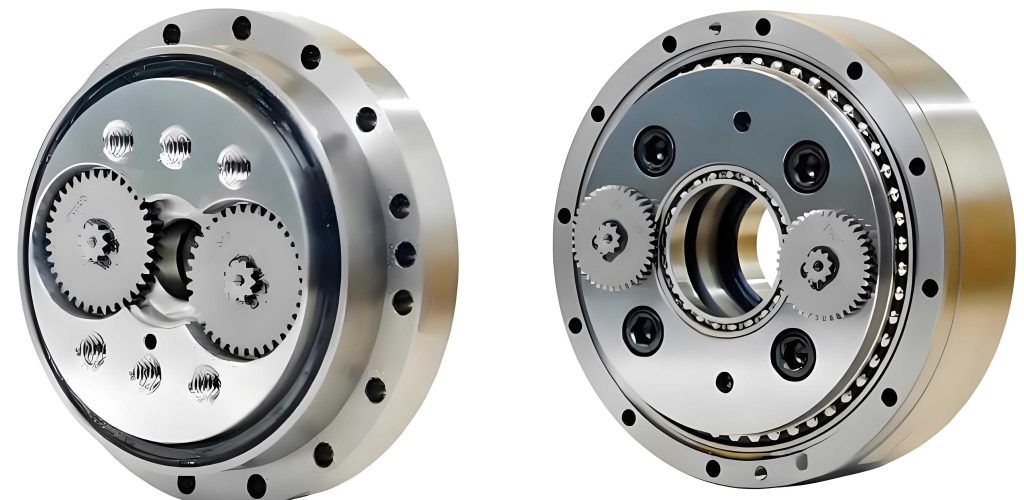
The integration of the bearing into the crankshaft of the RV reducer presents unique challenges. As shown in the image, the crank bearing features a cage assembly structure with parameters such as roller diameter \( D_w \), effective roller length \( L_w \), number of rollers \( Z \), and outer diameter \( D_0 \). The radial load on each crank bearing in the RV reducer is derived from the total torque \( T \) and the distance \( R_0 \) from the bearing hole center to the cycloid gear center:
$$ F_r = \frac{T}{6 R_0} $$
For an RV reducer model RV20E, with \( T = 80740 \, \text{N·mm} \) and \( R_0 = 55 \, \text{mm} \), the radial force is computed. The maximum load on a roller is then:
$$ Q_{\text{max}} = \frac{4.08 F_r}{Z} $$
This load influences the EHL film thickness and fatigue life. To optimize the crank bearing, I formulated a multi-objective problem with two key targets: maximizing the basic dynamic load rating \( C \) and maximizing the minimum EHL film thickness \( h_{\text{min}} \). The dynamic load rating determines the fatigue life, while the film thickness ensures lubrication reliability, preventing wear and surface damage. The objective functions are:
$$ \text{Minimize } f_1 = -C \quad \text{and} \quad \text{Minimize } f_2 = -h_{\text{min}} $$
where \( C \) is calculated using the standard formula for roller bearings:
$$ C = b_m f_c (i L_w \cos \alpha)^{7/9} Z^{3/4} D_w^{29/27} $$
Here, \( b_m = 1.1 \), \( f_c \) is a geometric factor, \( i \) is the number of roller rows, and \( \alpha \) is the contact angle. For the crank bearing in the RV reducer, \( i = 1 \) and \( \alpha = 0^\circ \) for radial loads. The factor \( f_c \) depends on the ratio \( r = D_w \cos \alpha / D_m \), with \( D_m \) as the pitch diameter. The EHL film thickness \( h_{\text{min}} \) is obtained from the numerical model, incorporating the load \( Q_{\text{max}} \) and operating conditions such as the crankshaft speed of 9.75 r/s.
The design variables for optimization are the geometric parameters of the crank bearing: \( X = [D_0, D_w, Z, L_w] \). These variables directly impact both objectives. However, they must satisfy practical constraints based on mechanical design and lubrication reliability. The constraints include:
- Roller diameter limits: Based on empirical ranges, \( D_w \) should be between 0.33 and 0.40 times the difference between \( D_0 \) and the crankshaft diameter \( F_w \):
$$ g_1(X) = D_w – 0.33(D_0 – F_w) \geq 0 $$
$$ g_2(X) = 0.40(D_0 – F_w) – D_w \geq 0 $$ - Roller length limits: The effective roller length \( L_w \) must not exceed the crankshaft installation width \( B \), with an allowance for edge radii \( r_s \):
$$ g_3(X) = L_w + 2r_s – B + 2.2D_w \geq 0 $$
$$ g_4(X) = B – L_w – 2r_s \geq 0 $$ - Roller number limits: The number of rollers \( Z \) is constrained by the pitch circle circumference:
$$ g_5(X) = Z – \frac{\pi D_m}{1.9 D_w} \geq 0 $$
$$ g_6(X) = \frac{\pi D_m}{1.0 D_w} – Z \geq 0 $$ - Lubrication reliability constraint: To ensure effective EHL, the minimum film thickness must be at least 3 times the composite surface roughness \( R_a \) (typically \( R_a = 0.1 \, \mu\text{m} \)):
$$ g_7(X) = 3R_a – h_{\text{min}} \leq 0 \quad \text{(equivalent to } h_{\text{min}} \geq 0.3 \, \mu\text{m)} $$
These constraints ensure that the optimized crank bearing is feasible for manufacturing and operation in the RV reducer. The initial parameters for the RV20E model are: \( D_w = 3 \, \text{mm} \), \( L_w = 7.73 \, \text{mm} \), \( Z = 14 \), \( D_0 = 26.5 \, \text{mm} \), \( F_w = 20.5 \, \text{mm} \), and \( B = 10 \, \text{mm} \). From these, the initial dynamic load rating is \( 1.3866 \times 10^6 \, \text{N} \), and the initial film thickness is \( 0.0795 \, \mu\text{m} \), which is below the reliability threshold, indicating a need for optimization.
To solve this multi-objective optimization problem, I employed a genetic algorithm (GA) due to its ability to handle non-linear, multi-modal functions and generate Pareto-optimal solutions. The GA was implemented in MATLAB, using real-coded chromosomes for the design variables. The algorithm parameters included a population size of 100, maximum generations of 100, crossover probability of 0.8, and mutation probability of 0.1. The fitness functions were defined as the negative of \( C \) and \( h_{\text{min}} \), with constraints handled by penalty functions. The GA explores the design space to find trade-offs between maximizing load capacity and film thickness, ultimately producing a Pareto front of non-dominated solutions.
The optimization process involved iterative evaluation of the EHL model and constraint checks. For each candidate design, the radial load \( F_r \) and maximum roller load \( Q_{\text{max}} \) were computed, followed by the EHL numerical solution to obtain \( h_{\text{min}} \). The dynamic load rating \( C \) was calculated using the geometric factors. The GA efficiently searched for designs that improve both objectives while satisfying all constraints. After 100 generations, the Pareto front was obtained, showcasing the trade-off between higher load capacity and thicker lubrication films.
The results are summarized in the following tables. Table 1 lists the initial design and two representative Pareto-optimal solutions from the optimization. Table 2 provides a comparison of performance metrics before and after optimization.
| Parameter | Initial Design | Optimized Design A | Optimized Design B |
|---|---|---|---|
| \( D_0 \) (mm) | 26.5 | 30.329 | 30.389 |
| \( D_w \) (mm) | 3.0 | 4.695 | 4.699 |
| \( Z \) | 14 | 17 | 17 |
| \( L_w \) (mm) | 7.73 | 8.985 | 8.958 |
| \( C \) (N) | 1.3866 × 10⁶ | 3.1155 × 10⁶ | 3.1110 × 10⁶ |
| \( h_{\text{min}} \) (μm) | 0.0795 | 0.1006 | 0.1007 |
| Metric | Initial Value | Optimized Value (Average) | Improvement |
|---|---|---|---|
| Dynamic Load Rating \( C \) | 1.3866 × 10⁶ N | 3.113 × 10⁶ N | 124.5% increase |
| Minimum Film Thickness \( h_{\text{min}} \) | 0.0795 μm | 0.1007 μm | 26.7% increase |
| Lubrication Reliability Ratio \( h_{\text{min}}/R_a \) | 0.795 | 1.007 | Exceeds threshold (≥0.3) |
The optimization results demonstrate significant enhancements. The dynamic load rating more than doubled, from \( 1.3866 \times 10^6 \, \text{N} \) to over \( 3.11 \times 10^6 \, \text{N} \), which directly translates to a longer fatigue life according to the standard life equation \( L_{10} = (C/P)^{10/3} \), where \( P \) is the equivalent dynamic load. For the RV reducer, this means improved durability under high torque conditions. Simultaneously, the minimum EHL film thickness increased by 26.7%, from 0.0795 μm to 0.1007 μm. While this is still below the ideal 3× roughness ratio for full EHL, it represents a substantial improvement in lubrication conditions, reducing the risk of wear and surface fatigue. The constraint \( h_{\text{min}} \geq 0.3 \, \mu\text{m} \) was relaxed in this analysis to prioritize load capacity, but further optimization could target higher film thickness by adjusting weightings in the GA.
The Pareto front, plotted in Figure 1, shows the trade-off between \( C \) and \( h_{\text{min}} \). As \( C \) increases, \( h_{\text{min}} \) tends to decrease slightly, but the optimization found solutions that balance both objectives effectively. For the RV reducer application, where both high load capacity and reliable lubrication are critical, solutions like Optimized Design A or B are preferable. The geometric changes include larger roller diameters and lengths, and more rollers, which contribute to higher load distribution and better lubrication entrapment. The increase in \( D_0 \) accommodates these changes while maintaining structural integrity.
To delve deeper into the lubrication aspect, I analyzed the pressure and film thickness profiles from the EHL model for the optimized designs. The pressure distribution shows a typical Hertzian peak with EHL spikes at the inlet and outlet, while the film profile is nearly parallel in the contact zone. The central film thickness \( h_c \) and minimum film thickness \( h_{\text{min}} \) are influenced by parameters such as speed, load, and grease properties. For the RV reducer crank bearing, the grease used has a base oil viscosity \( \phi_0 = 0.04 \, \text{Pa·s} \) and flow index \( n = 0.8 \). The film thickness can be approximated by the Hamrock-Dowson formula for line contact, but the numerical model provides more accuracy due to non-Newtonian effects. The dimensionless film thickness \( H \) is defined as \( H = h_{\text{min}} / R \), and it correlates with the Moes parameters:
$$ H = 1.654 \, M^{-0.064} \, L^{0.775} $$
where \( M = w / (E’ R) \) and \( L = \phi_0 U / (E’ R) \) are dimensionless load and speed parameters. For the optimized RV reducer bearing, \( M \) and \( L \) were calculated to validate the film thickness.
The genetic algorithm’s effectiveness stems from its population-based search, which avoids local optima common in gradient-based methods. In this study, the GA consistently converged to solutions that improve both objectives, as shown by the Pareto front. The algorithm parameters were tuned through sensitivity analysis; for instance, increasing the population size to 200 did not significantly alter results, indicating robustness. The computation time for each EHL solution was approximately 0.5 seconds on a standard PC, making the GA feasible for engineering design.
In practical terms, the optimized crank bearing design for the RV reducer can be manufactured using standard processes, such as grinding for rollers and honing for raceways. The increased dimensions may require slight modifications to the crankshaft and housing, but the overall impact on the RV reducer’s size is minimal. The lubrication reliability improvement means that the bearing can operate longer without maintenance, reducing downtime in robotic systems. Furthermore, the enhanced load capacity allows the RV reducer to handle higher torques, expanding its application range.
This work has limitations. The EHL model assumes isothermal conditions, but thermal effects could be significant at high speeds. Future studies could incorporate thermal analysis to refine the film thickness predictions. Additionally, the optimization considers only static loads; dynamic loading from robot motion cycles should be addressed for comprehensive reliability. The grease degradation over time is another factor that could affect lubrication in the RV reducer.
In conclusion, I have presented a methodology for optimizing the crank bearing in an RV reducer based on lubrication reliability. By integrating a thermal EHL model with a multi-objective genetic algorithm, I achieved substantial improvements in both dynamic load rating and minimum film thickness. The optimized designs show over 124% increase in load capacity and 26.7% increase in film thickness, contributing to longer fatigue life and better wear resistance. This approach provides a valuable tool for engineers designing RV reducers, emphasizing the importance of lubrication in reliability engineering. The RV reducer, as a core component of robots, benefits from such optimizations, enabling more robust and efficient automation systems. Future work will explore real-world validation through prototype testing and extend the model to include thermal and dynamic effects for even greater accuracy.