
As a critical component in precision transmission fields such as industrial robotics and aerospace, the RV reducer is renowned for its high stiffness, compact size, and excellent overload capacity. The transmission performance, load-bearing capacity, and operational lifespan of an RV reducer are directly governed by the contact characteristics of its meshing pairs. The second-stage cycloid-pinwheel planetary transmission is the core of its speed reduction mechanism, leveraging multi-tooth engagement and error averaging effects to achieve high precision and high torque density. Therefore, a deep investigation into the contact mechanics of the cycloid-pinwheel pair is of paramount importance for the design and optimization of RV reducers. In this study, we first establish a theoretical mechanical model for the cycloid-pinwheel pair. Subsequently, we employ the single-variable method to analyze the influence of key structural parameters on its contact stress. To validate the theoretical model and gain further insights into the dynamic engagement process, we construct detailed transient dynamic finite element analysis (FEA) models of a full RV reducer assembly under various structural parameters. The simulation results provide a clear visualization of the stress distribution during meshing, confirm the correctness of the mathematical model, and offer a theoretical foundation for the structural design of high-performance RV reducers.
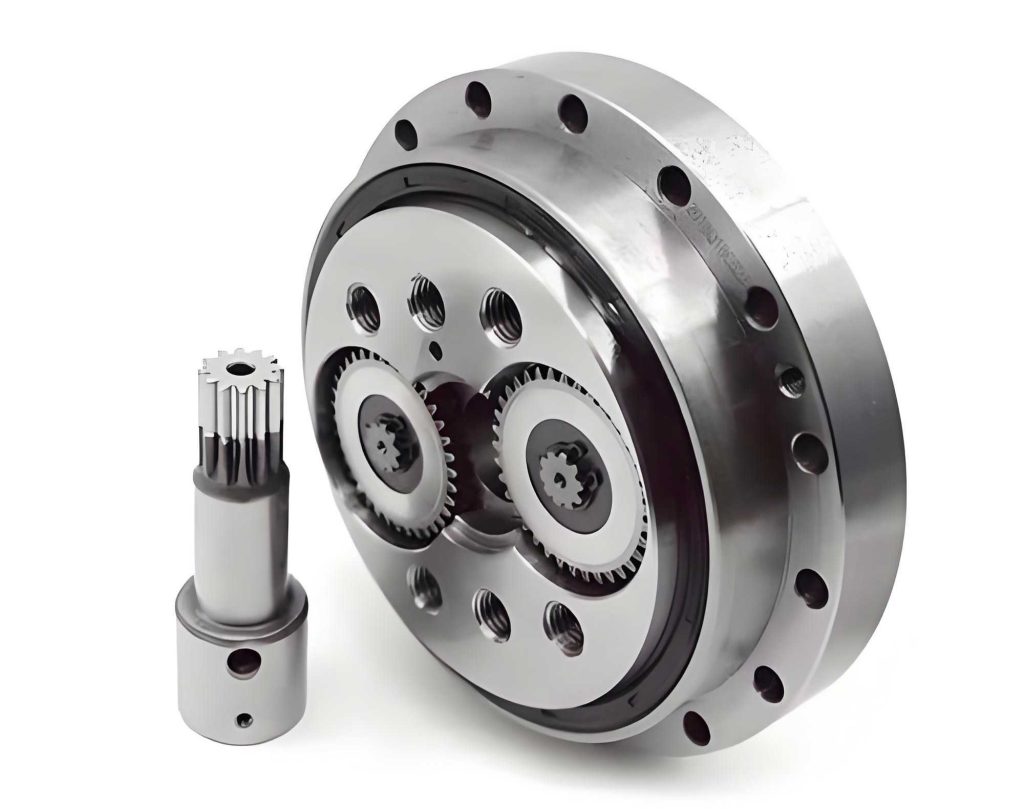
The core of the second-stage transmission in an RV reducer is the cycloid drive. During operation, the cycloid disk undergoes an eccentric revolution around the center of the pinwheel, driven by the crankshaft. This motion, combined with the constraint from the pins, forces the cycloid disk to rotate in the opposite direction relative to its revolution. The output torque is taken from this reverse rotation via the planetary carrier. The engagement primarily occurs between the cycloid disk and the pins located on one side of the centerline. The force exerted by each pin on the cycloid disk acts along the common normal line at the point of contact. To analyze this system, we establish a mathematical model based on gear geometry and Hertzian contact theory.
The tooth profile of a standard cycloid disk, represented in a Cartesian coordinate system fixed to the pinwheel, is given by:
$$ x = R_z \sin\phi – e\sin(z_b\phi) + r_z \frac{K_1\sin(z_b\phi) – \sin\phi}{\sqrt{1 + K_1^2 – 2K_1\cos(z_b\phi)}} $$
$$ y = R_z \cos\phi – e\cos(z_b\phi) – r_z \frac{-K_1\cos(z_b\phi) + \cos\phi}{\sqrt{1 + K_1^2 – 2K_1\cos(z_b\phi)}} $$
where $R_z$ is the radius of the pin distribution circle, $r_z$ is the radius of the pins, $e$ is the eccentricity, $z_b$ is the number of pins, $\phi$ is the generating (or phase) angle, and $K_1$ is the shortening coefficient defined as $K_1 = e z_b / R_z$.
Assuming the cycloid disk is stationary and applying a moment to the pin housing, the tangential displacement $\Delta s$ of a pin center leads to a component $\Delta s’_i$ along the line of action. The contact load $F_i$ at the $i$-th pin is proportional to this component. Through geometric relations and equilibrium conditions, the maximum contact load $F_{max}$ occurring at the pin where the phase angle satisfies $\phi_i = \arccos K_1$ can be derived. Considering that two cycloid disks share the output torque $T_v$ with an assumed 55% load on each, the expression is:
$$ F_{max} = \frac{2.2 T_v}{K_1 z_b R_z} $$
The contact load for any $i$-th pin is then:
$$ F_i = F_{max} \cdot \frac{\sin \phi_i}{\sqrt{1 + K_1^2 – 2K_1 \cos \phi_i}} = \frac{2.2 T_v}{K_1 z_b R_z} \cdot \frac{\sin \phi_i}{\sqrt{1 + K_1^2 – 2K_1 \cos \phi_i}} $$
Finally, applying Hertzian contact theory, the contact stress $\sigma_i$ at the $i$-th meshing point is calculated as:
$$ \sigma_i = \sqrt{ \frac{F_i}{\pi b} \cdot \frac{E^*}{\rho^*} } $$
where $b$ is the face width of the cycloid disk. The equivalent elastic modulus $E^*$ and the equivalent radius of curvature $\rho^*$ are given by:
$$ E^* = \frac{E_1 E_2}{E_1(1-\nu_2^2) + E_2(1-\nu_1^2)} $$
$$ \frac{1}{\rho^*} = \frac{1}{\rho_1} – \frac{1}{\rho_2} $$
$E_1$, $\nu_1$ and $E_2$, $\nu_2$ are the elastic moduli and Poisson’s ratios of the cycloid disk and pin materials, respectively. $\rho_2 = r_z$ is the pin radius. The radius of curvature of the cycloid profile $\rho_1$ is a function of the phase angle $\phi$:
$$ \rho_1 = \frac{R_z (1 + K_1^2 – 2K_1 \cos \phi)^{3/2}}{K_1(1+z_b)\cos\phi – (1+z_b K_1^2)} + r_z $$
To systematically investigate how design choices affect the performance of an RV reducer, we employed the single-variable method. Using the parameters of an RV-80E type RV reducer as a baseline, we varied one structural parameter at a time while keeping others constant to study its isolated effect on the contact stress distribution. The baseline parameters are listed in the table below.
| Parameter | Symbol | Baseline Value |
|---|---|---|
| Number of Cycloid Teeth | $z_g$ | 39 |
| Number of Pins | $z_b$ | 40 |
| Shortening Coefficient | $K_1$ | 0.78947 |
| Eccentricity | $e$ | 1.5 mm |
| Pin Radius | $r_z$ | 4 mm |
| Pin Distribution Radius | $R_z$ | 76 mm |
The analysis, based on the theoretical model, yielded the following trends for the RV reducer‘s cycloid-pinwheel pair:
1. Influence of Number of Pins ($z_b$): Holding $e$, $R_z$, and $r_z$ constant, we varied $z_b$. The contact stress always peaks at $\phi_i = \arccos K_1$. For phase angles between approximately $18^\circ$ and $108^\circ$, the contact stress increases with $z_b$. Outside this range, it decreases slightly. A higher number of pins generally leads to a higher maximum contact stress.
2. Influence of Eccentricity ($e$): Holding $z_b$, $R_z$, and $r_z$ constant, we varied $e$. Similar to the trend for $z_b$, the maximum stress occurs at $\phi_i = \arccos K_1$. For phase angles between $18^\circ$ and $90^\circ$, the contact stress increases with eccentricity. For other angles, it decreases. Overall, a larger eccentricity results in higher maximum contact stress.
3. Influence of Pin Distribution Radius ($R_z$): Holding $z_b$, $e$, and $r_z$ constant, we varied $R_z$. The analysis shows a clear trend: increasing the pin distribution radius $R_z$ leads to a decrease in the contact stress across nearly all phase angles, including the maximum value. This is a key parameter for reducing stress in an RV reducer.
4. Influence of Pin Radius ($r_z$): Holding $z_b$, $e$, and $R_z$ constant, we varied $r_z$. The effect is non-monotonic across the engagement cycle. For small phase angles ($0^\circ \leq \phi_i \leq 45^\circ$), contact stress increases with $r_z$. For the majority of the engagement ($45^\circ \leq \phi_i \leq 180^\circ$), it decreases. Crucially, the maximum contact stress decreases with an increase in pin radius.
To validate the theoretical findings and observe the dynamic stress distribution, we developed a full-assembly transient dynamics finite element model of the RV reducer in ANSYS Workbench. Transient dynamics solves the fundamental equation of motion:
$$ [M]\{\ddot{u}\} + [C]\{\dot{u}\} + [K]\{u\} = \{F(t)\} $$
where $[M]$, $[C]$, and $[K]$ are the mass, damping, and stiffness matrices, $\{\ddot{u}\}$, $\{\dot{u}\}$, and $\{u\}$ are the acceleration, velocity, and displacement vectors, and $\{F(t)\}$ is the time-varying load vector.
The modeling process was as follows:
- Geometry and Materials: The full 3D CAD model was imported. The cycloid disks and pins were set as flexible bodies made of GCr15 bearing steel (E = 208 GPa, $\nu$ = 0.3). All other components were treated as rigid bodies to reduce computational cost while preserving the system’s kinematics and load paths.
- Meshing: The flexible bodies were meshed with hexahedral elements using a multizone method. A refined mesh size was applied to the contact regions of the cycloid disks and pins to ensure accuracy in stress results.
- Contacts: Critical interactions were defined: “Bonded” for connections without relative motion (e.g., crankshaft-to-planetary gear spline), and “Frictional” for mating surfaces like cycloid-pin, planetary-sun gear, and pin-to-pin housing.
- Boundary Conditions and Joints: The model was constrained using joint connections. The pin housing was fixed. A rotational velocity of 486 rpm was applied to the sun gear (input). A resistive torque of -700,000 N·mm was applied to the planetary carrier (output).
- Solution: A two-step analysis was set up with ramped loading to ensure convergence. The solver was set to direct sparse matrix, and large deflection was enabled.
For the baseline RV reducer model, the simulation predicted a maximum contact stress of approximately 1001.9 MPa between the cycloid disk and pins, with 17 pins in simultaneous contact. The theoretical calculation from the Hertzian model yielded 1054.2 MPa. The deviation of about 5.03% and the realistic number of contacting pins validate the accuracy of both the theoretical model and the FEA setup. The stress contour also revealed a secondary stress concentration in the cycloid disk around the pin holes connecting to the output carrier pins. This highlights a structural vulnerability; while designing the RV reducer, the size of these holes should be minimized to strengthen the surrounding webbing, provided the transmission requirements are still met.
We then created separate FEA models, each modifying one structural parameter from the baseline, as summarized below, to visually confirm the theoretical trends.
| Variable Parameter | Model 1 Value | Model 2 Value | Other Fixed Parameters |
|---|---|---|---|
| Number of Pins, $z_b$ | 38 | 44 | $e$=1.5mm, $R_z$=76mm, $r_z$=4mm |
| Eccentricity, $e$ | 1.4 mm | 1.6 mm | $z_b$=40, $R_z$=76mm, $r_z$=4mm |
| Pin Distribution Radius, $R_z$ | 75 mm | 77 mm | $z_b$=40, $e$=1.5mm, $r_z$=4mm |
| Pin Radius, $r_z$ | 3 mm | 5 mm | $z_b$=40, $e$=1.5mm, $R_z$=76mm |
The FEA results were conclusive:
- Increasing $z_b$ from 38 to 44 caused the maximum contact stress to rise significantly from 936.7 MPa to 2217.2 MPa.
- Increasing $e$ from 1.4 mm to 1.6 mm increased the maximum stress from 971.4 MPa to 1268.8 MPa.
- Increasing $R_z$ from 75 mm to 77 mm decreased the maximum stress from 1172.3 MPa to 1015 MPa.
- Increasing $r_z$ from 3 mm to 5 mm decreased the maximum stress from 1313.2 MPa to 958.4 MPa.
These finite element results align perfectly with the predictions made by the theoretical mathematical model, confirming the identified trends for the RV reducer.
This study provides a comprehensive analysis of the contact characteristics in the cycloid-pinwheel transmission of an RV reducer. We established a theoretical mechanical model and utilized finite element analysis to investigate the influence of key structural parameters. The main conclusions are: Firstly, the maximum contact stress consistently occurs at the pin located near the phase angle $\phi_i = \arccos K_1$. Furthermore, stress concentrations are identified in the cycloid disk around the output pin holes, indicating a potential area for structural reinforcement. Secondly, the contact stress in the RV reducer is highly sensitive to design parameters: it increases with the number of pins ($z_b$) and the eccentricity ($e$), but decreases with a larger pin distribution radius ($R_z$) and a larger pin radius ($r_z$). These findings offer clear guidance for designers. To enhance the contact strength and longevity of an RV reducer, designers can consider increasing $R_z$ or $r_z$ within allowable design spaces. Simultaneously, careful attention must be paid to minimizing the size of auxiliary holes in the cycloid disk to improve the strength of its webbed structure. This integrated theoretical and numerical approach forms a solid foundation for the optimized design of high-performance and reliable RV reducers.