
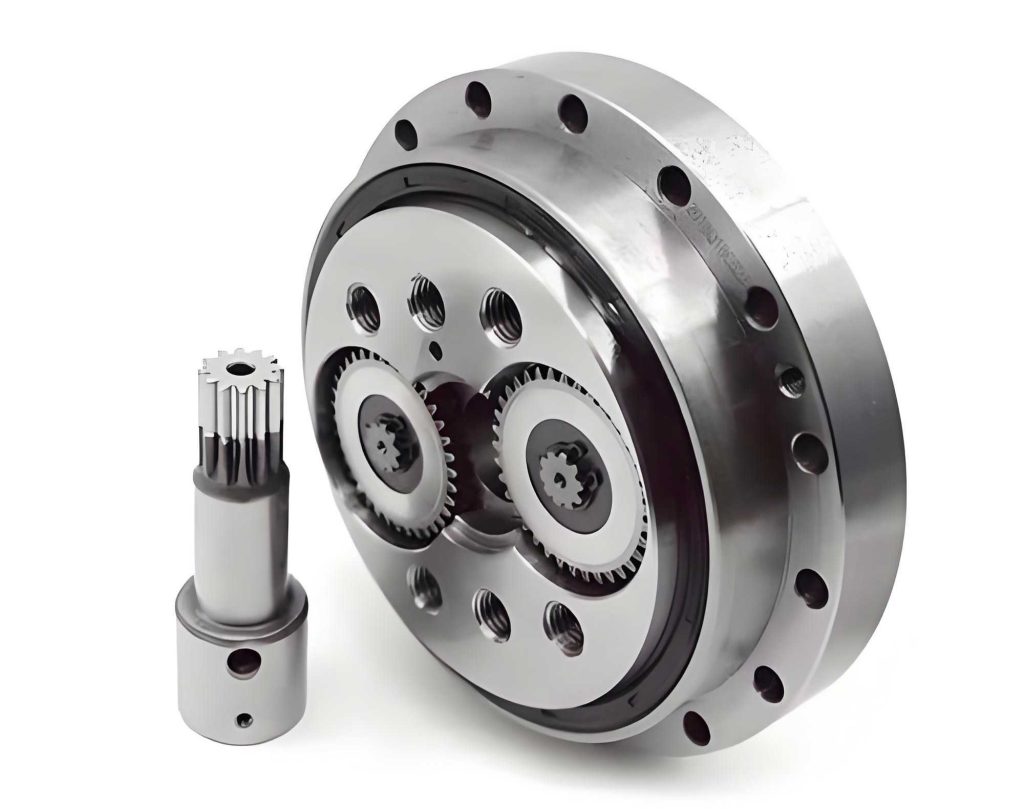
As a researcher focused on condition monitoring and fault diagnosis for industrial robotics, I have encountered significant challenges in diagnosing faults within high-precision RV reducers. These components are critical for robotic joint motion, and their sealed nature makes direct monitoring difficult. Planetary gear root cracks, in particular, exhibit subtle signatures under variable operating conditions, complicating traditional vibration analysis. In this work, I propose a novel fault identification method that synergistically combines information entropy with variational mode decomposition (VMD) to extract meaningful fault features from vibration signals, guided by motor current analysis. The core innovation lies in using servo motor current to estimate operational speed and synchronously segment vibration data, thereby enabling precise fault detection even during non-stationary robotic movements.
The operational environment of an industrial robot involves repetitive, non-cyclic motions where the RV reducer experiences constantly changing speeds and loads. Direct spectral analysis of vibration signals often fails due to frequency smearing. Therefore, I first analyze the three-phase servo motor current. The current signal provides a robust proxy for the motor shaft rotational frequency, which is directly linked to the sun gear of the RV reducer. By performing a Hilbert transform on the current, I obtain an instantaneous frequency trend. The plateau region in this trend, corresponding to peak operational power and stable speed, serves as the reference window. I synchronously extract the vibration signal from this stable phase, effectively converting a variable-speed problem into a quasi-stationary analysis frame. This initial step is crucial for reliable subsequent processing.
To understand the signal processing core, let’s revisit the theoretical underpinnings of Variational Mode Decomposition. VMD is a fully non-recursive, adaptive signal decomposition technique that excels at separating multicomponent AM-FM signals into intrinsic mode functions (IMFs). The algorithm solves a constrained variational problem: it seeks a set of modes \( u_k \) and their respective center frequencies \( \omega_k \) such that the bandwidth of each mode is minimized. The formulation is as follows:
$$ \min_{\{u_k\},\{\omega_k\}} \left\{ \sum_k \left\| \partial_t \left[ \left( \delta(t) + \frac{j}{\pi t} \right) * u_k(t) \right] e^{-j\omega_k t} \right\|_2^2 \right\} $$
subject to \( \sum_k u_k = f(t) \), where \( f(t) \) is the original signal, \( \delta(t) \) is the Dirac delta, and \( * \) denotes convolution. The augmented Lagrangian \( \mathcal{L} \) introduces a penalty factor \( \alpha \) and a Lagrange multiplier \( \lambda \):
$$ \mathcal{L}(\{u_k\},\{\omega_k\},\lambda) = \alpha \sum_k \left\| \partial_t \left[ \left( \delta(t) + \frac{j}{\pi t} \right) * u_k(t) \right] e^{-j\omega_k t} \right\|_2^2 + \left\| f(t) – \sum_k u_k(t) \right\|_2^2 + \langle \lambda(t), f(t) – \sum_k u_k(t) \rangle. $$
The solution is found via the Alternate Direction Method of Multipliers (ADMM), iteratively updating \( u_k^{n+1} \), \( \omega_k^{n+1} \), and \( \lambda^{n+1} \). For practical application, selecting the number of modes \( K \) is vital. I employ a center-frequency observation method: increment \( K \) until adjacent modes show spectral overlap, then set \( K \) to the previous value. The penalty \( \alpha \) is typically set to 2000 for vibration signals. This adaptive decomposition is key to isolating fault-related impulses from other gear meshing components within the complex RV reducer vibration signature.
Information entropy (IE) serves as the selection criterion for the most relevant IMF. Entropy quantifies the disorder or randomness in a signal. For a discrete probability distribution \( p(x_i) \), the Shannon information entropy \( H \) is:
$$ H(X) = -\sum_{i=1}^{n} p(x_i) \log p(x_i). $$
A fault event, such as a periodic impact from a cracked tooth, introduces order into the vibration signal, theoretically lowering the entropy of the component carrying that fault. I calculate the IE of the original segmented vibration signal and each IMF obtained from VMD. The IMF whose entropy value is closest to the original signal’s entropy is deemed the optimal component, as it likely retains the most significant fault information while filtering out irrelevant noise and other meshing frequencies. The segment length for entropy calculation is determined by the number of planetary gear rotations within one second, given by \( N = \frac{n_1 \times Z_1}{60 \times Z_2} \), where \( n_1 \) is the sun gear speed in RPM, \( Z_1 \) is sun gear teeth, and \( Z_2 \) is planetary gear teeth.
The complete fault diagnosis methodology for the RV reducer planetary gear unfolds in a systematic sequence. First, I acquire the servo motor current and the vibration signal from the joint housing. The current signal undergoes FFT to identify the dominant power frequency, which corresponds to the motor shaft rotational frequency \( f_m \). For a servo motor with \( P \) pole pairs, the sun gear rotational speed \( n_1 \) in RPM is \( n_1 = \frac{60 f_m}{P} \). From this, the fundamental characteristic frequencies of the RV reducer are computed. The key frequencies for a two-stage RV reducer with a fixed pinwheel are:
| Frequency Description | Symbol | Formula |
|---|---|---|
| Sun gear rotational frequency | \( f_1 \) | \( f_1 = n_1 / 60 \) |
| Planetary gear rotational frequency | \( f_2 \) | \( f_2 = \frac{Z_1 Z_4}{(Z_3 – Z_4)(Z_1 + Z_2 Z_4)} f_1 \) |
| First-stage meshing frequency (sun-planet) | \( f_{1c} \) | \( f_{1c} = \frac{Z_1 Z_2 Z_4}{Z_1 + Z_2 Z_4} f_1 \) |
Second, I apply the Hilbert transform to the current signal to get the instantaneous frequency (IF) trajectory \( \omega(t) = d\theta(t)/dt \), where \( \theta(t) = \arctan(Y(t)/X(t)) \) and \( Y(t) \) is the Hilbert transform of the current \( X(t) \). The IF trend clearly shows acceleration, stable peak, and deceleration phases. I identify the stable plateau (e.g., 1-2 seconds duration) and extract the corresponding segment from the raw vibration signal. This ensures the analysis focuses on a period of constant input speed, mitigating non-stationarity effects.
Third, an envelope analysis is performed on this segmented vibration signal. The envelope spectrum, obtained by demodulating the signal (often via Hilbert transform and spectral analysis of the resulting amplitude), reveals amplitude-modulated frequencies. For a healthy RV reducer, the spectrum shows the first-stage meshing frequency \( f_{1c} \) and its harmonics, with sidebands spaced at \( f_1 \). When a planetary gear root crack is present, the impact during the cracked tooth’s engagement modulates the vibration amplitude. This causes the sideband amplitudes around \( f_{1c} \) and its harmonics to increase significantly, and the sun gear rotational frequency \( f_1 \) itself may show heightened amplitude. This initial envelope inspection narrows the diagnostic search to the frequency bands around \( f_{1c} \) and its multiples.
Fourth, the segmented vibration signal is decomposed using VMD with the pre-determined parameter \( K \). The resulting IMFs are then subjected to information entropy calculation. By comparing the entropy of each IMF to the original signal’s entropy, I select the optimal IMF—the one minimizing the entropy difference. This component predominantly contains the fault-induced periodic impacts, having filtered out other vibration sources like bearing tones or second-stage cycloid-pin meshing.
Finally, a detailed frequency spectrum (FFT) of the selected optimal IMF is examined. The definitive fault indicators for a planetary gear root crack in an RV reducer are two-fold. The primary indicator \( f_{p1} \) appears at the first-stage meshing frequency and its harmonics, but with a crucial twist: the amplitude at \( f_{1c} \pm f_1 \) (the sidebands) becomes exceptionally high, often surpassing the amplitude at the meshing frequency harmonic itself. This is a classic sign of localized gear damage. The secondary indicator \( f_{p2} \) is a more specific modulation product, appearing at frequencies like \( n f_{1c} + f_1 + f_2 \). While not always as prominent, a noticeable amplitude increase at such a combination frequency in the higher spectrum further confirms the planetary gear fault. The entire process effectively isolates the fault signature from the dense forest of other gear mesh frequencies inherent to the complex RV reducer.
To validate this methodology, I constructed a dedicated test rig simulating a robotic joint. The core is an RV-40E reducer with a reduction ratio of 121, mounted in a fixed pinwheel configuration. The gear parameters are summarized below:
| Gear Component | Notation | Number of Teeth |
|---|---|---|
| Sun Gear | \( Z_1 \) | 12 |
| Planetary Gear | \( Z_2 \) | 42 |
| Cycloid Gear | \( Z_3 \) | 39 |
| Pin Gear | \( Z_4 \) | 40 |
An artificial root crack was introduced into one of the two planetary gears. A servo motor drove the joint through a repetitive 80° arm lift motion. Data acquisition involved a clamp-on current transducer on the motor drive’s U-phase output (sampled at 25.6 kHz) and a uniaxial accelerometer mounted on the servo motor housing (sampled at 1 MHz). Signals were preprocessed: current was denoised via wavelet decomposition and low-frequency reconstruction, while vibration data underwent morphological filtering.
Applying the current-based speed estimation to a lift motion cycle, the current spectrum showed a dominant frequency at 62.7 Hz. With a 5-pole-pair motor, this yields a sun gear speed \( n_1 = 752.4 \) RPM. The calculated characteristic frequencies are: \( f_1 = 12.54 \) Hz, \( f_2 = 3.56 \) Hz, and \( f_{1c} = 149.41 \) Hz. The instantaneous frequency trend from the current signal clearly delineated the stable phase from 1 to 2 seconds, and the corresponding vibration block was extracted.
The envelope spectrum of this vibration segment immediately revealed anomalies compared to a baseline healthy signal. The amplitudes at \( f_1 \) and at the sidebands \( f_{1c} \pm f_1 \) were markedly elevated, and the sideband amplitude was close to the meshing frequency amplitude itself. This prompted a focused analysis on the frequency region around 150 Hz and its harmonics. Next, VMD was applied. By testing different \( K \) values, I observed clear center frequency separation for \( K=3 \), while \( K=4 \) led to mode mixing. Therefore, VMD was executed with \( K=3 \) and \( \alpha=2000 \), producing three IMFs.
Information entropy was computed for the original 1-second vibration signal and each IMF. The segment number \( N \) for entropy calculation, based on planetary gear rotations per second, was \( N = \frac{752.4 \times 12}{60 \times 42} \approx 3.58 \), rounded to 4 segments for practical calculation. The entropy values were:
| Signal Source | Information Entropy Value |
|---|---|
| Original Vibration Segment | 0.8786 |
| IMF1 | 0.8307 |
| IMF2 | 0.9954 |
| IMF3 | 0.9532 |
IMF1 had the smallest entropy difference from the original signal, making it the optimal component. Its envelope spectrum showed a much cleaner representation of the meshing frequency and its sidebands, with other irrelevant frequencies suppressed. The final step, spectral analysis of IMF1, provided conclusive evidence. The spectrum showed a pronounced peak at \( f_{1c} = 149.41 \) Hz. Crucially, the sideband at \( f_{1c} + f_1 = 161.95 \) Hz exhibited an amplitude that was higher than the amplitude at the second harmonic of the meshing frequency \( 2f_{1c} \). This inversion of the expected amplitude relationship is a strong indicator of a localized fault. Furthermore, in the higher frequency range, a distinct peak was observed at \( f_{1c} + f_1 + f_2 = 165.51 \) Hz, which corresponds to the theoretical \( f_{p2} \) fault feature. The presence of both \( f_{p1} \) and \( f_{p2} \) features confirms the planetary gear root crack. For comparison, analysis of a healthy RV reducer under the same conditions showed sidebands at \( f_{1c} \pm f_1 \) with amplitudes consistently lower than the meshing harmonic amplitudes, and no significant energy at combination frequencies like \( f_{1c} + f_1 + f_2 \).
The integration of motor current analysis for speed estimation and stable-phase segmentation is a pivotal contribution for RV reducer diagnostics in robotic applications. It elegantly addresses the vexing issue of variable speed operation. The subsequent fusion of VMD and information entropy creates a powerful filtering and selection mechanism. VMD’s ability to adaptively split the signal into narrowband modes prevents the aliasing of closely spaced frequencies—a common issue in complex gearboxes like the RV reducer. Information entropy then acts as an intelligent selector, identifying the mode that carries the most fault-related “order” amidst the signal “disorder.” This two-stage process is far more effective than applying either technique alone or using fixed-bandwidth filters. The method successfully extracted the tell-tale modulation sidebands and combination frequencies characteristic of a planetary gear root crack, even when those features were buried within a dominant meshing spectrum. This approach is not limited to planetary gears; it can be adapted to other RV reducer components like the cycloid gear or bearings, provided the theoretical fault frequencies are known. Future work could explore real-time implementation and the fusion of additional sensor data, such as temperature or acoustic emissions, to build a comprehensive health management system for robotic RV reducers. The robustness of this method under varying load conditions also warrants further investigation to fully deploy it in industrial settings.