
The landscape of artificial intelligence research is currently undergoing a profound and necessary paradigm shift. For decades, the dominant model, often termed classical or symbolic AI, was built upon a foundation of computation and representation. In this view, intelligence was considered a property of abstract algorithms, a disembodied process of manipulating formal symbols according to logical rules. The body, if considered at all, was merely a peripheral input/output device, a vessel for a computational mind. My own journey in understanding intelligence has led me to believe this view is fundamentally incomplete. The emerging paradigm, which I find far more compelling, posits that true intelligence is embodied, situated, and enactive. It is not computed in a vacuum but emerges from the continuous, dynamic coupling between an agent—with its specific physical form and capacities—and the environment in which it is embedded.
This shift is not merely technical; it is philosophical. It forces us to reconsider the very ontology of intelligent systems. The central question becomes: what forms of embodiment constitute the necessary conditions for intelligence to arise? To explore this, I will structure my analysis around three constitutive dimensions of embodied intelligence: the sensorimotor, the situated, and the interactive. I will then examine the humanoid robot as the most provocative and illustrative testbed for these ideas. While a humanoid robot physically approximates the human form, a critical analysis reveals a gap between functional mimicry and genuine, phenomenologically-rich embodiment. This gap, however, is precisely where the most important insights lie.
The Paradigm Shift: From Disembodied Computation to Embodied Emergence
The classical paradigm, rooted in what can be called cognitivism or computationalism, treated cognition as information processing. The famous “physical symbol system hypothesis” declared that such a system was both necessary and sufficient for general intelligence. Intelligence was seen as a series of logical operations on amodal symbols that represented the world. This approach achieved notable successes in structured, rule-based domains but famously struggled with the messiness of the real world—interpreting a novel scene, grasping a delicate object, or understanding social nuance.
The limitations are ontological. This paradigm implicitly subscribes to a form of Cartesian dualism, separating the “mind” (the software) from the “body” (the hardware). The consequent challenges in perception, context-understanding, and adaptive action are not merely engineering hurdles; they are symptoms of a flawed foundational premise. As critics pointed out, this model lacks what we might call “situated understanding.” It attempts to reconstruct the world from discrete, pre-defined symbols, missing the continuous, holistic, and lived quality of experience. The key insight that changed my perspective is that intelligence is not primarily about representing the world accurately inside a central processor, but about engaging with it effectively through a body.
The embodied turn argues that cognition exists for action. An agent’s cognitive processes are shaped by, and in turn shape, its goal-directed interactions with the environment. The body is not a passive carrier but an active constituent of cognitive activity. Morphology, sensorimotor contingencies, and physical dynamics all play a computational role, often simplifying control problems. This is sometimes formalized as the idea that the brain is not the sole seat of cognition; cognition is distributed across the brain, body, and environment. A simple but powerful mathematical expression of this coupling is the concept of a sensorimotor loop:
$$ \text{State}_{t+1} = f(\text{State}_t, \text{Action}_t, \text{Environment}_t) $$
$$ \text{Perception}_t = g(\text{State}_t, \text{Environment}_t) $$
$$ \text{Action}_t = \pi(\text{Perception}_t, \text{Internal Goal}) $$
In embodied intelligence, the function $\pi$ (the policy) and even the perceived state are deeply dependent on the physical realization of the agent. The body’s properties (like limb length, joint stiffness, sensor placement) directly influence the space of possible actions and perceptions, a concept known as morphological computation.
| Feature | Classical/Disembodied AI | Embodied AI |
|---|---|---|
| Core Unit | Symbol, Proposition | Action, Sensorimotor Loop |
| Body’s Role | Peripheral I/O Device | Constitutive Element of Cognition |
| Knowledge | Explicit, Representational | Implicit, Skill-based, Enactive |
| Interaction | Sequential (Input-Process-Output) | Continuous Dynamic Coupling |
| Goal | Accurate World Model | Successful Situated Action |
| Example | Expert Systems, Game-Playing AI (Chess) | Autonomous Robots, Developmental Robotics |
The Three Pillars of Embodied Intelligence
To move beyond metaphor, I find it essential to decompose embodied intelligence into three interwoven yet analytically distinct dimensions. These dimensions form a hierarchy of complexity, each building upon the previous.
1. Sensorimotor Embodiment: The Foundational Layer
This is the most basic dimension, focusing on the constitutive role of the physical body in perception and action. The core idea is that our cognitive categories and even our perception of the world are grounded in the specific ways our bodies can act upon it. The geometry of our limbs, the placement of our sensors, and the dynamics of our muscles are not incidental; they fundamentally structure our experience and problem-solving strategies.
In robotics, this led to the seminal work on behavior-based robotics, which rejected centralized world models in favor of tight sensorimotor loops. Intelligence was built from the bottom-up through layers of such behaviors. The modern manifestation of this is the intense focus in humanoid robot research on dynamic balance, compliant control, and locomotion. The walking algorithm for a humanoid robot is not a pure mathematical plan executed blindly; it is a constant negotiation between planned trajectories and real-time feedback from joint torques, foot pressure sensors, and inertial measurement units. The physical body itself, through its mechanics and material properties, absorbs perturbations and simplifies control—this is morphological computation in action. We can model a simplified joint controller using concepts from impedance control:
$$ \tau = J^T (K_p (x_{d} – x) + K_d (\dot{x}_{d} – \dot{x})) $$
Here, $\tau$ is the torque applied, $J$ is the Jacobian, $x_d$ is the desired position/velocity, and $x$ is the actual state. The gains $K_p$ and $K_d$ effectively define the “stiffness” and “damping” of the virtual spring-damper system at the task space. Tuning these for a humanoid robot involves respecting the body’s dynamics to achieve stable, human-like motion.
2. Situated Embodiment: The Context of Meaning
While sensorimotor embodiment provides the mechanism, situated embodiment provides the context for meaning. An intelligent agent is never in a generic environment; it is always in a specific situation rich with structural regularities and possibilities for action, termed affordances. An affordance is a relationship between the environment and an agent: a chair affords sitting-to-a-human, a handle affords grasping-to-a-hand. Crucially, these are not symbolic properties but directly perceivable opportunities for action defined by the agent’s embodiment.
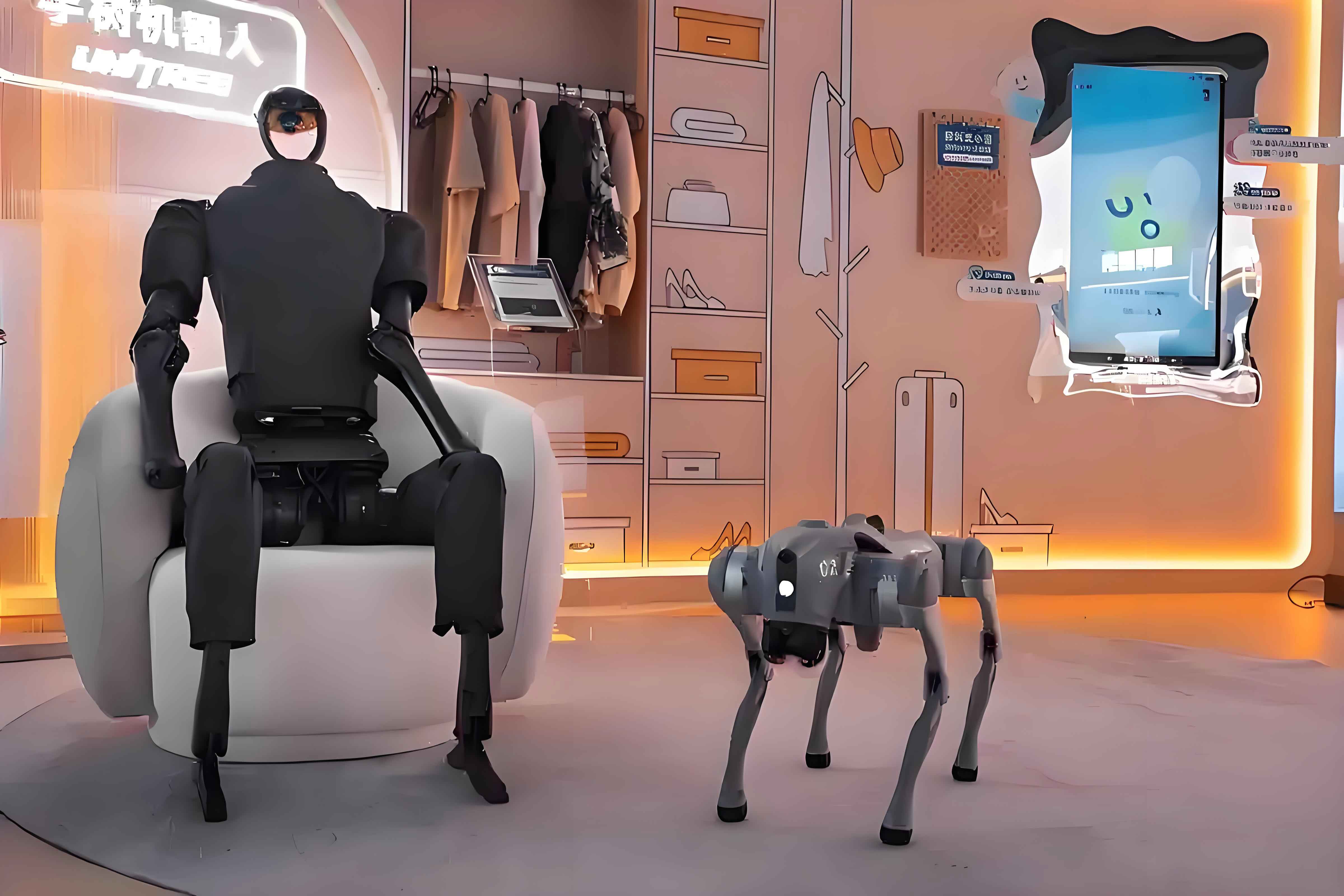
A humanoid robot designed to operate in human environments must perceive the world not as a collection of geometric primitives but as a field of affordances. A doorknob is not just a cylinder; it is a “turnable” object that leads to a “passable” aperture. This requires a deep integration of perception with the robot’s own action capabilities. The meaning of objects emerges from this agent-relative, action-oriented perspective. The challenge is to build systems that can learn these affordances through interaction, not just have them pre-programmed. This can be framed as learning a function that maps perceived scene features $S$ and the robot’s own capability vector $C$ to a set of potential actions $A$:
$$ \text{Affordance}(S, C) \rightarrow \{A_1, A_2, …, A_n\} $$
For a humanoid robot, $C$ includes parameters like reach envelope, grip strength, and balance constraints, which constantly modulate the perceived affordances of the world.
3. Interactive Embodiment: The Social and Co-Creative Dimension
The most complex dimension extends embodiment into the social realm. Intelligence is not just about coupling with a physical environment but also with other agents. This is the domain of social cognition, joint action, and participatory sense-making. Meaning is not just individually enacted; it is often co-created through coordinated interaction. This involves non-verbal cues, timing, turn-taking, and the shared establishment of situational norms.
For a humanoid robot to be truly integrated into human societies, it must master this dimension. It’s not enough to pass an object; it must do so with appropriate gaze, handing-over trajectory, and force modulation that signals intent and enables smooth transfer. This requires the robot to model not just the physical state of the other agent, but their intentional state, and to make its own intentions legible. The dynamics can be modeled as a coupled system where the actions of each agent ($a_H$ for human, $a_R$ for robot) continuously influence each other’s internal states ($s_H$, $s_R$) and future actions:
$$ \frac{d}{dt} \begin{bmatrix} s_H \\ s_R \end{bmatrix} = F \left( \begin{bmatrix} s_H \\ s_R \end{bmatrix}, \begin{bmatrix} a_H \\ a_R \end{bmatrix} \right) $$
$$ a_H = \pi_H(s_H, \hat{s}_R), \quad a_R = \pi_R(s_R, \hat{s}_H) $$
Here, $\hat{s}$ denotes an estimated or inferred state of the other. Achieving fluent interaction requires the humanoid robot to engage in this reciprocal prediction and coordination loop, a frontier area combining theory of mind models with real-time motion planning.
| Dimension | Theoretical Principle | Engineering Challenge in Humanoid Robots | Key Performance Metrics |
|---|---|---|---|
| Sensorimotor | Morphological Computation, Dynamics | Dynamic balance, whole-body compliant control, energy-efficient locomotion. | Walking speed, stability margin, torque control bandwidth, fall recovery success rate. |
| Situated | Affordance Perception, Ecological Psychology | Multi-modal scene understanding for action (vision, touch, proprioception), learning object affordances. | Task success rate in novel environments, time to identify actionable objects, generalizability across domains. |
| Interactive | Participatory Sense-Making, Joint Action | Real-time intention recognition & legibility, natural social cue generation (gaze, gesture), collaborative task planning. | Human subjective comfort/trust ratings, efficiency in collaborative tasks (e.g., assembly time), fluency of interaction (pause lengths, interruptions). |
The Humanoid Robot: A Paradigm Artifact and Its Limits
The humanoid robot stands as the ultimate ambition and the most critical case study for embodied AI. Its form factor is not arbitrary. By adopting a human-like morphology, it is designed to seamlessly operate in environments built for humans—using our stairs, sitting in our chairs, and manipulating our tools. This gives the humanoid robot a unique advantage in terms of environmental compatibility and social acceptance over wheeled or non-anthropomorphic robots.
From an engineering perspective, the humanoid robot is a system of immense complexity, integrating advancements in mechanics (lightweight actuators, compliant joints), sensing (high-resolution vision, tactile skins, proprioception), and computation (real-time operating systems, machine learning models). Modern examples demonstrate stunning feats of sensorimotor embodiment: parkour, dynamic running, and precise manipulation. They are increasingly addressed with large, multi-modal AI models that process language, vision, and sensor data to generate action plans, attempting to tackle the situated dimension.
However, a deep philosophical critique emerges here. While a humanoid robot may simulate the external form and even some functions of human embodiment, does it achieve genuine embodiment in the phenomenological sense? I argue there remains a fundamental gap. Human embodiment is characterized by a pre-reflective, lived experience (le corps vécu). Our body is not just an object we control; it is our primary subjective perspective on the world. It is “fleshy,” with needs, pleasures, and vulnerabilities. It has a history that sediment into habits. The body of a humanoid robot, no matter how sophisticated, is primarily a functional instrument. Its “experience” is a stream of calibrated sensor data and actuator commands.
This difference manifests in several ways. First, the humanoid robot‘s body lacks the intrinsic biological values (like avoiding tissue damage, seeking energy) that deeply structure human cognition and motivation. Second, its learning, while potentially vast, is often disembodied in the sense that it can be acquired through massive simulation or data, not necessarily through the slow, painstaking, and affectively-rich process of bodily exploration that characterizes human development. Third, the social interaction of a humanoid robot, even when fluent, risks being a sophisticated simulation of sociality rather than a true engagement stemming from shared vulnerability and mutual care.
The following table categorizes major types of humanoid robot based on their primary design focus, which often emphasizes one dimension of embodiment over others:
| Type / Example | Primary Embodiment Dimension | Key Characteristics | Typical Application |
|---|---|---|---|
| Dynamic Locomotion (e.g., Boston Dynamics Atlas) | Sensorimotor | Exceptional balance, agility, and whole-body coordination. Often hydraulic, high power. | Search & Rescue, Extreme Environment Inspection |
| Social & Service (e.g., SoftBank Pepper, PAL Robotics TIAGo) | Interactive | Expressive features (eyes, screen), voice interaction, safe & slow movement. | Customer Service, Education, Elderly Assistance |
| Research Platform (e.g., Honda ASIMO (legacy), Toyota HSR) | Integrated (All Dimensions) | Designed for flexibility in algorithms research. Good balance of mobility and manipulation. | Academic and Corporate R&D in Robotics and AI |
| General Purpose / Humanoid (e.g., Figure 01, Tesla Optimus, Agility Digit) | Situated & Sensorimotor | Aims for practical utility in human spaces (factories, warehouses). Focus on manipulation, mobility, and task learning. | Logistics, Manufacturing, Domestic Tasks |
The pursuit of the humanoid robot, therefore, has a dual value. Practically, it drives integration and creates potentially versatile machines. Philosophically, it acts as a “phenomenological probe.” By building systems that approach but inevitably fall short of human-like embodiment, we are forced to articulate what is missing. It highlights that intelligence is not just a computational problem but an existential one, intertwined with having a body that is not just a tool, but a condition of being. This realization carries profound ethical implications. As we create increasingly embodied and socially competent humanoid robots, we must be警觉 of anthropomorphization, clarify the boundaries of responsibility, and consider the impact on human social bonds and self-understanding.
Conclusion: Toward a Deeper Embodiment
In my view, the embodiment of intelligence is the most significant frontier in AI. The journey from disembodied symbols to physically embedded agents marks a maturation of the field, aligning it more closely with the reality of biological cognition. The three-dimensional framework—sensorimotor, situated, interactive—provides a robust scaffold for both analyzing natural intelligence and engineering its artificial counterparts.
The humanoid robot serves as the flagship project of this endeavor, a powerful demonstration of the principles of embodied intelligence in action. Its successes in mobility and manipulation validate the sensorimotor paradigm. Its need to understand human environments underscores the situated dimension. Its aspiration for social integration points toward the interactive future. Yet, a critical analysis reminds us that current humanoid robots achieve a functional, externalist form of embodiment. They possess a body-in-form, but not yet a body-as-lived-experience.
The future path, therefore, is not merely about making humanoid robots faster, stronger, or smarter in a narrow task sense. It is about exploring architectures that might incorporate deeper bio-inspired principles: intrinsic motivation, homeostatic regulation, developmental learning timelines, and perhaps even forms of artificial affect grounded in the integrity of the physical system. The goal is not to create a human, but to understand the principles that make intelligence possible in a physical and social world. In this pursuit, the humanoid robot remains our most essential and revealing companion, a mirror that reflects both our engineering ambitions and the enduring mystery of our own embodied existence.