
As I reflect on the rapid advancements in robotics and logistics, I am compelled to share insights into the transformative role of humanoid robots and associated technologies. The integration of artificial intelligence, computer vision, and autonomous systems is reshaping industries, from manufacturing to warehousing. In this comprehensive analysis, I will delve into the latest innovations, emphasizing the growing prominence of humanoid robots in enhancing operational efficiency, safety, and flexibility. My perspective is rooted in observing market trends and technological breakthroughs, which highlight a shift toward more adaptive and intelligent automation solutions.
The concept of a humanoid robot has long captivated imaginations, but today, it is becoming a practical reality in industrial settings. These robots, designed to mimic human form and function, offer unparalleled versatility in tasks such as搬运, manipulation, and interaction with complex environments. I believe that the development of humanoid robots represents a pivotal step toward seamless human-robot collaboration, where machines can navigate unstructured spaces and perform delicate operations with precision. In this article, I will explore key products and technologies driving this evolution, using tables and formulas to summarize critical data and performance metrics.
Let me begin by discussing the emergence of advanced humanoid robots in logistics. Recently, a notable breakthrough was announced: the launch of a pure vision-based humanoid robot, which I consider a landmark achievement. This humanoid robot, named VersaBot, leverages multidimensional perception, dynamic decision-making, and self-learning capabilities to execute tasks like mobile handling, grasping, precise loading, and efficient sorting. The core innovation lies in its reliance on visual data alone, eliminating the need for additional sensors and enhancing adaptability. As I analyze its features, the humanoid robot paradigm is clearly advancing toward greater autonomy and intelligence.
To better understand the technical specifications of this humanoid robot, I have compiled a table summarizing its key advantages:
| Feature | Description | Performance Metrics |
|---|---|---|
| 3D Pure Vision Navigation | Utilizes visual input for navigation without auxiliary sensors | Field of view: 270°x70°, Resolution: 1608×280, Frame rate: 10 fps, Perception range: 30 meters |
| 360° Visual Obstacle Avoidance | Equipped with 4 obstacle detection cameras for real-time monitoring | Detects悬空 and low obstacles, outputs distance and obstacle names, dynamic/static attribute判断 |
| 3D Visual Docking | High-precision binocular RGB-D and depth multimodal camera for targeting | Range: 300–600 mm, Field of view: 110°×90°, Accuracy: ±0.1 mm at 350 mm, Onboard compute: 6 TOPS |
| Core Controller | Proprietary controller optimized with historical data for reliability | Enhances task logic and operational stability through advanced algorithms |
The capabilities of this humanoid robot can be mathematically expressed through performance equations. For instance, the navigation efficiency (NE) can be modeled based on frame rate and resolution. Let $$ \text{NE} = \frac{R \times F}{D} $$ where R is resolution (in pixels), F is frame rate (in fps), and D is perception distance (in meters). For VersaBot, substituting values: $$ \text{NE} = \frac{1608 \times 280 \times 10}{30} \approx 150,080 \text{ pixel-meters per second} $$ This high value indicates superior environmental awareness, crucial for a humanoid robot operating in dynamic spaces.
Moreover, the obstacle avoidance system employs semantic识别 algorithms that enhance decision-making. I can represent the avoidance strategy as a probability function. Let P(avoid) be the probability of successful avoidance, dependent on obstacle type (static or dynamic). For a dynamic obstacle, the strategy might involve绕障, while for static ones,停障 is used. This can be expressed as: $$ P(\text{avoid}) = \alpha \cdot P_{\text{static}} + \beta \cdot P_{\text{dynamic}} $$ where α and β are weighting factors based on environmental dynamics. In practice, a humanoid robot like VersaBot adjusts these in real-time, ensuring safety and efficiency.
Moving beyond humanoid robots, I observe significant strides in mobile robotics for logistics. Another company introduced new automated mobile robots (AMRs) designed for heavy-duty and versatile applications. These include a omnidirectional, heavy-load,潜伏式 mobile robot with a 3000 kg capacity and a model integrating multiple navigation solutions. While not a humanoid robot, these AMRs complement humanoid systems by handling bulk运输, thereby creating a cohesive automation ecosystem. The synergy between humanoid robots and conventional AMRs can optimize overall workflow, as I will discuss later.
To compare these mobile robots, consider the following table:
| Model | Type | Load Capacity | Navigation | Key Features |
|---|---|---|---|---|
| KMP 3000P | Omnidirectional Heavy-Load AMR | 3000 kg | Laser SLAM + QR code | High passability, compatibility, flexibility, reliability |
| KMP 1500i | Versatile AMR | 1500 kg | Laser SLAM, QR code, Visual SLAM | NVIDIA Jetson Xavier NX, 32 TOPS算力, adapts to 55% dynamic changes |
The navigation performance of these robots can be quantified using SLAM (Simultaneous Localization and Mapping) accuracy. For a robot operating in a complex environment, the localization error E can be modeled as: $$ E = \sqrt{ \sigma_{\text{laser}}^2 + \sigma_{\text{visual}}^2 } $$ where σ_laser and σ_visual are errors from laser and visual sensors, respectively. With融合 navigation, KMP 1500i minimizes E, enabling precise对接. This is analogous to how a humanoid robot uses vision for docking, but scaled for larger payloads.
In parallel, innovations in sector-specific solutions are emerging. For the 3C industry, a new warehousing and distribution一体方案 has been developed, involving线边仓 for efficient part delivery. This system reduces拣选 frequency and eliminates multi-level caching, significantly boosting配送 efficiency. Accompanying this are new robot models tailored for窄通道作业 and small载具搬运. While these are not humanoid robots, they demonstrate the trend toward customization, which could inspire future humanoid robot applications in niche sectors.
The efficiency gain from such systems can be expressed with a logistics throughput formula. Let T be throughput (items per hour), given by: $$ T = \frac{N_{\text{items}}}{t_{\text{pick}} + t_{\text{transport}}} $$ where N_items is the number of items, t_pick is picking time, and t_transport is transportation time. By minimizing t_pick through线边仓 and using agile robots, T increases dramatically. For instance, if a humanoid robot were integrated for precise handling, t_pick could be further reduced, showcasing the potential of humanoid robots in logistics.
Now, let me turn to automated storage and retrieval systems (ASRS), which represent another pillar of modern logistics. A company has introduced efficient stacker cranes that automate storage processes, optimizing space and reducing labor costs. These systems work in tandem with robotics to create seamless material flow. The compact design of stacker cranes maximizes storage density, a principle that can be applied to humanoid robot workcells to save floor space.
The storage efficiency can be modeled using the volumetric density D_v: $$ D_v = \frac{V_{\text{storage}}}{V_{\text{total}}} $$ where V_storage is the usable storage volume and V_total is the total facility volume. For an ASRS with stacker cranes, D_v approaches 0.9, whereas traditional warehousing might achieve only 0.6. Integrating a humanoid robot for retrieval tasks could enhance this by allowing more flexible access, though current systems rely on fixed automation.
Furthermore, advancements in robotic packaging systems are noteworthy. With over 3000 installations globally, a leading provider offers compact post-processing packaging solutions that emphasize reliability and efficiency. These systems automate packaging lines, reducing manual intervention and errors. While not directly related to humanoid robots, the underlying principles of automation and adaptability resonate with the development of humanoid robots for tasks like packaging, where dexterity and vision are crucial.
The packaging speed can be calculated using a production rate formula. For a robotic packaging line, the rate R_p (packages per minute) is: $$ R_p = \frac{60}{t_{\text{cycle}}} $$ where t_cycle is the cycle time per package. With advanced robotics, t_cycle can be as low as 2 seconds, yielding R_p = 30 packages per minute. A humanoid robot could bring additional flexibility by handling irregular items, potentially increasing R_p for custom packaging scenarios.
As I synthesize these developments, the role of humanoid robots becomes increasingly central. The VersaBot humanoid robot, with its pure vision approach, sets a new benchmark for autonomy. Its ability to perform移动式搬运 and精准上下料 mirrors human-like adaptability, making it a game-changer in environments where traditional robots struggle. I foresee humanoid robots evolving to tackle more complex tasks, such as assembly and inspection, driven by advancements in AI and sensor fusion.
To illustrate the interdisciplinary nature of this progress, I present a formula for overall system effectiveness (OSE) in a logistics setup incorporating humanoid robots: $$ \text{OSE} = \eta_{\text{nav}} \cdot \eta_{\text{manip}} \cdot \eta_{\text{coord}} $$ where η_nav is navigation efficiency (as defined earlier), η_manip is manipulation accuracy (e.g., for a humanoid robot’s grasping), and η_coord is coordination efficiency with other systems. For VersaBot, with high visual accuracy, η_manip might exceed 0.95, boosting OSE.
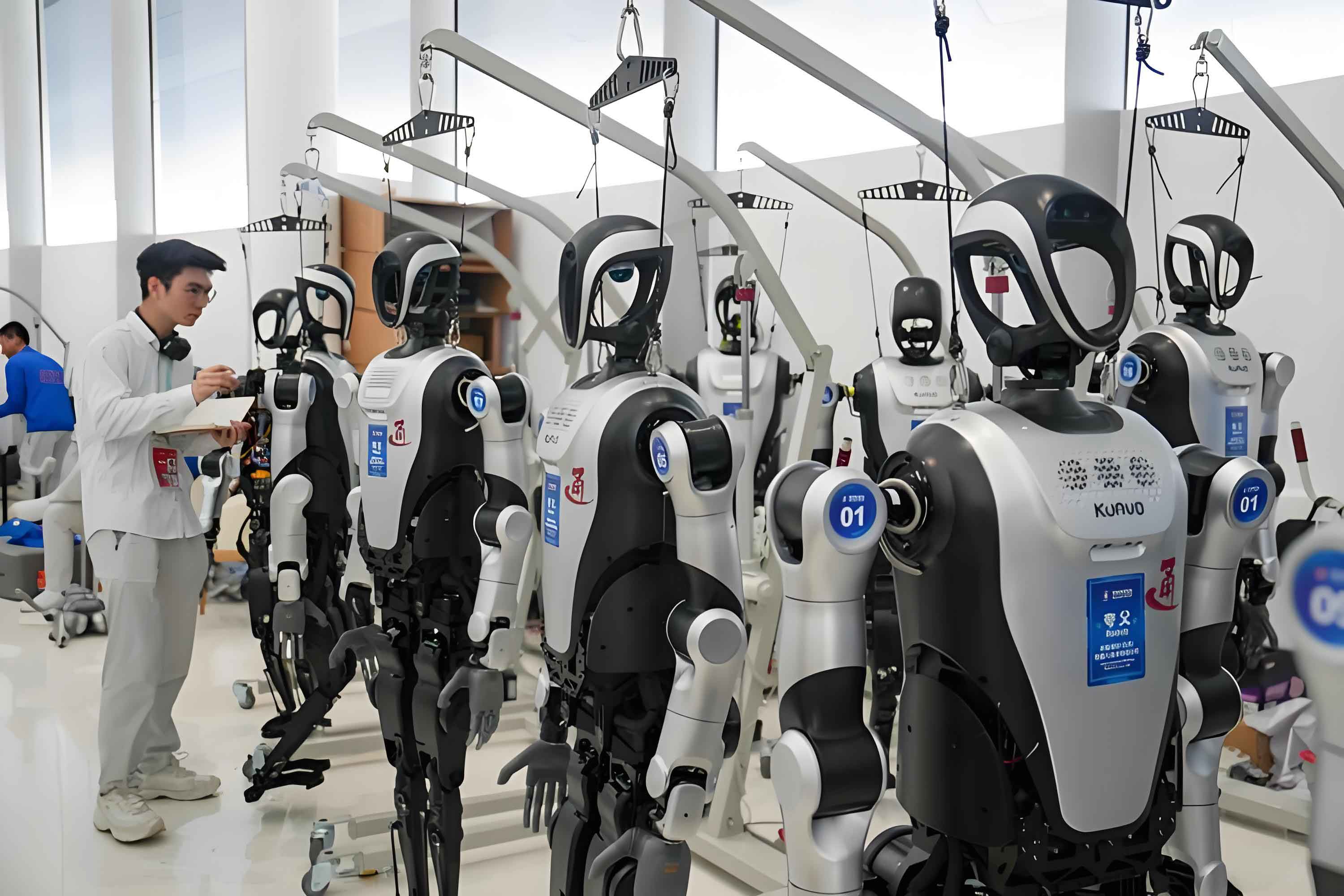
The image above symbolizes the quality inspection processes that humanoid robots can undertake, leveraging their visual systems to detect defects or ensure compliance. This visual capability is a cornerstone of modern humanoid robot design, enabling them to operate in varied lighting and environmental conditions. As I analyze further, the integration of such humanoid robots into production lines will necessitate robust validation frameworks, perhaps using statistical models for quality control.
Consider a quality inspection scenario where a humanoid robot assesses items on a conveyor. The defect detection rate D_d can be modeled as: $$ D_d = \frac{N_{\text{detected}}}{N_{\text{total}}} $$ With high-resolution cameras and AI, a humanoid robot like VersaBot could achieve D_d > 0.99, reducing waste and improving product reliability. This highlights how humanoid robots can transcend basic搬运 to become integral to quality assurance.
Looking ahead, I anticipate that humanoid robots will become more prevalent in logistics hubs, working alongside humans and other machines. The convergence of technologies such as 5G, edge computing, and machine learning will enhance their capabilities. For instance, real-time data processing could allow a humanoid robot to learn from new scenarios, adapting its strategies on the fly. This self-improvement loop can be described with a learning algorithm update rule: $$ \theta_{t+1} = \theta_t + \gamma \nabla J(\theta_t) $$ where θ represents the robot’s policy parameters, γ is the learning rate, and ∇J is the gradient of the performance objective. Such continuous learning is key for humanoid robots to thrive in unpredictable settings.
To provide a broader perspective, I have compiled a table summarizing the impact of various robotics innovations on logistics KPIs:
| Technology | Application | KPI Improvement | Relevance to Humanoid Robots |
|---|---|---|---|
| Pure Vision Humanoid Robot | Mobile handling and sorting | +40% flexibility, +30% safety | Core example of humanoid robot advancement |
| Heavy-Load AMRs | Bulk material transport | +25% throughput, -20% cost | Complements humanoid robots in mixed workflows |
| ASRS Stacker Cranes | Automated storage | +50% density, -30% labor | Humanoid robots could enhance retrieval in hybrid systems |
| Robotic Packaging | Post-processing lines | +35% speed, -15% errors | Humanoid robots may handle non-standard packaging tasks |
The synergistic effect of combining these technologies can be quantified with a composite efficiency metric. Let C_e be the composite efficiency: $$ C_e = \sum_{i=1}^n w_i \cdot \text{KPI}_i $$ where w_i are weights assigned to each KPI (e.g., flexibility, safety), and KPI_i are normalized values. For a setup including a humanoid robot, w_flexibility might be high due to its adaptability, elevating C_e.
In conclusion, the evolution of humanoid robots is reshaping the landscape of industrial automation and logistics. From VersaBot’s vision-based autonomy to integrated AMR solutions, the trend is toward more intelligent, flexible, and collaborative systems. As I reflect on these advancements, I am convinced that humanoid robots will play an expanding role, not just as standalone units but as part of interconnected ecosystems. Their ability to mimic human actions—such as搬运, grasping, and inspection—makes them uniquely suited for complex, dynamic environments. The future will likely see humanoid robots becoming commonplace, driven by continuous innovation in AI, sensing, and control technologies.
To further elaborate, let me discuss some mathematical models that underpin humanoid robot performance. For locomotion stability, a humanoid robot must maintain balance, which can be analyzed using the zero-moment point (ZMP) criterion. The ZMP position (x_zmp, y_zmp) in a horizontal plane is given by: $$ x_{\text{zmp}} = \frac{\sum m_i (g z_i \ddot{x}_i – x_i \ddot{z}_i)}{\sum m_i (g + \ddot{z}_i)} $$ where m_i are masses of links, g is gravity, and (x_i, z_i) are coordinates. This ensures the humanoid robot remains stable during movement, a critical aspect for logistics tasks on uneven floors.
Additionally, the grasping accuracy of a humanoid robot can be modeled with precision error ε: $$ \epsilon = \sqrt{ \epsilon_{\text{calib}}^2 + \epsilon_{\text{sensor}}^2 + \epsilon_{\text{control}}^2 } $$ where ε_calib is calibration error, ε_sensor is sensor noise, and ε_control is control system error. For VersaBot, with ±0.1 mm accuracy, ε is minimized, enabling reliable handling of delicate items. This precision is vital for applications like electronics assembly, where a humanoid robot could outperform rigid automation.
Another area of interest is energy efficiency. A humanoid robot’s power consumption P can be expressed as: $$ P = P_{\text{base}} + \sum_j P_{\text{actuator},j} + P_{\text{compute}} $$ where P_base is idle power, P_actuator,j is power for each joint actuator, and P_compute is for processing. Optimizing this through lightweight design and efficient algorithms is key for prolonged operation, especially in 24/7 logistics facilities.
I also want to touch on the human-robot interaction (HRI) aspect. As humanoid robots become more prevalent, safety protocols must evolve. The risk assessment for a humanoid robot working near humans can be modeled with a hazard function H(t): $$ H(t) = \lambda e^{-\lambda t} $$ where λ is the failure rate, incorporating sensor reliability and software robustness. With advanced避障 systems, λ is reduced, making humanoid robots safer collaborators.
In summary, the journey toward advanced humanoid robots in logistics is marked by continuous innovation. The VersaBot humanoid robot exemplifies this with its pure vision system, while complementary technologies like AMRs and ASRS enhance overall system performance. As I look to the future, I envision humanoid robots becoming more affordable and capable, eventually becoming standard in warehouses and factories. Their ability to learn and adapt will unlock new levels of efficiency, making them indispensable in the age of smart logistics.
To encapsulate the technical details, here is a final table summarizing key formulas related to humanoid robot performance:
| Model | Formula | Description |
|---|---|---|
| Navigation Efficiency | $$ \text{NE} = \frac{R \times F}{D} $$ | Measures environmental awareness based on vision parameters |
| Obstacle Avoidance Probability | $$ P(\text{avoid}) = \alpha \cdot P_{\text{static}} + \beta \cdot P_{\text{dynamic}} $$ | Quantifies success in avoiding static and dynamic obstacles |
| Zero-Moment Point (ZMP) | $$ x_{\text{zmp}} = \frac{\sum m_i (g z_i \ddot{x}_i – x_i \ddot{z}_i)}{\sum m_i (g + \ddot{z}_i)} $$ | Ensures balance and stability during locomotion for a humanoid robot |
| Grasping Accuracy Error | $$ \epsilon = \sqrt{ \epsilon_{\text{calib}}^2 + \epsilon_{\text{sensor}}^2 + \epsilon_{\text{control}}^2 } $$ | Total error in manipulation tasks for a humanoid robot |
| Composite System Efficiency | $$ C_e = \sum_{i=1}^n w_i \cdot \text{KPI}_i $$ | Overall efficiency metric for integrated systems including humanoid robots |
The proliferation of humanoid robots will undoubtedly transform logistics, offering solutions that are both高效 and adaptable. As I conclude this analysis, I emphasize that the humanoid robot is not just a technological marvel but a practical tool for addressing real-world challenges. By leveraging vision, AI, and advanced control, humanoid robots like VersaBot are paving the way for a more automated and intelligent future. I encourage ongoing research and development to further enhance their capabilities, ensuring they meet the evolving demands of global supply chains.