
As a researcher deeply immersed in the field of robotics, I observe the accelerating evolution of humanoid robots with a mix of excitement and sober reflection. These machines, designed to mimic human form and function, are transitioning from laboratory prototypes to potential fixtures in our societal fabric. Their promise to revolutionize sectors from advanced manufacturing and healthcare to domestic assistance and emergency response is immense. However, this transformative potential is tethered to a critical, often underappreciated, foundation: robust and forward-looking standardization. This article, from my perspective, delves into the intricate technical landscape of humanoid robots, scrutinizes the current—and often fragmented—state of global standardization efforts, and proposes a cohesive framework for a “standards-strengthened chain” essential for nurturing the new quality productive forces embodied by these advanced machines.
The very definition of a humanoid robot centers on biomimicry—possessing a bipedal posture, dual manipulators, and a multi-jointed structure that allows for operation in environments built for humans. The technical architecture is a symphony of interdisciplinary engineering. It can be broadly decomposed into several integrated layers:
- Physical Layer (The Body): This encompasses the mechanical skeleton, actuators (often rotary or linear electric motors, or hydraulic systems), and power supply. The dynamics are highly complex due to the unstable nature of bipedal locomotion. A simplified equation for the dynamics of a humanoid robot’s limb can be expressed using the Lagrangian formulation:
$$ \tau = M(q)\ddot{q} + C(q, \dot{q})\dot{q} + G(q) $$
Where \( \tau \) is the vector of joint torques, \( q \) is the vector of joint angles, \( M(q) \) is the inertia matrix, \( C(q, \dot{q}) \) accounts for Coriolis and centrifugal forces, and \( G(q) \) represents gravitational forces. Stabilizing this system in real-time is a fundamental challenge.
- Sensing and Perception Layer (The Senses): This layer fuses data from a suite of sensors: vision (RGB-D cameras, stereo vision), proprioception (encoders, inertial measurement units – IMUs), force/torque sensing, tactile sensors (often termed “electronic skin”), and sometimes audio. Sensor fusion algorithms are critical for state estimation and environmental understanding.
- Control and Cognition Layer (The Brain and Cerebellum): This is the core intelligence. It is increasingly divided into two conceptual subsystems:
- Low-level Control (“The Cerebellum”): Manages real-time balance, gait generation, and motion trajectory tracking. It relies on sophisticated control theories like Zero-Moment Point (ZMP) control, Model Predictive Control (MPC), or reinforcement learning-trained policies.
- High-level Cognition (“The Brain”): Enabled by large AI models, this layer handles task planning, natural language interaction, complex object recognition, and long-term decision-making. The performance can be linked to the model’s parameter scale and training data diversity.
The current developmental trajectory is characterized by rapid prototyping from leading tech conglomerates and agile startups alike. The focus has expanded from pure mobility (walking, climbing stairs) to dexterous manipulation (using tools, handling objects) and interactive communication. However, significant headwinds persist. The cost of precision actuators and bespoke components remains prohibitive for mass adoption. The energy efficiency of bipedal locomotion is still far inferior to wheeled or tracked bases, a problem quantifiable by the Cost of Transport (COT):
$$ \text{COT} = \frac{P}{m g v} $$
where \( P \) is power consumption, \( m \) is mass, \( g \) is gravity, and \( v \) is velocity. Achieving a human-like COT is a major research goal. Furthermore, ensuring functional safety and operational robustness in unstructured environments presents an immense software and systems engineering challenge.
A critical, yet frequently nascent, area of development is the standardization ecosystem surrounding the humanoid robot. Standardization is the invisible infrastructure that ensures safety, enables interoperability, drives down costs through economies of scale, and builds user trust. The current international landscape is a patchwork, primarily built around broader robotic categories.
The foremost international body, ISO/TC 299 (Robotics), has published numerous standards, but they are largely categorized by application domain rather than morphology. As illustrated in the table below, standards exist for vocabulary, industrial robots, service robots, and medical robots, but none specifically titled for the unique requirements of humanoid robots.
| ISO Document Number | Title | Primary Category |
|---|---|---|
| ISO 8373:2021 | Robotics — Vocabulary | Fundamental |
| ISO 10218-1/2 | Robotics — Safety requirements for industrial robots | Industrial Robots |
| ISO 13482:2014 | Robotics — Safety requirements for personal care robots | Service/Medical Robots |
| ISO 18646 series | Performance criteria and test methods for service robots | Service Robots |
| ISO/TS 15066:2016 | Robots and robotic devices — Collaborative robots | Industrial Robots |
National and regional efforts show more variety but similar gaps. The United States leverages organizations like ASTM International and IEEE to develop detailed performance test methods, particularly for ground robots in emergency response scenarios. However, these are often tailored to specific, non-humanoid form factors. A snapshot of U.S. standards activity reveals a focus on mobility and communication testing:
| Standard Identifier | Focus Area | Relevance to Humanoid Robots |
|---|---|---|
| ASTM E2827/E2827M-20 | Evaluating robot mobility using crossing pitch/roll ramps | High (locomotion testing) |
| ASTM E2853/E2853M-22 | Evaluating ground robot capabilities: Search Tasks | Medium (task-based testing) |
| IEEE 7007-2021 | Ontological Standard for Ethically Driven Robotics | High (ethical frameworks) |
| UL 3300 | Outline for Service, Communication, Information Robots | Medium (safety guidelines) |
In Europe, standardization often follows ISO or develops specific safety norms for consumer-facing devices, including some robotic appliances. Japan has a long history of industrial robot standardization, with recent work beginning to touch on service robot safety management systems.
The glaring omission across all these frameworks is a dedicated, holistic set of standards addressing the *humanoid robot* as a unique class. Their combination of bipedal dynamics, complex manipulation, and advanced AI-powered interaction creates distinct hazards and performance metrics that existing industrial or service robot standards only partially cover. For instance, a standard for collaborative robot (cobot) force limits (as in ISO/TS 15066) is relevant for a humanoid robot’s arm, but does not address the risk of dynamic instability causing a full-body collision.
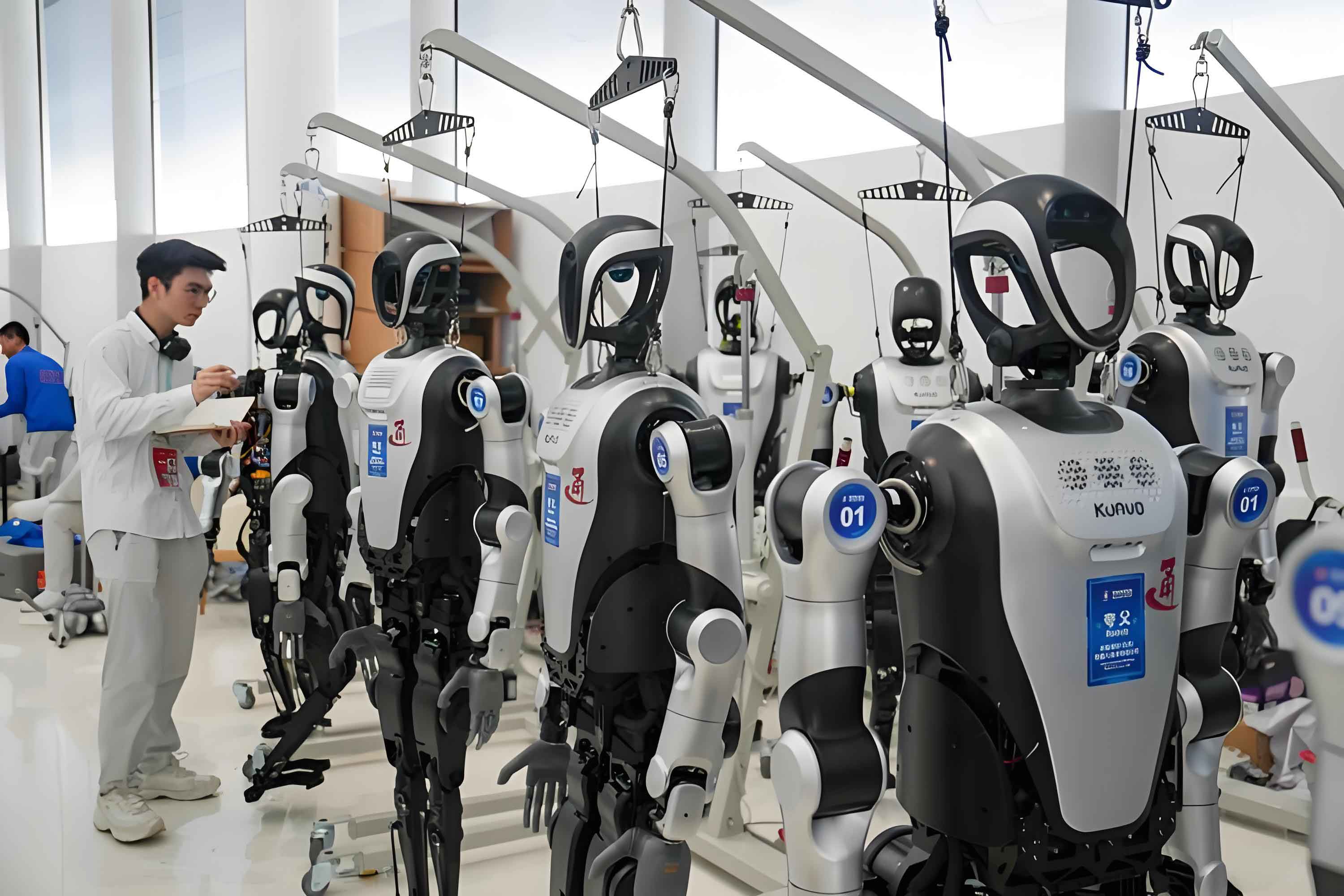
The quality assurance and validation process for a humanoid robot, as suggested by the focus of the linked image, necessitates standardized testing rigs and procedures for everything from joint endurance and impact resistance to vision system accuracy in variable lighting—areas still lacking unified protocols.
Therefore, to truly catalyze the development of humanoid robots as a new quality productive force, a proactive and strategic approach to standardization is not just beneficial—it is imperative. I propose a multi-pronged strategy to build this “standards-strengthened chain”:
1. Accelerate Foundational and Component-Centric Standard Development: Priority must be given to creating standards for the unique technological pillars of humanoid robots.
- Performance & Safety: Develop specific performance criteria (e.g., gait stability metrics, fall recovery procedures, manipulation precision under load) and safety requirements that account for whole-body movement and human-robot co-existence in diverse settings. A risk assessment formula for a humanoid robot must integrate both static and dynamic factors:
$$ R_{\text{humanoid}} = f(P_{\text{collision}}, S_{\text{instability}}, E_{\text{environment}}, C_{\text{AI\_error}}) $$
where risk \( R \) is a function of collision probability \( P \), severity of instability \( S \), environmental complexity \( E \), and the potential for cognitive system error \( C \). - Key Hardware Interfaces: Standardize mechanical and electrical interfaces for modular components like manipulator end-effectors (beyond simple grippers to dexterous hands), battery packs, and sensor modules to foster a competitive supply chain.
- AI & Data: Establish guidelines for training, validating, and auditing the AI models governing humanoid robot behavior, including benchmarks for task comprehension, failure mode analysis, and data privacy.
- Ethics & Legal Compliance: Formulate clear ethical guidelines addressing autonomy, accountability, and social impact, providing a framework for developers and regulators.
2. Cultivate a Cohort of Standard-Implementing Leader Enterprises: Theoretical standards gain credence through practical application. National and international initiatives should identify and support pioneering companies willing to implement draft standards in their design, manufacturing, and verification processes. These “living labs” will generate invaluable feedback, de-risk the standards for broader industry adoption, and create tangible blueprints for compliance. Their experiences should be disseminated through case studies and technical workshops.
3. Construct a Holistic Standardization Ecosystem: Standardization cannot thrive in silos. The ecosystem must include:
- Dynamic Technical Committees: Strengthen and potentially establish new sub-committees under bodies like ISO/TC 299 or IEC, dedicated to humanoid robot technology, with representation from academia, industry (large and small), testing labs, and end-users.
- Open Collaboration Platforms: Foster pre-competitive collaboration where competitors jointly develop and validate test methods for common challenges, such as benchmarking battery life under dynamic loads or standardizing simulation environments for training.
- Integration with Regulatory Pathways: Actively engage with safety certification bodies and regulatory agencies to ensure emerging standards are recognized and can form the basis for future type-approval or certification schemes for humanoid robots in specific applications (e.g., healthcare, public spaces).
4. Champion Internationalization and “Chinese Solutions”: Given the global nature of both the supply chain and the market, standards must have international buy-in. Proactive participation in ISO, IEC, and IEEE working groups is essential. Furthermore, regions with vigorous development programs should leverage their market scale and innovation velocity to pilot advanced standards—transforming successful domestic practices into proposed international norms. This “domestic pilot, global promotion” model can position a region’s technological framework at the heart of the global humanoid robot discourse. Encouraging leading enterprises to form or lead global consortia around specific technical challenges (e.g., a “Humanoid Robot Communication Protocol Alliance”) is a powerful strategy.
In conclusion, the journey of the humanoid robot from a marvel of engineering to a ubiquitous tool for enhancing human productivity and well-being is inevitable. However, the pace, safety, and economic viability of this journey are directly contingent upon the parallel development of a sophisticated, coherent, and internationally harmonized standardization framework. By focusing on the unique technical stack of the humanoid robot, empowering early adopters, building a collaborative ecosystem, and engaging assertively on the global stage, we can construct the essential “standards-strengthened chain.” This chain will not constrain innovation but will instead provide the reliable rails upon which the high-speed train of humanoid robot technology can safely and efficiently deliver its transformative potential to the world.