
As I observe the technological landscape, it becomes increasingly clear that humanoid robots are poised to become a transformative force in the automotive industry. The recent unveiling of advanced humanoid robots capable of dynamic interactions and complex tasks has ignited fervent discussion across manufacturing sectors. While the concept of humanoid robots has existed for decades, breakthroughs in artificial intelligence, sensor technology, and actuation systems are now converging to make these machines more viable than ever. My analysis delves into how humanoid robots could reshape automotive manufacturing, the challenges hindering their mass production, and the collaborative steps necessary for integration.
The fascination with humanoid robots stems from their potential to operate in environments designed for humans. In automotive factories, where assembly lines require dexterity, mobility, and cognitive decision-making, humanoid robots offer a unique solution. Traditional industrial robots excel in repetitive, structured tasks like welding or painting, but they lack the adaptability for final assembly, quality inspection, or logistics in unstructured settings. This is where humanoid robots enter the picture. By mimicking human form and movement, they can navigate existing workspaces without major infrastructural changes, handle diverse tools, and perform delicate operations. I believe that the automotive sector, with its high stakes in efficiency and innovation, will be a primary testing ground for these machines.
Potential Applications of Humanoid Robots in Automotive Manufacturing
From my perspective, the application of humanoid robots in car manufacturing is not a distant fantasy but an imminent evolution. The final assembly stage, often referred to as the “touch labor” phase, remains predominantly manual due to its complexity. Tasks like installing dashboards, wiring harnesses, or interior trim require visual recognition, fine motor skills, and on-the-fly problem-solving—capabilities that are now within reach for advanced humanoid robots. For instance, a humanoid robot could identify and pick up a specific component from a mixed bin, position it accurately within a vehicle frame, and secure it with appropriate fasteners, all while adapting to minor variations in part placement.
Beyond assembly, humanoid robots could revolutionize logistics and maintenance within factories. Imagine a humanoid robot autonomously conducting quality inspections by comparing visual data against digital twins, or performing risky maintenance tasks in hazardous areas such as paint shops or battery rooms. The flexibility of humanoid robots allows them to switch between roles—one hour they might be moving materials using their bipedal locomotion, and the next, they could be assisting human workers with heavy lifting. This multifunctionality is key to justifying their integration. To illustrate the comparative landscape, I have compiled a table summarizing robot types and their automotive applications:
| Robot Category | Primary Applications in Automotive | Automation Level | Adaptability to Unstructured Tasks |
|---|---|---|---|
| Traditional Industrial Robots (e.g., articulated arms) | Welding, painting, material handling in fixed stations | High (for specific tasks) | Low—require precise programming and fixed environments |
| Mobile Robots (AGVs/AMRs) | Internal logistics, part delivery | Moderate | Moderate—navigate defined paths but limited manipulation |
| Collaborative Robots (Cobots) | Assisting humans in assembly, screw driving | Moderate to High | Moderate—safe interaction but limited mobility and complexity |
| Humanoid Robots | Final assembly, quality inspection, maintenance, flexible logistics | Emerging (potential for high adaptability) | High—designed for human-like environments and task variety |
The economic impetus is substantial. Labor shortages and rising wages in many manufacturing regions are pressing automakers to seek automation solutions that go beyond rigid robotics. Humanoid robots, with their general-purpose design, could fill this gap. However, their deployment is not merely about replacing human workers; it’s about augmenting capabilities and tackling tasks that are dangerous, tedious, or ergonomically challenging for people. In my view, the synergy between human workers and humanoid robots will define the next generation of smart factories.
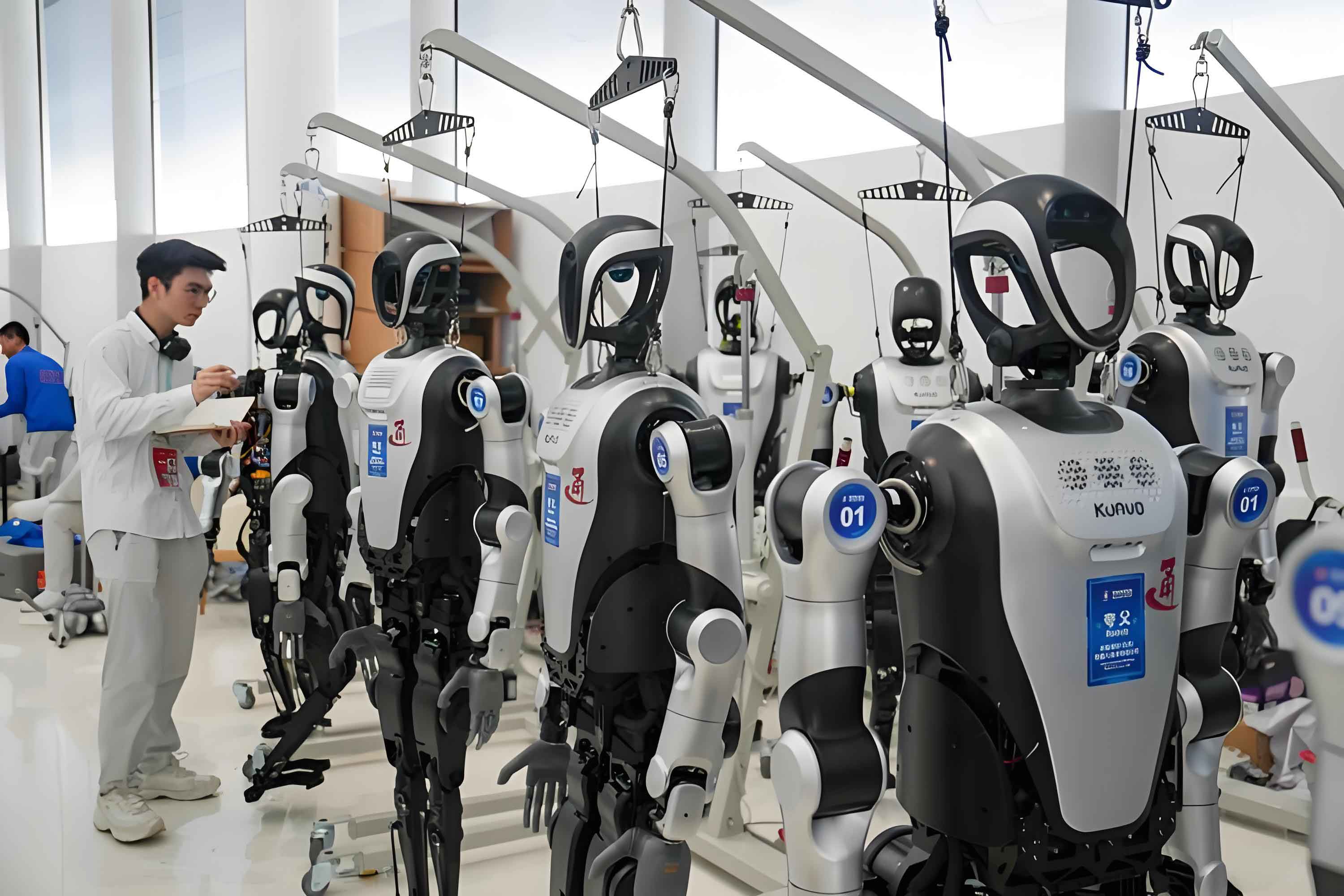
Visual inspection is one area where humanoid robots could excel, leveraging advanced vision systems and AI to detect defects imperceptible to the human eye. The image above symbolizes the meticulous scrutiny that humanoid robots might bring to production lines, ensuring higher quality standards. Integrating such capabilities requires robust perception algorithms and seamless coordination with other automated systems, like autonomous guided vehicles or digital control platforms.
The Evolution and Mass Production Timeline for Humanoid Robots
Watching the rapid progression of humanoid robot prototypes, I am struck by the accelerated pace of development. Initial models from various research entities could barely walk without assistance, but within a few years, we have seen humanoid robots performing dances, sorting objects, and even conducting basic factory operations. This trajectory suggests that mass production might be on the horizon, but it is fraught with technical and economic hurdles. The evolution of a humanoid robot’s capabilities can be modeled as a learning curve, where each iteration incorporates lessons from previous deployments. A simple formula to represent this progress in task complexity over time is:
$$ C(t) = C_0 \cdot e^{kt} $$
Here, \( C(t) \) denotes the complexity of tasks a humanoid robot can perform at time \( t \), \( C_0 \) is the initial capability baseline, and \( k \) is a constant representing the rate of technological improvement driven by advances in AI, mechanics, and sensor fusion. For instance, if \( k \) is high due to cross-industry knowledge transfer (like from electric vehicles to humanoid robots), complexity grows exponentially.
The sharing of core technologies between electric vehicles and humanoid robots—such as battery systems, motor controls, and neural network processors—is a significant accelerator. This synergy reduces R&D costs and speeds up prototyping. However, moving from prototypes to mass production is a leap. Current humanoid robot units are often hand-assembled with premium components, leading to exorbitant costs. To achieve economies of scale, manufacturers must streamline design, standardize parts, and optimize supply chains. I estimate that the cost per unit must drop by at least an order of magnitude to make humanoid robots viable for widespread automotive use. A breakdown of cost drivers can be expressed as:
$$ \text{Total Cost} = \sum_{i=1}^{n} (N_i \cdot P_i) + C_{\text{software}} + C_{\text{integration}} $$
where \( N_i \) is the number of units for component \( i \) (e.g., actuators, sensors), \( P_i \) is its price, \( C_{\text{software}} \) covers AI and control system development, and \( C_{\text{integration}} \) includes calibration and testing expenses. Dominant cost factors include high-precision servo motors, harmonic drives, force-torque sensors, and powerful onboard computers. Until these components see mass-market adoption and price erosion, humanoid robots will remain niche.
Moreover, reliability is paramount for factory environments. A humanoid robot must operate continuously for thousands of hours with minimal downtime, a challenge given the mechanical wear on joints and the computational demands of real-time perception. Accelerated life testing and redundancy in critical systems are essential. From my observations, pilot programs in automotive plants are crucial for gathering performance data. These trials help refine designs and build confidence among manufacturers. I anticipate that small-scale commercial deployments will occur within 2-3 years, followed by broader adoption over a 5-10 year horizon as costs decline and reliability improves.
Challenges Impeding the Widespread Adoption of Humanoid Robots
Despite the optimism, I must acknowledge the formidable barriers that humanoid robots face before becoming commonplace in automotive factories. The challenges are multidimensional, spanning technical, economic, regulatory, and social domains. Firstly, the hardware of humanoid robots is inherently complex. Each joint requires precise actuation and sensing to mimic human motion, leading to a high parts count and potential failure points. The performance of these robots in dynamic, unstructured settings is still inferior to humans in terms of speed, accuracy, and energy efficiency. For example, a humanoid robot might complete an assembly task at 70% of the speed of a skilled worker, which impacts overall line throughput. This efficiency gap can be quantified as:
$$ \eta = \frac{T_{\text{human}}}{T_{\text{robot}}} \times 100\% $$
where \( \eta \) is the relative efficiency percentage, \( T_{\text{human}} \) is the time taken by a human, and \( T_{\text{robot}} \) is the time taken by a humanoid robot. Currently, \( \eta \) often falls below 100%, meaning robots are slower. Improving \( \eta \) requires advances in control algorithms and mechanical design.
Secondly, cost remains a massive hurdle. As mentioned, prices for humanoid robots range from tens of thousands to millions of dollars per unit, depending on capabilities. This makes large-scale procurement prohibitive for most automakers. The table below outlines key cost components and their typical share in total expense for a mid-tier humanoid robot:
| Cost Component | Description | Approximate Share of Total Cost | Current Supply Chain Notes |
|---|---|---|---|
| Actuation System (Servo motors, drivers) | Provides motion and force control for joints | 35-50% | Dominant suppliers are overseas; custom designs are expensive |
| Reduction Gears (Harmonic drives, cycloidal) | Increases torque and precision | 15-25% | High-precision gears are costly; alternatives being explored |
| Sensors (IMU, force-torque, vision cameras) | Enables perception and interaction | 10-20% | Varied sourcing; some sensors are commoditized, others specialized |
| Computing Hardware (AI chips, controllers) | Runs perception, planning, and control algorithms | 10-15% | Increasingly available from tech companies; performance vs. power trade-offs |
| Structural Materials (lightweight alloys, composites) | Forms the skeleton and exterior | 5-10% | Dependent on aerospace-grade materials; potential for cost reduction |
| Software & Integration | AI models, calibration, system testing | 10-20% | Recurring cost; scales with complexity and customization |
Thirdly, safety and standardization concerns loom large. Automotive production lines are high-stakes environments where any malfunction can cause costly downtime or injuries. There are no universally accepted safety standards for humanoid robots working alongside humans. Issues like collision avoidance, emergency stopping, and fail-safe mechanisms need rigorous certification. Additionally, data security is critical; humanoid robots equipped with cameras and network connectivity could become vectors for intellectual property theft if not properly shielded.
Lastly, the societal impact cannot be ignored. The introduction of humanoid robots may displace certain low-skill jobs, necessitating workforce retraining. Conversely, new roles in robot maintenance, programming, and supervision will emerge. A balanced approach that prioritizes human-robot collaboration and ethical guidelines is essential to gain public and worker acceptance.
Key Strategies to Foster Integration Between Humanoid Robots and Automotive Sector
To overcome these challenges and unlock the potential of humanoid robots, I propose a collaborative framework involving industry, academia, and policymakers. The goal is to create an ecosystem where technological innovation aligns with practical automotive needs. Based on my research, several strategic actions are pivotal.
1. Foster Cross-Industry Collaboration and Ecosystem Development: The automotive and robotics industries possess complementary strengths—automakers understand large-scale manufacturing and quality control, while robotics firms excel in innovation and software. Joint ventures, consortiums, or open innovation platforms can facilitate knowledge exchange. For instance, defining common interfaces for humanoid robot tools or communication protocols would simplify integration. A shared roadmap could prioritize use cases with the highest return on investment, such as final assembly or precision inspection.
2. Accelerate R&D in Core Technologies: Breakthroughs in hardware and AI are non-negotiable. For hardware, developing compact, high-torque actuators and durable, lightweight materials will improve performance and reduce costs. In AI, enhancing the autonomy of humanoid robots through large foundation models tailored for physical tasks is crucial. These models enable robots to understand natural language instructions, learn from demonstrations, and adapt to new scenarios without exhaustive reprogramming. The progress in AI can be modeled as an optimization problem:
$$ \min_{W} \sum_{j=1}^{m} L(f(x_j; W), y_j) + \lambda R(W) $$
where \( W \) represents the model parameters, \( L \) is a loss function measuring prediction error for task \( j \), \( x_j \) and \( y_j \) are input-output pairs from training data, and \( \lambda R(W) \) is a regularization term to prevent overfitting. Efficient training on diverse datasets will allow humanoid robots to generalize across automotive tasks.
3. Leverage Domestic Supply Chains for Cost Reduction: Localizing the production of key components like servo motors, reducers, and sensors can drastically lower costs and mitigate geopolitical risks. Domestic suppliers often excel at incremental innovation and scaling production. By co-designing components with robot manufacturers, they can optimize for manufacturability and cost without sacrificing performance. This collaboration could follow a cost-learning curve model:
$$ P(n) = P_0 \cdot n^{-b} $$
Here, \( P(n) \) is the price per unit after producing \( n \) units, \( P_0 \) is the initial price, and \( b \) is the learning elasticity (typically between 0.1 and 0.3 for manufacturing). Increasing \( n \) through pooled demand across industries will drive \( P(n) \) down.
4. Establish Robust Standards and Certification Protocols: Safety standards must be developed specifically for humanoid robots in industrial settings. These should cover mechanical safety (e.g., force limits, collision detection), functional safety (reliable operation under faults), and cybersecurity (data encryption, access controls). Drawing inspiration from existing standards for collaborative robots or autonomous vehicles can expedite the process. Certification bodies need to create testing regimens that simulate real-world factory conditions, including variable lighting, electromagnetic interference, and human proximity.
5. Address Ethical and Workforce Transition Concerns Proactively: Guidelines for human-robot interaction should emphasize transparency, accountability, and privacy. For example, humanoid robots should clearly signal their intentions and log decisions for audit trails. To manage workforce impact, reskilling programs focusing on robotics maintenance, AI supervision, and data analysis should be instituted. Partnerships with vocational schools and universities can pipeline talent. A holistic approach ensures that the adoption of humanoid robots enhances productivity while supporting social stability.
The following table summarizes these strategies and their expected outcomes:
| Strategy Area | Key Actions | Expected Impact | Timeline (Estimated) |
|---|---|---|---|
| Collaboration Ecosystem | Form industry alliances, shared testbeds, define interoperability standards | Faster innovation cycles, reduced integration costs | Short-term (1-3 years) |
| Technology R&D | Invest in actuator design, AI training frameworks, sensor fusion algorithms | Improved robot performance, autonomy, and energy efficiency | Medium-term (3-7 years) |
| Supply Chain Localization | Co-develop components with domestic suppliers, scale production | Cost reduction by 30-50%, increased supply resilience | Medium to long-term (5-10 years) |
| Standards & Certification | Develop safety protocols, testing methodologies, cybersecurity norms | Enhanced trust, smoother regulatory approval, lower liability risks | Short to medium-term (2-5 years) |
| Ethical & Workforce Development | Create ethical guidelines, launch reskilling initiatives, promote human-robot collaboration models | Social acceptance, smoother transition, skilled talent pool | Ongoing, with immediate steps |
Conclusion: The Road Ahead for Humanoid Robots in Automotive
Reflecting on the journey ahead, I am convinced that humanoid robots will gradually become integral to automotive manufacturing, but their path is iterative and collaborative. The convergence of AI, robotics, and automotive engineering presents a unique opportunity to redefine productivity and creativity in factories. As humanoid robots evolve from novelties to reliable tools, they will not only automate tasks but also enable new manufacturing paradigms—such as highly customizable production runs or lights-out factories for certain processes.
The pace of adoption will hinge on overcoming cost barriers, proving reliability in real-world settings, and building a supportive regulatory framework. I envision a future where humanoid robots work seamlessly alongside human colleagues, handling the tedious, dangerous, or precise jobs while humans focus on supervision, innovation, and complex problem-solving. This synergy could elevate the entire automotive industry to new levels of efficiency and quality.
In summary, the era of humanoid robots in automotive is dawning. By addressing technical challenges through cross-sector collaboration, leveraging economies of scale, and prioritizing safety and ethics, stakeholders can unlock immense value. The humanoid robot is more than a machine; it is a catalyst for the next industrial revolution, one where flexibility and intelligence merge to create smarter, more resilient production systems. The race to perfect and deploy humanoid robots is underway, and its winners will shape the future of manufacturing globally.