
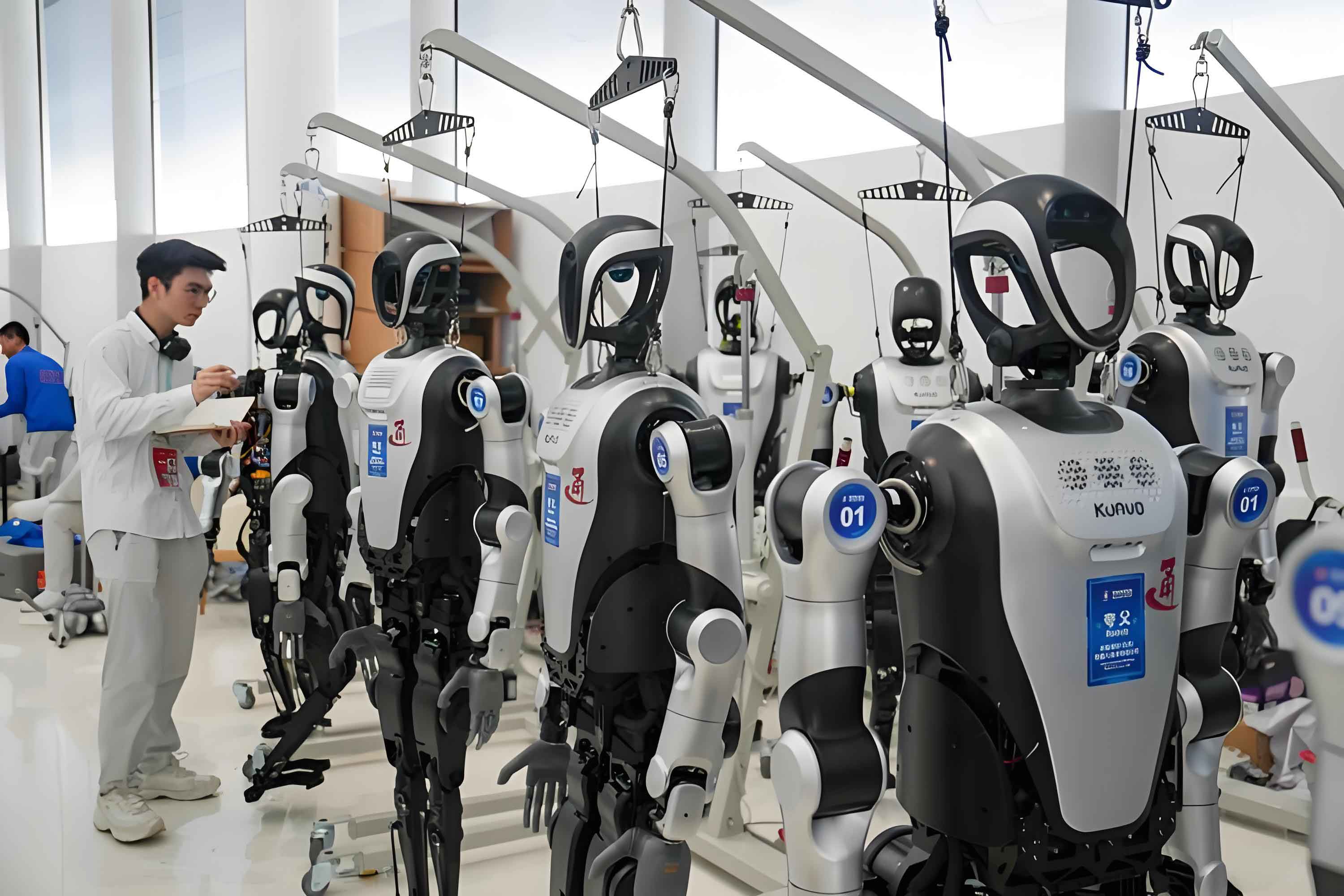
As the most advanced form of robotics, the development of humanoid robots is inseparable from a region’s foundation in high-end manufacturing, particularly its robotics industry. The Beijing-Tianjin-Hebei region, the Yangtze River Delta, and the Guangdong-Hong Kong-Macao Greater Bay Area are the three leading hubs for China’s robotics industry and have now become the pioneering regions for the development of China’s humanoid robot industry.
Since the birth of the world’s first humanoid robot in 1969, the field has traversed over five decades. Today, with the explosive growth of generative AI, the pace of development for humanoid robots has accelerated. Leading global tech giants such as NVIDIA, OpenAI, Microsoft, and Tesla have entered the humanoid robot arena, and the sector in China is also exceptionally vibrant. It is evident that humanoid robots have become a new frontier in global technological and industrial competition, making the large-scale commercial deployment of humanoid robots a tangible possibility.
According to the “Humanoid Robot Industry Research Report” released at the China Humanoid Robot Industry Conference in April 2024, China’s humanoid robot market size is expected to reach approximately ¥2.7 billion in 2024, about ¥10.4 billion in 2026, and around ¥75 billion in 2029, accounting for an estimated 32.7% of the global total and ranking first in the world. By 2035, it is projected to reach a scale of ¥300 billion. Market consultancy Markets & Markets forecasts that the global humanoid robot industry will grow from $1.8 billion in 2023 to $13.8 billion in 2028.
What exactly is a humanoid robot? What is the status of China’s humanoid robot industry in the global landscape? How is China’s regional development pattern for humanoid robots structured? And in which areas can further strengthening occur?
Humanoid Robot: The Optimal Embodiment of Embodied AI
A humanoid robot is a type of robot that mimics human form and behavior. Integrating robotics and AI technologies, it possesses a highly simulated appearance and strong human-robot interaction capabilities. It is considered the optimal carrier for embodied AI and is poised to become a disruptive product following computers, smartphones, and new energy vehicles, profoundly transforming human production, lifestyles, and reshaping the global industrial landscape. Based on application domains, humanoid robots can be categorized into General-Purpose, Industrial, Service, and Special-Purpose types.
From an industrial chain perspective, the humanoid robot industry chain primarily consists of three segments: upstream components, midstream humanoid robot本体 (本体, or “ontology,” referring to the complete robot system), and downstream terminal applications. The humanoid robot represents a synthesis of technologies from mechanical design, motion control, and artificial intelligence. Its core components are mainly reducers, servo motors, controllers, and sensors. The technical challenge in humanoid robot development lies in simulating the human “perception-cognition-decision-execution” process, which implies that a humanoid robot requires a “brain,” a “cerebellum,” and a “body.” The “brain” governs high-level logical reasoning, decision-making, planning, and communication using natural language with other intelligent agents and the environment. The “cerebellum” primarily controls the body through visual, tactile, and other perceptions to execute complex tasks. The “body” must possess sufficient hardware, such as sensors and actuators, to perform the required actions.
This process can be abstracted into a fundamental control and learning loop, often described by a sequential decision-making framework like a Partially Observable Markov Decision Process (POMDP), though simplified for understanding. The robot’s objective is to maximize cumulative reward $R$ over time:
$$ R = \mathbb{E}\left[ \sum_{t=0}^{T} \gamma^t r(s_t, a_t) \right] $$
where $s_t$ represents the state (e.g., joint angles, camera feed processed into features), $a_t$ is the action taken (e.g., motor torques), $r(\cdot)$ is the reward function, $\gamma$ is a discount factor, and $T$ is the task horizon. The “brain” and “cerebellum” work together to learn and execute a policy $\pi(a_t | o_t)$ that maps observations $o_t$ (a partial view of $s_t$) to actions $a_t$ to achieve this maximization.
Development Trends of China’s Humanoid Robot Industry
Overall, regions such as Europe, the United States, and Japan possess deep technological accumulation in fields like artificial intelligence and sensing technologies, giving them first-mover advantages and a relatively mature industrial development system for humanoid robots. However, in recent years, China has also made significant progress in core components and本体 technology, giving rise to a batch of excellent humanoid robot companies. According to a patent analysis report, as of the end of May 2023, China ranked first globally in the number of humanoid robot patent applications, surpassing the United States, Japan, Europe, South Korea, and other regions. Furthermore, regarding patent concentration—a measure of the number of patent applicants—China’s concentration level for humanoid robot patents is between 20% and 30%. This indicates intense technological competition and vigorous development vitality, although it also suggests there is still room for追赶 in core technology areas when compared to Japan’s approximately 80% concentration and the roughly 50% levels in the US, Europe, and South Korea.
| Applicant Type | China | Japan | United States | South Korea |
|---|---|---|---|---|
| Enterprises | 56.3% | 93.3% | 89.8% | 72.4% |
| Universities & Research Institutes | 38.1% | 4.0% | 5.9% | 22.9% |
| Others | 5.7% | 2.7% | 4.3% | 4.8% |
Examining various segments of the industrial chain reveals gaps compared to Europe, the US, Japan, and others. China still has significant room for improvement in core components such as high-end chips (e.g., computing chips, driver ICs, motion control chips) and sensors (e.g., LiDAR, depth cameras), as well as in core technologies like humanoid robot algorithms and models, and hardware-software integration. The proportion of high-value invention patents in China’s total humanoid robot patent portfolio is between 60% and 70%, whereas this figure exceeds 90% in the US, Japan, and South Korea, and remains above 80% in Europe. Furthermore, a large portion of China’s patents in this field are focused or general patents with relatively单一的技术布局 (singular technological布局), indicating a notable deficiency in core patent布局 and leaving much room for enhancing discourse power in core technologies.
The technological innovation systems also differ. While countries like Japan, the US, and South Korea are primarily driven by enterprise innovation, China’s system relies heavily on enterprises, universities, and research institutions. As shown in Table 1, enterprises in Japan, the US, and South Korea account for over 72% of patent applications, whereas in China, enterprises apply for 56.3% and universities/research institutes apply for 38.1%. This structure highlights the more prominent frontier-leading role of academic and research institutions in China’s humanoid robot field.
Regional Development Patterns of China’s Humanoid Robot Industry
The regional development of China’s humanoid robot industry is characterized by concentrated efforts across multiple regions, with the Beijing-Tianjin-Hebei area, the Yangtze River Delta, and the Greater Bay Area each developing distinct characteristics and leveraging their respective strengths.
Since 2023, China has密集 introduced policies related to the humanoid robot industry. In October 2023, a guiding opinion was issued outlining goals to establish a preliminary innovation system for humanoid robots by 2025 and significantly enhance technological innovation capabilities by 2027. Regions are also加速构建 (accelerating the construction of) R&D capabilities, with places like Beijing and Guangdong successively establishing humanoid robot innovation centers to accelerate technological breakthroughs.
The development of humanoid robots, as the pinnacle of robotics, is closely tied to a region’s high-end manufacturing base, especially its robotics industry foundation. The three aforementioned regions are China’s leading robotics industry clusters and have become the先行 areas for humanoid robot industry development. Among them, the industrial strength is strongest in key cities, which have gathered a number of capable universities, research institutions, platforms, and innovative enterprises in the humanoid robot field, securing first-mover advantages.
| Region | Core Hub | Key Strengths & Characteristics | Representative Focus Areas/Entities |
|---|---|---|---|
| Beijing-Tianjin-Hebei | Beijing | Abundant innovation resources; strong technological innovation advantage. | Leading universities & research institutes;特种机器人 (special robots), medical, logistics, service robots. |
| Distinct industrial cluster advantages in surrounding areas. | Tianjin: Underwater/UAVs. Hebei: High market share in特种 & mobile robots. | ||
| Yangtze River Delta | Shanghai | Strong electronics & manufacturing base; complete robot industry ecosystem. | National/public innovation platform; complete industry chain from components to integration. |
| Jiangsu: Multiple leading development zones. | Various humanoid robot products; industrial parks & alliances. | ||
| Zhejiang: Strength in core components; advanced R&D. | Precision reducers, servos; university-led robot development. | ||
| Guangdong-Hong Kong-Macao Greater Bay Area | Shenzhen | Key global supply chain hub;领先 in control & servo systems; active industrial finance. | Dense cluster of core component suppliers; numerous domestic humanoid robot companies and products. |
| Strong manufacturing base in surrounding cities. | Corporate R&D centers; companies pioneering仿人脊柱 (spine-like) platforms. |
The Beijing-Tianjin-Hebei Regional Development Pattern: This region has formed a pattern with Beijing as the development core, complemented by Tianjin and Hebei with their distinctive strengths. Beijing boasts concentrated innovation resources. Tianjin and Hebei have formed notable cluster advantages in specific robotics fields, providing a solid foundation for humanoid robot development. Regional collaboration is emphasized, with joint initiatives like industrial chain mapping aiming to create internationally competitive clusters.
The Yangtze River Delta Regional Development Pattern: This region has developed a pattern with Shanghai as the核心, and Jiangsu, Zhejiang, and Anhui each leveraging their strengths. Shanghai possesses a relatively complete industrial chain system for intelligent robots. Jiangsu has emerged with a number of humanoid robot products with independent intellectual property, covering multiple fields and forming several development pilot zones. Zhejiang has strong capabilities in core components like precision reducers and servo motors, alongside advanced R&D forces. Anhui has established a certain development foundation across the humanoid robot “brain,” “cerebellum,” and “limbs,” with several research teams and industrial chain enterprises, and is establishing dedicated provincial laboratories and innovation centers.
The Greater Bay Area Regional Development Pattern: This region exhibits a pattern with Shenzhen as the发展重心 (development focal point), and Guangzhou, Foshan, and Dongguan as main development forces. As a vital global supply chain cluster for humanoid robots, the Greater Bay Area leads in control and伺服系统技术 (servo system technology) and has an active industrial finance atmosphere. Shenzhen has first-mover advantages, aggregating enterprises across the entire core component spectrum and possessing several本地 (local) humanoid robot companies and research institutes, with multiple products already released. Dongguan’s robust manufacturing base has attracted major corporate humanoid robot research centers, and local companies have introduced innovative general-purpose humanoid robot platforms.
Key Focal Points for Promoting the Development of China’s Humanoid Robot Industry
To advance China’s humanoid robot industry, emphasis should be placed on the following aspects.
1. Enhancing International Standard-Setting Leadership. International standards represent the high ground in global technological competition. Currently, international standards in the humanoid robot field have not yet been solidified. China should continuously strengthen exchanges and cooperation with major international standardization organizations regarding humanoid robot standards, actively participate in international standard formulation, promote the graded and classified development of national, industry, and group standards, and foster synergy between international and domestic standards to seize the initiative in the global humanoid robot industry development.
2. Strengthening Layout in Key Core Technologies. Future efforts should focus on areas with相对欠缺 (relative deficiencies), such as core humanoid robot algorithms, models, and core components like high-end chips and sensors. By launching major R&D initiatives, implementing “unveiling the list and appointing leaders” mechanisms, and creating innovation consortiums, China can strengthen its core technology布局, continuously enhancing the technological支撑能力 (support capability) for industrial development. Investment in fundamental research for perception and control is critical. For instance, improving stability and adaptability often involves optimizing control laws. A simplified model for a bipedal humanoid robot‘s balance might use the Linear Inverted Pendulum Model (LIPM), where the dynamics are approximated by:
$$ \ddot{x} = \frac{g}{z_c} (x – p) $$
Here, $x$ is the Center of Mass (CoM) position, $p$ is the Center of Pressure (CoP) or foot position, $g$ is gravity, and $z_c$ is the constant CoM height. Advanced control seeks to find optimal foot placement $p$ and torque profiles to maintain $x$ within stable bounds.
3. Optimizing the Structure of the Technological Innovation System. China should better leverage the role of enterprises as the main actors in innovation, deepen industry-university-research-application integration led by enterprises, and enhance the转化水平 (transformation level) of humanoid robot scientific and technological achievements. Support for the humanoid robot industry should be increased, actively cultivating and growing “patient capital,” and encouraging various forms of social capital to invest in the humanoid robot industry to elevate the level of financial empowerment. Furthermore, the opening and promotion of application scenarios should be expanded, driving the deep application of humanoid robots across multiple fields such as manufacturing, security, logistics, and生活服务 (daily life services).
4. Prioritizing Development Layout in Key Regions. Future strategy should reinforce prioritized development in key regions. Fully leveraging the three major humanoid robot industry development regions—Beijing-Tianjin-Hebei, Yangtze River Delta, and the Greater Bay Area—China should capitalize on their respective advantages: abundant innovation resources in京津冀, a complete industrial chain in长三角, and领先 control/servo technology coupled with an active industrial finance atmosphere in粤港澳. Development of humanoid robot technological innovation and industry should be promoted based on local conditions to create advantageous humanoid robot industry clusters.
The potential economic impact of scaling humanoid robot adoption can be modeled. A simplified total addressable cost (TAC) consideration for replacing or augmenting human labor in a specific task might consider the humanoid robot‘s cost ($C_r$), operational cost per hour ($C_o$), duty cycle ($\delta$), and expected lifespan ($L$), compared to human labor cost ($C_h$). Widespread adoption becomes viable when the total cost of ownership per effective work hour satisfies:
$$ \frac{C_r}{L \cdot \delta \cdot H} + C_o < C_h $$
where $H$ is annual operational hours. Advances in AI (improving $\delta$) and manufacturing (lowering $C_r$) are key drivers for this inequality to hold across更多 sectors (more sectors).
In conclusion, the race for humanoid robot dominance is intensifying globally. China has demonstrated remarkable momentum through vigorous patent activity, a burgeoning industrial ecosystem, and strategic regional clustering. The path forward requires a concerted effort to transition from quantitative patent leadership to qualitative technological breakthroughs, strengthen weak links in the core technology chain, foster a more enterprise-driven and commercially-oriented innovation system, and leverage the unique synergies of its major economic powerhouses. By focusing on these strategic pillars, China can solidify its position and actively seize the overtaking opportunity in the transformative humanoid robot赛道 (race track).