
Reflecting from the vantage point of the present, the trajectory of artificial intelligence is nothing short of breathtaking. From its conceptual germination to the large-scale models that now converse with us, AI has accelerated at a pace that reshapes our civilization with each passing year. Within this grand technological revolution, the humanoid robot stands out, transitioning from the pages of science fiction into tangible reality. It has become a unique mirror, reflecting our aspirations, our technological prowess, and the profound questions about our own future.
The quest to create a machine in our own image is a deep-seated one. The modern journey of the humanoid robot began in earnest with the advent of microprocessor technology. The first full-scale models emerged in the early 1970s, representing a pivotal leap from theoretical design to physical embodiment. For over half a century since, development has progressed through distinct phases: from achieving basic bipedal locomotion, to integrating sensor-based environmental interaction, and now, toward genuine cognitive engagement. Landmarks in this journey include early systems that could walk on flat surfaces, followed by dynamic machines capable of remarkable athletic feats like backflips and parkour, and more recently, platforms designed for dexterous manipulation and natural interaction in human environments.
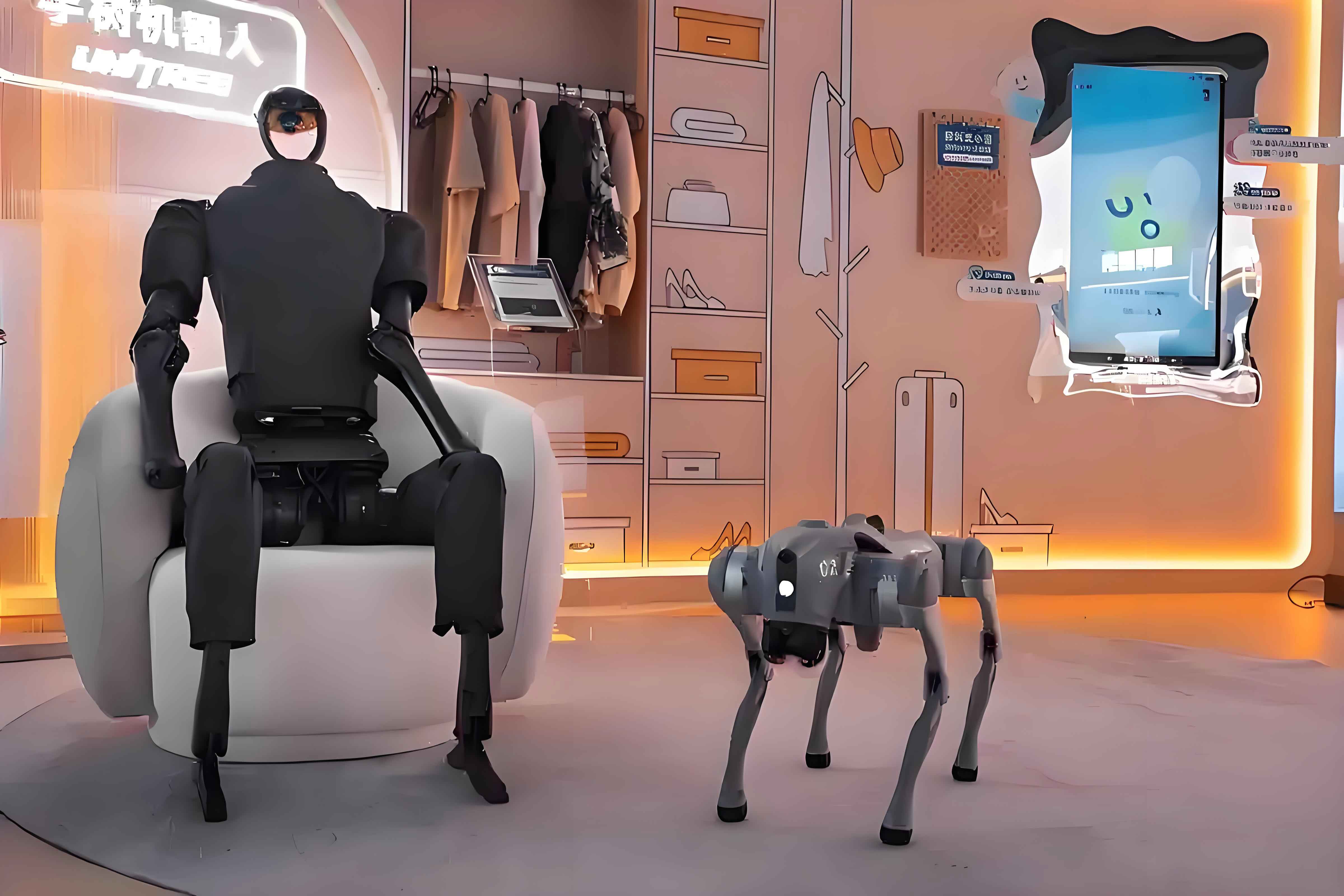
The dramatic capabilities we see in today’s humanoid robot prototypes are not merely a triumph of mechanical engineering. They are the direct result of convergent innovation in artificial intelligence. This synergy can be broken down into core technological pillars, each contributing a critical layer of intelligence.
1. Perception and Vision through Deep Learning: A humanoid robot must see and understand its world. Convolutional Neural Networks (CNNs) have revolutionized machine vision, enabling robots to identify objects, people, and scenes with high accuracy. The process often involves learning a complex function mapping pixel inputs to semantic labels. The learning objective for an image classifier can be framed as minimizing a loss function, such as categorical cross-entropy:
$$ L = – \sum_{i=1}^{C} y_i \log(\hat{y}_i) $$
where \( C \) is the number of classes, \( y_i \) is the true label (one-hot encoded), and \( \hat{y}_i \) is the predicted probability for class \( i \). This foundational capability allows a humanoid robot to recognize a chair, a tool, or a human face.
2. Motor Control and Locomotion through Reinforcement Learning (RL): The dynamic, agile movements of a modern humanoid robot are largely trained using RL. Here, the robot (agent) learns optimal policies through interaction with its environment. The core mathematical framework is the Markov Decision Process (MDP) defined by the tuple \( (S, A, P, R, \gamma) \), where:
- \( S \): State space (e.g., joint angles, body orientation, velocity).
- \( A \): Action space (e.g., torque commands to each actuator).
- \( P(s’ | s, a) \): Transition probability to state \( s’ \) from state \( s \) after taking action \( a \).
- \( R(s, a) \): Reward received for taking action \( a \) in state \( s \).
- \( \gamma \): Discount factor for future rewards.
The goal is to find a policy \( \pi(a | s) \) that maximizes the expected cumulative reward, or return:
$$ J(\pi) = \mathbb{E}_{\pi} \left[ \sum_{t=0}^{\infty} \gamma^t R(s_t, a_t) \right] $$
Algorithms like Proximal Policy Optimization (PPO) or Deep Deterministic Policy Gradient (DDPG) are used to train these policies in simulation, which are then transferred to the physical humanoid robot, enabling it to learn complex skills like balancing, walking on uneven terrain, and recovering from pushes.
3. Cognition and Interaction through Large Language Models (LLMs): The latest frontier is endowing the humanoid robot with a form of common-sense reasoning and natural dialog ability. By integrating LLMs as a high-level “brain,” the robot can understand complex verbal instructions, plan multi-step tasks involving tool use, and engage in contextual conversation. The planning process can be modeled as generating a sequence of actions conditioned on a goal \( G \) and the current world state \( W \), leveraging the LLM’s knowledge:
$$ P(A_1, A_2, …, A_n | G, W) = \prod_{t=1}^{n} P(A_t | G, W, A_{<t}) $$
where \( A_t \) represents a primitive or high-level action. This fusion turns the humanoid robot from a pre-programmed automaton into an adaptable, instruction-following agent.
The convergence of these AI disciplines creates a powerful flywheel for the humanoid robot‘s advancement, as summarized in the table below.
| AI Technology | Core Function for Humanoid Robot | Key Algorithm/Model Examples | Outcome Manifestation |
|---|---|---|---|
| Deep Learning (Computer Vision) | Environmental Perception & Object Recognition | CNNs, Vision Transformers (ViTs) | Identifies “cup,” “table,” “person,” navigates around obstacles. |
| Reinforcement Learning | Dynamic Motion Control & Skill Acquisition | PPO, DDPG, Model Predictive Control (MPC) | Walks, runs, jumps, manipulates objects with force feedback. |
| Large Language & Multimodal Models | Task Planning, Reasoning & Natural Interaction | Transformer-based LLMs (GPT, Claude, etc.), V-LMs | Understands “please tidy the workshop,” explains its actions, answers questions. |
Despite these exhilarating advances, the path to a truly capable, ubiquitous humanoid robot is fraught with formidable challenges. These hurdles exist across the hardware-software spectrum and are deeply intertwined with economic realities.
Hardware and Physical Intelligence: The human body is an engineering marvel that we have yet to fully replicate. Key limitations include:
- Actuation and Power Density: Human muscles are highly efficient, compliant, and powerful. Most current humanoid robot platforms use high-gear-ratio electric motors or hydraulic actuators, which can lack compliance, be energy-inefficient, or have limited torque/weight ratios. The quest for artificial muscles (e.g., using pneumatic or piezoelectric materials) continues.
- Bipedal Stability and Energy Efficiency: Passive, efficient walking like humans is extremely difficult to achieve. Current control algorithms often require significant computational power and energy to maintain balance in complex environments. The Zero-Moment Point (ZMP) criterion is a classic stability metric used in trajectory planning:
$$ x_{ZMP} = \frac{\sum_{i} m_i ( \ddot{z}_i + g ) x_i – \sum_{i} m_i \ddot{x}_i z_i}{\sum_{i} m_i ( \ddot{z}_i + g )} $$
where \( m_i \) is the mass of link \( i \), \( (x_i, z_i) \) its coordinates, and \( g \) gravity. Keeping the ZMP within the support polygon is crucial for stability, but this approach can result in stiff, energy-consuming gaits. - Tactile Sensing and Dexterous Manipulation: The human hand, with its dense array of touch receptors and intricate musculature, sets a very high bar. Providing a humanoid robot with comparable tactile feedback and fine motor control for tasks like threading a needle or handling delicate objects remains a major research problem.
Software and Cognitive Intelligence: Beyond physical motion, understanding and reasoning in open-world settings is the grand challenge.
- World Models and Common Sense: A humanoid robot needs an internal model of how the world works—physics, social norms, object affordances (a chair is for sitting, a cup has an inside). While LLMs encode vast amounts of semantic knowledge, grounding this knowledge in physical sensory-motor experience is an unsolved problem.
- Long-Horizon Task Planning: Executing a command like “make me a cup of coffee” requires decomposing it into hundreds of sub-steps, each with conditional logic and recovery from failures. This requires robust hierarchical planning under uncertainty.
- Embodied AI and Learning: Ultimately, a humanoid robot must learn from its own interaction with the world, not just from static datasets or simulated training. Developing algorithms for continual, lifelong learning in the physical world is critical.
The Commercialization “Chasm”: Cost and Scalability Perhaps the most pressing immediate barrier is economic. The sophisticated components—custom actuators, high-end force-torque sensors, powerful onboard computers, and specialized software—make current humanoid robot prototypes prohibitively expensive. A typical breakdown of cost drivers is illustrative:
| Cost Category | Key Components/Activities | Estimated Contribution to Unit Cost (Prototype) | Scaling Challenges |
|---|---|---|---|
| Hardware (BOM) | Actuators, Sensors, Structural Materials, Battery, Compute Unit | 60-75% | Low-volume custom parts; lack of supply chain; battery energy density. |
| Software R&D | AI Model Development, Simulation, Control Algorithms | 20-30% (amortized) | Extremely high initial investment; need for continuous updates and training. |
| Integration & Testing | System Assembly, Calibration, Real-World Validation | 5-15% | Labor-intensive; requires specialized expertise; time-consuming. |
The total unit cost for a advanced research or early industrial humanoid robot can range from tens to hundreds of thousands of dollars. The industry’s central dilemma is encapsulated in a simple inequality that must be reversed for mass adoption:
$$ \text{Cost of Humanoid Robot} + \text{Operation Cost} \ll \text{Economic Value Generated} $$
Achieving this requires breakthroughs not just in technology, but in manufacturing, supply chains, and software scalability. This gap between technical possibility and commercial viability is a sobering reminder to avoid the traps of a “techno-utopian” mindset, where visions outpace practical constraints.
Yet, the potential value proposition is immense, driving relentless investment and research. The application spectrum for a mature humanoid robot technology is broad, spanning multiple sectors of the economy.
| Sector | Potential Applications | Value Driver | Technical Prerequisites |
|---|---|---|---|
| Industrial Manufacturing & Logistics | Assembly line tasks, machine tending, palletizing, warehouse picking, inspection. | 24/7 operation, consistency, filling labor shortages, performing dangerous tasks (e.g., in foundries). | Extreme reliability, safety around humans, precise & strong manipulation. |
| Healthcare & Assisted Living | Patient mobility assistance, rehabilitation therapy, fetch-and-carry in hospitals, elderly companionship and monitoring. | Addressing caregiver shortages, enabling independent living, providing consistent physiotherapy. | Gentle physical interaction, robust safety protocols, social intelligence, hygiene. |
| Domestic & Service | Household chores (cleaning, laundry, organizing), cooking assistance, home maintenance checks. | Saving time, assisting individuals with disabilities, providing convenience. | Extreme dexterity, understanding unstructured environments, long-term autonomous operation. |
| Education & Research | Interactive teaching assistant, programmable platform for STEM education, testbed for AI and robotics research. | Personalized learning, hands-on experimentation, accelerating discovery in embodied AI. | Easy programmability, safe interaction with children, expressive communication. |
| Exploration & Emergency Response | Disaster zone search-and-rescue, space exploration, operations in toxic or radioactive environments. | Reaching places unsafe for humans, enduring extreme conditions, performing critical reconnaissance. | Extreme robustness, advanced locomotion (climbing, crawling), operation without direct communication. |
Beyond these functional applications, the deeper significance of the humanoid robot project is philosophical. By attempting to recreate ourselves, we are forced to ask fundamental questions: What is intelligence? What is the nature of embodiment? How do mind and body interact to produce adaptive behavior? The humanoid robot serves as the ultimate testbed for theories of cognition. In interacting with it, we are inevitably renegotiating the boundaries of the human-machine relationship. Is such a robot a tool, a partner, or something else entirely? These are not merely technical questions but profound philosophical inquiries that will shape our social and ethical landscape for decades to come.
Standing at the crest of this technological wave, I believe we must navigate with both ambition and prudence. The development path for the humanoid robot will be nonlinear, marked by breakthroughs and setbacks. The challenges in hardware, cognition, and economics are significant, but they define the very frontier of exploration that makes this field so compelling. As we move forward, a balanced approach is essential: embracing the transformative potential with an open mind, while guiding its development with careful consideration of safety, ethics, and societal impact. The goal is not to replace humanity, but to augment our capabilities and deepen our understanding of ourselves. In this endeavor, the humanoid robot is more than a machine; it is our mirror, our challenge, and potentially, our companion in writing the next chapter of a human-centric, symbiotic future.