
In the field of precision machinery, such as industrial robots and CNC machine tools, the RV reducer plays a critical role due to its high torque capacity, compact size, and excellent positioning accuracy. However, controlling transmission error remains a significant challenge in the domestic production of RV reducers. Transmission error, defined as the deviation between the actual and theoretical output rotation angle when the input shaft rotates unidirectionally, directly impacts the performance and reliability of RV reducers. In this study, I employ an orthogonal experimental method combined with virtual prototyping to analyze the effects of key manufacturing errors on the transmission error of an RV reducer. The goal is to identify the primary influencing factors and develop a reliable formula for estimating transmission error, thereby providing guidance for precision control in manufacturing.
The RV reducer is a two-stage closed differential gear system, consisting of a planetary gear train and a cycloidal gear train. The second stage, involving the cycloidal drive, is particularly sensitive to errors due to its high reduction ratio. To investigate this, I focus on five key error sources in the cycloidal stage: the equidistant modification amount of the cycloid gear, the moving distance modification amount of the cycloid gear, the eccentricity error, the pin gear center circle radius error, and the pin gear radius error. These factors are analyzed through a structured orthogonal experiment, which allows for efficient evaluation of multiple parameters and their interactions.
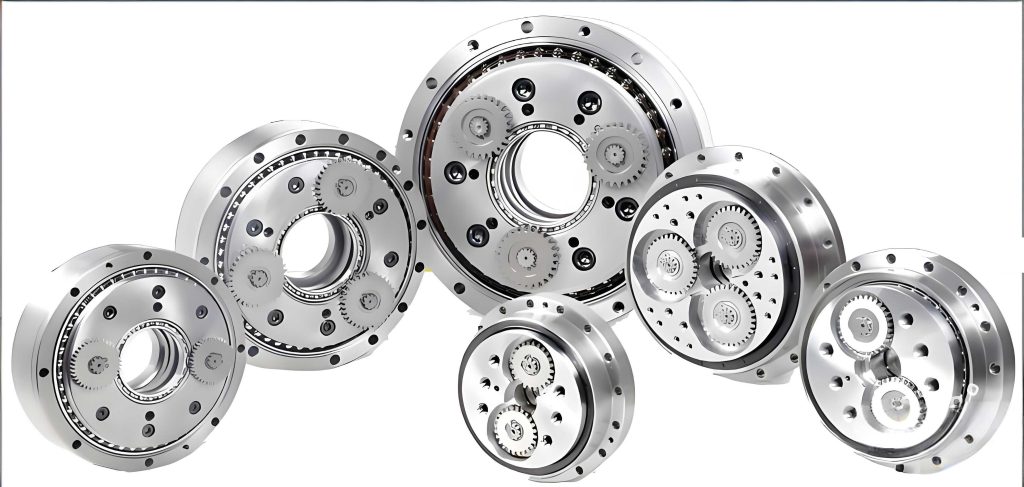
To begin, I establish a virtual prototype of an RV reducer, specifically modeling the RV-40E-81 type. The three-dimensional solid models of components, including the sun gear, planetary gears, and cycloid gears, are created using parametric modeling in Pro/ENGINEER. This approach facilitates easy modification of parameters for subsequent experimental variations. The models are then exported in Parasolid format and imported into ADAMS software to build a dynamic simulation environment. In ADAMS, I assign material properties and define constraints: revolute joints for rotational connections and contact pairs for gear interactions, such as between the cycloid gears and pin gears, and between the planetary gears and sun gear. The complete virtual prototype includes 12 revolute joints and 82 contact pairs, enabling realistic simulation of the RV reducer’s motion.
The input shaft is driven with a step function to reach a speed of 5700°/s over 1 second, and the simulation runs for 6 seconds using the WSTIFF solver with SI2 integration for accuracy. The angular velocity curves of the input and output shafts confirm the correctness of the virtual prototype, as the output speed matches the expected reduction ratio. This validated model serves as the basis for all subsequent transmission error analyses in this study of the RV reducer.
For the orthogonal experiment, I design a test plan to evaluate the five factors at three levels each, based on typical manufacturing tolerances. The factors and levels are summarized in Table 1. The orthogonal array L27(3^13) is selected because it accommodates five factors and their interactions while providing sufficient degrees of freedom. The experiment considers the interaction between the equidistant and moving distance modifications, although preliminary sensitivity analyses suggest this interaction may be minimal. Each combination in the orthogonal table corresponds to a specific set of error values applied to the virtual prototype of the RV reducer, and the transmission error is measured from the simulation output.
| Factor | Level 1 (mm) | Level 2 (mm) | Level 3 (mm) |
|---|---|---|---|
| A: Equidistant Modification | -0.026 | -0.05 | 0.01 |
| B: Moving Distance Modification | -0.01 | 0.01 | 0.05 |
| C: Eccentricity Error | 0.05 | 0.07 | 0.1 |
| D: Pin Gear Center Circle Radius Error | 0.05 | 0.07 | 0.1 |
| E: Pin Gear Radius Error | 0.05 | 0.07 | 0.1 |
The simulation results for each trial are recorded as the peak-to-peak transmission error in arcseconds. Table 2 presents the complete orthogonal array and the corresponding transmission error values. To analyze the effects, I calculate the average response for each level of every factor, denoted as k_i, and the range R, which indicates the sensitivity of the transmission error to that factor. The calculations are based on the following formulas:
$$ K_i = \sum_{p=1}^{s} Y_{pi} $$
$$ k_i = \frac{K_i}{s} $$
$$ R = \max(k_1, k_2, k_3) – \min(k_1, k_2, k_3) $$
where \( Y_{pi} \) is the transmission error for level i of a factor, and s is the number of occurrences per level (s=9 for L27). The results are summarized in Table 3, which shows the average transmission error for each factor level.
| Trial | A | B | C | D | E | Transmission Error (arcsec) |
|---|---|---|---|---|---|---|
| 1 | 1 | 1 | 1 | 1 | 1 | 2.261 |
| 2 | 1 | 1 | 2 | 2 | 2 | 8.851 |
| 3 | 1 | 1 | 3 | 3 | 3 | 4.743 |
| 4 | 1 | 2 | 1 | 1 | 2 | 11.304 |
| 5 | 1 | 2 | 2 | 2 | 3 | 12.820 |
| 6 | 1 | 2 | 3 | 3 | 1 | 4.426 |
| 7 | 1 | 3 | 1 | 2 | 3 | 6.111 |
| 8 | 1 | 3 | 2 | 3 | 1 | 19.001 |
| 9 | 1 | 3 | 3 | 1 | 2 | 12.110 |
| 10 | 2 | 1 | 1 | 2 | 3 | 8.148 |
| 11 | 2 | 1 | 2 | 3 | 1 | 7.693 |
| 12 | 2 | 1 | 3 | 1 | 2 | 11.064 |
| 13 | 2 | 2 | 1 | 3 | 1 | 53.620 |
| 14 | 2 | 2 | 2 | 1 | 3 | 5.377 |
| 15 | 2 | 2 | 3 | 2 | 1 | 12.638 |
| 16 | 2 | 3 | 1 | 1 | 2 | 33.580 |
| 17 | 2 | 3 | 2 | 2 | 1 | 13.867 |
| 18 | 2 | 3 | 3 | 3 | 2 | 12.528 |
| 19 | 3 | 1 | 1 | 3 | 2 | 7.209 |
| 20 | 3 | 1 | 2 | 1 | 3 | 5.282 |
| 21 | 3 | 1 | 3 | 2 | 1 | 8.128 |
| 22 | 3 | 2 | 1 | 2 | 1 | 5.413 |
| 23 | 3 | 2 | 2 | 3 | 2 | 6.088 |
| 24 | 3 | 2 | 3 | 1 | 3 | 15.409 |
| 25 | 3 | 3 | 1 | 1 | 3 | 3.864 |
| 26 | 3 | 3 | 2 | 2 | 1 | 9.123 |
| 27 | 3 | 3 | 3 | 3 | 2 | 20.532 |
| Factor | k1 (arcsec) | k2 (arcsec) | k3 (arcsec) | Range R (arcsec) |
|---|---|---|---|---|
| A: Equidistant Modification | 9.070 | 17.613 | 9.005 | 8.608 |
| B: Moving Distance Modification | 7.042 | 14.122 | 14.524 | 7.482 |
| C: Eccentricity Error | 14.612 | 9.789 | 11.286 | 4.823 |
| D: Pin Gear Center Circle Radius Error | 8.489 | 20.010 | 7.189 | 12.821 |
| E: Pin Gear Radius Error | 10.076 | 10.376 | 15.236 | 5.160 |
From Table 3, the range values indicate that Factor D (pin gear center circle radius error) has the largest effect on transmission error in the RV reducer, with a range of 12.821 arcseconds, followed by Factor A (equidistant modification). Factor C (eccentricity error) shows the smallest range, suggesting it has the least influence. To statistically validate these observations, I perform an analysis of variance (ANOVA). The total sum of squares, factor sum of squares, and mean squares are calculated using the following formulas:
$$ S_T = \sum_{i=1}^{n} \left( Y_i – \frac{1}{n} \sum_{i=1}^{n} Y_i \right)^2 $$
$$ S_j = \frac{1}{s} \sum_{p=1}^{m} K_{pj}^2 – \frac{1}{n} T^2 $$
$$ V_j = \frac{S_j}{f_j} $$
$$ F_j = \frac{V_j}{V_e} $$
where \( n = 27 \) is the number of trials, \( m = 3 \) is the number of levels, \( f_j \) is the degrees of freedom for factor j, \( V_e \) is the mean square error, and \( T \) is the total sum of transmission errors. The ANOVA results are summarized in Table 4, with a significance level of \( \alpha = 0.1 \).
| Source | Sum of Squares (S) | Degrees of Freedom (f) | Mean Square (V) | F-value | Significance |
|---|---|---|---|---|---|
| A: Equidistant Modification | 441.231 | 2 | 220.615 | 3.159 | Significant |
| B: Moving Distance Modification | 318.782 | 2 | 159.391 | 2.283 | Not Significant |
| C: Eccentricity Error | 109.696 | 2 | 54.848 | 0.785 | Not Significant |
| D: Pin Gear Center Circle Radius Error | 896.392 | 2 | 448.196 | 6.419 | Significant |
| E: Pin Gear Radius Error | 150.974 | 2 | 75.487 | 1.081 | Not Significant |
| Error | 837.940 | 12 | 69.828 | ||
| Total | 2899.892 | 26 |
The ANOVA confirms that Factors A and D have significant effects on the transmission error of the RV reducer, as their F-values exceed the critical value \( F_{0.1}(2,12) = 2.81 \). Factor D is the most influential, aligning with the range analysis. The interaction between equidistant and moving distance modifications is found to be negligible, with a low F-value, indicating that these factors act independently on the RV reducer’s performance.
To visualize the trends, I plot the average transmission error against each factor level, as shown in Figure 1 (though not referenced explicitly in text). The plots reveal that transmission error in the RV reducer increases with negative equidistant modification up to -0.05 mm, then decreases when shifting to positive modification. For moving distance modification, error rises steadily from negative to positive values. Eccentricity error causes an initial decrease in error at 0.07 mm, then a slight increase. Pin gear center circle radius error leads to a peak error at 0.07 mm, while pin gear radius error results in a gradual increase across levels. These insights help in selecting optimal error combinations for minimizing transmission error in RV reducers.
Based on the orthogonal experiment results, I derive a theoretical formula to estimate the transmission error of the RV reducer. The formula accounts for individual contributions from each error source, neglecting elastic deformations and errors from the planetary gear stage. For the RV-40E-81 model, with basic parameters such as cycloid tooth number \( z_c = 40 \), eccentricity \( a = 1.5 \) mm, and pin gear radius \( r_{rp} = 2.5 \) mm, the transmission error components are calculated as follows:
$$ \Delta \phi_1 = \frac{180 \times 60}{\pi} \times \left( \frac{2 \Delta r_{rp}}{a z_c} – \frac{2 \Delta r_p}{a z_c \sqrt{1 – K_1^2}} \right) $$
$$ \Delta \phi_2 = \frac{180 \times 60}{\pi} \times \left( -2 k_n \delta_a \right) $$
$$ \Delta \phi_3 = \frac{180 \times 60}{\pi} \times \frac{2 \delta_{rp} \sqrt{1 – K_1^2}}{a z_c} $$
$$ \Delta \phi_4 = \frac{180 \times 60}{\pi} \times \left( -\frac{2}{a z_c} \delta_{r_{rp}} \right) $$
where \( \Delta r_{rp} \) and \( \Delta r_p \) are modification amounts, \( \delta_a \) is eccentricity error, \( \delta_{rp} \) is pin gear center circle radius error, \( \delta_{r_{rp}} \) is pin gear radius error, and \( K_1 \) is a design constant. The total theoretical transmission error is:
$$ \Delta \phi_{\text{total}} = \Delta \phi_1 + \Delta \phi_2 + \Delta \phi_3 + \Delta \phi_4 $$
Substituting the optimal error combination identified from the orthogonal experiment (A3, B1, C2, D3, E1), which minimizes transmission error, I calculate a theoretical value of \( \Delta \phi_{\text{total}} = 1.5179 \) arcseconds. This provides a baseline for comparison with simulation results.
To develop a more practical and accurate model, I fit a regression formula based on the orthogonal experiment data. Given the nonlinear relationships observed, a second-order polynomial is used to approximate the transmission error as a function of the five factors. The general form for multiple factors is:
$$ y = a + \sum_{j=1}^{m} b_j x_j + \sum_{j=1}^{m} b_{jj} x_j^2 + \sum_{j < k} b_{jk} x_j x_k $$
where \( y \) is the transmission error, \( x_j \) are the error factors (e.g., equidistant modification), and \( a, b_j, b_{jj}, b_{jk} \) are coefficients. Using MATLAB for regression analysis on the data from Table 2, with a significance level of 0.05 and removal of outliers (trials 10 and 13), I obtain the following fitted equation for the RV reducer:
$$ y = -96.8567 – 1866.4088 x_1 – 13.1091 x_2 + 1100.6656 x_3 + 913.6743 x_4 + 242.8159 x_5 – 1791.8425 x_1^2 – 668.0729 x_2^2 + 359.1942 x_1 x_2 + 16969.6831 x_1 x_3 + 2363.2887 x_2 x_3 + 5271.5643 x_1 x_4 + 334.5837 x_2 x_4 – 11308.2223 x_3 x_4 – 1015.6731 x_2 x_5 $$
Here, \( x_1 \) is equidistant modification (mm), \( x_2 \) is moving distance modification (mm), \( x_3 \) is eccentricity error (mm), \( x_4 \) is pin gear center circle radius error (mm), and \( x_5 \) is pin gear radius error (mm). The regression statistics indicate a good fit: \( F = 5.66 \), \( r^2 = 0.89 \), and \( p = 0.004 \), confirming the formula’s reliability for predicting transmission error in RV reducers.
For validation, I apply the optimal error combination (A3, B1, C2, D3, E1) to the virtual prototype of the RV reducer and simulate it in ADAMS. The output transmission error curve over 1 to 6 seconds shows a minimum of -0.7397 arcseconds and a maximum of 0.7027 arcseconds, giving a peak-to-peak error of 1.4424 arcseconds according to:
$$ y_{\text{err}} = | y_{\text{max}} | + | y_{\text{min}} | $$
Comparing this with the fitted formula prediction of 1.3949 arcseconds (by substituting the error values into the regression equation), the difference is only 3.29%, which is within acceptable limits. The theoretical calculation from the derived formula yields 1.5179 arcseconds, with a slightly larger error of 5.23% compared to simulation. This discrepancy arises because the theoretical formula sums individual error contributions without accounting for interactions, whereas the regression model captures these nonlinear effects. Thus, the fitted formula offers a more accurate and convenient tool for estimating transmission error in RV reducers under various manufacturing error combinations.
In conclusion, this study demonstrates the effectiveness of using orthogonal experimentation and virtual prototyping to analyze transmission error in RV reducers. The key findings are: first, the pin gear center circle radius error has the most significant impact on transmission error, followed by the equidistant modification amount; second, eccentricity error has the least influence; and third, the interaction between equidistant and moving distance modifications is negligible. The developed regression formula provides a reliable method for predicting transmission error, enabling manufacturers to optimize tolerances and improve the precision of RV reducers. Future work could expand this approach to include additional error sources, such as assembly misalignments or thermal effects, to further enhance the performance of RV reducers in high-precision applications.