
As we stand at the forefront of technological evolution, I believe that the humanoid robot represents a transformative leap, integrating advanced technologies such as artificial intelligence, high-end manufacturing, and new materials. It is poised to become a disruptive product following computers, smartphones, and new energy vehicles, profoundly altering human production and lifestyles, and reshaping the global industrial landscape. Currently, the acceleration of humanoid robot technology evolution has made it a new high ground for technological competition, a new track for future industries, and a new engine for economic development, with immense potential and broad application prospects. To propel the high-quality development of the humanoid robot industry, cultivate new quality productive forces, empower new industrialization at a high level, and robustly support the construction of a modern industrial system, we have formulated this guidance.
From my perspective, the overall thinking is grounded in a forward-looking ideology that emphasizes innovation, security, and holistic development. We aim to build on existing robotic technologies, leveraging breakthroughs in large AI models to lead progress. By adhering to a path driven by application traction, whole-machine leadership, software-hardware synergy, and ecological cultivation, and adopting methods of technical grading, product generation, and task phasing, we can harness advantages such as a complete manufacturing sector, rich application scenarios, a vast market scale, and a new nationwide system. This approach will accelerate the innovative development of China’s humanoid robot industry, providing support for building a manufacturing powerhouse, a cyber powerhouse, and a digital China.
Our development goals are clear and phased. By 2025, we intend to establish a preliminary innovation system for humanoid robots, achieve breakthroughs in key technologies like the “brain, cerebellum, and limbs,” and ensure secure and effective supply of core components. Whole-machine products should reach international advanced levels, achieve batch production, and demonstrate applications in specialized, manufacturing, and livelihood service scenarios, while exploring effective governance mechanisms. We plan to cultivate 2-3 ecologically influential enterprises with global reach and a group of specialized, refined, distinctive, and innovative SMEs, create 2-3 industrial development clusters, and foster a batch of new businesses, models, and formats.
By 2027, we expect significant enhancement in the technological innovation capability of humanoid robots, forming a safe and reliable industrial and supply chain system, building an internationally competitive industrial ecosystem, and reaching world-leading levels in comprehensive strength. The industry should accelerate toward large-scale development, with richer application scenarios, and related products deeply integrated into the real economy, becoming an important new engine for economic growth.
To summarize these targets, I present the following table outlining key milestones:
| Timeline | Key Objectives for Humanoid Robot Development | Expected Outcomes |
|---|---|---|
| By 2025 | Establish innovation system; breakthrough in “brain, cerebellum, limbs”; secure component supply. | Batch production; demo applications; 2-3 ecosystem leaders; 2-3 clusters. |
| By 2027 | Enhance innovation; safe supply chain; competitive ecosystem. | Large-scale growth; diverse applications; economic engine. |
In breaking through key technologies, we focus on creating the “brain” and “cerebellum” for humanoid robots. Developing a humanoid robot “brain” based on AI large models will enhance environmental perception, behavioral control, and human-machine interaction, promoting collaborative deployment of cloud and edge intelligence. We are building large model training databases, innovating methods for automated data annotation, cleaning, and usage, and expanding high-quality multimodal data. Scientifically arranging computing power for humanoid robots will accelerate large model training iteration and product application. For the “cerebellum” controlling humanoid robot motion, we are establishing motion control algorithm libraries and network control system architectures. For specific application scenarios, we construct simulation systems and training environments to speed up technical iteration and reduce innovation costs.
The “limbs” technology is equally critical. Utilizing existing robotic foundations, we systematically deploy key technology groups for “machine limbs,” innovating basic theories of human movement mechanics to create bionic mechanical arms, dexterous hands, and legs/feet, breaking through lightweight and rigid-flexible coupling design, whole-body coordinated motion control, and dynamic grasping for dexterous operation. We are tackling “machine body” technology groups, overcoming lightweight skeletons, high-strength body structures, and high-precision sensing, while developing highly integrated, long-endurance power units and energy management technologies for humanoid robots.
To consolidate these efforts, we are健全ing the technological innovation system. This involves refining lists of key technologies, materials, enterprises, manufacturing equipment, quality, standards, and key software to precisely “supplement shortcomings and forge strengths.” Supporting leading enterprises to lead innovation consortia with industry-university-research-application collaboration will strengthen key technology and product攻关, accelerating innovation. We are accelerating the integration of humanoid robots with frontier technologies like the metaverse and brain-computer interfaces, exploring interdisciplinary and cross-domain innovation models.
I can express some technical aspects using formulas. For instance, the motion control of a humanoid robot can be modeled with dynamics equations. The generalized torque $ \tau $ required for joint movement is given by:
$$ \tau = M(q)\ddot{q} + C(q,\dot{q})\dot{q} + g(q) $$
where $ M(q) $ is the inertia matrix, $ C(q,\dot{q}) $ represents Coriolis and centrifugal forces, $ g(q) $ is the gravitational vector, and $ q $, $ \dot{q} $, $ \ddot{q} $ denote joint position, velocity, and acceleration, respectively. For perception, a simplified model for sensor fusion might involve:
$$ P(x_t | z_{1:t}) \propto P(z_t | x_t) \int P(x_t | x_{t-1}) P(x_{t-1} | z_{1:t-1}) dx_{t-1} $$
where $ P $ represents probability, $ x_t $ is the state at time $ t $, and $ z_t $ is the observation, highlighting the Bayesian filtering used in humanoid robot environment perception.
In培育重点产品, we emphasize creating whole-machine products. We are developing basic version whole-machines to build a general platform for humanoid robots, supporting subsequent personalized function development. For different application needs, we are creating low-cost interactive, high-precision, and high-reliability humanoid robot whole-machine products for extreme environments. For varied power demands, we are introducing electric-driven, hydraulic-driven, or hybrid-driven humanoid robots. Strengthening batch manufacturing capabilities for humanoid robot whole-machines will continuously improve product quality and reliability.
To夯实基础部组件, we focus on specialized sensors for humanoid robots, breaking through high-precision sensing key technologies for vision, hearing, force, and smell to enhance comprehensive environmental perception. We are developing high-power-density actuators to meet demands for high-burst mobility and high-precision operation. Creating specialized chips for humanoid robots will improve computational efficiency for motion control and cognitive decision-making. Aligning with new energy trends, we are researching high-efficiency specialized power components suited to humanoid robot characteristics.
推动软件创新 involves building a high-real-time, high-reliability, high-intelligence specialized operating system for humanoid robots, promoting deep integration with technologies like general large models to provide a safe, stable, and user-friendly system platform. We are developing application software for various scenarios, constructing和完善 application development platforms and toolkits for humanoid robots, and building a rich software-enabled application ecosystem. Exploring new models like “Robot as a Service” will accelerate low-cost, flexible deployment of humanoid robots.
Here is a table summarizing key product categories and components for humanoid robots:
| Product Category | Key Components | Technological Focus |
|---|---|---|
| Basic Whole-Machine | 通用 platform,软硬件架构 | Customization support, modular design |
| Functional Whole-Machine | Interactive, high-precision,高可靠 types | Human-environment adaptation,精细 operation |
| Sensors | Vision, auditory, tactile, olfactory | High accuracy, multimodal perception |
| Actuators | Hydraulic, electric驱动 | High power density, precision control |
| Controllers | Specialized chips, motion controllers | Real-time coordination, cognitive决策 |
| Power Energy | High-energy-density batteries, management | Long endurance, compact design |
In拓展场景应用, we are加快人形机器人在特种领域应用. For恶劣条件 and hazardous scenarios, we强化 capabilities in本体控制, rapid movement, and precise perception to create high-reliability humanoid robot solutions. For guard duty in key areas, we enhance高机动鲁棒行走 and situational awareness with intelligent decision-making. For特殊环境 like民爆 and rescue, we improve本体安全防护 and complex task generation with high-precision operation to reduce risks for personnel.
打造制造业典型场景 focuses on sectors like 3C and automotive,提升 tool operation and task execution abilities to establish示范产线和工厂 for deep application in typical manufacturing. For structured production, we promote humanoid robot use in assembly, transfer, inspection, and maintenance. For unstructured production, we加强协作交互 with equipment, personnel, and environments to support flexible, customized manufacturing.
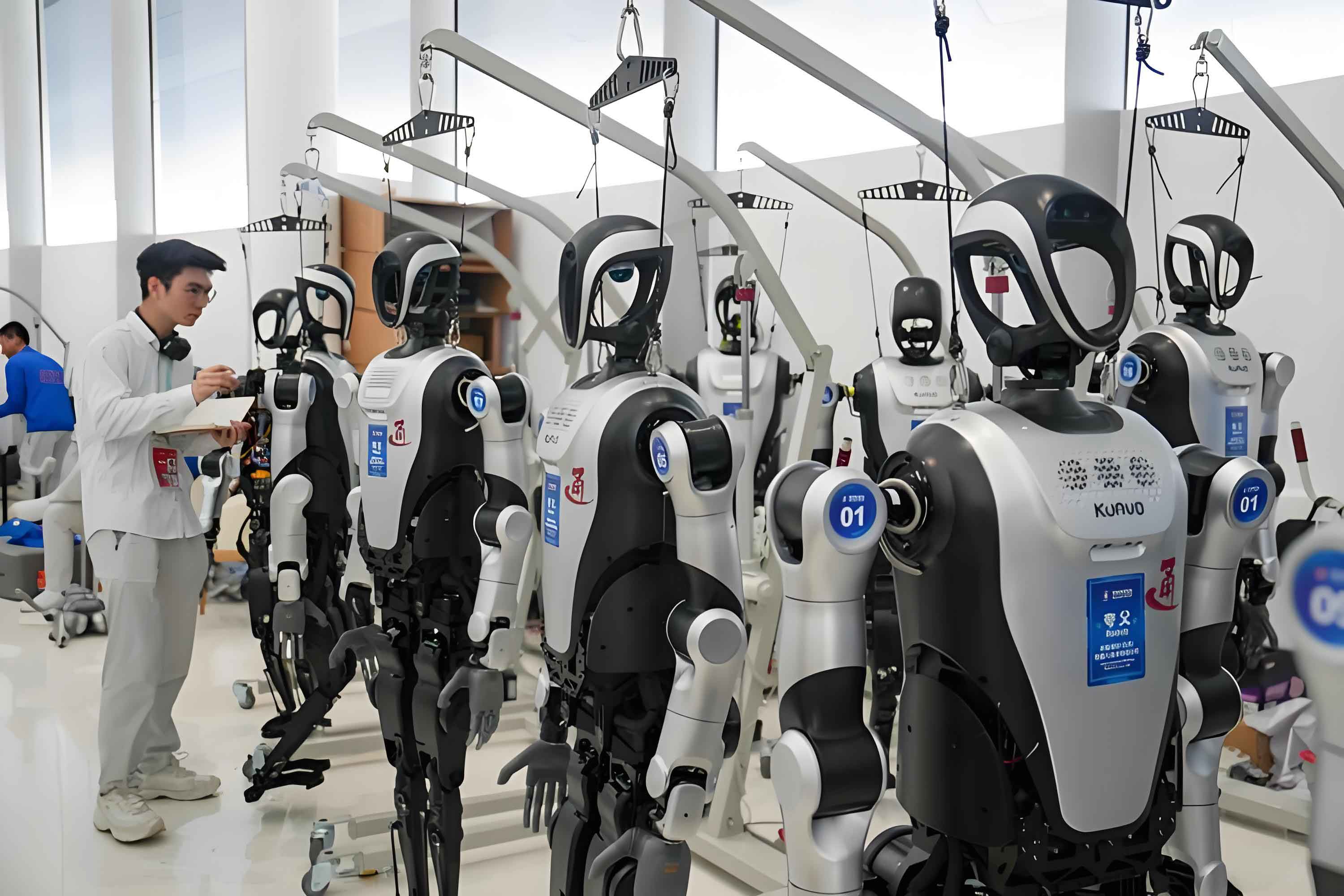
加快民生及重点行业推广 involves expanding humanoid robot service applications in healthcare,家政, emphasizing reliable and safe human-machine interaction, and developing solutions for complex area guidance, flexible operation, robust walking, and multimodal interaction to meet high-quality life needs like health and companionship. We are推动应用落地 in agriculture and logistics, enhancing abilities in human-machine interaction, dexterous grasping, sorting搬运, and intelligent delivery.
To quantify application benefits, consider a formula for efficiency gain from deploying humanoid robots in manufacturing. If $ E_{\text{traditional}} $ is the efficiency of traditional methods and $ E_{\text{robot}} $ is with humanoid robots, the improvement $ \Delta E $ can be:
$$ \Delta E = \frac{E_{\text{robot}} – E_{\text{traditional}}}{E_{\text{traditional}}} \times 100\% $$
In营造产业生态, we are培育优质企业 by strengthening the innovation主体地位 of enterprises, cultivating “chain master” firms with ecological dominance and global competitiveness for humanoid robots, to attract industrial innovation resources. For component配套, specialized integration, and scenario application, we加大培育力度 to stimulate the emergence of specialized SMEs, manufacturing championship firms, and unicorns. Promoting协同发展 between large and small enterprises will create a favorable environment and a safe, reliable industrial ecosystem.
完善创新载体和开源环境 includes supporting the construction of key laboratories and manufacturing innovation centers for humanoid robots, pooling strengths from industry, academia, and research to enhance supply of key common technologies. Establishing industry organizations like a humanoid robot百人会 will promote technical exchange,供需对接, and international cooperation, deepening the integration of innovation, industrial, capital, and talent chains. Building开源社区 and advancing开源基金会 capabilities, while supporting key enterprise open-source projects, will汇聚 global developers for collaborative innovation.
推动产业集聚发展 involves guiding innovation elements for humanoid robots to regions with good foundations and potential, leveraging local characteristics and industrial advantages to build incubators and industrial parks, creating集聚区 with strong innovation and application scenarios, and promoting cluster development across the industrial chain. We are构建产业协同生态, encouraging跨领域合作 among robotics, AI, and new materials firms for joint technological攻关, enhancing软硬协同适配, and improving industrial chain resilience.
Here is a table summarizing ecological elements for humanoid robot development:
| Ecological Aspect | Key Initiatives | Expected Impact |
|---|---|---|
| Enterprise Cultivation | Lead firms, SMEs,融通协同 | Resource集聚, innovation活力 |
| Innovation Carriers | Labs, centers,开源社区 | Technology supply, global collaboration |
| Industrial Clustering | Regional集聚,跨领域合作 | Chain resilience, synergy |
In强化支撑能力, we are健全产业标准体系 by researching standardization roadmaps, comprehensively梳理标准化需求, and establishing a sound standard system for the humanoid robot industry,推动标准制定 by classification. Focusing on基础共性, system evaluation,安全可信, and industry application, we加快制定 of national, industry, and group standards. Deepening标准宣贯 will promote implementation. We are大力推动中国标准走出去 and participating in international standard setting.
提升检验检测和中试验证能力 involves formulating product检验检测 methods, establishing key indicator systems for intelligence, reliability, and safety, and building implementable, measurable, scalable evaluation benchmarks. Creating authoritative检验检测机构 with完善评测配套工具 will meet enterprise and user needs. Supporting joint construction of pilot verification platforms by firms and institutions will加强软硬耦合适配, providing services like pilot maturation, engineering development, and process improvement to accelerate technology engineering and industrialization, and promote product quality.
加强安全治理能力 includes enhancing functional safety performance of humanoid robots to ensure友好 to humans and environments. Strengthening cybersecurity防护 will improve capabilities in information acquisition, data interaction, and data security. Conducting security risk assessments for whole-machines, key components, core software, and algorithms will promote安全能力提升. Deepening科技伦理 risk研判 and advancing related ethical standard research will foster协调 development between innovation and ethics.
A formula for safety assessment might involve a risk score $ R $ for a humanoid robot system:
$$ R = \sum_{i=1}^{n} w_i \cdot S_i $$
where $ w_i $ are weights for different risk factors (e.g., hardware failure, cyber threats), and $ S_i $ are severity scores, ensuring comprehensive safety治理.
Finally, in保障措施, we加强统筹协同 through departmental coordination to advance technology攻关, industrial development, integration application, and安全治理, promoting融合发展 between humanoid robots and areas like AI and robotics. Deepening央地协作 will optimize industrial布局, encouraging localities to formulate targeted policies to drive innovation and development based on actual conditions.
完善产业政策 involves promoting implementation of innovation projects for humanoid robots, increasing investment in key tasks like specialized software, core components, whole-machines, and application demonstrations. Leveraging funds like the manufacturing transformation and upgrading fund will guide industrial and financial capital participation. Utilizing national产融合作 platforms will support leading firms in上市融资, fostering a良性循环 of technology-industry-finance. Organizing competitions and exhibitions for humanoid robots will stimulate innovation活力.
加快人才引育 includes strengthening talent cultivation in related disciplines for humanoid robots, encouraging cooperation between humanoid robot enterprises and universities/research institutes to innovate产学研合作培养模式, jointly cultivating interdisciplinary and engineering talents, and enhancing supply of high-level人才.加强职业教育 and technical retraining will培育产业应用型人才.加强高端人才海外交流引进 and健全人才服务体系 will ensure talent attraction and retention.
深化交流合作 involves expanding international cooperation space for humanoid robots, aggregating global innovation resources, strengthening industrial development exchanges, encouraging foreign firms to establish R&D centers and manufacturing bases domestically, and promoting国际化发展. Encouraging domestic firms to go global will推动新技术、新产品迈向国际市场, expanding transnational business. Deep participation in international rule and standard setting will contribute Chinese wisdom to global humanoid robot industry development.
To encapsulate these measures, here is a table outlining key保障措施:
| Measure Category | Specific Actions | Goals |
|---|---|---|
| Coordination | Departmental synergy,央地协作 | Holistic progress, optimized布局 |
| Industrial Policy | Innovation projects, fund leverage, platform use | Investment boost,金融循环 |
| Talent Development | Discipline cultivation,产学研合作, retraining | Skill supply, talent retention |
| International Cooperation | Global resource aggregation, outward expansion | Market growth,标准 influence |
In conclusion, from my vantage point, the journey toward advanced humanoid robots is both challenging and exhilarating. By adhering to this strategic guidance, we can navigate the complexities of innovation, foster a thriving ecosystem, and unlock the immense potential of humanoid robots to drive economic growth and societal transformation. The integration of AI, robust manufacturing, and ethical considerations will be pivotal in ensuring that humanoid robots become a cornerstone of future industrial systems, enhancing productivity and quality of life worldwide. As we advance, continuous iteration and collaboration will be key to realizing the vision of humanoid robots as ubiquitous, reliable partners in diverse domains.