
With the rapid rise of generative artificial intelligence, I have observed that humanoid robots, as a product of the intersection of AI and robotics, are attracting widespread attention from the world’s leading economies. In this article, I will delve into the development strategies and key directions of humanoid robots in major economies such as China, the United States, Germany, Japan, and South Korea from 2021 to 2024. My analysis reveals that these economies integrate humanoid robot development into broader fields like AI, robotics, materials science, and advanced manufacturing, focusing on critical areas such as perception-decision systems, control algorithms, and limb joint systems. Based on my research, I propose insights to accelerate the humanoid robot industry by fostering innovation ecosystems, enhancing manufacturing capabilities, and promoting multi-domain applications.
The evolution of humanoid robots can be traced through three stages: early development (1972–1986), dominated by Japanese academic research; highly integrated system development (1986–2010), led by Japanese companies like Honda and SoftBank for simple applications; and high-dynamic motion development (2010–present), driven by U.S. firms creating advanced humanoid robots for complex tasks such as rescue and factory logistics. Currently, the global market for humanoid robots is expanding steadily. According to Goldman Sachs, by 2035, global shipments of humanoid robots are projected to reach 1.4 million units, with a market size of $38 billion, reflecting significant growth from earlier forecasts. Humanoid robots integrate disciplines like mechanical engineering, electronics, computer science, AI, and materials science, enabling applications in safety rescue, medical care, education, and entertainment. Thus, accelerating the development of humanoid robots holds profound significance for technological and economic advancement.
In examining the strategic orientations of major economies, I note that China has taken a proactive stance by releasing the “Guidance on the Innovative Development of Humanoid Robots” in 2023, outlining goals for technological breakthroughs and industrial scaling by 2025 and 2027. Other economies, including the U.S., Germany, Japan, and South Korea, have not issued dedicated humanoid robot strategies but embed related initiatives within broader policies on AI, robotics, and advanced manufacturing. To summarize these approaches, I present the following table comparing key strategic focuses:
| Economy | Key Strategies (2021–2024) | Focus Areas Relevant to Humanoid Robots |
|---|---|---|
| United States | National Robotics Initiative (NRI) 3.0 (2021), National AI R&D Strategic Plan (2023), Advanced Manufacturing National Strategy (2022) | Collaborative robotics, AI integration for perception and mobility, additive manufacturing for custom parts |
| Germany | AI Action Plan (2023), Robotics Research Action Plan (2023), Lightweighting Strategy (2023) | AI-driven robotics, interdisciplinary research, lightweight materials for enhanced mobility |
| Japan | AI Strategy 2022, Integrated Innovation Strategy 2024 | AI foundational technologies, material science fusion, cross-sector collaboration |
| South Korea | 2022 Intelligent Robot Implementation Plan, Fourth Basic Plan for Intelligent Robots (2024–2028) | Industrial and service robot deployment, domestic component production, regulatory frameworks for commercialization |
| China | Humanoid Robot Innovation Development Guidance (2023) | Holistic development of “brain, cerebellum, limbs,” mass production, and scenario-based applications |
From this table, I infer that while China leads with a specialized directive, other economies leverage multi-domain policies to underpin humanoid robot advancement. This integration highlights the complexity of developing humanoid robots, which require synergies across technologies. For instance, the U.S. emphasizes AI for robot autonomy, as reflected in its strategic plans, where AI models enhance decision-making in humanoid robots. A relevant formula for AI-based perception in humanoid robots is the softmax function used in classification tasks:
$$ P(y_i | x) = \frac{e^{z_i}}{\sum_{j=1}^{K} e^{z_j}} $$
where \( P(y_i | x) \) represents the probability of class \( y_i \) given input \( x \), and \( z_i \) is the score for class \( i \). This formula underpins the “brain” of humanoid robots, enabling them to process sensory data and make informed decisions.
Moving to the key development directions, I have identified three core systems in the upstream humanoid robot产业链: perception-decision systems, algorithm control systems, and limb joint systems. These areas are critical for enhancing the functionality and efficiency of humanoid robots. Global companies from economies like the U.S., China, Germany, Japan, and innovative Nordic nations are actively investing in these components, driving innovation and competition.
First, the perception-decision system encompasses vision, touch, and cognitive functions for environmental awareness and human-robot interaction. In vision, humanoid robots often employ 3D sensors, with a trend toward “time-of-flight + binocular vision” solutions, as seen in U.S. firms like Stereolabs and FLIR. This approach mimics human eye functionality, improving depth perception and low-light performance. For touch, force sensors and electronic skins are evolving, with companies like Australia’s Contactile and South Korea’s Robotous developing six-axis force sensors for precise manipulation. The force-torque relationship in humanoid robot joints can be modeled using:
$$ \tau = J^T F $$
where \( \tau \) is the joint torque vector, \( J^T \) is the transpose of the Jacobian matrix, and \( F \) is the external force vector. This equation helps humanoid robots achieve delicate object handling, akin to human touch. In decision-making, AI chips and large models like RobotGPT are pivotal. U.S. firms such as NVIDIA and OpenAI, along with Chinese companies like Baidu, are advancing natural language processing for humanoid robots, enabling tasks like conversational interaction. The transformer architecture, foundational for models like GPT, can be expressed as:
$$ \text{Attention}(Q, K, V) = \text{softmax}\left(\frac{QK^T}{\sqrt{d_k}}\right)V $$
where \( Q \), \( K \), and \( V \) are query, key, and value matrices, and \( d_k \) is the dimensionality. This mechanism allows humanoid robots to process sequential data, enhancing their cognitive abilities.
Second, the algorithm control system coordinates motion through control algorithms and network architectures. Most humanoid robot companies, including South Korea’s Boston Dynamics (under Hyundai) and U.S.’s Tesla, rely on self-developed algorithms combining offline behavior libraries with real-time adjustments. For example, model predictive control (MPC) optimizes trajectories for humanoid robots like Atlas, formulated as:
$$ \min_{u} \sum_{t=0}^{N-1} (x_t – x_{ref})^T Q (x_t – x_{ref}) + u_t^T R u_t $$
subject to \( x_{t+1} = f(x_t, u_t) \), where \( x_t \) is the state, \( u_t \) is the control input, \( Q \) and \( R \) are weighting matrices, and \( f \) represents the dynamics. This enables stable locomotion in complex environments. In network control, the Robot Operating System (ROS) from the U.S. dominates, but China’s OpenHarmony is emerging as an alternative, offering enhanced connectivity and security for humanoid robots.
Third, the limb joint system is vital for cost reduction and performance, involving integrated joints, lightweight bodies, and power units. Integrated joints, which constitute about 50% of humanoid robot costs, often use harmonic or planetary reducers. Companies like Japan’s Harmonic Drive Systems and Germany’s Schaeffler Group lead in this space. The torque transmission in a harmonic drive can be described by:
$$ T_{out} = T_{in} \cdot \eta \cdot i $$
where \( T_{out} \) is output torque, \( T_{in} \) is input torque, \( \eta \) is efficiency, and \( i \) is the reduction ratio. Lightweighting leverages materials like polyetheretherketone (PEEK), used in Tesla’s Optimus Gen2 to reduce weight by 10 kg. The density \( \rho \) of materials affects mass:
$$ m = \rho \cdot V $$
where \( m \) is mass and \( V \) is volume. By selecting low-density materials, humanoid robots achieve better agility. Power units typically use ternary lithium batteries for high energy density, with Chinese firms like CATL poised to lead in mid-sized batteries for humanoid robots.
To illustrate the global landscape of humanoid robot components, I have compiled a table summarizing key players and technologies across economies:
| System | Key Technologies | Leading Companies (by Economy) | Applications in Humanoid Robots |
|---|---|---|---|
| Perception-Decision | 3D vision sensors, force/torque sensors, AI chips, large models | U.S. (FLIR, NVIDIA), China (Baidu), South Korea (Robotous), Australia (Contactile) | Environment mapping, object manipulation, natural language interaction |
| Algorithm Control | Model predictive control, ROS, OpenHarmony | U.S. (Boston Dynamics, Tesla), South Korea (Hyundai), China (Leju Robotics) | Motion planning, balance control, real-time adaptation |
| Limb Joint | Harmonic drives, PEEK materials, ternary lithium batteries | Japan (Harmonic Drive), Germany (Schaeffler), U.S. (Tesla), China (CATL) | Joint actuation, lightweight structures, power supply |
This table underscores the collaborative yet competitive nature of humanoid robot development, with each economy contributing niche expertise. For instance, German precision in materials complements U.S. prowess in AI, collectively advancing humanoid robot capabilities. As I analyze these trends, I believe that fostering innovation ecosystems is crucial. Humanoid robot clusters can form in regions with strong foundations, supported by open-source communities and standardization efforts. Standards for humanoid robot interoperability might reference metrics like accuracy \( A \) calculated as:
$$ A = \frac{TP + TN}{TP + TN + FP + FN} $$
where \( TP \), \( TN \), \( FP \), and \( FN \) are true positives, true negatives, false positives, and false negatives in performance testing.
Enhancing manufacturing capabilities for humanoid robots involves improving key components and scaling production. Breakthroughs in sensors, reducers, and actuators can lower costs while boosting reliability. For example, the stiffness \( k \) of a joint affects precision:
$$ k = \frac{F}{\delta} $$
where \( F \) is force and \( \delta \) is deflection. Higher stiffness in humanoid robot joints enables precise movements. Additionally, pilot production platforms can accelerate commercialization, as seen in China’s push for generic humanoid robot platforms. The integration of additive manufacturing, highlighted in U.S. strategies, allows for custom parts, reducing lead times for humanoid robot assembly.
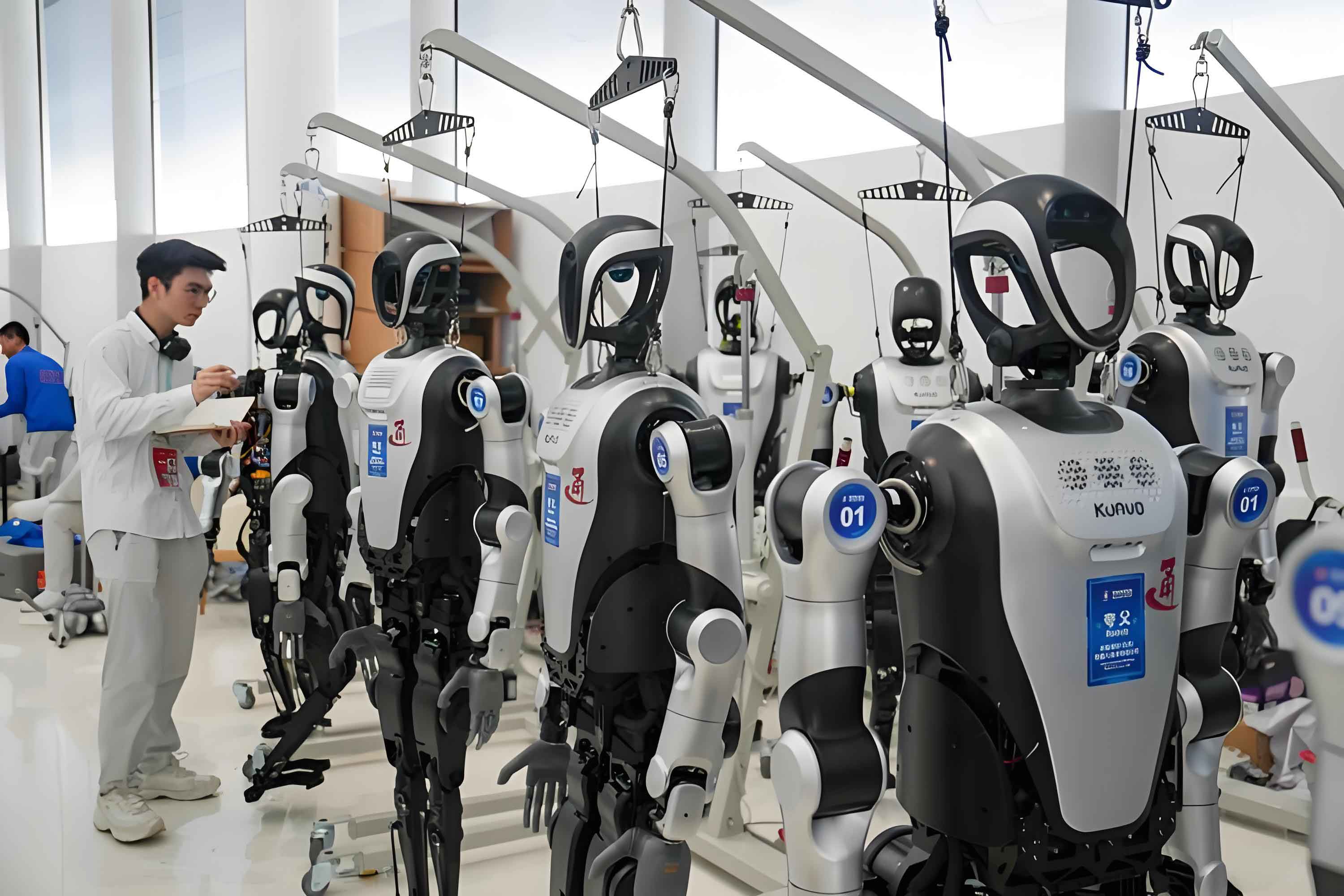
In this context, quality inspection becomes vital for humanoid robot manufacturing, as depicted in the image above. Advanced vision systems, powered by AI, can detect defects in humanoid robot components, ensuring high standards. This ties into my recommendation for multi-domain applications. Humanoid robots should be deployed in diverse scenarios like healthcare, logistics, and education. For instance, in rescue operations, humanoid robots can navigate debris using SLAM algorithms:
$$ x_{t} = x_{t-1} + u_t + w_t $$
where \( x_t \) is the pose, \( u_t \) is control, and \( w_t \) is noise. Testing in real-world environments will refine humanoid robot functionalities, driving adoption. Moreover, fusion with emerging technologies like brain-computer interfaces could enable direct neural control of humanoid robots, expanding their utility.
In conclusion, the development of humanoid robots is a multifaceted endeavor shaped by global strategic investments. From my perspective, the synergy between AI and robotics is propelling humanoid robots toward greater autonomy and affordability. By building robust innovation ecosystems, enhancing manufacturing prowess, and exploring varied applications, economies can harness the potential of humanoid robots to transform industries and society. As I reflect on the progress from 2021 to 2024, it is clear that humanoid robots are not just a technological marvel but a catalyst for future growth, with each economy playing a pivotal role in this exciting journey. The continued emphasis on cross-disciplinary research and international collaboration will be key to unlocking the full capabilities of humanoid robots in the decades ahead.