
As I reflect on the recent technological demonstrations, such as the captivating performance of 16 humanoid robots during a Spring Festival gala, where they expertly manipulated handkerchiefs and danced with fluid movements, I am struck by the growing public fascination. This event, coupled with announcements from industry leaders like Tesla’s plan to produce thousands of humanoid robots by 2025, signals a pivotal moment. Many analysts now predict that 2025 could mark the “first year of mass production” for humanoid robots. However, as I delve deeper into the subject, I realize that mass production does not equate to widespread adoption or scalability. The journey of humanoid robots from research labs to real-world integration is fraught with technical, economic, and societal challenges.
In popular media, humanoid robots are often depicted with near-human aesthetics and超凡的运动能力, engaging in dramatic narratives. But in reality, the current state of humanoid robotics is more modest. A humanoid robot is typically defined as a bipedal machine that integrates advanced technologies such as artificial intelligence, precision manufacturing, and new materials. At its core, it represents the deep fusion of AI with electromechanical systems. From my observations, most humanoid robots today are in a nascent stage, possessing basic locomotion and limited dexterity. For instance, some models can walk and perform simple hand manipulations, but they lack the robustness for complex tasks. The technology gap between regions is notable, with early pioneers focusing on foundational research in areas like underlying algorithms and core components.
To better understand the global landscape, I have compiled a table comparing key players in the humanoid robot sector. This highlights the competitive dynamics and technological focuses.
| Region/Country | Leading Entities | Key Humanoid Robot Models | Primary Focus Areas |
|---|---|---|---|
| United States | Boston Dynamics, Tesla | Atlas, Optimus | Dynamic movement, AI integration |
| Japan | SoftBank Robotics | Pepper, Nao | Human-robot interaction, service applications |
| China | Ubtech, Xiaomi, Fourier Intelligence | Walker, CyberOne, GR-1 | Industrial use, cost reduction, commercialization |
| Europe | Various research institutes | iCub, Roboy | Cognitive robotics, open-source platforms |
The motion control of a humanoid robot is governed by complex dynamics. For a bipedal system, the equations of motion can be expressed using Lagrangian mechanics. Consider a simplified model with generalized coordinates $\mathbf{q}$; the dynamics are given by:
$$ \mathbf{M}(\mathbf{q})\ddot{\mathbf{q}} + \mathbf{C}(\mathbf{q}, \dot{\mathbf{q}})\dot{\mathbf{q}} + \mathbf{G}(\mathbf{q}) = \boldsymbol{\tau} $$
where $\mathbf{M}$ is the mass matrix, $\mathbf{C}$ represents Coriolis and centrifugal forces, $\mathbf{G}$ is the gravitational vector, and $\boldsymbol{\tau}$ denotes the joint torques. Achieving stable walking requires solving these equations in real-time, which is a significant computational challenge. Current humanoid robots often rely on simplified controllers, but advancements in AI are enabling more adaptive approaches. For example, reinforcement learning algorithms can optimize policies for balance and gait, though they demand substantial data and processing power.
From an industrial perspective, the production of humanoid robots is accelerating. Data indicates a surge in specialized enterprises, with thousands of companies emerging globally. In China alone, there are tens of thousands of firms engaged in this field, including many focused on core components. The following table summarizes market projections and key statistics, underscoring the growth potential.
| Metric | Current Status (2024) | Projection (2034) | Notes |
|---|---|---|---|
| Global Humanoid Robot Sales | Several thousand units annually | Over 1 million units annually (China market) | Driven by industrial adoption |
| Market Value (Optimistic Scenario) | Billions of USD | 1540 billion USD by 2035 | High growth in service and industrial sectors |
| Number of Enterprises (China) | 24,747 firms | Expected consolidation and specialization | Includes 1,051 national-level innovative SMEs |
| Average Cost per Unit | 10,000 to 1,000,000 USD | Target below 50,000 USD for mass adoption | Cost reduction critical for scalability |
The cost structure of a humanoid robot can be modeled as a function of components and R&D. Let $C_{total}$ represent the total cost, which can be broken down as:
$$ C_{total} = C_{hardware} + C_{software} + C_{integration} + C_{R\&D} $$
where $C_{hardware}$ includes actuators, sensors, and structural materials; $C_{software}$ covers algorithms and AI models; $C_{integration}$ involves assembly and testing; and $C_{R\&D}$ accounts for research expenses. Currently, hardware dominates, with actuators like servo motors and reducers being major cost drivers. However, as supply chains mature and economies of scale kick in, I anticipate a decline. For instance, the price of core components in some regions has already dropped significantly due to local manufacturing.
In terms of applications, humanoid robots are finding niches where their form factor offers advantages. Industrial settings, such as automotive factories, are becoming early adoption grounds. Here, humanoid robots can perform tasks like assembly, inspection, and logistics, often working alongside autonomous vehicles. The reliability and precision required in these environments push technological boundaries. Another promising area is education and research, where humanoid robots serve as platforms for experimentation, with lower demands on robustness. Additionally, high-risk scenarios—involving hazards like radiation or toxic environments—present opportunities where humanoid robots can reduce human exposure. The table below categorizes these application domains.
| Application Domain | Examples of Tasks | Key Requirements | Current Readiness Level |
|---|---|---|---|
| Industrial Manufacturing | Assembly, welding, material handling | High reliability, precision, safety | Pilot projects underway |
| Education & Research | Teaching AI, robotics experiments | Programmability, modular design | Widely used in academia |
| High-Risk Environments | Nuclear cleanup, disaster response | Durability, remote operation, sensor fusion | Experimental stages |
| Healthcare & Elderly Care | Rehabilitation assistance, companionship | Gentle interaction, privacy, safety | Early prototypes emerging |
As humanoid robots evolve, their interaction with the world relies heavily on sensory perception. Visual systems, often incorporating cameras and depth sensors, enable object recognition and navigation. The integration of such technologies is crucial for autonomous operation. In this context, the advancement of robotic vision parallels developments in other areas, such as robotic dogs used for surveillance or assistance.
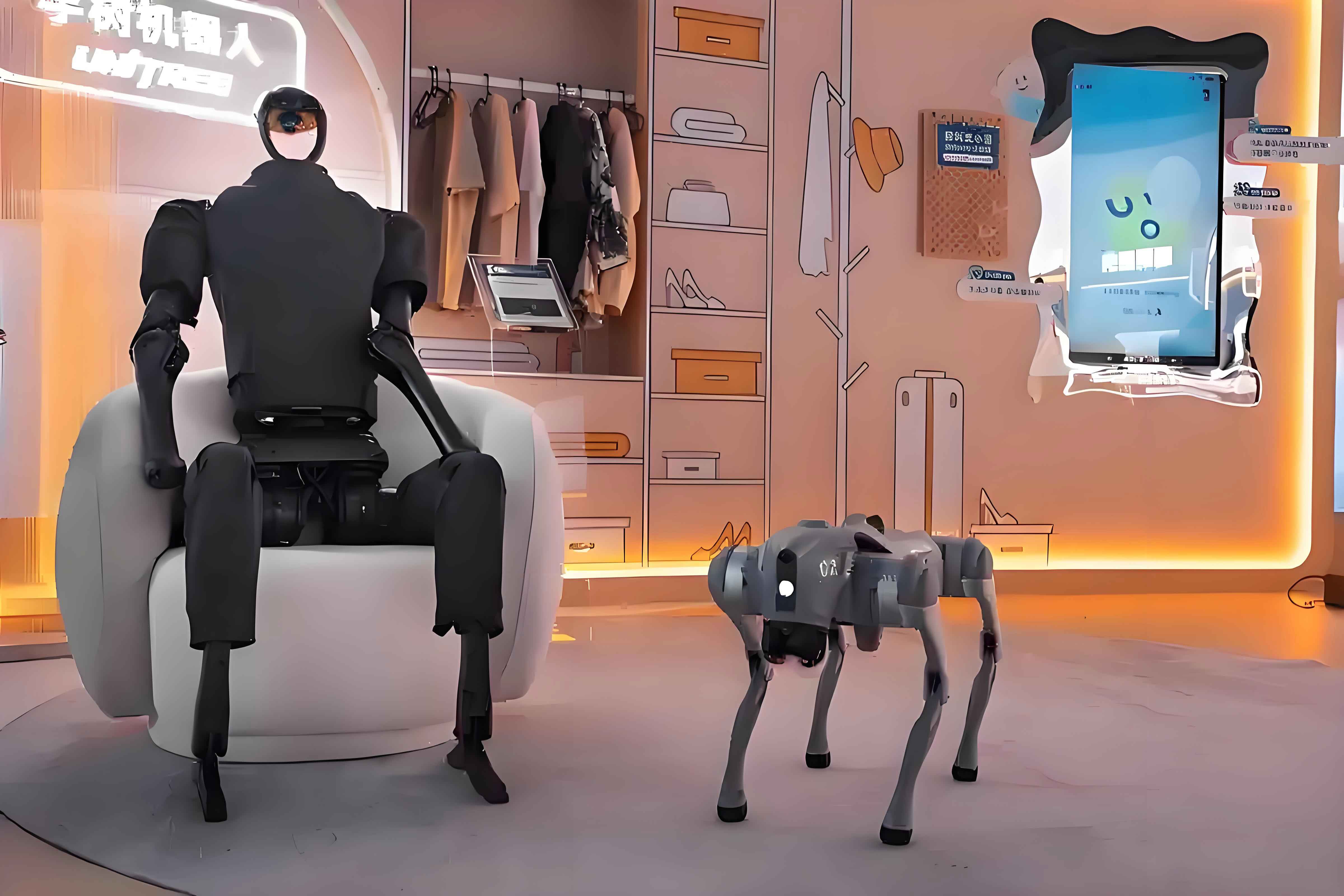
This synergy highlights how innovations in one domain can benefit others, fostering a broader ecosystem of intelligent machines.
The path to widespread deployment of humanoid robots hinges on overcoming several bottlenecks. First, technical reliability must improve. The mean time between failures (MTBF) for a humanoid robot in dynamic environments is currently low. We can express reliability $R(t)$ as a function of time, often modeled exponentially: $R(t) = e^{-\lambda t}$, where $\lambda$ is the failure rate. Reducing $\lambda$ through better design and materials is essential. Second, cost reduction is imperative. Using a learning curve model, the cost per unit $C_n$ after producing $n$ units can be approximated as $C_n = C_1 \cdot n^{-b}$, where $C_1$ is the cost of the first unit and $b$ is the learning rate. Mass production aims to increase $n$ and $b$, driving costs down. Third, intelligence levels need enhancement. The autonomy of a humanoid robot can be measured by its ability to handle unstructured environments, which depends on AI algorithms. For example, task success probability $P_{success}$ might be modeled as $P_{success} = f(\text{data}, \text{compute}, \text{algorithm complexity})$, requiring advances in machine learning.
Looking at the supply chain, core components like servo motors, controllers, and reducers are critical. In some regions, local production has reduced dependencies and costs. However, gaps remain in fundamental algorithm frameworks and software stacks. The competition among different business models—startups focusing on innovation, traditional firms leveraging integration, tech giants investing in AI, and manufacturing conglomerates applying scale—is shaping the industry. This diversity may accelerate progress, as each player brings unique strengths to the table.
When considering the ultimate goal of humanoid robots entering households, the challenges multiply. Safety, privacy, and affordability become paramount. Battery safety, for instance, involves managing energy density and thermal risks. If $E$ is the energy stored and $T$ is the temperature rise, we must ensure $T < T_{critical}$ under all conditions. Privacy concerns relate to data collection by sensors, requiring robust encryption and user control. Moreover, the cost barrier is steep; most humanoid robots today are priced beyond the reach of average consumers. A affordability index $A$ could be defined as $A = \frac{\text{average household income}}{\text{robot price}}$, where $A > 1$ is desirable for mass adoption. Currently, $A$ is often less than 0.1, indicating a long way to go.
Policy support and capital investment are driving forces. In some countries, initiatives to integrate humanoid robots into eldercare are gaining traction, aiming to address demographic shifts. This could serve as a gateway for home use. However, the timeline for true “home entry” remains uncertain. Technological breakthroughs are inherently unpredictable; they depend on cumulative research, serendipity, and collaborative effort. As I ponder this, I believe that while 2025 may see initial mass production runs, scalable and affordable humanoid robots for everyday life are likely years away. The journey involves iterative improvement, with each step building on prior advances.
In conclusion, the era of humanoid robot mass production is indeed on the horizon, but it is just the beginning. The humanoid robot, as a symbol of advanced robotics, embodies both promise and challenge. Through continued innovation in hardware, software, and applications, coupled with economic scaling, the vision of humanoid robots as ubiquitous assistants may gradually materialize. As I follow this field, I am reminded that progress is nonlinear, but the collective efforts across academia, industry, and policy circles are paving the way for a future where humanoid robots play meaningful roles in our lives.