
For over three decades, the humanoid robot has existed as a pinnacle of engineering ambition, primarily confined to research labs and controlled demonstrations. We are now witnessing a pivotal transition from technical validation to the cusp of preliminary commercialization. The catalyst for this shift is the meteoric rise of Artificial Intelligence (AI) Large Models in 2023. These models are endowing humanoid robot platforms with a “primary brain,” enabling capabilities such as autonomous decision-making, natural language interaction, and refined motion control. Crucially, their inherent generalization and emergent abilities are unlocking the potential for deployment across diverse and complex real-world applications. As we move through 2024, continued breakthroughs in large model technology, supportive government policies, and the influential entry of major players like Tesla are converging to accelerate the exploration of viable commercial pathways for the humanoid robot.
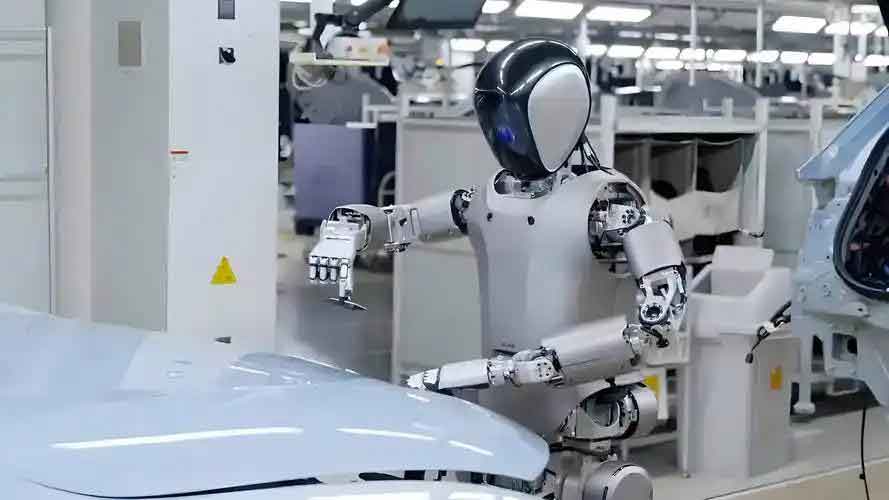
The integration is transformative. We are observing breakthroughs that fundamentally alter the trajectory of humanoid robot development. Firstly, the paradigm of human-robot interaction is being reshaped. Large Language Models (LLMs), through their advanced Chat applications, provide humanoid robot systems with profound natural language understanding. This grants the robot a foundational knowledge base across multiple domains, powerful content generation, nuanced contextual comprehension, and the ability for continuous dialogue. This drastically accelerates the process of natural language interaction between humans and machines. Concurrently, developments in Computer Vision (CV) large models have significantly improved the accuracy of core visual tasks—classification, object detection, semantic segmentation, and depth estimation—thereby massively enhancing a humanoid robot‘s environmental perception. Recent explorations into brain-computer interface control methods further hint at future leaps in interaction convenience.
Secondly, the user base is poised for radical expansion. Historically, deploying a humanoid robot required specialized robotics engineers to interpret tasks, decompose them into actions, and program applications using complex robotics languages, as the robots lacked common-sense reasoning. Large models, with their capabilities in commonsense understanding and logical reasoning, are directly addressing this decision-making短板 (shortcoming). Their prowess in high-level planning allows a humanoid robot to connect task goals with necessary actions. The enhanced natural language comprehension means the operator can shift from a specialist programmer to a general user issuing instructions in plain language. This dramatic reduction in usage barrier is the essential starting point for mass-market adoption and rapid industry scaling.
Thirdly, the scope of applications is breaking through previous limits. Compared to traditional AI models, large models possess superior generalization capabilities,颠覆 (overturning) the traditional software development paradigm for robots. Previously, a humanoid robot required a uniquely trained model for each specific domain (e.g., robotic arms for assembly, vacuum robots for homes), severely limiting its versatile application. Large models address the “long-tail” and Out-Of-Distribution (OOD) generalization problem, enabling a humanoid robot to perform competently in scenarios it was never explicitly trained on. This is the bedrock for achieving General-Purpose AI. We can model the emergent chain-of-thought reasoning as a function of model scale:
$$ \text{Reasoning Capability}(T) \propto \text{Scale}(N, D) $$
where \(T\) is task complexity, \(N\) is the number of model parameters, and \(D\) is the training data volume. Beyond a certain threshold, this capability allows the model to logically decompose complex tasks, vastly improving usability. Furthermore, the pre-training paradigm equips large models with knowledge compression ability. This shifts the development cycle from the lengthy “data collection → annotation → training → deployment → application” pipeline to a more efficient “pre-trained large model + specific task fine-tuning” approach, dramatically accelerating development speed for new scenarios.
| Technical Module | Core Function | Empowering Large Model Type | Key Impact |
|---|---|---|---|
| Environmental Perception | Object recognition, scene understanding, spatial mapping | Vision Foundation Models (e.g., SAM), Multi-modal Models | Automates image/video annotation; improves accuracy of core CV tasks; enables nuanced scene comprehension. |
| Human-Robot Interaction (HRI) | Natural language dialog, intent recognition, affective computing | Large Language Models (LLMs), Multi-modal Audio-Visual-Language Models | Enables intuitive instruction following and conversation; expands user base to non-experts; allows for multi-channel interaction. |
| Motion Planning & Control | Trajectory generation, balance control, real-time actuator command | Embodied AI Models, Vision-Language-Action (VLA) Models (e.g., RT-2) | Connects high-level goals to low-level actions; improves task generalization; allows for reactive planning based on perception. |
However, the path to a fully capable, ubiquitous humanoid robot powered by large models is fraught with significant challenges that we must address.
A primary constraint is the current insufficiency in perceptual dimensions and the need for further improvement in generalization. The ultimate goal for a humanoid robot is multi-sensory fusion decision-making, akin to humans, which requires robust multi-modal large models. Presently, there is a disconnect. While a model like ChatGPT excels at text, a humanoid robot must perceive the world through sensors (cameras, microphones, force/torque sensors). Today, this often requires converting sensor data (like images) into textual descriptions before the LLM can process it, losing rich information. Future large models need native multi-modal understanding, directly ingesting diverse data streams to holistically assess external environments and internal states. Furthermore, achieving true generalization demands vast quantities of high-quality, real-world robot interaction data. Control-action datasets are particularly scarce. The data generated by a humanoid robot during task execution is immensely complex—high-dimensional, sequential, and multi-modal. Training models that can reliably generalize across tasks and environments requires orders of magnitude more of this real robotic experience.
The most critical bottleneck for real-world deployment is real-time responsiveness in motion control, fundamentally a compute power issue. A humanoid robot operates in dynamic physical environments; its motion control systems demand high real-time performance and precision. Perception, decision-making, and actuation must be tightly coupled in a continuous loop. For instance, when encountering an unexpected obstacle, a humanoid robot must perceive it and compute an avoidance trajectory within milliseconds. Current large model-based control paradigms struggle with this. The latency can be modeled as:
$$ T_{latency} = T_{perception} + T_{model\_inference} + T_{control\_signal} $$
where \(T_{model\_inference}\) for a large model like RT-2 is currently too high. Demonstrations often require sped-up playback to appear fluid. RT-2 achieves a control cycle of only about 3Hz, whereas stable, dynamic locomotion for a humanoid robot typically requires control frequencies of 100-500Hz. Bridging this gap necessitates immense, localized compute power to complete complex calculations within strict time windows. Even with dedicated supercomputing investments like Tesla’s Dojo, significant feedback delay persists, and achieving robust, fluent walking in unstructured settings remains an unsolved challenge.
The empowerment of a humanoid robot by large models is multi-layered, requiring advancement across different algorithmic fronts. As outlined in the table, each technical module leverages specific model types. In the short term, a hybrid approach is likely, combining traditional robust control models (for low-level stability) with large models (for high-level planning and perception). The long-term vision is a fully end-to-end, sufficiently generalized model that takes raw, multi-modal sensor data as input and directly outputs coordinated actuator commands. Whether such a model can be hosted in the cloud with acceptable latency or must reside on powerful edge computing units within the humanoid robot itself is a key area for exploration.
| Challenge Category | Specific Issue | Consequence | Potential Mitigation |
|---|---|---|---|
| Data & Generalization | Lack of large-scale, multi-modal robotic interaction datasets. | Limited ability to perform novel tasks or adapt to new environments (poor OOD generalization). | Develop large-scale simulation frameworks; create industry consortiums for data sharing; employ data augmentation and synthetic data generation. |
| Compute & Real-time Performance | High inference latency of large models incompatible with real-time control requirements (<< 100ms). | Robotic movements are slow, hesitant, or unstable in dynamic environments. | Model compression & distillation; specialized AI chips for edge robotics; hybrid AI architectures (large model plans, small model executes). |
| System Integration & Safety | Difficulty in integrating probabilistic large model outputs with deterministic safety-critical control systems. | Risk of unpredictable or unsafe actions from the humanoid robot. | Develop “guardrails” and verification layers; use large models for planning only, with traditional controllers for safe execution; rigorous real-world testing. |
We firmly believe that the next major wave in AI will be embodied intelligence—systems that understand, reason, and interact with the physical world. The convergence of “humanoid robot + large model” is entering a fast lane of development. For telecommunications operators like us, this presents a critical strategic inflection point. We must leverage our core competencies to proactively position ourselves in this emerging ecosystem, securing roles in key segments of the humanoid robot value chain.
Our first strategic imperative is to foster application development by simplifying robot structures and aligning with downstream demand to accelerate humanoid robot deployment. In the short term, we can pioneer service-oriented robots for customer-facing scenarios. These settings prioritize sophisticated human-machine interaction, perfectly aligning with the strengths of LLMs. We can deploy humanoid robot units for intelligent customer service in smart communities or flagship stores, for companionship and basic assistance in smart homes, or as embodied versions of our existing digital avatars in operational hubs. This enhances customer experience, boosts intelligent guidance and marketing capabilities, and reduces service complexity. Furthermore, leveraging our position and resources, we can collaborate on or develop simplified humanoid robot solutions for specific verticals like industrial inspection, energy facility monitoring, or government services. By focusing on constrained environments, we can circumvent some of the broader technical hurdles, reduce dependencies on extreme data and compute, and achieve faster integration and deployment within our existing service portfolios.
The second, and perhaps most significant, strategic opportunity lies in becoming an enabler of the intelligence itself. We can enter the industry chain by offering a cloud robotics platform, essentially empowering the “mind” of the robot. AI capability defines the functional horizon of a humanoid robot, with data and compute as its lifeblood. Here, our advantages are substantial. On the data front, we support the digital lives of billions of users and manage connections for tens of billions of devices. Through careful data governance and partnerships with vertical industry leaders, we can help curate and provide access to high-quality, multi-source datasets. These datasets are crucial for training and fine-tuning domain-specific large models for robotics, enhancing their professionalism and scenario adaptability. The value of a curated dataset \(D\) for model fine-tuning can be expressed as an improvement in task success rate \(S\):
$$ \Delta S = f(D_{quality}, D_{relevance}, D_{volume}) $$
where \(f\) is a positive function. On the compute front, we must provide the robust, distributed compute power necessary for both training massive robotic AI models and supporting their low-latency inference. Inspired by models like Huawei’s cloud robot platform, we can offer a comprehensive cloud-edge-end compute capability platform. This would provide robot developers with seamless resources for model training and system simulation. Crucially, it would enable efficient split computing: complex reasoning and planning could occur in the cloud, while time-critical perception and control loops run on edge servers or even on-board the humanoid robot, minimizing latency. The total required effective compute \(C_{total}\) for a fleet of robots can be conceptualized as:
$$ C_{total} = \sum_{i=1}^{N} (C_{training\_i} + C_{cloud\_inference\_i} + C_{edge\_inference\_i}) $$
Our networks and data centers are ideally positioned to deliver this integrated compute power stack.
| Strategic Pillar | Operator’s Action | Value Proposition | Key Assets Leveraged |
|---|---|---|---|
| Application Pioneer & Integrator | Deploy and manage service humanoid robots in customer-facing & vertical scenarios. | Drives early adoption, creates use cases, enhances own service delivery, gathers proprietary field data. | Customer touchpoints (stores, hubs), enterprise client relationships, system integration expertise. |
| Data & AI Platform Enabler | Provide curated datasets and cloud-edge AI training/inference platforms for robot developers. | Accelerates industry-wide AI development for robotics; creates a sticky platform ecosystem; generates platform-as-a-service revenue. | Massive anonymized connectivity & service data, cloud infrastructure, AI research teams. |
| Connectivity & Compute Fabric Provider | Offer ultra-reliable, low-latency communication (5G/6G, F5G) and distributed compute resources. | Ensures real-time coordination for robot swarms, enables split computing, provides backbone for cloud robotics. | Network infrastructure, spectrum, nationwide data centers, edge computing nodes. |
In conclusion, the fusion of large AI models and humanoid robots is not merely an incremental improvement but a paradigm shift, creating a symbiotic relationship where each accelerates the development of the other. While formidable challenges in real-time control, data, and system integration remain, the trajectory is clear. For telecommunications operators, this represents one of the most consequential frontiers in the next phase of digital transformation. By strategically positioning ourselves not just as connectivity providers but as integral enablers of robotic intelligence—through application development, data stewardship, and distributed compute power—we can secure a vital role in shaping and benefiting from the era of embodied intelligence. The time to lay the groundwork and establish our presence in this key arena is now, as the foundations for the future humanoid robot-powered world are being built.