
The world of advanced manufacturing is witnessing a profound shift. From the pages of science fiction and blockbuster films, a new form of technological life is stepping into our warehouses, workshops, and workplaces. I am referring to the rise of the humanoid robot. For decades, the concept of a machine that mirrors human form and capability was a distant dream, confined to cinematic imagination. Today, it is a tangible reality, emerging as a pivotal force in industrial automation and a potential new star within the robotic family. These bipedal machines, endowed with human-like adaptability and intelligence, are beginning to execute a diverse array of tasks, signaling the onset of a transformation in global labor structures.
This transformation is driven by more than just mechanical mimicry. The core of this evolution lies in the deep integration of transformative technologies, particularly Artificial Intelligence (AI). As these technologies mature and converge, the humanoid robot is poised to become significantly more intelligent, flexible, and efficient. This report, from my perspective as an observer and analyst of this field, aims to dissect this phenomenon. I will explore the expanding applications, the technological pillars enabling this progress, the staggering market potential, and the complex socio-economic implications that lie ahead. To structure this analysis, I will employ tables to summarize key data and conceptual frameworks, and mathematical models to illustrate growth trajectories and performance metrics.
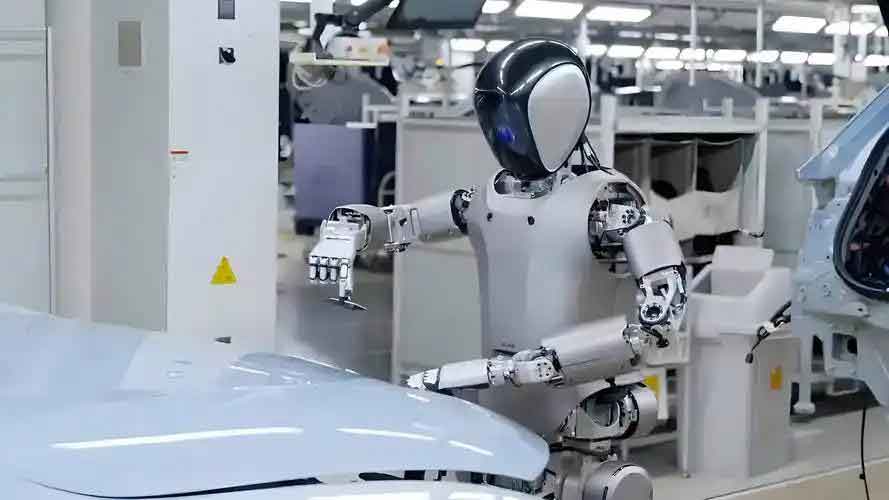
The journey from fiction to factory floor has been accelerated by pioneering engineering. Early demonstrations focused on dynamic mobility—walking, dancing, or navigating obstacle courses—captured public imagination and proved technical feasibility. Today, the focus has decisively shifted toward practical utility. Consider the evolution of high-profile platforms. Advanced bipedal platforms from leading robotics companies have moved beyond acrobatics to perform tasks like search operations, equipment manipulation, and navigating complex industrial environments. Their quadrupedal counterparts are already deployed for industrial inspection, construction site monitoring, and safety checks.
This practical turn is evident across the industry. Specialized firms have developed humanoid units designed explicitly for high-precision manufacturing. Under the command of sophisticated AI systems, these robots can handle delicate assembly work for consumer goods, pharmaceuticals, and electronics. Their skill set includes operations like laser engraving, rolling, and 3D printing. The vision extends to collaborative fleets of humanoid robot workers, offering flexible, reconfigurable automation solutions for factories of all sizes. Similarly, a prominent electric vehicle manufacturer has repurposed its advanced robotics project from a demonstration dancer to a capable worker. Videos from its own factories showcase this humanoid robot performing a range of duties, from simple material handling to more complex logistical operations, proving its mettle in a real-world setting. The penetration continues with newer-generation humanoids from AI startups being tested on the production lines of major automotive plants, with the goal of enhancing efficiency and creating safer work environments.
Expanding Application Matrix: From Repetition to Reasoning
The application landscape for humanoid robot technology is not monolithic; it is stratified by complexity and required autonomy. We can categorize current and near-future applications into distinct tiers, as summarized in the table below.
| Tier | Primary Driver | Task Examples | Environment | Key Humanoid Robot Advantage |
|---|---|---|---|---|
| Tier 1: Structured Dexterity | Pre-programming & Sensor Feedback | Precision assembly, laser welding, 3D printing, CNC machine tending. | Controlled factory cells, labs. | Human-like hand-eye coordination for tools and parts designed for people. |
| Tier 2: Adaptive Logistics | Computer Vision & Path Planning | Loading/unloading pallets, sorting parcels, transporting goods in warehouses. | Semi-structured warehouses, logistics hubs. | Bipedal mobility to navigate spaces built for humans without retrofitting. |
| Tier 3: Human-Robot Collaboration | Natural Language Processing (NLP) & Force Control | Handing tools to technicians, collaborative assembly, “fetch-and-carry” in dynamic settings. | Mixed human-robot workspaces (e.g., aircraft assembly, construction). | Intuitive interaction and safe physical co-existence in shared spaces. |
| Tier 4: Unstructured Autonomy | Multi-Modal AI & World Models | Emergency response, complex maintenance in hazardous plants, exploratory missions. | Completely unstructured, unpredictable environments. | General form factor to use human tools and infrastructure while making autonomous decisions. |
The progression from Tier 1 to Tier 4 represents a shift from specialized tools to general-purpose partners. The economic rationale is powerful. A significant portion of global economic activity occurs in environments built for the human form. Retrofitting the entire world for wheeled or fixed-base robots is impractical. The humanoid robot, by design, is the automation solution that adapts to our world, not the other way around. This fundamental advantage can be expressed through a simple conceptual formula for integration cost (IC):
$$ IC = C_{robot} + C_{retrofit} + C_{retraining} $$
Where \( C_{robot} \) is the cost of the humanoid robot itself, \( C_{retrofit} \) is the cost of modifying the environment (e.g., installing rails, ramps, specialized workstations), and \( C_{retraining} \) is the cost of training human staff to interface with a non-intuitive system. For traditional, non-humanoid automation, \( C_{retrofit} \) and \( C_{retraining} \) can be prohibitively high. The thesis of the humanoid robot is that its form factor minimizes \( C_{retrofit} \) (as it uses stairs, doors, and standard tools) and potentially lowers \( C_{retraining} \) through intuitive interaction, making the total \( IC \) favorable for widespread adoption.
Technological Pillars: The Multidimensional Engine
The rapid advancement of the humanoid robot is not due to a single breakthrough but a confluence of progress across several critical technological domains. These pillars work in concert to create machines that are stable, aware, dexterous, and intelligent.
1. Sensing and Perception: The ability to understand the environment is paramount. Modern humanoids are equipped with sophisticated sensor suites far beyond simple cameras. They integrate:
- Depth Sensors & LiDAR: To build precise, real-time 3D point cloud maps of their surroundings. A point cloud \( P \) can be represented as a set of \( n \) points in 3D space: \( P = \{p_1, p_2, …, p_n\} \), where each \( p_i = (x_i, y_i, z_i, I_i) \) may include intensity data.
- Inertial Measurement Units (IMUs) & Force-Torque Sensors: These provide proprioception—the sense of self-movement and force. This is crucial for balance and delicate manipulation. The balance control often involves continuously solving equations for the Zero Moment Point (ZMP), a key stability criterion in dynamic walking.
- Multi-Modal Fusion: The future lies in combining visual, auditory, tactile, and inertial data into a unified perceptual model.
2. Actuation and Mechanics: The “body” of the humanoid robot has seen revolutionary improvements. Electric actuators have become more powerful and efficient, with higher torque-to-weight ratios. Novel materials and hydraulic systems (in some cases) allow for compliant, force-controlled movements that are both strong and safe for interaction. The design of joints and limbs increasingly mimics biological principles to achieve energy-efficient and natural motion.
3. The AI Brain: Learning, Reasoning, and Control: This is the most transformative pillar. AI moves the humanoid robot from a pre-scripted machine to a learning, adapting entity.
- Simulation & Reinforcement Learning (RL): Millions of years of trial-and-error learning can be condensed into days or weeks inside high-fidelity physics simulators. A robot can learn to walk, grasp, or recover from a stumble through algorithms that maximize a reward function \( R \). The policy \( \pi(s) \), which dictates the action \( a \) in state \( s \), is optimized to maximize the expected cumulative reward: $$ J(\pi) = \mathbb{E}_{\tau \sim \pi} \left[ \sum_{t=0}^{T} \gamma^t R(s_t, a_t) \right] $$ where \( \tau \) is a trajectory, and \( \gamma \) is a discount factor.
- Large Language Models (LLMs) and Vision-Language-Action (VLA) Models: These provide high-level reasoning and task planning. A human can give a natural language command (“Please tidy up this workbench”), and the LLM, integrated with perceptual models, can break it down into a sequence of actionable steps for the robot’s control system to execute. This moves programming from code to conversation.
- Unified World Models: A frontier of research seeks to create single, general models that integrate perception, reasoning, and low-level control. The goal is an AI that, given multi-sensor input, can both understand a scene and generate the precise motor commands needed to interact with it, enabling a new level of autonomy.
| Technology Domain | Key Function | Impact on Humanoid Robot Capability |
|---|---|---|
| Advanced Sensor Fusion | Creates a unified, real-time 3D understanding of the environment. | Enables safe navigation in complex, dynamic spaces and precise manipulation of objects. |
| High-Performance Actuation | Provides physical force and movement. | Allows for human-level strength, dexterity, and endurance in a compact, energy-efficient form. |
| Reinforcement Learning (RL) | Enables learning of complex motor skills through simulated practice. | Dramatically reduces the time and cost of programming sophisticated behaviors like walking, running, or handling tools. |
| Large Language Models (LLMs) | Provides high-level task understanding and planning from natural language. | Makes robots easily instructable by non-experts and capable of handling ambiguous or novel commands. |
| Unified World Models | Integrates perception, cognition, and action into one model. | Points toward true general-purpose autonomy, where a robot can reason about and act in the world without task-specific programming. |
Market Potential: A Trillion-Dollar Trajectory
The convergence of expanding applications and rapid technological progress has ignited significant financial and strategic interest. Multiple financial institutions and think tanks have projected the global humanoid robot industry to reach a trillion-dollar scale by 2035. These projections are not mere speculation but are based on plausible adoption curves across several massive sectors: manufacturing, logistics, healthcare, retail, and domestic service.
We can model the potential market size \( M(t) \) as a function of time using a modified S-curve (logistic growth) model, common for disruptive technologies:
$$ M(t) = \frac{K}{1 + e^{-r(t – t_0)}} $$
Where:
- \( K \) is the carrying capacity or ultimate market saturation potential (e.g., $1.5 trillion).
- \( r \) is the growth rate.
- \( t_0 \) is the inflection point year where growth is fastest.
- \( t \) is the time in years.
Projections from various analysts suggest different parameters, but the trajectory is consistently steep. A visionary entrepreneur has made an even bolder prediction regarding unit volume, suggesting that the number of humanoid robot units could surpass the human population by 2040. While this is an extreme scenario, it underscores the perceived scale of the opportunity. The driving equation for unit adoption often hinges on the declining cost per capability. We can express a simplified cost model:
$$ C_{cap}(t) = \frac{C_{hardware}(t) + C_{software}(t)}{P(t)} $$
Here, \( C_{cap}(t) \) is the “cost per unit of capability” (e.g., cost per dexterous manipulation task per hour), \( C_{hardware}(t) \) is the falling cost of sensors and actuators, \( C_{software}(t) \) is the amortized cost of AI models (which may rise then fall), and \( P(t) \) is the exponentially increasing performance of the system. The commercial inflection point occurs when \( C_{cap}(t) \) drops significantly below the cost of human labor for a wide range of tasks, factoring in reliability and uptime.
| Sector | Potential Applications (2030-2040) | Estimated Addressable Market (Annual) | Primary Value Proposition |
|---|---|---|---|
| Manufacturing & Logistics | Assembly, machine tending, palletizing, sorting, loading. | $400 – $600 Billion | 24/7 operation, consistency, filling labor shortages, dangerous task handling. |
| Healthcare & Elderly Care | Patient mobility assistance, routine check-ins, delivery of supplies, rehabilitation aid. | $150 – $300 Billion | Augmenting overburdened staff, enabling independent living, providing physical support. |
| Retail & Hospitality | Inventory management, shelf stocking, cleaning, basic customer interaction. | $100 – $200 Billion | After-hours operations, handling peak loads, performing repetitive upkeep tasks. |
| Domestic Service | Household chores, cooking assistance, gardening, security patrol. | $200 – $400 Billion | Saving time, assisting with disabilities or aging, providing convenience. |
| Other (Construction, Space, etc.) | Site inspection, hazardous environment work, extraterrestrial operations. | $50 – $100 Billion | Performing tasks in environments that are dangerous or inaccessible to humans. |
The Labor Structure Transformation: Partner, Proxy, or Replacement?
The ascent of the humanoid robot inevitably leads to profound questions about the future of work. This technology promises to redefine global labor structures on an unprecedented scale. The central, unresolved question is: Will these machines become indispensable assistants that augment human potential, or will they emerge as direct competitors, displacing human workers on a massive scale? The evidence and strategies currently point in multiple directions.
Many companies are strategically targeting areas where humanoid robot deployment creates clear synergies or fills critical gaps:
- Dangerous, Dirty, and Dull (3D) Jobs: This is a primary focus. Robots are being deployed for tasks that pose significant risks of injury, such as moving heavy loads in logistics, handling toxic materials, or working in extreme environments. Here, the humanoid robot acts as a proxy, preserving human health and safety.
- Superhuman Precision and Scale: Other applications leverage the machine’s ability to perform with microscopic accuracy or relentless consistency—tasks like high-speed, intricate assembly, micron-level welding, or 24/7 operation in lights-out factories. In these roles, the robot complements human workers by handling the sub-tasks that exceed biological limits.
- Addressing Demographic Shortfalls: In nations with aging populations and shrinking workforces, humanoid robot could become essential infrastructure for maintaining economic productivity and caregiving capacity, acting as partners to an older human workforce.
However, the very versatility of the humanoid robot means its capabilities will inevitably overlap with a broad spectrum of current human jobs, from warehouse pickers to certain types of technicians. The net impact on employment is a complex function of displacement, job creation (in robot manufacturing, maintenance, and supervision), and the catalyzing of new, yet-unimagined industries. This can be framed as:
$$ \Delta L_{net} = J_{created} + J_{new} – J_{displaced} $$
Where \( \Delta L_{net} \) is the net change in labor demand, \( J_{created} \) are jobs directly supporting the robot economy, \( J_{new} \) are jobs in novel industries enabled by the technology, and \( J_{displaced} \) are jobs automated away. Historically, technological waves have ultimately led to a positive \( \Delta L_{net} \), but the transition period can be painful and inequitable.
The most challenging scenarios involve potential use in military or conflict settings, where the humanoid robot could be tasked with missions in extremely hazardous combat zones. This raises urgent ethical and governance questions that society is only beginning to confront.
Conclusion: Navigating the Future We Are Building
The era of the humanoid robot is dawning. It is being built upon a foundation of breathtaking advances in AI, sensing, and mechanics. Its potential to transform industries is vast, backed by credible projections of a trillion-dollar market. The technology’s path is set toward greater intelligence, autonomy, and affordability.
Yet, the most significant challenges ahead are not primarily technical; they are human. How we integrate this new form of intelligence into our economic and social fabric will define the next century. It demands deliberate forethought from policymakers, educators, and business leaders. We must design systems that harness the productivity of the humanoid robot to elevate human work, create new opportunities, and share the generated prosperity broadly. We must establish clear ethical guidelines, particularly for autonomous systems in sensitive domains. The goal cannot be mere automation for efficiency’s sake, but augmentation for a better quality of life. The humanoid robot stands as a mirror, reflecting our own ingenuity. The image it ultimately reveals—that of a disruptive threat or an empowering partner—depends less on the code in its brain and more on the wisdom in our collective choices. Building a future where humans and humanoid robot coexist harmoniously will require our most concerted effort, empathy, and foresight.