
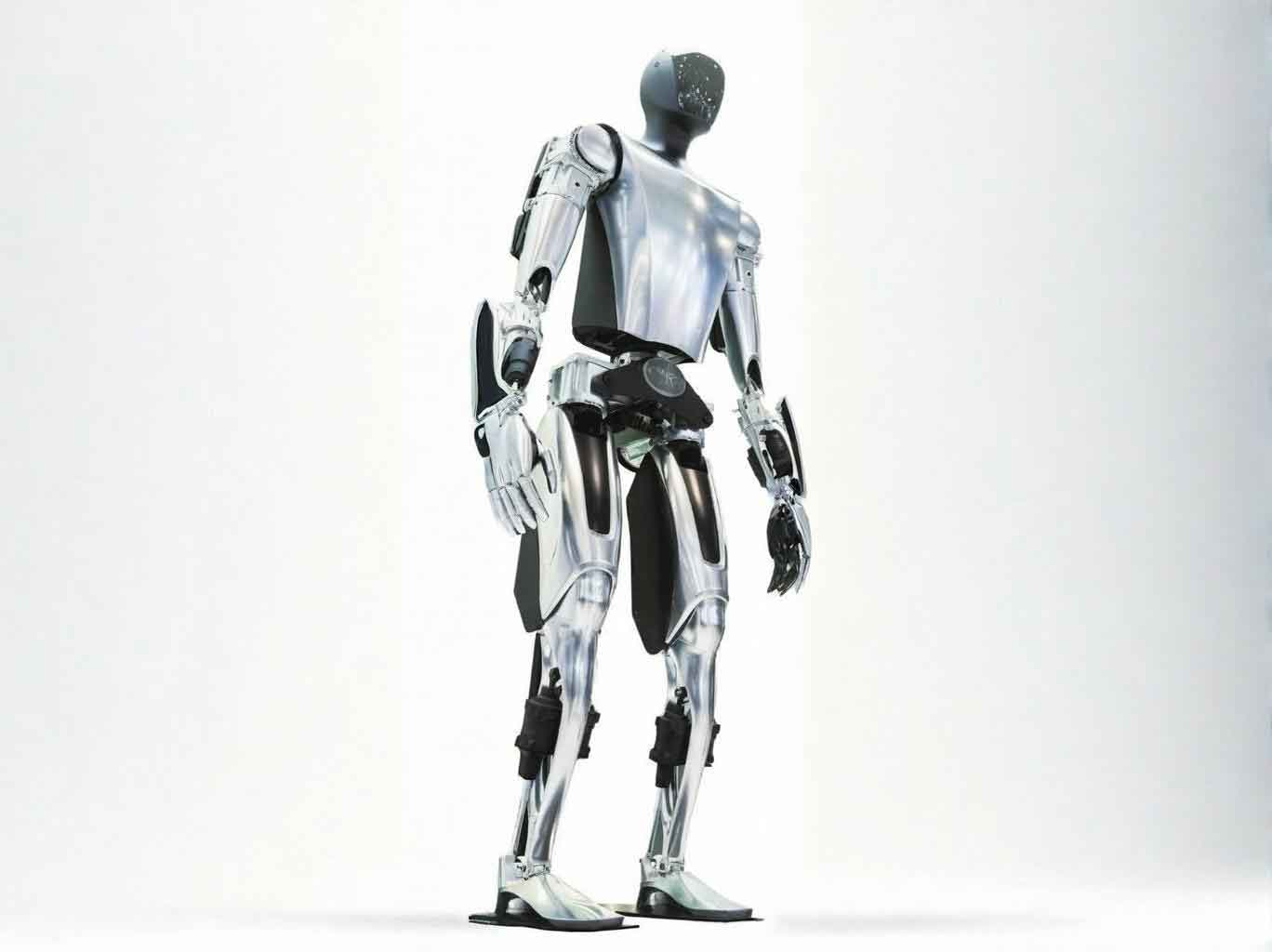
In recent years, the rapid advancement of artificial intelligence has ushered in a new paradigm known as intelligent embodied communication. From my perspective, this paradigm represents a profound shift where the body, mediated by technology, becomes central to the process of interaction, cognition, and emotional engagement. Unlike traditional disembodied communication, intelligent embodied communication integrates AI technologies to fuse the physical body with digital mediums, creating immersive experiences in virtual reality (VR), augmented reality (AR), and mixed reality (MR). A key manifestation of this is the metaverse, which epitomizes the convergence of real and virtual worlds. However, alongside these innovations, I observe significant ethical challenges that demand rigorous analysis. Particularly, the rise of ’embodied AI robot’—robotic systems that perceive, reason, and interact with the physical world—adds complexity to these issues, as these robots often serve as intermediaries or actors within intelligent embodied communication systems. In this article, I aim to explore the ethical risks inherent in intelligent embodied communication and propose governance strategies, emphasizing the role of ’embodied AI robot’ in shaping these dynamics. The discussion will be structured around four core ethical dimensions: privacy, capital, immersion, and subjectivity, followed by governance approaches at societal and individual levels.
The concept of intelligent embodied communication builds on theories from embodied cognition and phenomenology, such as Merleau-Ponty’s emphasis on the body as the foundation of perception. In AI-driven contexts, this translates to technologies that capture and utilize bodily data for enhanced interaction. For instance, ’embodied AI robot’ exemplifies this by autonomously navigating physical environments, but in communication settings, it can facilitate embodied experiences through avatars or assistive devices. I define intelligent embodied communication as a mode where AI enables seamless body-medium integration, generating experiences that blur the lines between physical and digital realms. This has applications in marketing, education, and healthcare, yet it introduces novel risks due to its deep embeddedness in daily life. My analysis draws on ethical frameworks to dissect these risks, using tables and formulas to summarize key points. Below, I outline the ethical risks before delving into governance.
Ethical Risks of Intelligent Embodied Communication
Intelligent embodied communication poses multifaceted ethical risks that transcend conventional issues. I categorize these into four areas: privacy, capital justice, embodied immersion, and human subjectivity. Each risk is exacerbated by the involvement of ’embodied AI robot’, which often acts as a data collector or interaction agent. To illustrate, consider the following table summarizing these risks and their characteristics:
| Ethical Risk Category | Key Characteristics | Role of ‘Embodied AI Robot’ |
|---|---|---|
| Privacy (Body-Mind Privacy) | Continuous, unconscious data collection; interaction between physiological and psychological data | Robots with sensors capture biometric data (e.g., gait, heart rate) for profiling |
| Capital Erosion (New Enclosure Movement) | Inequitable distribution, misrecognition, misrepresentation; data exploitation | Robots as tools for capital accumulation through user behavior monitoring |
| Embodied Immersion (Enhanced Addiction) | Heightened dependency; objectification of bodily functions; loss of self-regulation | Robots deliver immersive experiences that foster addiction, e.g., in VR gaming |
| Subjectivity Displacement (Emergence of the “Other”) | Erosion of human agency; value depletion; identity confusion | Robots as autonomous “others” that challenge human uniqueness in social interactions |
Body-Mind Privacy: An Escalated Challenge
From my viewpoint, privacy in intelligent embodied communication evolves into “body-mind privacy,” a composite risk where physiological and psychological data are interlinked. Technologies like extended reality (XR) devices and brain-computer interfaces (BCI) enable real-time capture of bodily signals, such as neural activity or heart rate, which can infer mental states like emotions or intentions. This differs from traditional privacy breaches because the data collection is continuous and often unconscious, facilitated by the embodied nature of interaction. For example, an ’embodied AI robot’ equipped with biometric sensors might monitor a user’s movements and vital signs during a VR session, creating a detailed profile without explicit consent. The risk is amplified by the dynamic interplay: physiological data leaks can lead to psychological inferences, and vice versa. I represent this with a formula for privacy risk $P$ as a function of bodily data $B$, mental data $M$, and technological embeddedness $E$:
$$ P = f(B, M, E) = \alpha \cdot \int_{t} (B(t) + M(t)) \cdot E(t) \, dt $$
Here, $\alpha$ is a risk coefficient, and the integral over time $t$ reflects the continuous collection. The variable $E(t)$ denotes the level of technological embedding, which is high in systems involving ’embodied AI robot’. This formula highlights how privacy erosion accelerates with prolonged exposure. Moreover, users may develop privacy cynicism, feeling powerless to protect their data while engaging with these technologies. In table form, the components of body-mind privacy are:
| Privacy Component | Description | Example in ‘Embodied AI Robot’ |
|---|---|---|
| Physiological Data | Biometric information (e.g., EEG, heart rate) | Robot sensors track user fatigue during interaction |
| Psychological Data | Inferred states (e.g., attention, emotion) | AI algorithms analyze robot-collected data for mood detection |
| Interactivity Risk | Data linkage across body-mind dimensions | Robot uses gait analysis to predict cognitive decline |
Capital Erosion: The “New Enclosure Movement”
I perceive intelligent embodied communication as a arena for “surveillance capitalism,” where capital interests exploit user data for profit, akin to a digital “new enclosure movement.” Drawing on Zuboff’s theory, this involves three injustices: maldistribution, misrecognition, and misrepresentation. In the context of the metaverse or ’embodied AI robot’ platforms, users often contribute labor—such as creating digital content or generating data—without fair compensation, leading to inequitable distribution. For instance, ’embodied AI robot’ systems in virtual lands may charge rents for access, reinforcing digital feudalism. Misrecognition occurs when platforms monopolize control, obscuring their operations and marginalizing user voices. Misrepresentation arises from algorithmic biases that exclude vulnerable groups from participation. I model this capital risk $C$ using a vector of injustices $\vec{I} = (I_d, I_r, I_p)$, where $I_d$ is distributional inequality, $I_r$ is recognition error, and $I_p$ is representation mismatch:
$$ C = \| \vec{I} \| = \sqrt{I_d^2 + I_r^2 + I_p^2} $$
This Euclidean norm represents the cumulative impact, with higher values indicating severe erosion of social justice. A practical example is the use of ’embodied AI robot’ in fitness apps: users’ bodily data are monetized by companies, while users receive minimal benefits. The table below summarizes these injustices:
| Injustice Type | Manifestation in Intelligent Embodied Communication | Involvement of ‘Embodied AI Robot’ |
|---|---|---|
| Maldistribution | Unpaid data labor; profit concentration in platforms | Robots collect user interaction data for corporate analytics |
| Misrecognition | Lack of transparency; user exclusion from decision-making | Robot-operated platforms hide algorithms governing virtual spaces |
| Misrepresentation | Algorithmic discrimination; underrepresentation of minorities | Robots replicate biases in avatar creation or access control |
Embodied Immersion: Enhanced Addiction and Bodily Objectification
In my analysis, the immersive nature of intelligent embodied communication fosters “enhanced addiction,” where users become excessively dependent on technological experiences, weakening self-control and moral responsibility. This is particularly evident in VR environments or interactions with ’embodied AI robot’ that provide hyper-realistic stimuli. The prolonged exposure can lead to bodily objectification, where the body is treated as a mere instrument for data production, akin to Heidegger’s concept of “enframing.” For example, users might rely on ’embodied AI robot’ for social interaction, gradually losing their physical social skills. The addiction risk $A$ can be expressed as a growth function over time $t$, with parameters for immersion depth $D$ and personal susceptibility $S$:
$$ A(t) = A_0 \cdot e^{k \cdot D \cdot S \cdot t} $$
Here, $A_0$ is initial addiction level, $k$ is a constant, and $D$ is high for technologies like ’embodied AI robot’. As $t$ increases, addiction escalates exponentially, leading to issues like neural fatigue or circadian disruption. Additionally, the objectification risk $O$ relates to the degree of bodily dependency $B_d$ and technological mediation $T_m$:
$$ O = B_d \cdot T_m $$
Where $B_d$ approaches 1 when users delegate bodily functions to robots. This underscores the paradox: while technology expands human capabilities, it may also diminish innate bodily agency. The following table outlines the components of immersion risks:
| Risk Aspect | Description | Example with ‘Embodied AI Robot’ |
|---|---|---|
| Addiction Enhancement | Increased dependency on immersive experiences | Users compulsively interact with robot companions in virtual worlds |
| Bodily Objectification | Body treated as data source; loss of organic function | Robots monitor and optimize user movements, reducing bodily autonomy |
| Moral Atrophy | Decline in ethical reasoning due to over-reliance | Users let robots make social decisions, eroding personal responsibility |
Subjectivity Displacement: The Emergence of the “Other”
From my perspective, intelligent embodied communication introduces “it-others”—autonomous entities like ’embodied AI robot’ that challenge human subjectivity. Drawing on Don Ihde’s philosophy, these robots act as independent “others” in social interactions, potentially displacing human agency and causing value depletion. For instance, digital avatars or robot assistants may replace human roles in communication, leading to identity confusion and a sense of emptiness. This aligns with Marxian alienation theory, where humans become estranged from their own data and interactions. The subjectivity risk $S_h$ can be modeled as a function of human agency $H_a$, technological autonomy $T_a$, and social integration $S_i$:
$$ S_h = \frac{H_a}{T_a + S_i} $$
As $T_a$ increases (e.g., with advanced ’embodied AI robot’), $S_h$ decreases, indicating virtualized subjectivity. Additionally, value depletion $V_d$ arises from excessive immersion, described by a entropy-like measure:
$$ V_d = – \sum p_i \log p_i $$
Where $p_i$ represents the probability of engaging in meaningful activities versus trivial ones dominated by technology. In practice, users might experience “filling” — where their time is occupied by robotic interactions, leading to existential boredom. The table below summarizes subjectivity risks:
| Subjectivity Risk | Manifestation | Role of ‘Embodied AI Robot’ |
|---|---|---|
| Agency Virtualization | Human decision-making ceded to algorithms | Robots autonomously manage user schedules or social interactions |
| Identity Fragmentation | Confusion between real and digital selves | Users adopt robot-like avatars, blurring self-perception |
| Value Erosion | Loss of purpose; increased nihilism | Robot-mediated experiences prioritize efficiency over meaning |
Governance Paths for Ethical Risks
To address these risks, I propose a dual-layered governance framework combining societal and personal approaches. This framework emphasizes agile governance to overcome the “Collingridge Dilemma,” where controlling technology becomes difficult after widespread adoption. The involvement of ’embodied AI robot’ necessitates tailored strategies that account for embodied data and autonomous behavior.
Societal Governance: Agile Responses to Ethical Challenges
At the societal level, I advocate for agile governance that adapts dynamically to technological changes. This involves three key mechanisms: transparent data governance, simulation-driven dynamic governance, and distributed responsibility sharing. For example, with ’embodied AI robot’, regulators could establish real-time monitoring systems using federated learning to protect body-mind privacy. I formalize agile governance efficacy $G_a$ as a function of transparency $T_r$, adaptability $A_d$, and inclusivity $I_c$:
$$ G_a = \beta \cdot T_r \cdot A_d \cdot I_c $$
Where $\beta$ is a scaling factor. Higher $G_a$ indicates better mitigation of risks like capital erosion. Specific measures include:
- Data Sovereignty Mechanisms: Implement graded data ownership for bodily information, allowing users to control access. For instance, ’embodied AI robot’ platforms could let users toggle data sharing for emergency versus routine use.
- Simulation Governance: Use VR simulations to test ethical policies before implementation, involving stakeholders like ethicists and robot developers.
- Distributed Networks: Create decentralized autonomous organizations (DAOs) for collective decision-making, reducing platform monopolies.
The table below outlines societal governance strategies:
| Governance Strategy | Implementation | Application to ‘Embodied AI Robot’ |
|---|---|---|
| Transparent Data Governance | Public audits of data usage; user-centric controls | Robots disclose all collected biometric data to users |
| Dynamic Simulation | Ethical labs in virtual environments for policy testing | Simulate robot-human interactions to assess addiction risks |
| Distributed Responsibility | DAO-based committees for oversight | Community-driven guidelines for robot behavior in public spaces |
Personal Autonomy: Embodied Ethics for Moral Shaping
On the individual level, I emphasize embodied ethics to cultivate moral cognition and情感, countering risks like addiction and subjectivity displacement. This involves shifting from a technology-centric view to a virtue-oriented approach, where users reflect on their embodied experiences with ’embodied AI robot’. For instance, practitioners in the field should engage in first-person simulations of ethical dilemmas to foster empathy. The moral cognition model $M_c$ can be represented as:
$$ M_c = \int (E_b \cdot R_f) \, d\tau $$
Where $E_b$ is embodied experience intensity, $R_f$ is reflective frequency, and $\tau$ is time. This integral suggests that cumulative, reflective embodied practice enhances moral understanding. Similarly, moral情感 $M_e$ is a vector of virtues like reverence and shame, modulated by embodied interactions:
$$ \vec{M_e} = \gamma \cdot \vec{V} \cdot I_e $$
Here, $\gamma$ is a constant, $\vec{V}$ represents virtue dimensions, and $I_e$ is the intensity of embodied engagement with technologies like ’embodied AI robot’. To operationalize this, I recommend:
- Ethical Training: Developers and users participate in embodied scenarios to experience privacy violations or addiction firsthand.
- Value Reinforcement: Promote “good life” pursuits beyond technological immersion, such as community activities that reduce reliance on robots.
The table summarizes personal governance approaches:
| Personal Governance Aspect | Method | Role of ‘Embodied AI Robot’ |
|---|---|---|
| Moral Cognition Development | Immersive ethics training; reflective journals | Robots create simulated ethical dilemmas for user reflection |
| Moral情感 Cultivation | Exposure to virtuous role models; empathy exercises | Robots demonstrate ethical behavior in social interactions |
| Autonomy Preservation | Digital detox routines; critical technology use | Users limit robot interactions to maintain self-agency |
Conclusion
In conclusion, intelligent embodied communication presents significant ethical risks related to privacy, capital, immersion, and subjectivity, many of which are amplified by the integration of ’embodied AI robot’. Through my analysis, I have highlighted how these risks manifest in continuous data collection, inequitable exploitation, addictive dependencies, and human agency erosion. The governance framework I propose combines societal agility—through transparent data mechanisms, simulated governance, and distributed responsibility—with personal embodied ethics to foster moral growth. By prioritizing these strategies, we can steer intelligent embodied communication toward a more ethical future, where technologies like ’embodied AI robot’ enhance rather than diminish human flourishing. Further research should explore cross-cultural applications and longitudinal studies on governance efficacy, ensuring that ethical considerations evolve alongside technological advancements.