
As I delve into the evolving landscape of modern manufacturing, it becomes increasingly clear that embodied AI robots are not merely tools but transformative agents reshaping production paradigms. The convergence of artificial intelligence with physical robotic systems marks a pivotal shift towards autonomy and intelligence in industrial settings. In this article, I explore the synergistic interplay between standardized frameworks and policy-driven initiatives that are propelling the rise of embodied AI robots, underpinning the next wave of smart manufacturing. Through detailed analysis, tables, and mathematical formulations, I aim to elucidate how these advancements are fostering innovation, efficiency, and scalability across sectors.
The foundation for this transformation lies in comprehensive standard systems designed to harmonize technological integration. I have observed that recent national guidelines emphasize a structured approach to smart manufacturing standards, which I categorize into three core areas. To summarize, the following table outlines this framework:
| Category | Key Components | Detailed Description |
|---|---|---|
| Basic Commonality | General Standards, Safety Protocols, Reliability Metrics, Testing Procedures, Evaluation Criteria, Personnel Competence | These elements ensure foundational interoperability, risk mitigation, and quality assurance, which are critical for deploying embodied AI robots in diverse environments. For instance, safety standards mitigate hazards in human-robot collaboration. |
| Key Technologies | Smart Equipment, Industrial Software, Smart Factories, Smart Supply Chains, Enabling Technologies (e.g., AI, IoT), New Manufacturing Models, Industrial Networks | This category focuses on the technological backbone that enables embodied AI robots to function seamlessly. Standards here facilitate integration of sensors, actuators, and AI models, enhancing the autonomy of embodied AI robots. |
| Industry Applications | Steel, Non-ferrous Metals, Automotive, Power Equipment, Shipbuilding, Aerospace, Electronics, Light Industry, Chemicals, and Others | Tailored standards for specific sectors ensure that embodied AI robots can be adapted to unique operational requirements, driving adoption in targeted industries. |
The efficacy of such standardization can be quantified through a benefit model. I propose the following formula to represent the cumulative impact: $$Total\ Benefit(TB) = \int_{t=0}^{T} \left( \sum_{i} (E_i(t) + C_i(t)) \right) dt$$ where \(E_i(t)\) denotes efficiency gains from embodied AI robots in area \(i\), \(C_i(t)\) represents cost reductions, and \(T\) is the time horizon. This integral highlights the long-term value of standardized systems for embodied AI robots.
Beyond standards, policy initiatives are crucial catalysts for industry growth. I have analyzed various regional efforts aimed at nurturing the embodied AI robot ecosystem. The targets set for the near future are ambitious, as depicted in this table:
| Target Year | Performance Indicator | Quantitative Goal | Implication for Embodied AI Robots |
|---|---|---|---|
| 2026 | Number of New/Revised Standards | Over 100 national and industry standards | Enhanced regulatory support for embodied AI robot deployment. |
| 2027 | Core Industry Scale (Monetary Value) | 100 billion units | Reflects the growing market for embodied AI robot components and systems. |
| 2027 | Total Robot Industry Scale | 2000 billion units | Indicates the broader economic impact, with embodied AI robots as a key driver. |
| 2027 | Number of Enterprises with Commercial Production | At least 3 companies | Focuses on scaling embodied AI robot manufacturing capabilities. |
| 2027 | Typical Application Scenarios | Over 300 scenarios | Demonstrates the versatility of embodied AI robots across domains. |
To achieve these targets, a multifaceted set of measures has been introduced. I have compiled them into a detailed table below, emphasizing how each action supports embodied AI robot innovation:
| Measure Category | Specific Actions and Incentives | Expected Impact on Embodied AI Robots |
|---|---|---|
| Project and Investment Support | Attracting major projects with comprehensive support in land use, facility construction, equipment upgrades, and talent acquisition; providing subsidies for R&D and industrialization. | Accelerates the development and mass production of embodied AI robots, reducing time-to-market. |
| Research and Development Focus | Encouraging breakthroughs in key components: specialized chips, integrated drive-control joints, high-precision reducers, advanced controllers, and novel sensors; supporting R&D on “brain, cerebellum, limb” architectures for humanoid embodied AI robots. | Enhances the technical prowess of embodied AI robots, improving autonomy and performance metrics. |
| Enterprise Recognition and Rewards | Facilitating applications for high-tech enterprise status, manufacturing champions, specialized SMEs, gazelle firms, and unicorns; offering monetary rewards for recognized achievements. | Fosters a competitive landscape where embodied AI robot companies can thrive and scale. |
| Application Scenario Expansion | Opening up scenarios in smart manufacturing, smart construction, healthcare, logistics, elderly care, commerce, agriculture, emergency response, and tourism; organizing供需对接 events. | Creates real-world testing grounds for embodied AI robots, driving iterative improvement and adoption. |
| AI and Model Development | Supporting participation in AI model evaluations for embodied AI robots; providing grants up to a specified amount for recognized projects. | Integrates advanced AI capabilities into embodied AI robots, boosting their cognitive functions. |
The technological core of embodied AI robots revolves around their ability to perceive, decide, and act autonomously. I model this using a control theory framework: $$Autonomy\ Index(AI) = \frac{\sum_{j} (w_j \cdot P_j)}{\tau \cdot R}$$ where \(P_j\) represents performance metrics such as sensor accuracy (\(S\)), actuator precision (\(A\)), and decision speed (\(D\)), \(w_j\) are weighting factors, \(\tau\) is response time, and \(R\) denotes reliability. For embodied AI robots, optimizing this index is key to operational success.
In manufacturing contexts, the efficiency gain from deploying embodied AI robots can be derived from a production function. Consider a Cobb-Douglas formulation: $$Q = A \cdot K^\alpha \cdot L^\beta \cdot R^\gamma$$ where \(Q\) is output, \(A\) is total factor productivity, \(K\) capital, \(L\) labor, and \(R\) represents embodied AI robot input. The marginal product of embodied AI robots is given by: $$MP_R = \gamma \cdot A \cdot K^\alpha \cdot L^\beta \cdot R^{\gamma-1}$$ This shows how embodied AI robots contribute to scalable output, especially when \(\gamma > 0\).
Furthermore, the learning curve for embodied AI robots can be expressed as: $$C(t) = C_0 \cdot N(t)^{-b}$$ where \(C(t)\) is the cost per unit at time \(t\), \(C_0\) is the initial cost, \(N(t)\) is the cumulative production volume of embodied AI robots, and \(b\) is the learning rate parameter. This formula underscores how mass production and experience reduce costs, making embodied AI robots more accessible.
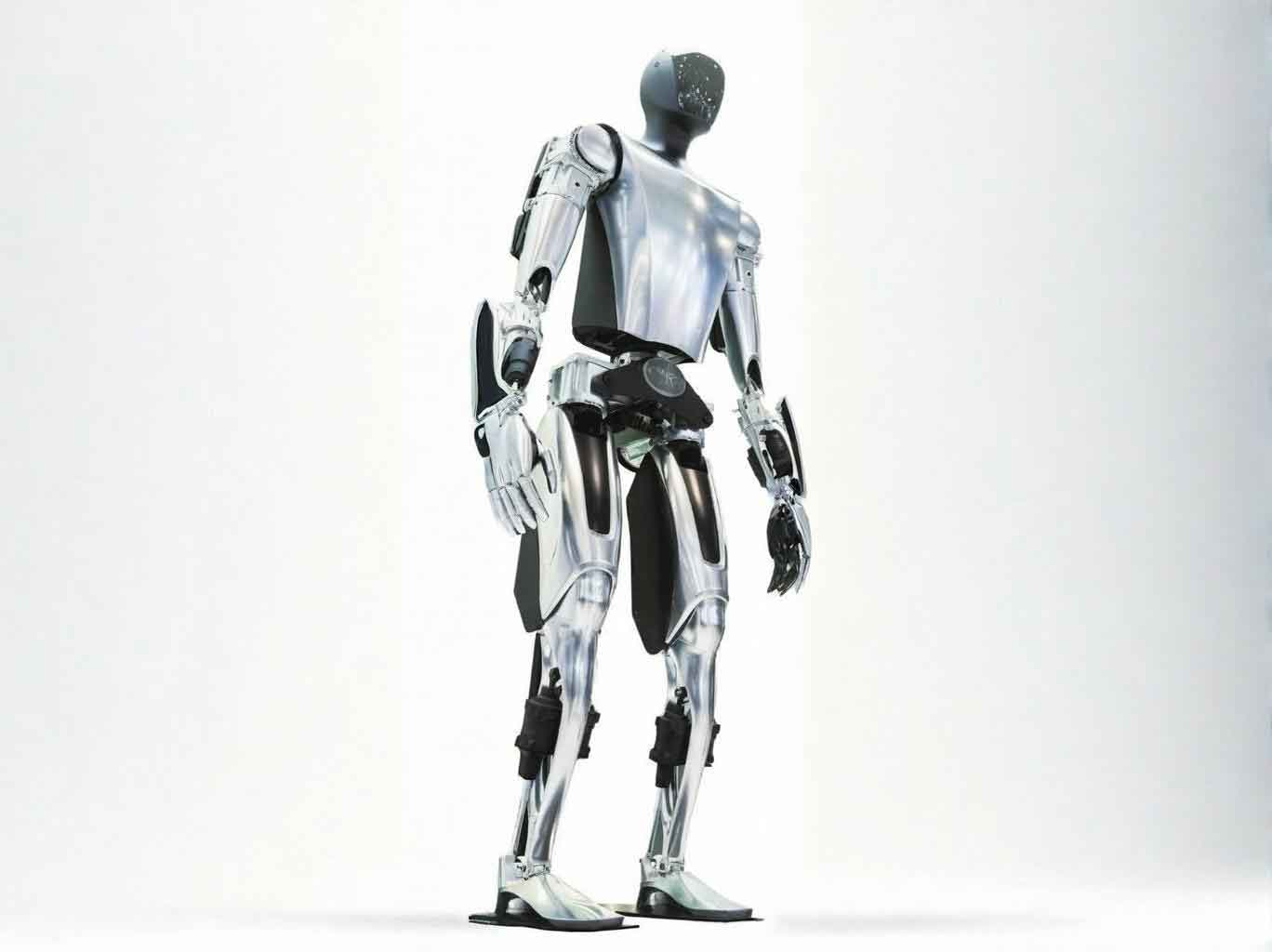
As illustrated above, embodied AI robots are increasingly integral to advanced manufacturing lines. From my perspective, this visual underscores the seamless integration of embodied AI robots in automated settings, where they perform tasks ranging from assembly to quality control with minimal human intervention. The deployment of embodied AI robots in such environments not only boosts productivity but also enhances flexibility, allowing for rapid reconfiguration in response to market demands.
The application spectrum for embodied AI robots is vast and expanding. I have detailed key domains in the following table, highlighting the roles and benefits of embodied AI robots:
| Application Domain | Primary Functions of Embodied AI Robots | Performance Metrics and Formulas |
|---|---|---|
| Smart Manufacturing | Precision assembly, real-time quality inspection, adaptive material handling, predictive maintenance. | Defect rate reduction: $$D_r = D_0 \cdot e^{-k \cdot t}$$ where \(D_0\) is initial defect rate, \(k\) depends on embodied AI robot accuracy. |
| Healthcare and Medical | Surgical assistance, rehabilitation therapy, patient monitoring, logistics within hospitals. | Success rate in procedures: $$S = \frac{N_{success}}{N_{total}} \cdot 100\%$$ often enhanced by embodied AI robot precision. |
| Logistics and Supply Chain | Automated sorting, warehouse navigation, last-mile delivery, inventory management. | Throughput: $$T = \frac{Items\ processed}{Time}$$ optimized by embodied AI robot speed and coordination. |
| Agriculture and Farming | Autonomous harvesting, soil and crop monitoring, targeted pesticide application, livestock management. | Yield improvement: $$Y = Y_0 + \Delta Y \cdot R_{density}$$ where \(R_{density}\) is embodied AI robot deployment density. |
| Emergency and Disaster Response | Search and rescue in hazardous zones, structural assessment, supply delivery, firefighting support. | Response effectiveness: $$E = \frac{People\ rescued}{Time\ elapsed}$$ boosted by embodied AI robot endurance and sensors. |
| Retail and Commercial Services | Customer assistance, inventory restocking, cleaning, security patrols. | Customer satisfaction score: $$CSAT = \frac{Positive\ responses}{Total\ responses} \times 100$$ influenced by embodied AI robot interaction quality. |
To further analyze the economic impact, I consider a cost-benefit model for adopting embodied AI robots. The net present value (NPV) can be calculated as: $$NPV = \sum_{t=1}^{n} \frac{CF_t}{(1 + r)^t} – I_0$$ where \(CF_t\) is the cash flow in year \(t\) from efficiency gains and cost savings attributed to embodied AI robots, \(r\) is the discount rate, \(I_0\) is the initial investment in embodied AI robots, and \(n\) is the project lifespan. Typically, as technology advances, \(I_0\) decreases while \(CF_t\) increases, making embodied AI robots more viable.
Interoperability remains a critical challenge for embodied AI robots, especially in heterogeneous systems. I propose a compatibility metric: $$Compatibility\ Score(CS) = \frac{\sum_{m} I_m}{M} \cdot \frac{1}{1 + \sigma^2}$$ where \(I_m\) is interoperability for module \(m\), \(M\) is the total modules, and \(\sigma^2\) is the variance in standards adherence. Higher scores indicate smoother integration of embodied AI robots across platforms.
Looking ahead, the evolution of embodied AI robots will be shaped by trends in AI convergence, edge computing, and sustainable design. I anticipate that embodied AI robots will become more energy-efficient, with power consumption modeled as: $$P = P_{base} + \sum_{c} (P_c \cdot U_c)$$ where \(P_{base}\) is base power, \(P_c\) is power per component (e.g., sensors, processors), and \(U_c\) is utilization rate. Innovations in materials and algorithms will drive down \(P\), enabling longer operation for embodied AI robots.
In conclusion, embodied AI robots stand at the forefront of industrial and societal transformation. Through robust standardization and targeted policy support, the ecosystem for embodied AI robots is maturing rapidly. As I reflect on these developments, it is evident that embodied AI robots will not only enhance productivity but also unlock new possibilities in automation, making them indispensable to the future of smart manufacturing and beyond. The continuous iteration of standards and incentives will ensure that embodied AI robots evolve in tandem with technological advancements, solidifying their role as key enablers of progress.