
The evolution of artificial intelligence from a “disembodied” to an “embodied” paradigm marks a pivotal juncture in technological and economic history. As AI acquires a physical form capable of interacting with and navigating the real world, it transcends its role as a purely computational tool. This new form, embodied AI robot, is emerging as a transformative force, particularly within the service economy. The service sector, characterized by the simultaneity of production and consumption, is inherently experiential. Its value is co-created in the moment of interaction between the provider and the consumer. This paper posits that service consumption is fundamentally an experiential manifestation of specific social relations, and embodied AI robot serves as the novel material vehicle for constructing and reshaping these relations. By physically embedding intelligence into service environments, these systems are driving a profound transformation from a standardized, functional model of service delivery to a personalized, high-value paradigm centered on human experience.
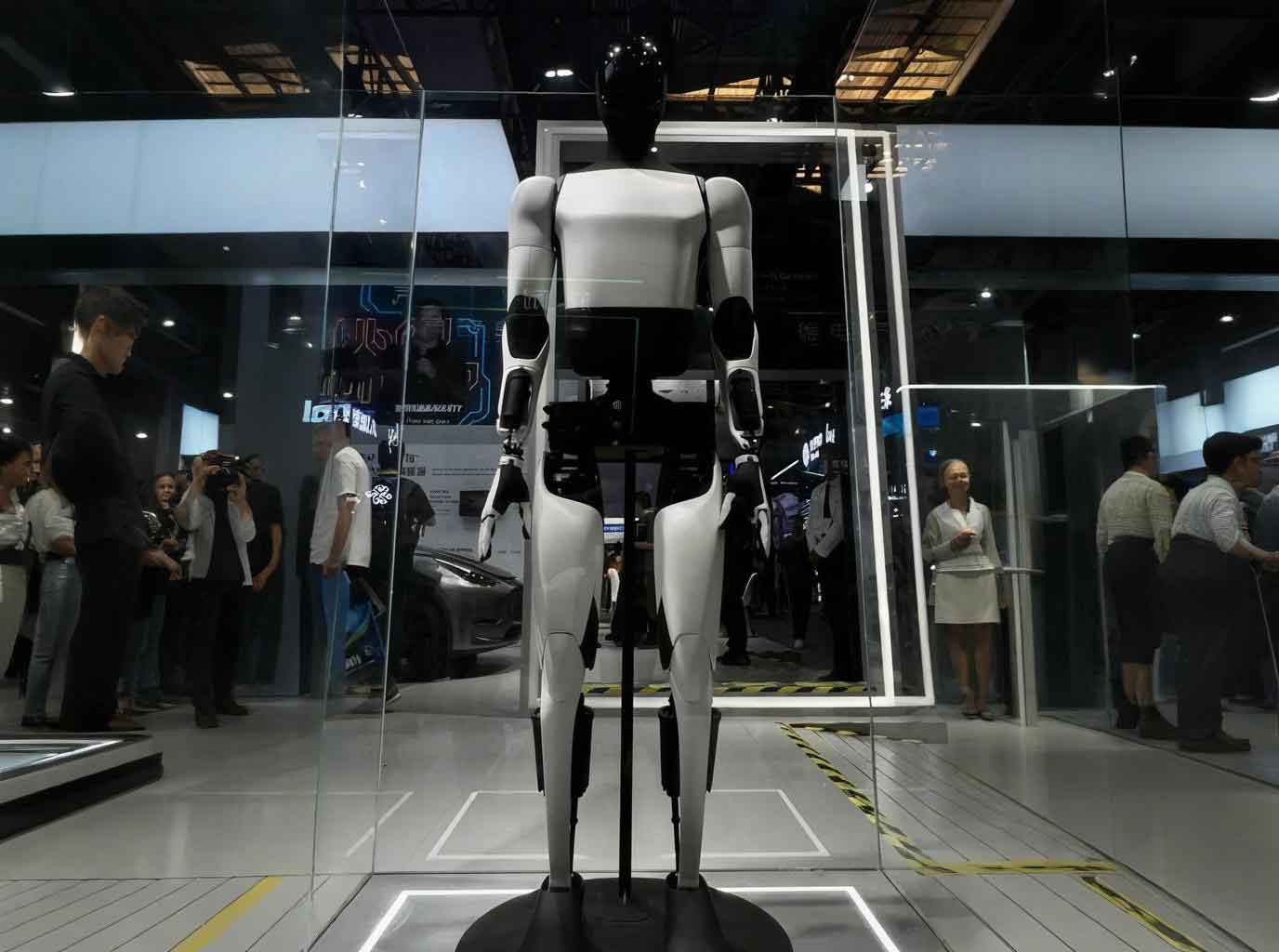
The theoretical departure of embodied AI robot from traditional AI lies in its foundation in embodied cognition. It challenges the “disembodied” view of intelligence as abstract symbol manipulation. Instead, intelligence is understood as arising from the dynamic interplay between an agent’s physical body, its sensory-motor capabilities, and its environment. An embodied AI robot operates through a continuous perception-action cycle: it perceives the world through sensors, understands context (often via large multimodal models), makes decisions, and executes physical actions, learning and adapting from the consequences. Formally, this can be represented as a cycle where the agent’s policy $\pi$ maps states $s_t$ from the environment to actions $a_t$, which in turn change the environment to a new state $s_{t+1}$, generating a reward $r_t$:
$$ s_t \xrightarrow{\pi(a_t|s_t)} a_t \longrightarrow s_{t+1}, r_t $$
This closed-loop interaction with the physical world is the core differentiator. The economic attribute of an embodied AI robot is that of a new capital form—an active, adaptive production factor that merges algorithms, data, and mechanics to directly participate in service value creation.
Theoretical Underpinnings: From Function to Experience
The transition in service consumption towards experientialization is not merely a market trend but a response to deeper socio-structural shifts. In an era of individualization and fleeting social connections, services that offer functional utility alone are insufficient. Consumers increasingly seek meaning, emotional engagement, and social connection through consumption. The value proposition shifts from the output of a service to the subjective process and its mnemonic, social, or transformative qualities.
Embodied AI robot acts as the key enabler for this shift by serving as an interactive, context-aware medium within service settings. Its roles can be categorized as follows:
| Role of Embodied AI Robot | Description | Impact on Service Relation |
|---|---|---|
| Interactive Mediator | Facilitates new forms of dialogue, gamified exploration, and task execution between consumer and service system. | Reshapes micro-foundations of interaction, creating novel social rituals and shared experiences. |
| Relationship Expander | Adapts its role from tool to companion, coach, or collaborator based on context (e.g., eldercare, retail, education). | Expands the boundaries of traditional service relationships, fostering hybrid human-machine partnerships. |
| Experience Enabler | Uses multimodal sensing and real-time data processing to deliver highly personalized, dynamic experience flows. | Turns service consumption into a loop of digital recognition and reinforcement of individual identity and social attributes. |
The Tripartite Mechanism of Transformation
The driving force of embodied AI robot can be dissected into three interconnected mechanisms that systematically reconfigure service consumption.
1. Empowering the Consumer: From Time Liberation to Agency Affirmation
The primary economic effect is the reconfiguration of time. Embodied AI robot automates low-value, repetitive tasks, freeing the consumer’s time from necessary consumption activities. Drawing from Becker’s time allocation theory, a consumer maximizes utility $U$ subject to a time budget constraint. If $T_w$ is work time, $T_c$ is consumption time for necessary services, and $T_l$ is leisure time for experiential activities, with $T$ as total time, we have:
$$ \max U(Z_1, Z_2, …, Z_n) $$
$$ \text{s.t. } T_w + T_c + T_l = T $$
$$ \text{and monetary budget constraint} $$
By reducing $T_c$, embodied AI robot increases $T_l$, allowing reallocation towards higher-utility experiential activities. However, the deeper value lies in what this liberated time enables: the affirmation of consumer agency. The embodied AI robot transitions from a passive tool to an active partner that supports creative exploration, learning, and social engagement, thereby fostering the consumer’s role as a co-creator rather than a passive recipient.
2. Deepening Service Value: From Sensory Capital to Human-Centricity
Embodied AI robot shifts the core of service value from instrumental functionality to affective and meaningful experience. It leverages affective computing to recognize and respond to user emotion, creating strong emotional anchors. It also expands the sensory dimension of interaction beyond sight and sound to include touch, kinesthetics, and more, creating a unique “sensory capital.” The value optimization can be linked to the Peak-End rule from behavioral economics, where the remembered experience $V_{mem}$ is a function of the peak intensity ($I_{peak}$), the end intensity ($I_{end}$), and a weighted sum of moments:
$$ V_{mem} \approx f( I_{peak}, I_{end}, \sum_{t=1}^{n} w_t I_t ) $$
An embodied AI robot can be programmed to strategically manage these peaks and endings, enhancing overall remembered utility. The ultimate direction, however, is a genuine human-centricity where technology fosters individual growth, empathy, and social connection, moving beyond mere stimulation.
3. Reconstructing the Supply-Demand Ecosystem: From Precision Matching to Symbiotic Ecology
This mechanism involves a systemic overhaul of the service economy’s foundational elements. The table below summarizes this reconstruction:
| Economic Element | Traditional Model | Embodied AI-Driven Model |
|---|---|---|
| Supply (Cost Structure) | Subject to Baumol’s “cost disease”; scaling personalized service is expensive. | High-value service processes are codified into digital models. Marginal cost of replicating quality experiences drops dramatically, enabling “democratization” of personalization. |
| Space | Passive container for service delivery; value based on “location rent.” | Active, sensing, interactive “experience field.” Value shifts to “experience rent,” enabling “scene-as-a-service” models. |
| Matching Mechanism | Static or algorithm-based matching on historical data. | Real-time, micro-production function based on instantaneous user state and latent preference: $S_t = f(P_t, E_t, C_t)$, where $S_t$ is service offered, $P_t$ is user preference, $E_t$ is environment, $C_t$ is context. |
| Ecosystem Dynamics | Linear value chain: producer → service → consumer. | Symbiotic, co-creative ecology: User data and feedback fuel system optimization, creating a virtuous cycle of value共创 (co-creation). |
Current Challenges and Impediments
Despite its potential, the widespread adoption of embodied AI robot in service consumption faces significant hurdles, which can be summarized as follows:
| Challenge Domain | Specific Bottlenecks | Consequence |
|---|---|---|
| Technical | Poor “Brain” (cognition) and “Little Brain” (motion control) coordination. Weak generalization for long-tail scenarios. Clumsy operation in dynamic human environments. | Low overall adaptability, high error rates, and unreliable performance in complex, unstructured settings. |
| Scenario Adaptation | “Potted landscape” demonstrations in showcase sites. Non-standardized service workflows. Lack of human-robot interface standards. Unclear return on investment (ROI). | Difficult cross-scenario migration and scaling. High initial deployment costs and integration complexity. |
| Policy & Ecosystem | Fragmented industry ecosystem. Lack of common technology platforms. Policy incentives skewed towards R&D, lacking support for scenario opening, procurement, and mid-stage testing. | High barriers to entry for SMEs. Slow pace of commercial validation and market formation. |
| Experience Evaluation | Subjective nature of experience makes it hard to quantify. Lack of standardized metrics for time efficiency, emotional connection, personalization, and fluency. | Technology optimization lacks data-driven guidance. Value distribution among stakeholders is difficult to rationalize. |
Strategic Pathways for Advancement
To overcome these challenges and realize the transformative potential, a coordinated, multi-dimensional strategy is essential.
1. Technological Breakthroughs: Focus must be on the integrated “Brain-Little Brain” system. Advancing multimodal large models and world models will enhance cognitive generalization. Concurrently, developing embodied “little brain” control algorithms is crucial for stable, fine motor skills in dynamic settings. Creating a closed-loop data flywheel—where deployment data feeds model training, leading to performance improvement—is vital for continuous evolution.
2. Scenario-Led Penetration: A tiered strategy is needed. Begin with mature scenarios (e.g., guided delivery in hotels, retail) and progressively tackle more complex ones (e.g., interactive education, advanced elderly assistance). Implementing a “job-based” design philosophy, where complex services are decomposed into standardized, modular roles performed by an embodied AI robot, greatly simplifies deployment and scaling. Network effects should be leveraged through demonstration zones and city-wide ecosystem builds.
3. Fostering a Collaborative Ecosystem: Policymakers should design precise incentives, such as procurement subsidies for both technology providers and scenario adopters, to de-risk early adoption. Building public service platforms—offering shared testing environments, simulation tools, and benchmarking standards—can lower the innovation threshold for all players, especially SMEs.
4. Quantifying the Experience: Developing a multidimensional experience assessment framework is critical. Metrics must translate subjective feelings (engagement, satisfaction) into objective, analyzable data. This framework will enable closed-loop optimization of service design and support the development of fair value-sharing business models among technology firms, service operators, and consumers.
Value Orientation and Synergistic Evolution: A Human-Centric Future
The ultimate goal of deploying embodied AI robot is not the mere substitution of human labor but the promotion of holistic human development. Technology must serve to amplify human agency, creativity, and well-being. Therefore, its development must be guided by a core value anchor: prioritizing human-centricity and consumer sovereignty. This requires ensuring that interaction with an embodied AI robot enhances the user’s sense of control, choice, and participation.
This value must be operationalized through:
- Promoting Inclusive Development: Implementing gradient promotion strategies and differentiated subsidy policies to prevent a “robotics divide” between developed and less-developed regions. Reducing usage barriers through cost optimization, intuitive interface design, and new vocational training for human-robot collaboration.
- Ensuring Safety and Privacy: Establishing rigorous safety standards and lifecycle监管 (supervision) for embodied AI robot. Embedding Privacy-by-Design principles, adhering to data minimization, and ensuring transparent user consent are non-negotiable for building trust.
- Developing Adaptive Governance: Creating a legal and regulatory framework that balances innovation encouragement with risk prevention. This involves agile, multi-stakeholder governance that can evolve alongside the technology, fostering a culture of responsible innovation.
Conclusion and Future Outlook
Embodied AI robot represents a paradigm shift, moving artificial intelligence from the digital realm into the fabric of our physical and social world. Its integration into service consumption is systematically dismantling the old functional model and constructing a new experiential one through mechanisms of consumer empowerment, value deepening, and ecosystem reconstruction. The path forward requires concerted efforts to break through technical bottlenecks, innovate in scenario application, cultivate a supportive ecosystem, and establish human-centric evaluation and governance体系 (systems).
Future research should empirically validate the proposed mechanisms, investigate cross-scenario migration capabilities, and deeply analyze the long-term socioeconomic impacts on labor structures and consumption equity. The grand challenge and opportunity lie in orchestrating the synergistic evolution of technology, industry, institution, and value, ensuring that the rise of the embodied AI robot ultimately leads to a more empowering, inclusive, and profoundly human service economy.