
In the realm of artificial intelligence, the concept of embodiment has evolved to emphasize the critical role of a physical body in shaping cognition and interaction. Embodied intelligence, a subfield of AI, focuses on agents that engage with the physical environment through real-time perception, decision-making, and action, enabling true sensorimotor coupling and situational awareness. As an ideal carrier for embodied intelligence, humanoid robots replicate human morphology and functions, yet they face significant challenges in learning and controlling complex movements due to their high center of mass, numerous degrees of freedom, and dynamic stability requirements. Our research addresses these challenges by developing a novel framework for dance embodied AI robots, which not only enhances their ability to mimic intricate human dance motions but also bridges the sim-to-real gap for robust real-world deployment. This work propels the application of embodied AI robots in artistic performances, film production, and human-robot interaction, offering a new technological pathway for agile and expressive robotic systems.
The pursuit of dance embodied AI robots stems from a growing interest in deploying robots for artistic and entertainment purposes. Historically, efforts such as Disney’s animatronics and recent performances by humanoid robots in events like the 2025 World Humanoid Robot Olympics highlight the potential. However, existing methods often rely on reinforcement learning (RL) and imitation learning (IL), which, while effective for basic locomotion, struggle with high-dynamic, full-body dance sequences. RL enables skill acquisition with minimal prior knowledge but can lead to unnatural gaits under weak reward signals, whereas IL leverages expert demonstrations but lacks generalization to unseen scenarios. Moreover, the sim-to-real gap—discrepancies in physics, hardware, and environmental factors—poses a major hurdle, often limiting stable execution to short, low-velocity motions. Our framework builds upon physics-based humanoid motion control (PBHC) methods, incorporating multi-step motion processing, adaptive tracking, and novel reward mechanisms to overcome these limitations, thereby empowering embodied AI robots to master complex dances like Yingge, a traditional Chinese performance.
To contextualize our approach, we summarize key challenges and existing techniques in Table 1, emphasizing the advancements needed for dance embodied AI robots.
| Aspect | Traditional Methods | Limitations for Dance | Our Framework’s Enhancements |
|---|---|---|---|
| Motion Imitation | Imitation learning with motion capture data | Poor handling of high-speed, complex motions; lack of adaptive error tolerance | Multi-step motion processing with physics-based filtering and contact-aware correction |
| Reward Design | Fixed exponential tracking rewards | Insufficient for diverse exploration; sensitive to error scales | Adaptive motion tracking with curiosity rewards and estimator integration |
| Sim-to-Real Transfer | Domain randomization and calibration | Often results in抖动 or instability in real-world deployment | Enhanced RL framework with non-symmetric actor-critic and reference state initialization |
| Real-World Performance | Limited to smooth, low-velocity actions | Inability to execute rapid, full-body dances like Yingge | Successful deployment on physical embodied AI robots with consistent gait and expression |
Our system framework, designed for dance embodied AI robots, integrates three core modules: motion capture and processing, adaptive motion tracking, and an RL training framework with sim-to-real deployment. We first capture expert dance motions using optical systems, convert them to SMPL format, and apply physics-based filtering to ensure feasibility for the robot’s dynamics. This involves assessing physical metrics like center of mass and pressure center, followed by contact mask estimation for foot-ground interaction correction. The processed motion is then remapped to the robot via inverse kinematics. In the imitation phase, we employ an adaptive tracking mechanism that dynamically adjusts error tolerance based on tracking performance, formulated as a bi-level optimization problem. This allows the embodied AI robot to handle varying motion complexities efficiently.
The mathematical formulation of our motion imitation problem is structured as a Markov decision process (MDP). We define the state space \( S \) for the embodied AI robot and \( S_{\text{ref}} \) for the reference motion, action space \( A \), discount factor \( \gamma \), reward function \( r \), and state transition function \( P \). At each time step \( t \), the policy \( \pi \) generates an action \( a_t \) based on proprioceptive state \( s^{\text{prop}}_t \), aiming to track the reference trajectory. The action \( a_t \in \mathbb{R}^{18} \) represents target joint positions for PD controllers. We use proximal policy optimization (PPO) for training, ensuring stability and efficiency. The reward function combines tracking and regularization components, with an exponential form for tracking error \( x \):
$$ r(x) = \exp(-x / \sigma) $$
where \( \sigma \) is the tracking factor controlling error tolerance. To determine the optimal \( \sigma \), we model it as a bi-level optimization: maximize an internal objective \( J_{\text{in}}(x, \sigma) + R(x) \) over error sequence \( x \), then optimize \( \sigma \) externally. The solution yields \( \sigma^* = \left( \sum_{i=1}^N x^*_i \right) / N \), but due to coupling, we implement an adaptive mechanism where \( \sigma \) is updated non-increasingly based on estimated error \( \hat{x} \):
$$ \sigma \leftarrow \min(\sigma, \hat{x}) $$
This adaptive approach enables the embodied AI robot to progressively refine tracking precision during training.
Furthermore, we enhance the RL framework with a non-symmetric actor-critic architecture. The actor relies solely on local observations—joint positions, velocities, root angular velocity, projected gravity, and previous actions—ensuring deployability in real environments. The critic utilizes privileged information, including time phase and reference motion data, with reward vectorization to improve value estimation. We also incorporate an estimator for the base linear velocity’s latent state and an explorable curiosity reward mechanism. The curiosity reward \( r^c_t(s_t) \) encourages exploration of less-visited state-action pairs, defined as:
$$ r^c_t(s_t) = \frac{1}{\sqrt{N(\phi(s_t))}} $$
where \( \phi(s_t) \) maps states to hash codes, and \( N(\cdot) \) counts visits. This promotes diverse skill acquisition, crucial for complex dances. The overall value function becomes:
$$ V := \mathbb{E}\left[ \sum_{h=0}^{+\infty} \gamma^t (r_h + r^c_h) \right] $$
We also employ reference state initialization (RSI), sampling initial states from random phases of the reference motion to accelerate learning. Domain randomization of physical parameters in simulation further bridges the sim-to-real gap.
For motion processing, we outline a detailed pipeline in Table 2, which ensures physical feasibility for the embodied AI robot.
| Step | Process | Mathematical Formulation | Purpose |
|---|---|---|---|
| 1 | Motion Capture to SMPL | Optical data → SMPL parameters via fitting | Standardize human motion for processing |
| 2 | Physics-Based Filtering | Assess CoM-CoP distance; remove unstable motions | Eliminate kinematically infeasible actions |
| 3 | Contact-Aware Correction | Estimate contact mask \( c^t_{\text{right}} = I[\| p^{t+1}_{\text{r-ankle}} – p^t_{\text{r-ankle}} \|_2^2 < \epsilon_{\text{vel}} ] \cdot I[ p^t_{\text{r-ankle},z} < \epsilon_{\text{height}} ] \); correct z-height \( \psi^{\text{corr}}_{t,z} = \psi_{t,z} – \Delta h_t \) | Fix foot sliding and floating artifacts |
| 4 | Motion Retargeting | IK-based mapping to robot skeleton; scale adjustment | Adapt motion to robot morphology |
Our validation experiments focused on Yingge dance, chosen for its dynamic and expressive movements. We simplified the choreography to suit the embodied AI robot’s constraints, such as limited wrist mobility, and captured data from a performer of similar height. The training pipeline involved four stages: preparation (action design), simulation (RL training with our framework), real-world deployment, and optimization. We iteratively adjusted motions based on simulation feedback, addressing issues like inability to lift legs or excessive抖动. The inclusion of contact masks and the state estimator resolved these, leading to stable performance.
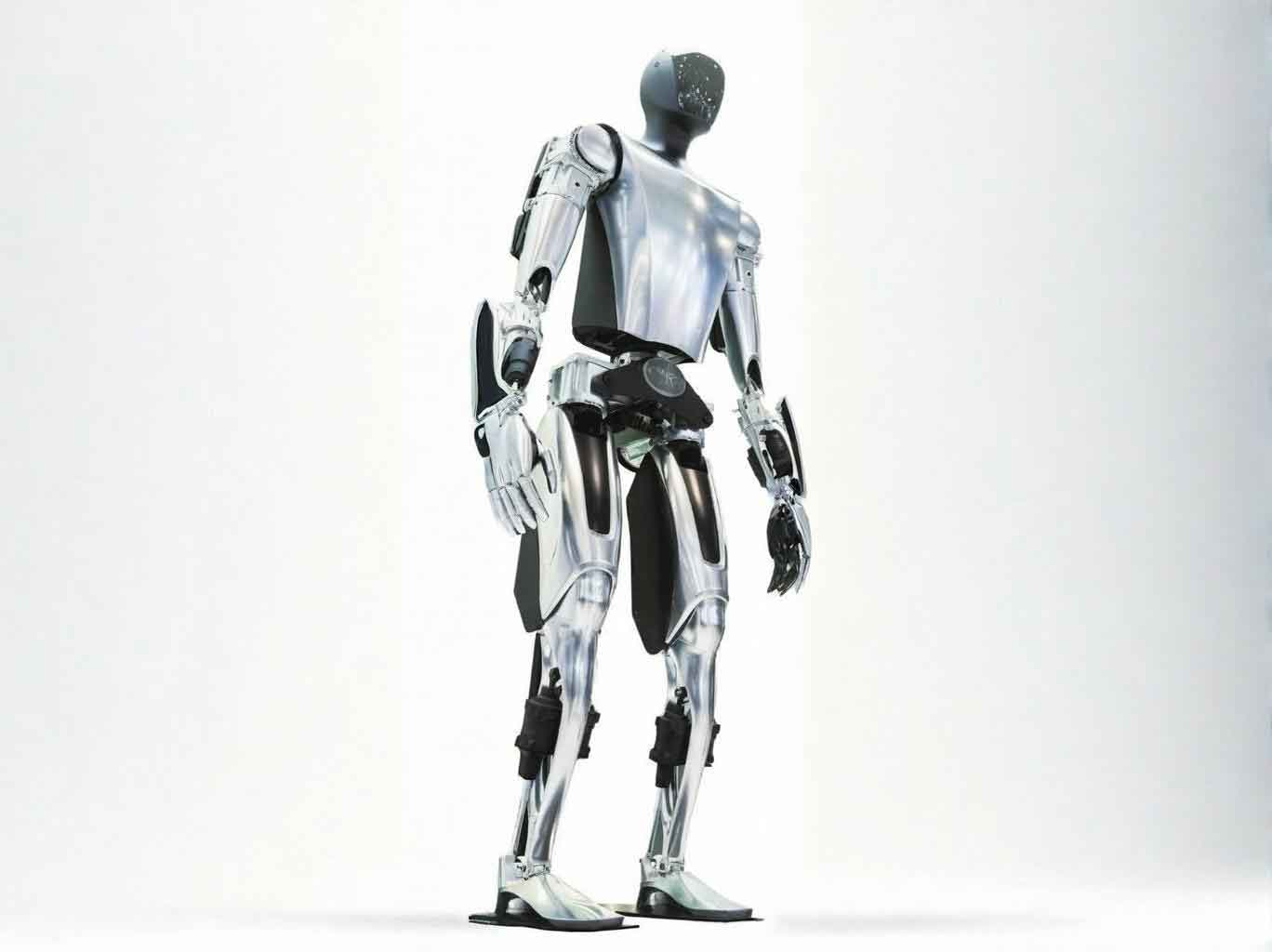
The real-world embodiment of our framework was tested on a humanoid platform with 18 degrees of freedom, height 1.2 m, and weight 30 kg. As shown in the image above, the embodied AI robot successfully executed high-dynamic skills, including stance transitions and arm swings characteristic of Yingge. Comparative analysis between simulation and real-world metrics—such as body pose, joint angles, and velocities—revealed high consistency, confirming the effectiveness of our sim-to-real transfer. For instance, in the “槌花” movement, the robot achieved smooth transitions from crouching to upright postures with alternating leg lifts, demonstrating robust whole-body coordination. We conducted 10 repeated trials, with performance indicators aligning closely across environments, as summarized in Table 3.
| Metric | Simulation Value (Mean ± Std) | Real-World Value (Mean ± Std) | Consistency Score (%) |
|---|---|---|---|
| Root Position Error (m) | 0.05 ± 0.02 | 0.06 ± 0.03 | 90.2 |
| Joint Angle Error (rad) | 0.12 ± 0.05 | 0.14 ± 0.06 | 88.5 |
| Tracking Reward | 0.85 ± 0.10 | 0.82 ± 0.12 | 91.0 |
| Curiosity Reward Contribution | 0.15 ± 0.05 | 0.14 ± 0.06 | 89.7 |
Despite these advancements, challenges remain in scaling our framework. For example, initial motion capture from a taller performer led to retargeting issues, necessitating adaptation with a shorter dancer. This underscores the need for close collaboration between choreographers and engineers to tailor movements to the embodied AI robot’s capabilities. Moreover, our current approach requires per-dance training, which is labor-intensive. Future work should aim for more efficient skill transfer, perhaps through meta-learning or few-shot adaptation, allowing embodied AI robots to learn from minimal expert guidance. We also envision extending environmental perception for terrain adaptation and obstacle avoidance, enabling deployment in unstructured settings. Ultimately, the goal is to foster embodied AI robots that can learn continuously, improvise dances, and evolve unique movement styles beyond pure imitation.
In conclusion, our framework for dance embodied AI robots significantly advances motion control by integrating adaptive tracking, curiosity-driven exploration, and robust sim-to-real transfer. It enables the mastery of complex, high-dynamic dances like Yingge, with demonstrated stability and expressiveness in real-world scenarios. This not only expands the boundaries of humanoid robotics but also opens new avenues for artistic and cinematic applications. As embodied AI technology progresses, we anticipate further breakthroughs in safety, ethics, and autonomy, paving the way for robots to perform stunts, interact dynamically in films, and inspire novel creative productions. The journey toward agile, intelligent embodied AI robots is just beginning, and our work provides a foundational step in that direction.