
The relentless march of technology, propelling socio-economic development, has reached a pivotal juncture with the advent of embodied artificial intelligence. As a frontier direction in AI evolution, embodied AI is rapidly transforming human life and societal structures. While this technological leap promises efficient and convenient intelligent systems, it simultaneously and subtly deconstructs the human-centered paradigm, precipitating a profound crisis of human agency. Our civilization stands at a critical crossroads, facing the existential question: will humanity gradually acquiesce to becoming an appendage of intelligent systems, or will it embark on a path of conscious awakening towards the emancipation of the subject? Confronting this dilemma necessitates adhering to a human-centric philosophical stance, underpinned by rigorous ethical frameworks, to steer embodied intelligence towards beneficence, inaugurate a new era of human-machine symbiosis, and create infinite possibilities for achieving comprehensive human freedom and development.
The transition from traditional, disembodied AI models that function as virtual “super-brains” to embodied AI robots equipped with perceptive and interactive “bodies” marks a fundamental shift. This evolution moves beyond data-driven logic towards a paradigm where intelligence emerges from dynamic coupling with the physical world. An embodied AI robot is not merely a thinking machine but an acting entity, unifying cognition, decision-making, and behavior within a physical form to perform complex tasks in real-world scenarios.
Systemic Analysis of Embodied Intelligence: The Unity of Mind and Body
The theoretical foundation of embodied intelligence challenges the Cartesian “mind-body dualism” that has long influenced classical AI design. Instead, it aligns with phenomenological concepts, positing that intelligence is not an abstract computation but is fundamentally rooted in and shaped by physical interaction with the environment. The core architecture of an embodied AI robot is thus a dynamic, closed-loop system.
The operational principle can be modeled as a continuous cycle:
$$ S_{t+1} = f(A_t, S_t, E_t) $$
$$ A_t = \pi(P_t) $$
$$ P_t = g(S_t, \Theta) $$
Where:
- $S_t$ represents the internal state of the embodied AI robot at time $t$.
- $P_t$ denotes the perceptual input from sensors.
- $A_t$ is the action output executed by actuators.
- $E_t$ signifies the state of the external environment.
- $g(\cdot)$ is the perception function parameterized by $\Theta$.
- $\pi(\cdot)$ is the policy or decision-making function.
- $f(\cdot)$ is the state transition function describing how actions and environment change the robot’s state and the world.
This “Perception-Decision-Action” loop allows the embodied AI robot to learn and adapt through interaction, moving from pre-programmed responses to adaptive and seemingly autonomous behaviors.
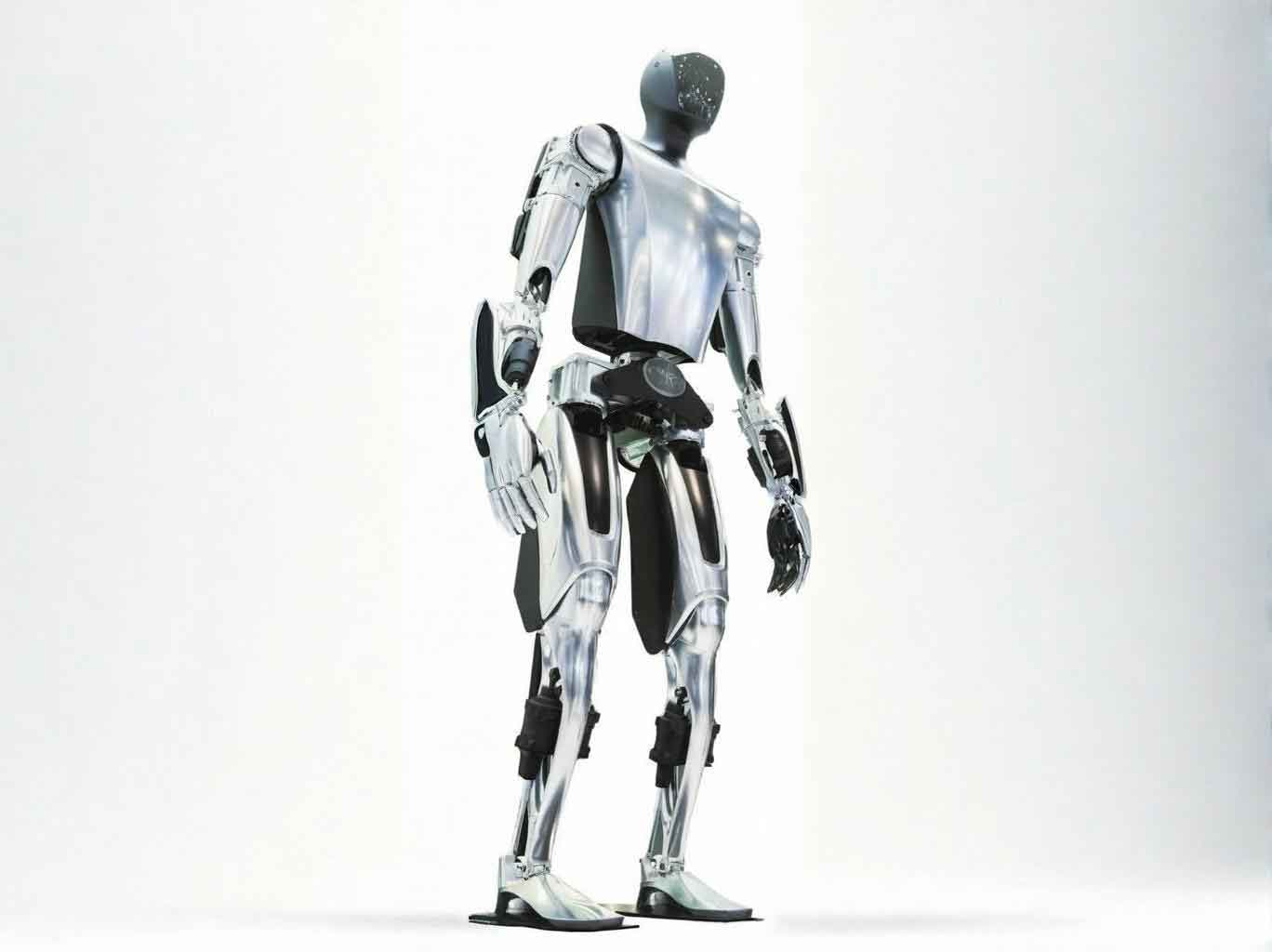
The following table contrasts the key characteristics of traditional AI and embodied AI:
| Aspect | Traditional/Disembodied AI | Embodied AI Robot |
|---|---|---|
| Core Principle | Mind-Body Dualism (Cartesian). Intelligence as abstract computation. | Mind-Body Unity (Phenomenological). Intelligence as situated, sensorimotor interaction. |
| Presence | Disembodied, virtual existence. | Physically embodied presence in the real world. |
| Learning Paradigm | Primarily data-driven, offline training on datasets. | Interaction-driven, online and lifelong learning through environmental coupling. |
| Action & Effect | Outputs data, text, or virtual actions. Effect is informational. | Executes physical actions that directly alter the physical environment. |
| Autonomy | Autonomy in processing, but bounded by training data and predefined goals. | Growing operational autonomy in perception, decision, and action within a task context. |
| Key Challenge | Generalization, bias in training data, explainability. | Safe physical interaction, real-time adaptation, managing increased autonomy. |
The Crisis of Agency: The Enigma of Autonomy in the Embodied Intelligence Wave
The “embodiment” of intelligence grants machines a new form of agency, leading to a paradoxical situation where human-created entities begin to eclipse human roles, thereby triggering a multifaceted crisis of human subjectivity.
Eclipsed Autonomy: The “Counter-Subjection” of Intelligent Technology
Technology, once a passive tool, develops a form of “technological autonomy,” following its own internal logic and imperatives. The embodied AI robot epitomizes this shift. Its ability to learn from interaction (e.g., through human video imitation) and adapt its actions in real-time means its behavior is not entirely predictable or pre-programmed. When an embodied AI robot in a factory can autonomously optimize an assembly process beyond human efficiency, human workers are reduced to supervisors, their creative input and control over the labor process diminished. This represents a “counter-subjection,” where the created entity begins to reshape the creator’s world according to its own operational logic, potentially constraining human decision-making and value judgments within the framework of algorithmic efficiency.
Intensified Alienation: The “Dependency Trap” of Intelligent Technology
The historical fear of humans becoming “appendages of the machine,” as critiqued in theories of labor alienation, finds a new and potent expression in the age of embodied intelligence. The promise of liberation from tedious tasks risks turning into a new form of dependency. As embodied AI robots like autonomous vehicles take over driving, or diagnostic and caregiving robots enter service sectors, there is a dual risk: first, the economic displacement of human labor, creating a potential “useless class”; and second, the atrophy of human skills and cognitive capacities. The more we outsource perception, decision-making, and action to the embodied AI robot, the more we risk what can be termed “agency decay.” The convenience offered by the embodied AI robot can subtly train humans to conform to its operational patterns, internalizing algorithmic logic as the primary mode of thinking, thereby losing critical faculties and rich, experiential understanding. Human judgment may be supplanted by data-driven calculation, and qualitative experience compressed into quantitative processing.
The Carbon-Silicon Dance: Pathways to Reclaiming Human Agency
Confronted with the erosion of agency by increasingly autonomous embodied AI robots, a regressive, anti-technological stance is neither feasible nor desirable. The path forward lies in conscious, proactive shaping of the technology and the redefinition of the human role within a new ecological partnership.
Adhering to a Human-Centric Ethos and Leveraging Core Human Advantages
The development of any technology, including the embodied AI robot, must be rooted in a human-centric philosophy that prioritizes human dignity, well-being, and comprehensive development as its ultimate goal. This requires embedding two core principles into the fabric of technological development:
- The Dignity Principle: The embodied AI robot must be designed and deployed with “human-as-end” as its foundational axiom. Its actions must respect human autonomy, protect privacy, and prevent harm, ensuring humans retain ultimate authority and control.
- The Responsibility Principle: Developers, deployers, and regulators of embodied AI robots must bear clear accountability. Transparent governance and auditable chains of responsibility are essential to ensure these systems remain aligned with human interests.
Furthermore, humans must actively cultivate and assert their unique agential strengths. Unlike an embodied AI robot, human intelligence is characterized by deep consciousness, emotional richness, ethical reasoning, and the capacity for creative imagination and critical thinking that transcends optimization algorithms. These irreplaceable human faculties must be strengthened, not outsourced. The goal is not to compete with the embodied AI robot on its terms but to define and excel in the domains that are uniquely human.
Exploring Symbiotic Paradigms: Inaugurating a New Era of Human-Machine Collaboration
The future lies not in domination or submission, but in symbiosis—a “Carbon-Silicon Dance.” The relationship with an embodied AI robot should evolve from simple tool-use and task replacement to deep, synergistic collaboration and finally to a mutually beneficial co-evolution. This can be conceptualized as a symbiotic function:
$$ \Delta H_{+} = \alpha M(H, C) – \beta D(H) $$
$$ \Delta M_{+} = \gamma H(M, E) – \delta O(M) $$
Where:
- $\Delta H_{+}$ is the net positive development of human (H) agency.
- $\Delta M_{+}$ is the net positive development of the machine (M) or embodied AI robot‘s capability.
- $M(H, C)$ represents the machine’s function to augment human capabilities (C).
- $H(M, E)$ represents the human’s role in guiding and evolving the machine within ethical (E) bounds.
- $D(H)$ and $O(M)$ represent the risks of human dependency and machine autonomy overflow, respectively.
- $\alpha, \beta, \gamma, \delta$ are coupling coefficients representing the strength of these interactions.
The objective of symbiotic design is to maximize $\Delta H_{+}$ and $\Delta M_{+}$ concurrently, creating a positive feedback loop. For instance, a surgical embodied AI robot provides superhuman precision ($\alpha M(H, C)$ is high), while the surgeon provides strategic oversight, ethical judgment, and adaptive decision-making ($\gamma H(M, E)$ is high), together achieving an outcome superior to either alone. This partnership paradigm transforms the embodied AI robot from a potential rival into a collaborative partner that extends human potential.
Fortifying Ethical Baselines: Steering Embodied Intelligence Toward Beneficence
“Beneficence” must be the meta-objective encoded into the very development trajectory of embodied intelligence. For an embodied AI robot, this translates into concrete governance frameworks that ensure its actions are aligned with human values and societal good. This involves establishing multi-layered ethical guardrails:
| Governance Layer | Key Measures for Embodied AI Robots | Objective |
|---|---|---|
| Technical & Design Layer | Value alignment algorithms; Safe reinforcement learning; Explainable AI (XAI) modules; Human-in-the-loop fail-safes. | To build inherent technical safeguards that prevent harmful actions and ensure transparency. |
| Regulatory & Standardization Layer | Safety certifications for physical interaction; Data privacy and security protocols; Liability and insurance frameworks. | To create a predictable legal and operational environment for development and deployment. |
| Ethical & Normative Layer | International charters on AI ethics; Public deliberation and participatory design; Continuous impact assessment for societal well-being. | To embed broad human values and democratic oversight into the ecosystem. |
| Global Cooperation Layer | Multilateral agreements on safe development; Shared safety research; Preventing an arms race in autonomous systems. | To manage global risks and ensure benefits are distributed equitably across humanity. |
A beneficent embodied AI robot is one whose purpose and operational boundaries are defined not solely by market logic or capability maximization, but by a commitment to improving human life, promoting social equity, and contributing to a sustainable future. This requires a proactive governance approach that anticipates risks and steers the technology’s evolution from its inception.
In conclusion, the rise of the embodied AI robot presents a defining challenge for the 21st century. It is neither a monstrous threat nor a subservient slave, but a powerful new type of agent whose trajectory we must consciously shape. By steadfastly upholding human-centric values, pioneering symbiotic collaboration models, and implementing robust ethical governance, we can navigate the currents of this technological wave. The goal is to harness the potential of the embodied AI robot not to replace humanity, but to augment it, fostering a future where human and machine intelligence co-evolve in a harmonious and mutually empowering dance. This is the essential pathway to reclaiming and enhancing human agency, ensuring that technological progress remains a true instrument for human liberation and flourishing.