
The concept of embodied AI robot intelligence, first proposed in the mid-20th century, is now poised to redefine the paradigm of industrial automation. As the manufacturing world pivots towards mass personalization and hyper-flexible production lines, the limitations of traditional, disembodied Artificial Intelligence (AI) become increasingly apparent. These systems, while powerful in digital realms, lack the capacity to directly perceive and physically manipulate the dynamic, unstructured environments of a modern factory floor. This is where the embodied AI robot emerges as the linchpin for the next chapter of smart manufacturing—an intelligent entity that integrates perception, cognition, and action into a unified physical form, capable of autonomous learning and collaboration within an open world.
The evolution from conventional robotics to an embodied AI robot signifies a shift from pre-programmed, repetitive task execution to adaptive, goal-oriented behavior. An embodied AI robot is not merely a tool but an active participant in the industrial ecosystem. Its “body” can be any industrial artifact—a robotic arm, an autonomous mobile robot (AMR), a CNC machine, or even a complex assembly of such entities forming a smart production line or an entire supply chain network. The true power of the embodied AI robot lies in its ability to learn from continuous interaction, generalize skills across tasks, and collaborate seamlessly with both humans and other machines. This transition is catalyzed by the advent of large AI models, which provide the cognitive substrate for reasoning, planning, and understanding the complex, multimodal sensory data of the physical world.
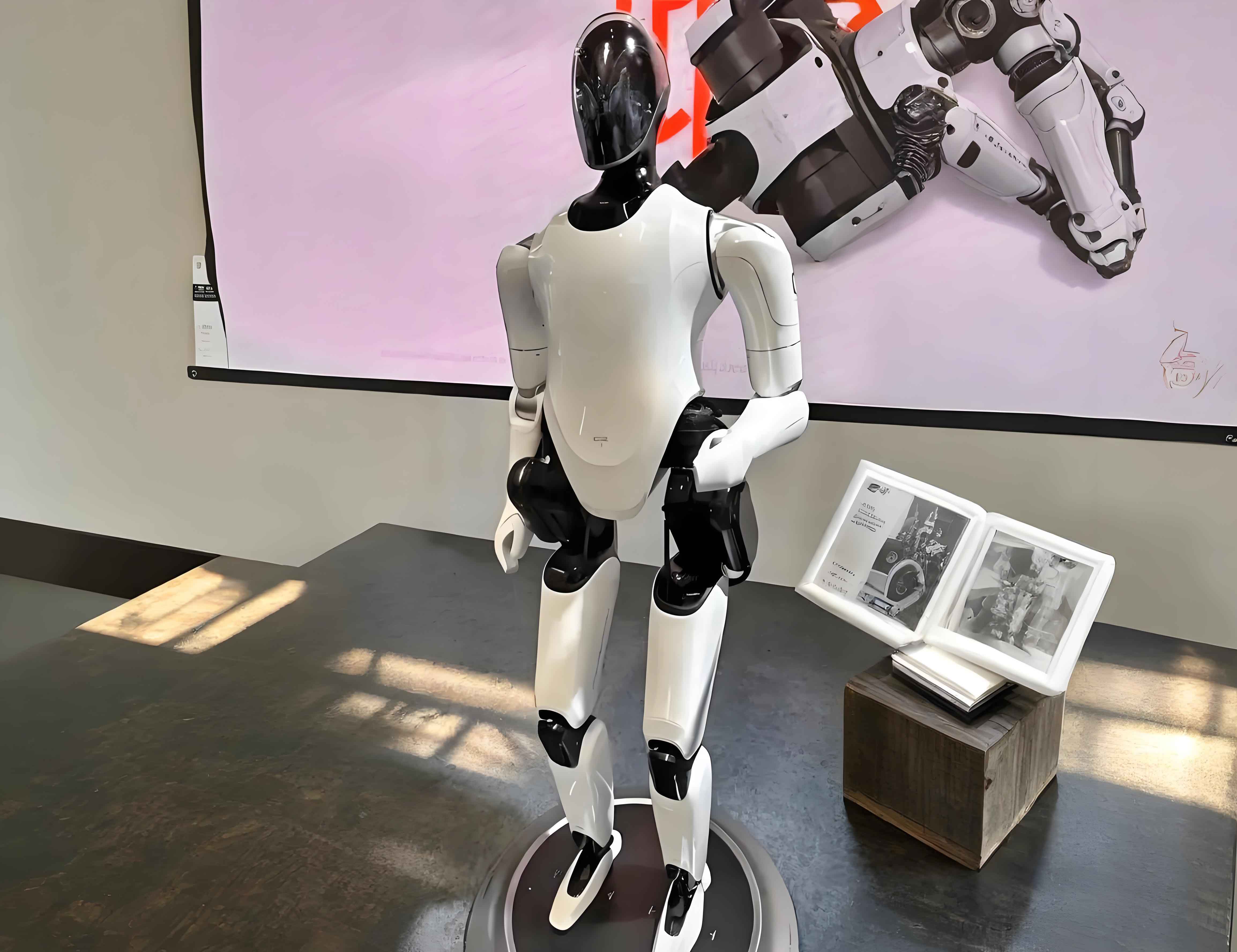
This architecture, which we can term the ABC Model of Embodiment, provides a holistic framework for understanding an embodied AI robot:
- AI Brain: This is the central cognitive unit, powered by large-scale foundation models. It handles high-level reasoning, task decomposition, long-term memory, and strategic planning. For an embodied AI robot, this brain interprets high-level goals (e.g., “assemble this engine module”) and formulates abstract plans.
- AI Cerebellum: Analogous to its biological counterpart, this component is responsible for sensorimotor coordination and low-level control. It processes proprioceptive feedback and exteroceptive sensory streams in real-time to refine movements, ensure balance, and execute smooth, precise actions. The cerebellum enables the fast, instinctive reactions essential for a physically situated embodied AI robot.
- Body (Actuation & Mechanical Structure): This is the physical manifestation—the motors, grippers, wheels, and mechanical linkages that enact the commands. The body’s capabilities and constraints directly shape the embodied AI robot‘s possible interactions with the world.
- Cross-Modal Sensing: A suite of sensors (visual, auditory, tactile, thermal, force-torque, etc.) provides a rich, multimodal representation of both the internal state (proprioception) and the external environment (exteroception). This sensory fusion is critical for an embodied AI robot to build a comprehensive world model.
Defining Characteristics of the Embodied AI Robot
The embodied AI robot is distinguished from previous generations of automation by several core characteristics, which are summarized in the following table.
| Feature | Traditional AI / Robotics | Embodied AI Robot |
|---|---|---|
| Task Scope | Finite, pre-defined tasks; Limited flexibility. | Infinite task learning; Continuous evolution and adaptation to novel scenarios. |
| Learning Paradigm | Relies on static, human-curated datasets; Offline training. | Autonomous data collection via interaction; Self-supervised and continual online learning. |
| World Interaction | Often disembodied (digital-only) or limited to structured physical interactions. | Direct, multi-modal physical interaction with an open, dynamic world. |
| Generalization | Poor performance in environments or conditions outside training distribution. | High generalization across dynamic, unstructured environments via foundation model priors. |
| Human Collaboration | Strictly programmed collaboration or isolated operation. | Natural, multi-modal (voice, gesture, intent) collaboration and instruction following. |
These characteristics manifest in three key operational paradigms for an embodied AI robot:
1. Continuous Learning for Unlimited Tasks: An embodied AI robot overcomes the data bottleneck by generating its own training data through exploration and task execution. It can learn compositional skills, where mastering a simple task like grasping becomes a foundation for a more complex task like assembling. This learning process can be formalized as optimizing a policy $\pi$ that maps states $s_t$ to actions $a_t$ to maximize cumulative reward $R$, but now within a lifelong learning context:
$$ \pi^* = \underset{\pi}{\arg\max} \, \mathbb{E}_{\tau \sim p_{\pi}} \left[ \sum_{t=0}^{T} \gamma^t R(s_t, a_t) \right] $$
where the trajectory distribution $p_{\pi}$ evolves as the embodied AI robot encounters new tasks and environments.
2. Multi-Modal Physical Interaction: The essence of an embodied AI robot is its capacity to affect and be affected by the physical world. It integrates perception (e.g., seeing an object’s pose) with action (e.g., calculating a force-controlled grip). This closed perception-action loop is fundamental. For instance, the process of compliant insertion can be guided by a hybrid policy combining model-based reasoning and real-time sensory feedback from force/torque sensors.
3. Unified Processing of Proprioception, Exteroception, and Task Commands: An advanced embodied AI robot seamlessly fuses different signal modalities. The “cerebellum” processes high-frequency proprioceptive data $P_t$ (joint angles, velocities, motor currents) for stability:
$$ \text{Control}_{cerebellum} = f_{low}(P_t, P_{t-1}, …, \text{Ref}_{traj}) $$
Simultaneously, the “brain” integrates slower, task-relevant exteroceptive data $E_t$ (camera images, human voice commands) with memory $M$ to produce high-level plans:
$$ \text{Plan}_{brain} = f_{high}(E_t, M, \text{Goal}) $$
The final actuator commands are a synergistic output of both pathways.
The Embodied AI Robot in the Industrial Context
In manufacturing, the embodied AI robot functions as a nexus within the classical industrial elements: Human, Machine, Material, Method, and Environment (H3ME). Its role is one of bidirectional interaction and intelligent mediation.
Its operational influence can be conceptualized by a dynamic interaction graph. The embodied AI robot (E) receives commands from Humans (H) and Methods (M), controls Machines (Mc), manipulates Materials (Mt), and senses/adapts to the Environment (Env). In return, it receives feedback/data from all these elements, forming a complex, data-rich network. The intelligence of the system emerges from these continuous, multi-directional exchanges.
The technical architecture of an industrial-grade embodied AI robot system is multi-layered, as detailed below.
| Layer | Components | Function for the Embodied AI Robot |
|---|---|---|
| Physical Layer | Humans, Machines (robots, AGVs, CNC), Materials, Environment. | Provides the physical substrate and context for interaction. The embodied AI robot‘s body resides here. |
| Communication Layer | Sensors, Actuators, Controllers (PLCs, Drives). | Forms the nerve system. Sensors feed data to the embodied AI robot‘s mind; actuators execute its physical will. |
| Data & Knowledge Layer | Industrial Data Lakes, Digital Twins, Knowledge Graphs, Proprietary Skill Libraries. | Serves as the long-term memory and experiential repository. The embodied AI robot queries this layer for historical data, simulation models ($\mathcal{M}_{sim}$), and procedural knowledge to inform decisions. |
| Embodied AI Engine | AI Brain (LLM/VLM), AI Cerebellum (Motion Planners), Cross-modal Fusion Core. | The core intelligence unit. It executes the ABC model, performing fusion: $S_{fused} = \text{Attention}(S_{vision}, S_{touch}, S_{proprio}, …)$. |
| Capability Layer | Perception, Cognition, Reasoning, Planning, Control, Interaction (HRI, Robot-Robot), Evolution. | Manifests the intelligent behaviors. This is where the abstract “intelligence” of the embodied AI robot becomes concrete action. |
| Application Layer | R&D Prototyping, Flexible Assembly, Predictive Maintenance, Logistics, Quality Inspection. | Domain-specific deployments across the product lifecycle, enabled by the underlying capabilities of the embodied AI robot. |
Core Capabilities and Their Mathematical Framings
The transformative potential of the embodied AI robot is unlocked through a suite of advanced capabilities.
Perception and World Modeling: An embodied AI robot builds a persistent, actionable 3D representation of its surroundings. This goes beyond 2D image recognition to include geometry, semantics, and physics. A foundational task is Simultaneous Localization and Mapping (SLAM), often framed as a Bayesian inference problem:
$$ p(x_{1:t}, m | z_{1:t}, u_{1:t}) $$
where $x$ is the robot’s pose, $m$ is the map, $z$ are observations, and $u$ are controls. For an embodied AI robot, this model is enriched with semantic labels from vision-language models.
Reasoning and Task Planning: Given a high-level instruction (“fetch the red gear from station A and deliver it to station B”), the AI brain of the embodied AI robot performs hierarchical task planning. It might use a formalism like Hierarchical Task Networks (HTNs) or logic programming to decompose the task into a sequence of primitive actions $\{a_1, a_2, …, a_n\}$ that are feasible given the current world model $W$ and the robot’s physical capabilities $C$:
$$ \text{Plan} \leftarrow \text{Decompose}(\text{Task}, W, C) $$
Learning and Evolution: This is the hallmark of a true embodied AI robot. It employs Reinforcement Learning (RL), where the robot learns a policy $\pi_\theta(a|s)$ parameterized by $\theta$. The policy is improved by trial and error, maximizing expected reward. A key challenge is sample efficiency, addressed by model-based RL or imitation learning. The evolution can be seen as optimizing the parameters over a lifetime of tasks $T_i$:
$$ \theta^* = \underset{\theta}{\arg\min} \sum_{T_i \sim \mathcal{D}} \mathcal{L}_{T_i}(\pi_\theta) $$
where $\mathcal{D}$ is the distribution of tasks encountered in the open world.
| Capability | Description | Enabling Technology |
|---|---|---|
| Multi-Modal Fusion | Aligning and interpreting data from vision, touch, sound, etc., into a coherent state representation. | Transformer-based fusion architectures, Cross-modal attention mechanisms. |
| Physically-Grounded Reasoning | Understanding object affordances (e.g., a cup is graspable, pour-able), material properties, and cause-effect in physics. | Physics-informed neural networks, Vision-Language-Action (VLA) models trained on interaction data. |
| Interactive Learning | Learning new skills from human demonstration (kinesthetic teaching, natural language instruction) or self-supervised play. | Inverse Reinforcement Learning, Large Language Model (LLM) guided skill synthesis. |
| Compositional Generalization | Combining known primitive skills (pick, place, turn) in novel sequences to solve unseen composite tasks. | Neuro-symbolic approaches, Program synthesis from language. |
Challenges and Future Directions
The path to ubiquitous embodied AI robot deployment is fraught with significant technical hurdles.
1. Scaling Multimodal Data for Training: The performance of the AI brain in an embodied AI robot is gated by the scale and quality of its training data. We need massive, diverse datasets of real-world physical interactions—not just images and text, but aligned 3D scenes, actions, and outcomes. The data problem is characterized by:
$$ \mathcal{D}_{ideal} = \{(V_i, L_i, A_i, S_i, \Omega_i)\}_{i=1}^{N} $$
where $V$ is multi-view video, $L$ is language annotation, $A$ is the robot’s action sequence, $S$ is the proprioceptive state stream, and $\Omega$ is the outcome. Creating such datasets at scale is a monumental challenge requiring automated annotation and simulation-to-real transfer techniques.
2. Building Self-Evolution Frameworks: For an embodied AI robot to be truly autonomous, it must implement a closed-loop of data collection, processing, and model updating. This requires robust systems for unsupervised skill discovery, anomaly detection as a learning signal, and managing the stability-plasticity dilemma in continual learning to avoid catastrophic forgetting of old skills.
3. Achieving Real-Time Human-Robot Interaction: Effective collaboration demands that the embodied AI robot understands implicit human intent, predicts human actions, and communicates its own state and intentions transparently. This involves solving difficult problems in real-time gesture recognition, conversational AI grounded in the physical scene, and shared autonomy. The system must maintain a low-latency loop:
$$ \text{Latency}_{\text{total}} = t_{\text{perceive}} + t_{\text{reason}} + t_{\text{act}} < \tau_{\text{human-tolerance}} $$
4. From Compression to Reasoning in AI Models: The next leap for the embodied AI robot will come from moving beyond pattern-matching in large models to true causal and counterfactual reasoning. The AI brain must not only associate “grasp” with an object but reason about why a specific grasp failed (slippery surface, incorrect force) and how to compensate. This involves integrating symbolic reasoning and world models into the neural network substrate.
5. Developing Advanced Cognitive-Motor Architectures: Mimicking the elegant division of labor between the human brain and cerebellum remains a grand challenge. Future embodied AI robot architectures need deeply integrated but functionally specialized pathways: a deliberative, slow-planning “brain” loop for strategy, and a fast, reactive “cerebellar” loop for motion execution and disturbance rejection. The coupling can be modeled as:
$$ a_t = \pi_{cerebellum}(s_t, g_t) $$
$$ g_{t+1} = \pi_{brain}(s_{t-k:t}, M, \text{Task}) $$
where $g_t$ is the sub-goal or trajectory set-point issued by the brain to the cerebellum at a slower update rate.
In conclusion, the era of the embodied AI robot signifies a fundamental convergence of cognition and actuation. By embedding powerful AI models into physical forms capable of sensing, learning, and manipulating the real world, we are engineering the cognitive engines that will drive the next generation of industrial systems. These systems will not just automate tasks but will understand contexts, adapt to variability, and collaborate as intelligent partners. The transition to smart manufacturing, adaptive logistics, and responsive supply chains will be underpinned by the continuous evolution and deployment of the embodied AI robot, marking the dawn of a truly flexible and resilient industrial age.