
As a researcher in mechanical engineering, I have been closely following the advancements in传动 components for robotic systems, particularly for humanoid robots. The demand for high-performance linear joints in humanoid robots is driving innovation in inverted screw pairs, which are critical for converting rotary motion into linear motion with precision and efficiency. In this article, I will explore the current state and future directions of these components, focusing on their application in humanoid robots. The integration of inverted screw pairs into humanoid robot joints enables compact designs and dynamic responses, which are essential for mimicking human-like movements. To illustrate, consider the linear joint of a humanoid robot, which relies on these mechanisms for smooth actuation.
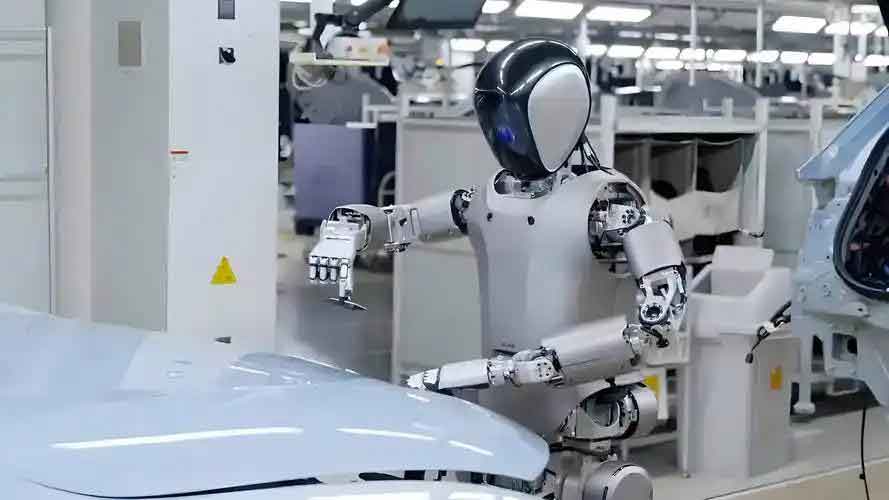
The use of inverted screw pairs in humanoid robots is becoming increasingly important due to their ability to provide high load capacity, rigidity, and accuracy. Humanoid robots require linear joints that can handle varying loads while maintaining efficiency, and inverted screw pairs offer a solution through their unique long-nut, short-screw design. In this context, I will delve into the types, performance characteristics, and emerging trends of these components, emphasizing their role in enhancing the functionality of humanoid robots. Throughout this discussion, I will incorporate tables and formulas to summarize key points, ensuring a comprehensive analysis aimed at engineers and developers working on humanoid robot systems.
Types and Structures of Inverted Screw Pairs
Inverted screw pairs can be broadly categorized into two main types: inverted planetary roller screw pairs and inverted ball screw pairs. Each type has distinct structural features and operating principles that make them suitable for specific applications in humanoid robots. The choice between them often depends on factors such as load requirements, efficiency, and space constraints in humanoid robot designs.
| Type | Key Components | Operating Principle | Advantages for Humanoid Robots | Challenges |
|---|---|---|---|---|
| Inverted Planetary Roller Screw Pair | Screw, nut, rollers, retaining ring | Nut rotation drives screw linear motion via threaded engagement of rollers | High load capacity, durability, suitable for harsh environments | Complex gear加工, wear in gears, noise |
| Inverted Ball Screw Pair | Screw, nut, balls, reverser | Nut rotation drives screw linear motion via ball circulation | High transmission efficiency, smooth operation, compact design | Reverser integration on screw reduces stiffness,加工难度 |
The inverted planetary roller screw pair, often used in humanoid robot joints, involves multiple rollers that distribute loads, but recent innovations have led to gearless designs to simplify manufacturing. For example, a cage-based structure eliminates gears, reducing vibration and enabling mass production for humanoid robot applications. On the other hand, inverted ball screw pairs offer higher efficiency, which is crucial for energy-efficient humanoid robots, but they require careful design of the reverser to maintain stiffness. In both cases, the goal is to optimize these components for the dynamic and precise movements required by humanoid robots.
Load-Bearing Performance of Inverted Screw Pairs
The load-bearing performance is a critical aspect for inverted screw pairs in humanoid robots, as it directly affects the robot’s ability to handle forces during tasks like lifting or walking. I have analyzed various studies that focus on load distribution, stiffness modeling, and static load ratings. For humanoid robots, achieving uniform load distribution across threads is essential to prevent premature wear and ensure longevity.
One key formula used to model contact stress in screw pairs is based on Hertzian contact theory. For a roller-screw interface, the contact stress $$\sigma$$ can be approximated as:
$$ \sigma = \sqrt{\frac{F E^*}{\pi R}} $$
where $$F$$ is the load per thread, $$E^*$$ is the equivalent modulus of elasticity, and $$R$$ is the effective radius of curvature. This formula helps in understanding how loads are distributed in inverted planetary roller screw pairs used in humanoid robots.
Factors such as pitch errors and assembly misalignments can lead to uneven load distribution. I have summarized these influences in the table below, which highlights their impact on humanoid robot joints:
| Factor | Effect on Load Distribution | Implication for Humanoid Robots |
|---|---|---|
| Pitch Error | Causes fluctuations in load curve, reducing individual thread loads | May lead to inaccuracies in linear joint movements of humanoid robots |
| Assembly Error | Can result in unloaded rollers, weakening overall capacity | Affects the reliability of humanoid robot actuators under dynamic loads |
| Structural Parameters (e.g., thread angle) | Optimizing parameters like 90° thread angle improves load sharing | Enhances the durability of humanoid robot joints |
| Dynamic Conditions | Loads vary with speed and acceleration, causing cyclic fluctuations | Influences the real-time performance of humanoid robots during tasks |
Stiffness modeling is another area I have explored. The axial stiffness $$K_a$$ of an inverted planetary roller screw pair can be expressed as:
$$ K_a = \frac{1}{\sum_{i=1}^{n} \frac{1}{k_i}} $$
where $$k_i$$ is the stiffness of each thread contact, and $$n$$ is the number of rollers. This model is vital for predicting how humanoid robot joints respond to external forces, ensuring high rigidity. Recent research has incorporated elastic deformations and errors into these models, but there is a need for more work on multi-error coupling effects specific to humanoid robot applications.
Transmission Efficiency of Inverted Screw Pairs
Transmission efficiency is paramount for humanoid robots, as it affects power consumption, heat generation, and overall system responsiveness. I have examined both inverted planetary roller screw pairs and inverted ball screw pairs, noting that efficiency directly influences the energy efficiency of humanoid robots during prolonged operation.
For inverted planetary roller screw pairs, the transmission efficiency $$\eta$$ can be modeled considering friction torques. A common approach involves:
$$ \eta = \frac{T_{out}}{T_{in}} = 1 – \frac{T_f}{T_{in}} $$
where $$T_{in}$$ is the input torque, $$T_{out}$$ is the output torque, and $$T_f$$ is the friction torque. The friction torque depends on factors like contact angle $$\alpha$$ and helix angle $$\beta$$, often expressed as:
$$ T_f = f(F, \alpha, \beta) $$
with $$f$$ being a function derived from contact mechanics. In humanoid robots, optimizing these angles can lead to efficiency improvements of up to 10%, which is significant for battery-powered systems.
For inverted ball screw pairs, efficiency tends to be higher due to lower rolling friction. The efficiency can be related to the lead $$L$$ and friction coefficient $$\mu$$:
$$ \eta = \frac{L}{L + \pi d \mu} $$
where $$d$$ is the screw diameter. This formula highlights how design parameters affect efficiency in humanoid robot joints. I have compiled key findings on efficiency influencers in the table below:
| Influencer | Effect on Efficiency | Relevance to Humanoid Robots |
|---|---|---|
| Equivalent Friction Coefficient | Most sensitive parameter; lower values boost efficiency | Critical for minimizing energy loss in humanoid robot actuators |
| Axial Load | Efficiency generally increases with load up to a point | Affects performance during high-force tasks in humanoid robots |
| Lead and Preload | Optimal lead and preload balance efficiency and stiffness | Ensures precise movements in humanoid robot joints |
| Lubrication and Wear | Better lubrication reduces friction; wear decreases efficiency over time | Impacts maintenance cycles for long-lasting humanoid robots |
Experimental setups for testing efficiency often involve dynamometers, but for inverted screw pairs in humanoid robots, specialized testbeds are needed due to their unique motion. I have noted that dynamic conditions, such as speed variations, can cause efficiency to fluctuate, which is crucial for humanoid robots operating in diverse scenarios. Future work should focus on real-time efficiency monitoring for humanoid robot systems.
Future Development Trends for Inverted Screw Pairs in Humanoid Robots
Looking ahead, the evolution of inverted screw pairs will be shaped by the demanding requirements of humanoid robots. I foresee three main areas of development: structural design and modeling, performance analysis and testing equipment, and manufacturing processes. Each area must address the need for high precision, reliability, and efficiency in humanoid robot applications.
Structural Design and Modeling
For humanoid robots, inverted screw pairs require optimized thread profiles to reduce friction and improve load distribution. I propose using advanced修形 techniques, such as thread crowning, which can be modeled using parametric equations. For example, the profile curve $$y(x)$$ might be defined as:
$$ y(x) = a x^2 + b x^3 $$
where $$a$$ and $$b$$ are coefficients adjusted for minimal wear. Additionally, multi-error coupling models should integrate pitch, alignment, and thermal errors to predict performance in humanoid robot joints. A comprehensive model could involve:
$$ \Delta L = \sum (\delta_{pitch} + \delta_{thermal} + \delta_{wear}) $$
where $$\Delta L$$ is the total displacement error affecting humanoid robot accuracy. Machine learning algorithms could be employed to analyze vibration data from humanoid robots, enabling predictive maintenance and state assessment of screw pairs.
Performance Analysis and Testing Equipment
Humanoid robots often operate under high-speed and high-load conditions, so testing inverted screw pairs for dynamic stability is essential. I recommend developing专用 testbeds that simulate humanoid robot movements, measuring parameters like repeatability and thermal effects. The critical speed $$n_c$$ for a screw can be calculated as:
$$ n_c = \frac{60}{2\pi} \sqrt{\frac{k}{m}} $$
where $$k$$ is the stiffness and $$m$$ is the mass, helping determine safe operating ranges for humanoid robot joints. Tables can summarize test scenarios, as shown below:
| Test Parameter | Target Value | Purpose for Humanoid Robots |
|---|---|---|
| Maximum Speed | Up to 5000 rpm | Assess high-speed performance in dynamic humanoid robot motions |
| Load Capacity | 10-100 kN | Verify strength for lifting and manipulation tasks in humanoid robots |
| Thermal Rise | Below 50°C | Ensure minimal heat impact on humanoid robot joint accuracy |
| Efficiency Under Load | Over 85% | Optimize energy use for extended humanoid robot operation |
Furthermore, testing both forward and reverse传动 efficiency is vital for humanoid robots that require bidirectional movements, such as in jumping or cushioning actions. New equipment should eliminate alignment biases to provide accurate data for humanoid robot applications.
Manufacturing Processes
The加工 of inverted screw pairs, especially long-nut internal threads, poses challenges for humanoid robot components. I advocate for advanced grinding technologies with real-time monitoring. The surface roughness $$R_a$$ can be controlled using the formula:
$$ R_a = C \cdot v^{m} \cdot f^{n} $$
where $$C$$, $$m$$, and $$n$$ are constants, $$v$$ is grinding speed, and $$f$$ is feed rate. Improving $$R_a$$ reduces friction, enhancing efficiency and寿命 for humanoid robot joints. Additionally, error control during manufacturing must address thermal deformation and vibration. A process capability index $$C_p$$ can be used:
$$ C_p = \frac{USL – LSL}{6\sigma} $$
where $$USL$$ and $$LSL$$ are specification limits, and $$\sigma$$ is the standard deviation, ensuring consistency in mass production for humanoid robots. Laser polishing and heat treatment innovations will further improve surface quality, benefiting the durability of humanoid robot systems.
Conclusion
In summary, inverted screw pairs are indispensable for the linear joints of humanoid robots, offering high performance in terms of load-bearing and transmission efficiency. Through my analysis, I have highlighted the current status of inverted planetary roller and ball screw pairs, emphasizing their roles in enabling precise and dynamic movements for humanoid robots. The use of formulas and tables has allowed me to summarize key aspects, such as contact stress models and efficiency influencers, which are critical for designing humanoid robot actuators.
Future trends point toward optimized designs, advanced testing, and refined manufacturing processes tailored to humanoid robot needs. As humanoid robots become more prevalent in various applications, from industrial to service sectors, the continuous improvement of inverted screw pairs will be essential. I believe that by addressing the challenges in modeling, performance evaluation, and加工, we can enhance the reliability and efficiency of these components, ultimately contributing to the advancement of humanoid robot technology. The integration of these developments will ensure that humanoid robots can perform complex tasks with human-like dexterity and endurance, making them more capable and energy-efficient in real-world environments.