
In recent years, artificial intelligence has achieved sustained breakthroughs and accelerated its permeation into the physical world. Embodied AI robots, representing a new class of human-robot collaborative intelligent equipment, have gradually become a pivotal force in developing future industries. In 2023, China issued the “Guiding Opinions on the Innovative Development of Humanoid Robots,” clarifying the strategic direction. Subsequently, the 2025 Government Work Report for the first time incorporated “embodied intelligence” into the national list of key future industries for cultivation, emphasizing the continuous advancement of the “AI Plus” initiative. These policy measures signify a new stage in China’s strategic deployment for the integration of AI and robotics. The embodied AI robot, undertaking the crucial mission of driving industrial intellectualization and forming new quality productive forces, has emerged as a new engine for promoting high-quality economic development.
Although the embodied AI robot industry, as a frontier sector, exhibits immense potential, its development still faces challenges such as insufficient technological drive, lack of policy synergy, and regional homogenized competition. This article analyzes the mechanisms through which the embodied AI robot industry promotes its own high-quality development by systematically innovating cutting-edge technologies, optimizing industrial structure, and strengthening ecological synergy. Building upon an examination of the developmental characteristics and practical experiences in China’s three major economic regions—the Beijing-Tianjin-Hebei area, the Yangtze River Delta, and the Pearl River Delta—this paper proposes targeted practical pathways covering policy drive, technological breakthroughs, industrial chain collaboration, and talent cultivation.
Theoretical Framework and Intrinsic Mechanisms
The high-quality development of the embodied AI robot industry is not a singular event but a systematic process driven by multiple forces. Based on the theories of innovation-driven development, industrial organization, and industrial symbiosis, the intrinsic mechanisms can be deconstructed into three interconnected dimensions: breakthrough technological innovation, structural optimization, and ecological synergy.
1. Innovation-Driven Perspective: The Mechanism of Breakthrough Technological Renewal
Innovation-driven development theory emphasizes promoting sustainable industrial advancement through autonomous technological breakthroughs, frontier scientific innovation, and systemic knowledge production. As a product of the interdisciplinary convergence of artificial intelligence, mechanical engineering, and advanced materials, the paradigm shift triggered by the disruptive technological progress of the embodied AI robot constitutes the core driving force for its high-quality industrial development. The “perception-decision-execution” closed-loop intelligent system constructed by embodied AI robots relies on the deep integration of key technologies such as embodied large model architectures, multi-modal sensors, and precision actuators.
From the perspective of basic technology R&D, foundational theoretical research is being strengthened, with a focus on original technological development in algorithm optimization and hardware innovation. Breakthroughs in core component technologies generate cost-reduction and efficiency-enhancing effects. For instance, the mass production of domestic high-precision harmonic reducers can lower the manufacturing costs of intelligent robots. As application scenarios expand, R&D focus shifts towards optimizing the interaction between the robot body and the external environment. The deep integration of embodied large models with robot hardware has become a critical competitive pivot. Such technological breakthroughs not only expand the functional boundaries of the embodied AI robot but also create new market advantages through performance improvements, thereby driving iterative upgrades of the industrial ecosystem.
From a scale economy perspective, clusters of embodied AI robots, interconnected via 5G, IoT, and cloud intelligence, facilitate the leap from single-unit intelligence to swarm intelligence. The formation of collaborative networks generates scale effects, expanding the scope of both individual and collective operations. This scale effect also enhances the economic attributes of the embodied AI robot, propelling its entry into high-end manufacturing and complex service domains, thus forming an endogenous driving force for high-quality industrial development.
The technological progress and scaling effects can be conceptually modeled. Let $T_i$ represent the level of a specific technology $i$ (e.g., actuator precision, model inference speed). Its evolution over time $t$ can be expressed as a function of R&D investment $R(t)$, knowledge stock $K(t)$, and feedback from application scale $A(t)$:
$$ \frac{dT_i}{dt} = \alpha_i R(t) + \beta_i K(t) + \gamma_i \ln(A(t) + 1) $$
where $\alpha_i, \beta_i, \gamma_i$ are coefficients specific to technology $i$. The logarithmic term reflects diminishing marginal returns from scale. The total system performance $P$ of an embodied AI robot can be seen as a multiplicative function of its key technological components:
$$ P = \prod_{j=1}^{n} (1 + \eta_j T_j) $$
where $\eta_j$ is the elasticity of performance with respect to technology $j$. This multiplicative form highlights the systemic nature where bottlenecks in one component (low $T_j$) can severely limit overall performance $P$.
2. Industrial Organization Perspective: The Mechanism of Industrial Structure Optimization
The development of embodied AI robots profoundly impacts industrial organization, reshaping industry and value chains while fostering new business models. In terms of the industry chain, an integrated ecosystem has been formed in China, covering upstream core components, midstream body manufacturing, downstream system integration, and terminal application scenarios.
| Chain Segment | Key Components/Activities | Optimization Driver |
|---|---|---|
| Upstream | High-precision sensors, actuators, chips, AI algorithms | Demand-pull from midstream; need for precision and reliability. |
| Midstream | Robot body manufacturing, modular design, system integration | Modularization and standardization for flexibility and cost reduction. |
| Downstream | Application in manufacturing, logistics, healthcare, services, etc. | Scale deployment creating a “scenario-data-algorithm” closed loop. |
Technological advancement directly drives the upgrading of upstream core components, creating a virtuous cycle of “demand-pull and supply innovation.” In the midstream system integration field, companies enhance chain efficiency through modular and standardized designs. The large-scale promotion of downstream application scenarios generates substantial real-world data feedback, forming a “scenario-data-algorithm” closed loop that propels the industry chain from “technology validation” to “value creation.”
Regarding new business model cultivation, embodied intelligence technology has spawned a series of innovative models. In the industrial sector, embodied AI robots replace humans in hazardous, repetitive tasks, promoting manufacturing towards “less-man” and “unmanned” operations. In the service industry, robots enable “unattended retail,” reducing operational costs. Combined with AR/VR technology, robots create new service models like “robot + digital human” in cultural tourism. In special and public service fields, companion robots innovate social service delivery by providing medication reminders and health monitoring.
The structural optimization can be analyzed through a value chain model. Let the total value added $V$ in the embodied AI robot industry be the sum of value added at each segment $s$:
$$ V = \sum_{s \in \{up, mid, down\}} V_s $$
The growth of value in a segment depends on its technological intensity $\tau_s$ and its degree of linkage with other segments $L_s$:
$$ \frac{dV_s}{dt} = \tau_s \cdot I_s(t) + \lambda \sum_{r \neq s} L_{s,r} \cdot V_r(t) $$
Here, $I_s(t)$ is investment in segment $s$, $\lambda$ is a synergy coefficient, and $L_{s,r}$ represents the linkage strength from segment $r$ to $s$. This illustrates how innovation in one segment (e.g., upstream components) propagates value to others (e.g., midstream integration).
3. Industrial Symbiosis Perspective: The Mechanism of Industrial Ecological Synergy
Industrial symbiosis theory emphasizes transforming environmental externalities into economic opportunities through market mechanisms and organizational innovation, enhancing resource efficiency for the entire industrial system. The development path of China’s embodied AI robot industrial ecosystem aligns well with this theory.
Firstly, comprehensive policy support from top-level design to scenario application fosters the industry. Measures such as financial subsidies, R&D support, scenario opening, and talent cultivation effectively expand market demand, construct the industrial ecosystem, and propel the industry towards the high end of the global value chain.
Secondly, the construction of a standard system is a key guarantee for the large-scale application of embodied AI robots. By establishing standards for technical specifications, safety, and market compatibility, issues such as poor interoperability, low safety levels, and high costs are addressed, fostering a virtuous cycle between technological breakthroughs and industrial upgrades.
Finally, industry-academia-research collaboration accelerates the translation of scientific and technological achievements. Universities and research institutes drive technological breakthroughs through cutting-edge research, while enterprises promote technology implementation through scenario application and capital investment. This synergistic model not only accelerates technology iteration and promotion but also strengthens collaboration across the industry chain’s upstream and downstream, laying a solid foundation for the large-scale development of the embodied AI robot.
The symbiotic relationships can be modeled using a network synergy equation. The state of the ecosystem $E$ is a function of the states of its $n$ constituent entities (firms, labs, institutions), represented by a vector $\vec{S} = (S_1, S_2, …, S_n)$. The evolution of the ecosystem’s overall health (e.g., innovation output, resilience) $H(E)$ is:
$$ H(E) = \sigma \cdot \left( \sum_{i=1}^{n} w_i S_i \right) + (1-\sigma) \cdot \left( \sum_{i=1}^{n} \sum_{j>i}^{n} \phi_{i,j} \cdot g(S_i, S_j) \right) $$
The first term is the weighted sum of individual entity strengths (with weights $w_i$). The second term sums the synergistic gains $g(S_i, S_j)$ from pairwise interactions, weighted by connection strength $\phi_{i,j}$. The parameter $\sigma \in [0,1]$ balances the importance of individual excellence versus collaborative synergy. For a thriving embodied AI robot ecosystem, a low $\sigma$ (high weight on synergy) is typically necessary.
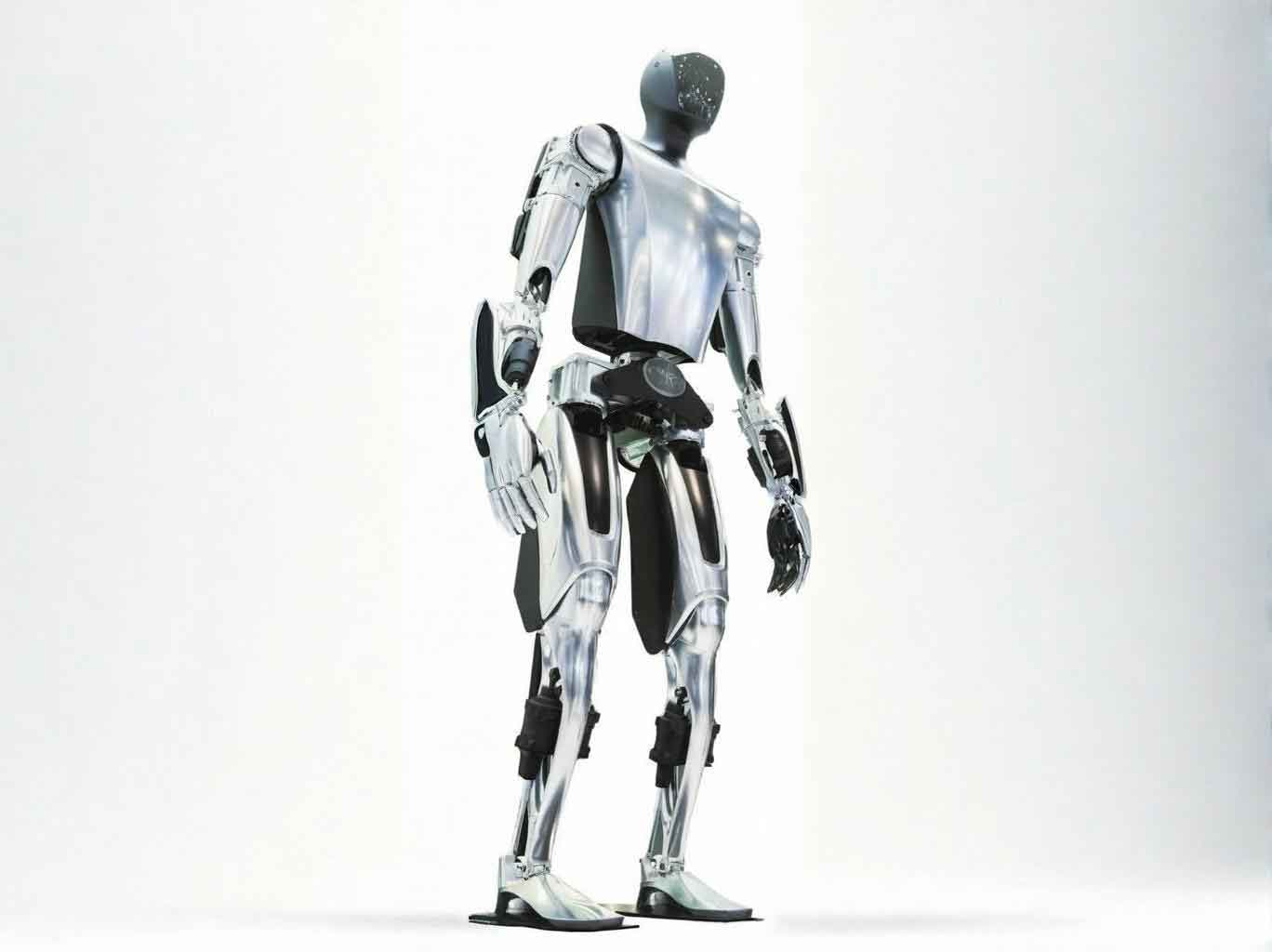
The reality of manufacturing embodied intelligence is characterized by precision, integration, and scale. As depicted, the assembly and testing of embodied AI robots require advanced facilities and rigorous processes, translating the theoretical models and mechanisms into tangible, high-value products. This visual underscores the transition from R&D to industrialized production, a critical phase governed by the mechanisms described above.
Regional Development Characteristics and Comparative Analysis
Currently, China’s embodied AI robot industry exhibits a tripartite development pattern across the Beijing-Tianjin-Hebei (BTH), Yangtze River Delta (YRD), and Pearl River Delta (PRD) regions. Each region possesses distinct industrial foundations and resource endowments, leading to differentiated development paths. The BTH region focuses on breakthroughs in high-end applications, the YRD emphasizes building a full-chain innovation system, and the PRD prioritizes flexible production and rapid supply chain response.
Comparative Analysis of Regional Industrial Layouts
The following table summarizes the key differential characteristics of the three major regions:
| Dimension | Beijing-Tianjin-Hebei Region | Yangtze River Delta Region | Pearl River Delta Region |
|---|---|---|---|
| Core Feature | Strong R&D, weak commercialization | Full-industry-chain development,突出精密制造 | Strong consumer-end innovation, fast supply chain |
| Industrial Ecology | Academia and research-oriented | Tight upstream-downstream collaboration | Market-driven, rapid iteration |
| Dominant Segment | Basic algorithms, frontier technology | Core components, system integration | Whole-machine design, scenario application |
| Representative Products | Special-purpose robots | Industrial collaborative robots | Service robots |
| Primary Challenge | Weak technology transfer pipeline | High-end technology lock-in; insufficient regional synergy | Insufficient foundational R&D capability; supply chain resilience短板 |
1. BTH Region: Research-Driven Industrial Layout
The BTH region, anchored by the Zhongguancun National Innovation Demonstration Zone, concentrates on cutting-edge technology R&D and the integration of large models and robotics. Its main characteristics include: (1) High concentration of R&D resources, with top-tier AI and robotics research institutions and talent pools leading in foundational technologies like perception algorithms and motion control. (2) Relatively weak industrial transformation. Representative enterprises are primarily R&D and innovation types, with insufficient investment in midstream manufacturing and market development. Core components heavily rely on precision manufacturers from the YRD.
2. YRD Region: Full Industrial Chain Synergistic Development
Leveraging its manufacturing base, the YRD lays out the embodied AI robot industry from a full-chain synergistic perspective. The region has achieved comprehensive coverage of the industry chain with high integrity. Shanghai excels in system integration and high-end R&D Suzhou and Wuxi are strong in precision manufacturing and core components; Hangzhou and Nanjing possess solid AI algorithm foundations. The region provides excellent application scenario supply, with strong market demand and rapid scenario implementation capabilities. Multi-faceted collaborative efforts, such as the establishment of the “Yangtze River Delta Robot Industry Chain Alliance,” further promote resource linkage and technology integration across the chain.
3. PRD Region: Market-Oriented Application-Driven Layout
The PRD region leverages its strengths in electromechanical and digital technologies to initially form a full “brain-cerebellum-limb” industry chain for embodied AI robots. The region focuses on terminal product manufacturing and commercialization. It possesses a globally leading supply chain system where the “one-hour supply chain” ecosystem enables small-batch, rapid-response production, forming a “small-order, quick-response” model for embodied AI robots.
This regional differentiation yields several overarching insights. First, a preliminary division of labor and collaboration has formed, with BTH as the technology source, YRD as the industrial base, and PRD as the commercialization frontier, avoiding homogenized competition. Second, technological innovation and scenario application develop interactively. The YRD drives technology iteration through scenario-data-algorithm closed loops, while the PRD validates a “market-feedback-technology-optimization” path. Third, industrial cluster effects are significant, with the YRD benefiting from scale and the PRD from supply chain efficiency.
The regional dynamics can be abstracted into a spatial interaction model. Let $Q_r$ represent the quality (e.g., innovation output, economic value) of the embodied AI robot industry in region $r$. Its growth depends on internal capabilities $C_r$ and spillovers from other regions $r’$:
$$ \frac{dQ_r}{dt} = \delta_r C_r(t) + \sum_{r’ \neq r} \rho_{r,r’} \cdot \frac{Q_{r’}(t)}{D_{r,r’}^\theta} $$
Here, $\delta_r$ is the internal efficiency multiplier, $\rho_{r,r’}$ is the spillover coefficient from $r’$ to $r$, $D_{r,r’}$ is the “distance” (geographic, institutional, technological) between regions, and $\theta$ determines the friction of distance. An optimal national policy aims to maximize $\sum_r Q_r$ by enhancing internal $\delta_r C_r$ and fostering positive spillovers $\rho_{r,r’}$ while reducing inhibiting distances $D_{r,r’}$.
Practical Pathways for High-Quality Development
The embodied AI robot industry, integrating strategic emerging fields like AI, advanced manufacturing, and new materials, continuously reshapes production models in manufacturing and services while promoting its own full industry chain renewal, improving efficiency and quality. Practical pathways for high-quality development are proposed across four key dimensions.
1. Strengthening Policy Drive: Constructing Top-Level Design and Institutional Safeguards
It is essential to build a coordinated development mechanism from the strategic level to resolve developmental dilemmas through top-level design. First, strengthen top-level design to forge a new pattern of regional coordinated development and prevent “involution-style” competition. A national perspective should guide differentiated positioning for key regions: BTH should focus on strengthening the R&D-transfer mechanism; YRD should deepen regional integration and implement standards mutual recognition; PRD should establish “scenario open demonstration zones.” Cross-regional industrial collaboration alliances and “innovation enclaves” should be promoted.
Second, innovate the supply of financial elements and establish a full lifecycle capital support system. Explore building a “government-guided, market-led” diversified capital ecosystem. Establish a national industrial guidance fund for embodied AI robots. Promote intellectual property securitization and pilot “robot leasing credit” schemes in the PRD.
Third, establish unicorn enterprise cultivation accelerators to build a cohort of industry leaders. Establish “embodied intelligence robot unicorn incubation bases”依托 national platforms to implement a “technology readiness acceleration plan” for promising enterprises, forming a cultivation mechanism for startups-gazelles-unicorns-champions.
2. Strengthening Technological Breakthroughs: Implementing Targeted Innovation Strategies
A multi-pronged approach to tackle core technologies is imperative. From the perspective of common technology R&D: (a) Strengthen perception technology R&D to build the “neural network” for environmental cognition, focusing on multi-modal sensor innovation. (b) Break through intelligent control bottlenecks to create the “motor cortex” for precise execution, strengthening “industry-academia-research-application” collaborative innovation. (c) Improve human-machine interaction systems to build “communication bridges” for emotional resonance, enhancing emotional computing and natural language processing capabilities.
From the perspective of regional-specific technology R&D: (a) The BTH region should strengthen its technology transfer capacity by building “robot technology pilot-scale alliance” platforms. (b) The YRD should break through high-end component bottlenecks by implementing a “core components攻坚 plan.” (c) The PRD should elevate its basic R&D capability by encouraging joint labs and “technology introduction-digestion-re-innovation” plans.
The technological frontier can be represented by a production possibility frontier (PPF) for the industry, trading off between different technological attributes like generality ($G$) and performance ($Perf$). The industry’s progress involves pushing this frontier outward. Investment $I$ in different technology vectors $\vec{T}$ shifts the frontier. The optimal allocation of R&D resources across regions $r$ and technology areas $a$ can be formulated as a constrained optimization:
$$ \max_{\{I_{r,a}\}} \sum_{t} \frac{ \Psi( \vec{T}(t) ) }{(1+r)^t} $$
subject to:
$$ \frac{dT_a}{dt} = f_a(I_{1,a}, I_{2,a}, …, I_{R,a}, \vec{T}) \quad \forall a $$
$$ \sum_{r,a} I_{r,a}(t) \leq I_{total}(t) $$
Here, $\Psi$ is a social welfare function aggregating the benefits of the technology vector $\vec{T}$, $r$ is a discount rate, and $f_a$ defines how investment across regions translates into progress in technology area $a$. The constraint ensures total investment does not exceed available resources $I_{total}(t)$. Solving such a model, even conceptually, highlights the need for coordinated, strategic investment.
3. Strengthening Industrial Chain Collaboration: Constructing a “Dual Circulation” Development Pattern
China should leverage the echelon advantage of “leading enterprises guiding, local enterprises breaking through, and SMEs filling gaps” to build an industrial ecosystem for the full-chain integrated development of embodied AI robots. First, build an echelon cultivation ecosystem for embodied robot enterprises. Utilize leading domestic enterprises as anchors to gather upstream and downstream players, forming an “embodied AI robot industry alliance” and creating a new collaborative development situation led by “chain leaders.”
Second, create a standards mutual recognition synergistic development community. Promote the integrated construction of standard systems, setting unified regional standards for key points like motor power and sensor accuracy. Establish a “components mutual recognition database” using blockchain to match compatible suppliers.
Third, build an efficient and synergistic supply chain system for embodied AI robots. Strengthen the interconnections between all segments of the industry chain. In the R&D design phase, encourage top universities and research institutes to form joint labs. In the intelligent manufacturing phase, promote flexible production lines and sharing mechanisms. In the supporting supply phase, create “core component industrial belts” and coordinate capacity allocation. Layout “key component reserve depots” in the YRD and PRD to ensure supply stability against disruptions.
The resilience and efficiency of the industrial chain can be modeled. Let the output $O$ of the chain be a function of the health $H_s$ of each segment $s$ and the connectivity matrix $C$ between them (where $C_{i,j}$ represents the strength of connection from segment $j$ to $i$).
$$ O = \Gamma( \vec{H}, C ) $$
A shock $\xi_k$ that damages segment $k$, reducing $H_k$, propagates through the network. The overall impact $\Delta O$ depends on the network structure:
$$ \Delta O \approx \frac{\partial \Gamma}{\partial H_k} \cdot \xi_k + \sum_{i \neq k} \frac{\partial \Gamma}{\partial H_i} \cdot \left( \sum_{j} \frac{\partial H_i}{\partial H_j} \cdot \delta_{j,k} \xi_k \right) $$
The second term captures indirect ripple effects. A resilient chain for embodied AI robots is one where critical nodes (high $\frac{\partial \Gamma}{\partial H_k}$) are robust and where the connectivity matrix $C$ helps absorb rather than amplify shocks $\xi_k$.
4. Strengthening Talent Cultivation: Building a Composite Innovation Talent System
A dual-driven talent strategy of “local cultivation + international introduction” must be established, forming differentiated cultivation systems aligned with the industrial positioning of the BTH, YRD, and PRD regions to provide solid intellectual support.
First, build a regionally adapted local cultivation system. The BTH should focus on “R&D + transfer” composite capabilities, offering courses covering core technologies and frontier content. The YRD should strengthen “precision manufacturing + system integration” capabilities through industry-academia joint institutes and skills competitions. The PRD should cultivate “market + technology” cross-border capabilities, offering courses in applied scenario design and implementing “technology broker cultivation plans.”
Second, promote cross-regional talent flow mechanisms. Break down barriers to factor flow by establishing “inter-regional talent qualification mutual recognition mechanisms” for roles like robotics system integrators. Implement “talent enclave” policies where researchers from BTH retain benefits when working on PRD projects.
Third, construct an international talent recruitment and cultivation network. Layout “embodied intelligence international joint laboratories” in BTH to introduce top overseas teams. Support YRD enterprises in building joint R&D centers with global leaders. Leverage the PRD’s market strengths to host global innovation and entrepreneurship competitions to attract overseas teams, forming an international talent attraction mechanism of “competition attracts talent, investment promotes落地.”
The talent dynamics can be framed as a stock-flow model. Let $L_r^m$ be the stock of talent of type $m$ (e.g., researchers, engineers, integrators) in region $r$. Its change over time is:
$$ \frac{dL_r^m}{dt} = E_r^m + I_r^m + M_{in,r}^m – M_{out,r}^m – A_r^m $$
where $E_r^m$ is the local education output, $I_r^m$ is international inflow, $M_{in/out,r}^m$ is inter-regional migration inflow/outflow, and $A_r^m$ is attrition. The output of the embodied AI robot sector in region $r$, $Y_r$, depends on a Cobb-Douglas-like combination of different talent types and capital $K_r$:
$$ Y_r \propto K_r^\alpha \cdot \prod_{m} (L_r^m)^{\beta_m} $$
subject to $\sum_m \beta_m = 1-\alpha$. High-quality development requires not just increasing $L_r^m$ but optimizing the mix (the $\beta_m$ parameters) and ensuring efficient matching between talent stocks and industry needs through policies affecting the flow terms $E, I, M$.
Conclusion
The high-quality development of the embodied AI robotics industry is a complex, systematic project driven by the deep interaction of technological innovation, structural optimization, and ecological synergy. As analyzed through the lenses of innovation-driven development, industrial organization, and industrial symbiosis theories, the intrinsic mechanisms involve the self-reinforcing cycles of technological advancement propelling industrial upgrading, which in turn creates demand for further innovation and more robust ecosystems. The differentiated yet complementary development models observed in China’s three major economic regions provide a real-world validation of these mechanisms and offer valuable practical experience.
The proposed pathways—encompassing strategic policy coordination, targeted technological攻坚, resilient industrial chain collaboration, and a multifaceted talent strategy—form an integrated framework for action. Success requires moving beyond isolated regional or sectoral approaches towards a nationally coordinated, ecosystem-centric perspective. It demands sustained investment in foundational R&D while aggressively pursuing commercialization to create the data-scenario feedback loops essential for AI advancement. Ultimately, the goal is to foster a vibrant, innovative, and globally competitive industrial ecosystem where embodied AI robots evolve from specialized tools into general-purpose platforms, fundamentally augmenting human capabilities and driving the next wave of economic and social transformation. The journey involves navigating significant technical, economic, and regulatory challenges, but the potential rewards—in productivity gains, new industries, and solutions to societal needs—are profound.