
In my years of involvement in advanced manufacturing and robotics, I have witnessed a transformative shift towards intelligent, autonomous systems. At the heart of this revolution lies the embodied AI robot—a physical entity that perceives, reasons, and acts in the real world. These robots are no longer mere programmed machines; they are evolving into adaptive agents capable of learning from their environments. This article delves into the critical technological enablers driving this evolution, from lightweight materials and robust data infrastructures to sophisticated simulation tools. Through extensive analysis, tables, and formulas, I will explore how these components synergize to propel embodied AI robots into new frontiers of application, particularly in sectors like electric vehicles, flexible production, and beyond.
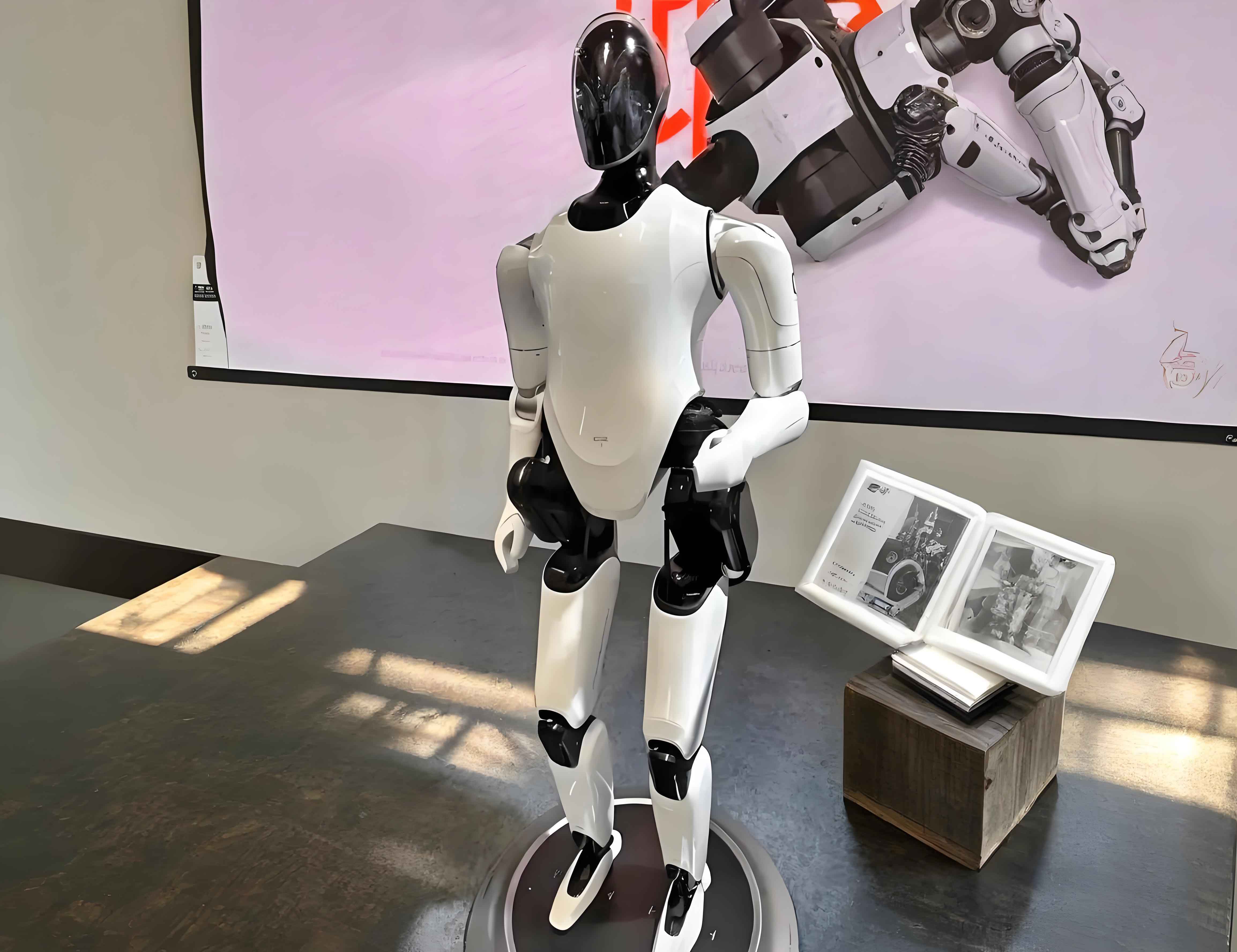
The integration of embodied AI robots into industrial settings necessitates a holistic approach, where hardware and software converge seamlessly. One foundational aspect is material science, specifically the push for light weighting. Embodied AI robots, especially those deployed in mobile or aerial forms, require structures that minimize mass without compromising strength. This is crucial for energy efficiency, agility, and payload capacity. For instance, in automotive and robotics, lightweight alloys play a pivotal role. I have observed that advanced injection molding techniques for materials like magnesium alloys are becoming increasingly prevalent. These processes allow for the production of complex, high-precision components that reduce overall weight. The performance of such materials can be quantified using formulas like the specific strength, which is a key metric for embodied AI robot design:
$$ \text{Specific Strength} = \frac{\sigma}{\rho} $$
where $\sigma$ is the tensile strength and $\rho$ is the density. Higher values indicate better strength-to-weight ratios, essential for robots that need to move dynamically. To illustrate, consider the following table comparing common materials used in embodied AI robot frameworks:
| Material | Density, $\rho$ (g/cm³) | Tensile Strength, $\sigma$ (MPa) | Specific Strength (MPa·cm³/g) | Suitability for Embodied AI Robots |
|---|---|---|---|---|
| Aluminum Alloy | 2.7 | 310 | 114.8 | High for lightweight frames |
| Magnesium Alloy | 1.74 | 250 | 143.7 | Excellent for intricate parts |
| Carbon Fiber Composite | 1.6 | 600 | 375.0 | Superior for high-performance bots |
| Steel | 7.85 | 460 | 58.6 | Limited due to weight |
Beyond materials, the intelligence of an embodied AI robot hinges on its ability to process and learn from data. In my work, I have emphasized the importance of a robust data backbone. Traditional robots rely on pre-defined code, but embodied AI robots require real-time data ingestion, storage, and analysis to adapt. This is where high-performance databases come into play. A database optimized for embedded systems can manage multimodal data—sensor feeds, control signals, and environmental inputs—efficiently. For an embodied AI robot, query latency and compression ratios are critical. We can model database performance with formulas like the query response time:
$$ T_q = T_{io} + T_{cpu} + T_{net} $$
where $T_q$ is total query time, $T_{io}$ is I/O latency, $T_{cpu}$ is processing time, and $T_{net}$ is network delay. In edge deployments for embodied AI robots, minimizing $T_q$ is essential for rapid decision-making. Additionally, data compression techniques reduce storage needs, which can be expressed as:
$$ C_r = \frac{S_o}{S_c} $$
with $C_r$ being the compression ratio, $S_o$ the original size, and $S_c$ the compressed size. Higher $C_r$ values allow embodied AI robots to retain more historical data for learning. The following table summarizes key database metrics relevant to embodied AI robot applications:
| Metric | Description | Target Value for Embodied AI Robots | Impact on Robot Performance |
|---|---|---|---|
| Query Throughput (queries/sec) | Number of queries handled per second | > 10,000 | Enables real-time sensor fusion |
| Latency (ms) | Time for data retrieval | < 5 | Critical for autonomous navigation |
| Compression Ratio | Ratio of uncompressed to compressed data | > 10:1 | Reduces storage footprint on edge devices |
| Vector Search Speed | Speed of similarity searches in vector databases | > 1M vectors/sec | Enhances AI inference for perception tasks |
Moreover, the embodied AI robot benefits from vector knowledge bases deployed at the edge, which accelerate AI推理 by storing embeddings of past experiences. This facilitates quick retrieval in dynamic environments. The efficiency of such systems can be modeled using nearest neighbor search complexity, often approximated as $O(\log n)$ for optimized structures, where $n$ is the number of vectors. This low complexity is vital for embodied AI robots operating under time constraints.
Another cornerstone in advancing embodied AI robots is simulation and digital twin technology. Before physical deployment, robots can be trained and tested in virtual environments that mimic real-world conditions. This is particularly evident in developments like digital tires for vehicles, which directly relate to robots’ mobility and perception systems. Simulation allows for the validation of kinematics, dynamics, and safety without costly prototypes. For an embodied AI robot, the equations of motion are fundamental. Consider the dynamics of a robotic manipulator, which can be described by the Lagrangian formulation:
$$ L = K – U $$
where $L$ is the Lagrangian, $K$ is kinetic energy, and $U$ is potential energy. The equations of motion follow:
$$ \frac{d}{dt} \left( \frac{\partial L}{\partial \dot{q}_i} \right) – \frac{\partial L}{\partial q_i} = \tau_i $$
with $q_i$ as generalized coordinates and $\tau_i$ as generalized forces. In simulation, these equations are solved numerically to predict robot behavior. Similarly, for wheeled embodied AI robots, tire-road interaction models are crucial. A simplified model might use the Pacejka formula for tire forces:
$$ F_y = D \sin(C \arctan(B \alpha – E(B \alpha – \arctan(B \alpha)))) $$
where $F_y$ is lateral force, $\alpha$ is slip angle, and $B, C, D, E$ are parameters. High-fidelity simulations integrate such models to train embodied AI robots for diverse terrains. The table below outlines simulation parameters that enhance embodied AI robot development:
| Parameter | Role in Simulation | Typical Range | Importance for Embodied AI Robots |
|---|---|---|---|
| Time Step ($\Delta t$) | Discretization interval for solving dynamics | 0.001 to 0.01 s | Affects accuracy and stability of motion prediction |
| Friction Coefficient ($\mu$) | Determines contact forces with surfaces | 0.3 to 1.2 | Critical for grasping and locomotion tasks |
| Sensor Noise Level | Simulated inaccuracies in perception sensors | 1% to 5% of signal | Ensures robustness in real-world deployments |
| Render Frequency (Hz) | Visual update rate in virtual environment | 60 to 240 Hz | Enables high-fidelity visual perception training |
The synergy between these technologies—lightweight materials, intelligent databases, and advanced simulation—creates a fertile ground for embodied AI robot innovation. In my view, the future of manufacturing and logistics will be dominated by embodied AI robots that can self-optimize. For example, in electric vehicle production, embodied AI robots equipped with lightweight arms and real-time data processing can assemble batteries with precision, while simulation tools pre-validate their movements to avoid collisions. The overall system efficiency can be quantified through metrics like throughput per energy unit:
$$ \eta = \frac{T}{E} $$
where $\eta$ is efficiency, $T$ is tasks completed, and $E$ is energy consumed. For embodied AI robots, maximizing $\eta$ is a key design goal, achievable through the integration discussed.
Furthermore, the scalability of embodied AI robot deployments relies on modular architectures. A common framework involves a hierarchical control system, where high-level planning interfaces with low-level actuators. The decision-making process can be modeled as a Markov Decision Process (MDP), defined by the tuple $(S, A, P, R)$, where $S$ is state space, $A$ is action space, $P$ is transition probability, and $R$ is reward function. Embodied AI robots use reinforcement learning to solve MDPs, with policies $\pi(a|s)$ that map states to actions. The value function $V^\pi(s)$ represents expected cumulative reward:
$$ V^\pi(s) = \mathbb{E}_\pi \left[ \sum_{t=0}^\infty \gamma^t R_{t+1} \mid S_0 = s \right] $$
where $\gamma$ is a discount factor. Optimizing this requires immense data, hence the need for efficient databases. The convergence rate of learning algorithms, often expressed as $O(1/\sqrt{n})$ for sample complexity, highlights why embodied AI robots benefit from simulated data generation prior to real-world training.
In terms of industry adoption, embodied AI robots are paving the way for flexible manufacturing cells. These cells can reconfigure autonomously based on production demands, leveraging light materials for quick movement and databases for scheduling. The economic impact can be summarized in a cost-benefit analysis table:
| Factor | Traditional Robots | Embodied AI Robots | Advantage for Embodied AI Robots |
|---|---|---|---|
| Initial Investment | Moderate to High | High (due to AI infrastructure) | Long-term savings through adaptability |
| Changeover Time | Hours to days | Minutes to hours | Reduces downtime in mixed-production lines |
| Energy Consumption per Task | High (rigid movements) | Lower (optimized paths) | Enhances sustainability and operational cost |
| Data Utilization | Limited to pre-programmed logs | Continuous learning from multimodal feeds | Improves quality and defect detection over time |
As we look ahead, the evolution of embodied AI robots will be accelerated by cross-domain collaborations. The fusion of material science, database engineering, and simulation expertise creates a virtuous cycle. For instance, digital tire models developed for vehicles can be adapted to improve the traction control of mobile embodied AI robots. The mathematical modeling of such systems often involves differential equations for vehicle dynamics, such as:
$$ m \dot{v} = F_t – F_r – F_a $$
where $m$ is mass, $v$ is velocity, $F_t$ is tractive force, $F_r$ is rolling resistance, and $F_a$ is aerodynamic drag. For an embodied AI robot navigating uneven terrain, these forces are simulated to train control policies. Moreover, the use of finite element analysis (FEA) for stress distribution in robot components ties back to material selection, with equations like:
$$ \nabla \cdot \sigma + f = 0 $$
where $\sigma$ is stress tensor and $f$ is body force. Optimizing this ensures durability for embodied AI robots in harsh environments.
The role of open ecosystems cannot be overstated. By building on shared platforms, developers can iterate faster on embodied AI robot designs. Standardized interfaces for data exchange, akin to the database systems mentioned, allow embodied AI robots from different vendors to interoperate. This interoperability is quantified through metrics like protocol efficiency $\epsilon_p$, defined as:
$$ \epsilon_p = \frac{D_{transferred}}{D_{total} \times T_{delay}} $$
Higher $\epsilon_p$ means smoother communication between embodied AI robots and central systems. The following table provides a snapshot of key interoperability standards relevant to embodied AI robots:
| Standard | Focus Area | Benefit for Embodied AI Robots | Adoption Level |
|---|---|---|---|
| ROS 2 (Robot Operating System) | Middleware for robot software | Facilitates modular development and integration | High in research and industry |
| OPC UA | Industrial communication | Enables secure data exchange in factories | Growing in smart manufacturing |
| MQTT | Lightweight messaging protocol | Reduces network overhead for sensor data | Widespread in IoT and robotics |
| ONNX (Open Neural Network Exchange) | AI model interoperability | Allows portability of learned policies across platforms | Increasing for embodied AI robot AI stacks |
In conclusion, the journey toward sophisticated embodied AI robots is a multidisciplinary endeavor. From the alloys that form their skeletons to the databases that house their experiences, every component must be optimized. Simulation acts as a sandbox for infinite experimentation, reducing time-to-market. As I reflect on trends, it is clear that embodied AI robots will become ubiquitous in the coming decades, driving efficiencies in sectors from automotive to logistics. The continuous iteration on materials, data systems, and virtual testing will unlock new capabilities, making embodied AI robots not just tools, but partners in innovation. The formulas and tables presented here are mere snapshots of a dynamic field; as we push boundaries, these models will evolve, further embedding intelligence into the physical realm through embodied AI robots.
To encapsulate the progress, consider the overall system performance metric for an embodied AI robot, which can be a weighted sum of factors like agility, intelligence, and durability:
$$ P_{robot} = w_1 \cdot A + w_2 \cdot I + w_3 \cdot D $$
where $A$ is agility score (e.g., from inverse of mass), $I$ is intelligence score (e.g., from query latency inverse), $D$ is durability score (e.g., from fatigue limit), and $w_i$ are weights. Maximizing $P_{robot}$ requires balancing these aspects, a challenge that ongoing research aims to address. Ultimately, the embodied AI robot represents the pinnacle of merging physical and digital worlds, and its advancement will redefine human-machine collaboration.