
The precise and reliable transmission of motion in industrial robotics is fundamentally dependent on the performance of core reduction gearboxes. Among these, the rotary vector reducer stands out for its compact size, high reduction ratio, and significant torque capacity. However, its complex multi-stage architecture, comprising numerous interacting components, presents a formidable challenge in the final assembly phase. Achieving the exceptionally high transmission accuracy—often required to be within one arc-minute—demands control over assembly clearances at the micrometer level. Traditional manual selective assembly methods, reliant on operator experience and trial-and-error, frequently result in low assembly efficiency, inconsistent precision, and consequently, a low product qualification rate. This necessitates the development of a systematic, intelligent optimization strategy to simultaneously maximize assembly yield and precision.
The operational principle of the rotary vector reducer involves a two-stage speed reduction. The primary stage is a planetary gear train, and the secondary stage is a cycloidal pin-wheel mechanism. The secondary stage, where motion is transferred from the crankshaft’s eccentric section to the cycloidal discs via needle bearings, and then to the output through the engagement of cycloidal discs with stationary pins housed in the pin shell, has a more direct and pronounced impact on the overall transmission error. Therefore, optimizing the assembly of this secondary stage is critical. The key to precision lies in managing the microscopic clearances within this mechanism, which are influenced by cumulative manufacturing tolerances of individual parts.
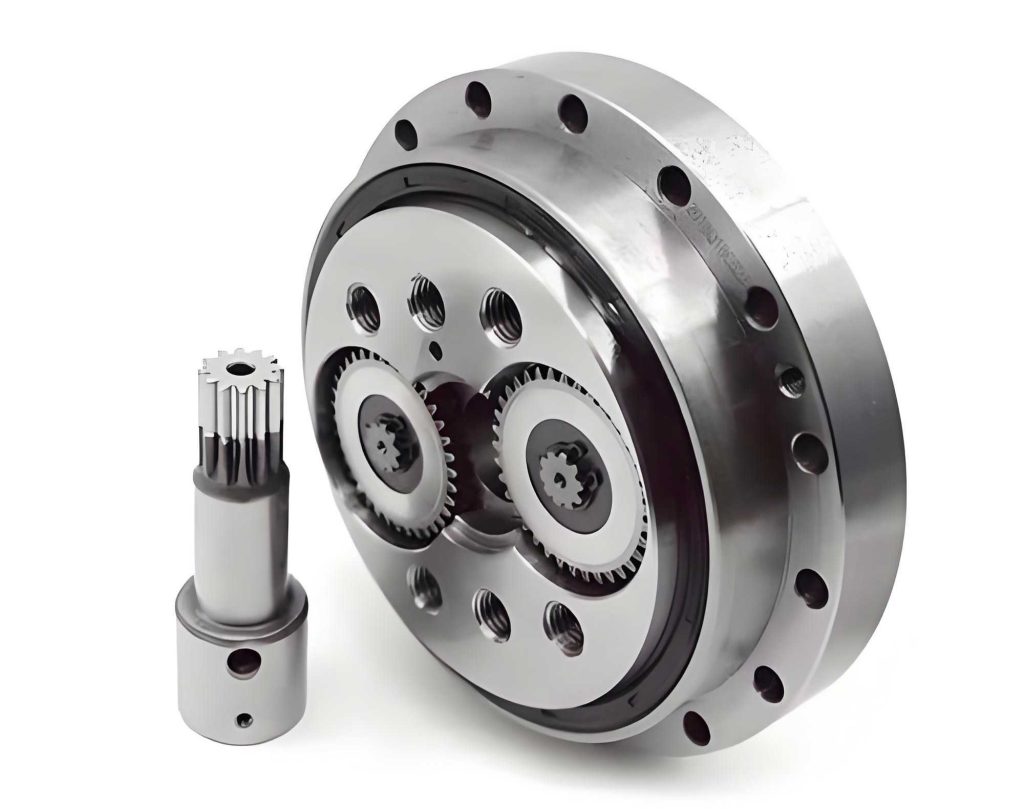
To systematically address this, we define two critical assembly dimension chains that directly affect the kinematic accuracy of the rotary vector reducer. Minimizing the variation in these chains’ closing links is equivalent to controlling critical errors.
Dimension Chain 1 (Bearing Clearance): This chain governs the clearance between the crankshaft eccentric section, the needle bearing, and the bore of the cycloidal disc. An optimal, minimal clearance here ensures smooth torque transmission without backlash. The relationship is defined by the diameters of the involved components:
$$ A_1 = D_{h} – D_{z} – 2 \times D_{p} $$
where \( A_1 \) is the closing link (clearance), \( D_{h} \) is the cycloidal disc crankshaft bore diameter, \( D_{z} \) is the crankshaft eccentric diameter, and \( D_{p} \) is the needle bearing roller diameter.
Dimension Chain 2 (Meshing Clearance): This chain controls the effective meshing condition between the cycloidal disc and the pins in the pin shell. It accounts for the pin diameter, the pin shell root circle diameter, and a measured value from the cycloidal disc using a master pin (or gauge pin). The closing link \( A_2 \) represents a derived meshing clearance:
$$ A_2 = l_{s} – l_{d} – 2 \times l_{p} $$
where \( l_{s} \) is the pin shell root circle diameter, \( l_{d} \) is the measured over-pin distance (or gauge distance) on the cycloidal disc, and \( l_{p} \) is the pin diameter.
For a rotary vector reducer assembly to be qualified, the actual values of \( A_1 \) and \( A_2 \) (considering two cycloidal discs, A and B) must fall within strict pre-defined tolerance intervals:
$$ l_{1} \leq A_{1}^{i} \leq u_{1}, \quad l_{2} \leq A_{2}^{i} \leq u_{2} $$
where \( i \) denotes the cycloidal disc (1 or 2), and \( l \), \( u \) represent the lower and upper specification limits, respectively.
The goal of selective assembly for the rotary vector reducer is twofold: first, to assemble as many qualified units as possible from a given batch of components (maximize qualification rate); second, to make the actual clearances \( A_1 \) and \( A_2 \) as close as possible to their ideal target values (maximize assembly precision). We therefore formulate a multi-objective optimization model.
Objective 1: Qualification Rate (\(\eta\)). For a given assembly scheme \( t \) that groups components into \( X_t \) units, if \( x_t \) units satisfy all clearance constraints, the qualification rate is:
$$ \eta_t = \frac{x_t}{X_t} \times 100\% $$
We seek to maximize \( \eta_t \).
Objective 2: Assembly Precision (\(f\)). This measures how close the closing links are to their ideal target values \( g \). For an assembly scheme with \( n \) units and \( j \) dimension chains (in this case, 4: \(A_1^1, A_1^2, A_2^1, A_2^2\)), we define a precision metric. A higher value indicates better overall precision. We use an inverse deviation function averaged over all closing links:
$$ f = \frac{1}{n} \sum_{i=1}^{n} \left( 1 – \frac{| A_{i,j} – g_{i,j} |}{\Delta_{i,j}} \right) $$
Here, \( \Delta_{i,j} \) is the allowable tolerance range for the specific closing link. This function yields a value of 1 when the clearance is exactly on target and decreases as it deviates. The objective is to maximize \( f \).
The complete multi-objective optimization model for the rotary vector reducer selective assembly is:
$$ \begin{aligned}
\text{Maximize:} \quad & M = [ \eta(\theta), f(\theta) ] \\
\text{Subject to:} \quad & D_{h}^1 – D_{z} – 2D_{p} = A_1^1 \in [l_1, u_1] \\
& D_{h}^2 – D_{z} – 2D_{p} = A_1^2 \in [l_1, u_1] \\
& l_{s} – l_{d}^1 – 2l_{p} = A_2^1 \in [l_2, u_2] \\
& l_{s} – l_{d}^2 – 2l_{p} = A_2^2 \in [l_2, u_2]
\end{aligned} $$
where \( \theta \) represents the matrix encoding the specific component assignments.
Given a batch of components, the number of possible assembly combinations for a rotary vector reducer is enormous ( \( N^6 \) for N sets of parts), making exhaustive search impractical. We employ the NSGA-II (Non-dominated Sorting Genetic Algorithm II) algorithm, renowned for its efficiency and ability to find a well-distributed set of Pareto-optimal solutions in multi-objective problems.
Encoding: A chromosome represents a complete assembly scheme for the entire batch. We use a matrix-based real-number encoding where each gene’s position corresponds to a specific part’s index in the inventory. For assembling \( n \) units, a chromosome is an \( n \times 6 \) matrix, each row representing one rotary vector reducer unit and containing indices for its six key parts: Crankshaft, Needle Bearing, Pin Shell, Pin, Cycloidal Disc A, and Cycloidal Disc B.
NSGA-II Procedure:
1. Initialization: A population of chromosomes is generated randomly, ensuring no duplicate part indices within a single unit.
2. Fitness Assignment: Each chromosome is evaluated using the \( \eta \) and \( f \) functions. NSGA-II performs non-dominated sorting to rank individuals into Pareto fronts (Front 1 is the best). Crowding distance is calculated within each front to maintain diversity.
3. Selection: Binary tournament selection picks parents, preferring individuals from better (lower) fronts. If two individuals are from the same front, the one with a larger crowding distance is chosen.
4. Crossover: A two-point, per-column partial mapping crossover (PMX) is applied. This ensures valid permutations in offspring by establishing and applying a mapping relationship to resolve conflicts outside the crossover segment.
5. Mutation: A swap mutation operator exchanges two randomly selected part indices within a column of the chromosome, enhancing local search capability.
6. Elitism: The parent and offspring populations are combined. The best individuals, based on front rank and crowding distance, are selected to form the next generation.
This process iterates until convergence, yielding a set of optimal trade-off solutions between qualification rate and assembly precision.
To validate the approach, we consider a batch of 30 sets of components for an RV-20E-150BX type rotary vector reducer. The specification limits for the closing links were: \( A_1 = 0^{+0.003}_{-0.001} \) mm and \( A_2 = 1.763^{+0.006}_{-0.002} \) mm. The target values \( g \) are set at the midpoint of these tolerances. A subset of the measured component data is shown below:
| Part Set ID | \(D_h^1\) (mm) | \(D_h^2\) (mm) | \(D_p\) (mm) | \(l_p\) (mm) | \(D_z\) (mm) | \(l_d^1\) (mm) | \(l_d^2\) (mm) | \(l_s\) (mm) |
|---|---|---|---|---|---|---|---|---|
| 1 | 25.999 | 25.999 | 2.9995 | 4.9985 | 20.0001 | 96.242 | 96.241 | 108.003 |
| 2 | 25.998 | 25.998 | 2.9985 | 4.9930 | 20.0002 | 96.245 | 96.247 | 107.995 |
| 3 | 25.999 | 25.999 | 2.9995 | 4.9970 | 20.0000 | 96.241 | 96.244 | 107.9997 |
| … | … | … | … | … | … | … | … | … |
| 15 | 26.000 | 26.000 | 2.9995 | 4.9985 | 20.0001 | 96.249 | 96.250 | 108.0049 |
The NSGA-II algorithm was configured with a population size of 100, crossover probability of 0.6, mutation probability of 0.01, and run for 200 generations. The Pareto-optimal solution selected for implementation achieved a remarkable improvement over traditional manual methods.
The optimized assembly scheme yielded the following results for the first 15 units (O=Qualified, X=Disqualified):
| Unit ID | Cyclo. A ID | Cyclo. B ID | Crank. ID | Bearing ID | Pin Shell ID | Pin ID | Status |
|---|---|---|---|---|---|---|---|
| 1 | 20 | 30 | 29 | 24 | 22 | 25 | O |
| 2 | 6 | 5 | 6 | 30 | 21 | 27 | O |
| 3 | 10 | 26 | 7 | 3 | 17 | 3 | O |
| … | … | … | … | … | … | … | … |
| 13 | 5 | 28 | 24 | 28 | 5 | 9 | X |
| 14 | 24 | 14 | 26 | 27 | 3 | 13 | O |
| 15 | 14 | 13 | 18 | 1 | 7 | 16 | O |
The corresponding closing link values for these units confirmed the precision of the matches, with nearly all values clustered near the target specifications. The performance comparison between the proposed NSGA-II-based method and the traditional manual method is stark:
| Method | Qualification Rate (η) | Assembly Precision (f) |
|---|---|---|
| Proposed NSGA-II Method | 96.67% | 3.4458 |
| Traditional Manual Method | 56.67% | 2.8225 |
The optimization framework developed for the rotary vector reducer demonstrates exceptional effectiveness. The application of the NSGA-II multi-objective genetic algorithm, guided by the precisely defined dimension chains for bearing and meshing clearance, successfully navigates the vast combinatorial space of selective assembly. The results show a dramatic increase in the qualification rate from 56.67% to 96.67%, effectively minimizing component waste. Simultaneously, the overall assembly precision, measured by the proximity of critical clearances to their ideal values, improved by approximately 22%. This dual achievement underscores the critical importance of a systematic, algorithmic approach in the high-precision assembly of complex mechanical systems like the rotary vector reducer. The methodology is not only feasible and practical for industrial application but also provides a robust framework that can be adapted to other precision assembly challenges in advanced manufacturing.