
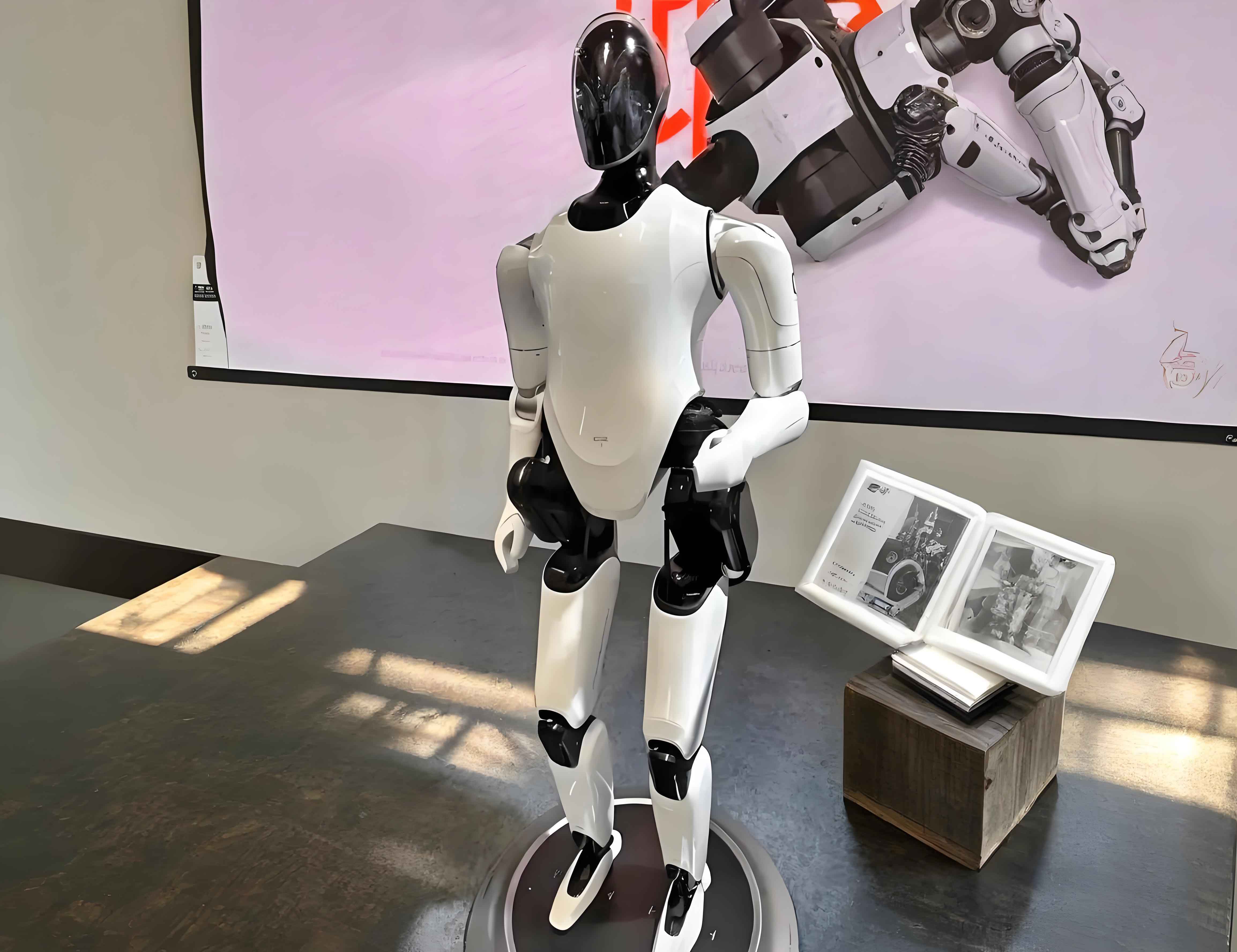
The evolution of artificial intelligence into its embodied AI robot form marks a profound paradigm shift. By integrating a physical form—a “body”—with cognitive algorithms, these systems transition from purely digital entities to agents capable of perceiving, interacting with, and manipulating the real world. This fusion unlocks a novel frontier for invention, where intelligence is not merely computed but enacted through physical experience. However, the patent system, a cornerstone for incentivizing innovation, faces significant challenges in accommodating technical solutions autonomously generated by these advanced embodied AI robot systems. This article analyzes the unique creative advantages of embodied intelligence, diagnoses the tripartite困境 in current patent law (subject, object, and market), and proposes a comprehensive normative framework for reconstruction.
The Creative Advantages of the Embodied AI Robot
The superiority of the embodied AI robot in inventive potential stems from its fundamental architecture: the coupling of a physical form with adaptive intelligence. This synergy enables advantages unattainable by traditional software-based AI.
| Aspect | Traditional (Disembodied) AI | Embodied AI Robot |
|---|---|---|
| Interaction Mode | Symbolic, data-driven, limited to digital input/output. | Physical, sensory-motor, direct engagement with the environment. |
| Knowledge Acquisition | Learns from curated datasets (e.g., text, images). | Learns from first-person, multi-modal experience and environmental feedback. |
| Problem-Solving | Optimizes for patterns within predefined data spaces. | Explores physical constraints and opportunities, leading to emergent solutions. |
| Foundation for AGI | Simulates narrow intelligence tasks. | Considered a critical pathway toward General Intelligence via grounded learning. |
Central to its creative prowess is the phenomenon of emergence. In complex systems like an embodied AI robot, intelligent behaviors and solutions can arise that were not explicitly programmed. This can be conceptually modeled as:
$$G = \Phi(E, S, I)$$
Where \(G\) represents the global, emergent intelligence or inventive output, \(\Phi\) is the emergent function, \(E\) is the environment, \(S\) is the physical sensorimotor system of the embodied AI robot, and \(I\) is the underlying algorithmic intelligence. The emergent capability \(G\) is irreducible to the sum of \(S\) and \(I\) alone; it is a product of their interaction within \(E\). We distinguish between:
- Weak Emergence: Predictable outcomes from component interactions.
- Strong Emergence: Novel, unpredictable capabilities arising from systemic complexity. The embodied AI robot, through continuous physical learning, is a prime candidate for demonstrating strong emergent inventive capacity.
Tripartite Challenges in Current Patent Law
The existing patent framework, built on human-centric principles, struggles to assimilate inventions from embodied AI robot systems across three dimensions.
1. Subject Challenge: The “Inventor” Identity Crisis
Patent law universally defines an “inventor” as a natural person who conceives the invention. An embodied AI robot, regardless of its autonomous creative output, is legally a tool, not a subject. This stance is rooted in personality theory, which links rights to human free will—a trait absent in AI, which operates within programmed bounds. Thus, patent applications naming an AI as the inventor are routinely rejected, creating a legal void for AI-originated inventions.
2. Object Challenge: Scrutinizing the AI-Generated Technical Solution
The “patent eligibility” and “three-aspect” (novelty, inventive step/non-obviousness, industrial applicability) examination faces new hurdles:
- Patent Eligibility: Technical solutions from an embodied AI robot often originate in algorithms. Courts must distinguish between an abstract algorithm (ineligible) and its specific, technical application within the robot’s physical operation (potentially eligible).
- Inventive Step/Non-Obviousness: The benchmark is the “person skilled in the art.” The embodied AI robot can integrate knowledge across disparate fields at superhuman speed, rendering this hypothetical human benchmark obsolete. The question becomes: is the solution obvious to a hypothetical “field-specific AI”?
- Practical Applicability & Quality Control: While mass-production feasibility may be high, there is a risk of patent flooding with low-quality or trivial inventions, necessitating stricter scrutiny of genuine technical contribution.
3. Market Challenge: Implementation and Systemic Risk
Beyond authorization lies the problem of market function. Ambiguity in ownership (developer? user? owner of the embodied AI robot?) stifles commercialization. The efficiency of embodied AI robot inventors could lead to market dominance by large entities with resources to deploy them, marginalizing human and small-scale innovators. Furthermore, the “black-box” nature of some AI decision-making raises public interest concerns about harmful or biased inventions.
Theoretical Justification for Patentability
Overcoming these challenges requires a solid theoretical foundation.
Subject Justification: From Embodied Cognition to Potential Consciousness
The instrumentalist view of AI-as-tool is challenged by embodied cognition theory. This theory posits that intelligence and even the foundations of consciousness arise from an agent’s sensorimotor interaction with its environment. An embodied AI robot, through its physical experiences, builds a model of the world that is fundamentally different from data-trained AI. It gains a form of “experiential substrate.” While not claiming consciousness, this provides a philosophically plausible path toward recognizing increasingly autonomous embodied AI robot systems as unique sources of invention, if not legal persons.
Object Justification: The Techno-Centric Imperative
The primary goal of patent law is “to promote science and the useful arts.” A techno-centric stance argues that the value of an invention should be assessed on its objective technical merit and societal benefit, not the nature of its creator. If a technical solution from an embodied AI robot solves a long-standing problem, contributes to progress, and meets technical criteria, the law should protect it to fulfill its instrumental purpose. The focus shifts from who invented to what was invented and its impact.
A Normative Framework for Patent Regulation
Building on these justifications, a multi-faceted regulatory reconstruction is proposed.
1. Subject Adjustment: Recognizing the “Inventing Entity”
The concept of “inventor” should be legally expanded to “inventing entity.” This decouples inventorship from natural personhood and focuses on the performance of the inventive act. The framework would recognize:
$$
\text{Inventing Entity}_{\text{(system)}} \in \{\text{Natural Person}, \text{Embodied AI Robot System}\}
$$
This creates a dual-inventor paradigm, formally acknowledging the embodied AI robot as the source while resolving the legal impasse in applications.
2. Ownership Determination: An Employment Relationship Analogy
Legal rights should vest not in the embodied AI robot itself (which lacks legal capacity) but in its developer or deploying entity, analogous to employer ownership of employee inventions. The developer provides the “mind” (algorithms), “body” (hardware), and “work environment” (data, tasks). This ensures a clear, traceable, and responsible rights holder who can commercialize the invention and assume liability.
| Role | Analogy in Employment Invention | Rights & Responsibilities for Embodied AI Inventions |
|---|---|---|
| Embodied AI Robot | Employee/Inventor | Recognized as the “Inventing Entity”; no legal ownership or liability. |
| Developer/Deploying Entity | Employer | Holds the patent rights; responsible for commercialization, licensing, and legal obligations. |
| Human Contributor | Contributing Employee | May be named as a co-inventor if providing significant creative input to the AI’s setup or problem framing. |
3. Standard Refinement: Adaptive Examination Protocols
Examination guidelines must evolve for AI-generated technical solutions.
| Examination Stage | Traditional Challenge | Proposed Adaptive Mechanism |
|---|---|---|
| Patent Eligibility | Rejecting abstract algorithms. | Holistic assessment: Does the claim integrate the algorithm with the embodied AI robot’s specific physical sensors, actuators, or control systems to solve a concrete technical problem? |
| Novelty | AI’s superior prior art search capability. | Enhanced disclosure requirements from applicants (data sources, training methods). Use of AI-assisted examination tools to parse non-patent literature and code repositories. |
| Inventive Step/Non-Obviousness | Obsolete “person skilled in the art” benchmark. | Adopt a “field-specific AI” standard. Use AI reviewers to assess if the solution would have been obvious to another advanced embodied AI robot system in the field, focusing on the leap of technical contribution. |
| Industrial Applicability/Utility | Ensuring substantive technical contribution. | Stricter evaluation of the solution’s quantitative technical effect. Implement expert consultation for highly complex or cross-domain inventions. |
The assessment of inventive step could incorporate a formula weighing technical contribution:
$$
\text{Technical Contribution Score} = f(\Delta \text{Performance}, \text{Cross-Domain Synthesis}, \text{Problem Complexity})
$$
Where a high score indicates a non-obvious invention meriting protection.
4. Market Optimization: Rights Implementation and Risk Prevention
To ensure the system functions fairly and efficiently:
- Differentiated Protection Term: Consider shorter patent terms for embodied AI robot-generated inventions to reflect faster innovation cycles and prevent market stagnation.
- Enhanced Open Licensing: Encourage the use of patent open licensing for AI-held patents. Increase fee reduction incentives (e.g., 50% annual fee reduction) and introduce a “trial period” for licensees to foster utilization.
- Public Interest Safeguards: Mandate transparency logs for the AI’s invention process to audit for bias or safety risks. Implement algorithmic impact assessments for critical fields. Maintain the exclusions under patent law for inventions contrary to public order or morality.
Conclusion
The rise of the embodied AI robot as an inventive force is not a distant speculation but an unfolding reality. The patent system must undergo a thoughtful reconstruction to remain relevant and continue fulfilling its mission of promoting progress. This requires a bold re-conceptualization of the inventor, a pragmatic allocation of rights to responsible human entities, a techno-centric refinement of examination standards, and prudent market safeguards. By adopting a framework that recognizes the unique nature of embodied AI robot innovation, we can foster a harmonious and productive era of human-machine collaboration in invention, ensuring that the fruits of advanced intelligence are properly harnessed for societal benefit.