
The global challenge posed by the COVID-19 pandemic starkly highlighted the critical vulnerabilities within healthcare systems, particularly the risk of pathogen transmission between patients and healthcare workers during close-contact procedures. A promising avenue to mitigate such risks and revolutionize patient care lies in the integration of non-contact, autonomous systems. Among these, medical robots stand out as a pivotal technology. They offer the potential for precise, remote diagnostics, minimally invasive surgeries, and consistent rehabilitation therapies, thereby reducing direct exposure and alleviating strain on medical staff. Recognizing this potential, national funding bodies and ministries have explicitly called for accelerated research and development in robotics and artificial intelligence to bolster healthcare resilience. This article, therefore, undertakes a systematic study to identify and analyze the core technological directions within the field of medical robotics. The insights aim to guide focused research efforts and strategic policy formulation, ultimately contributing to a more robust and technologically advanced healthcare infrastructure.
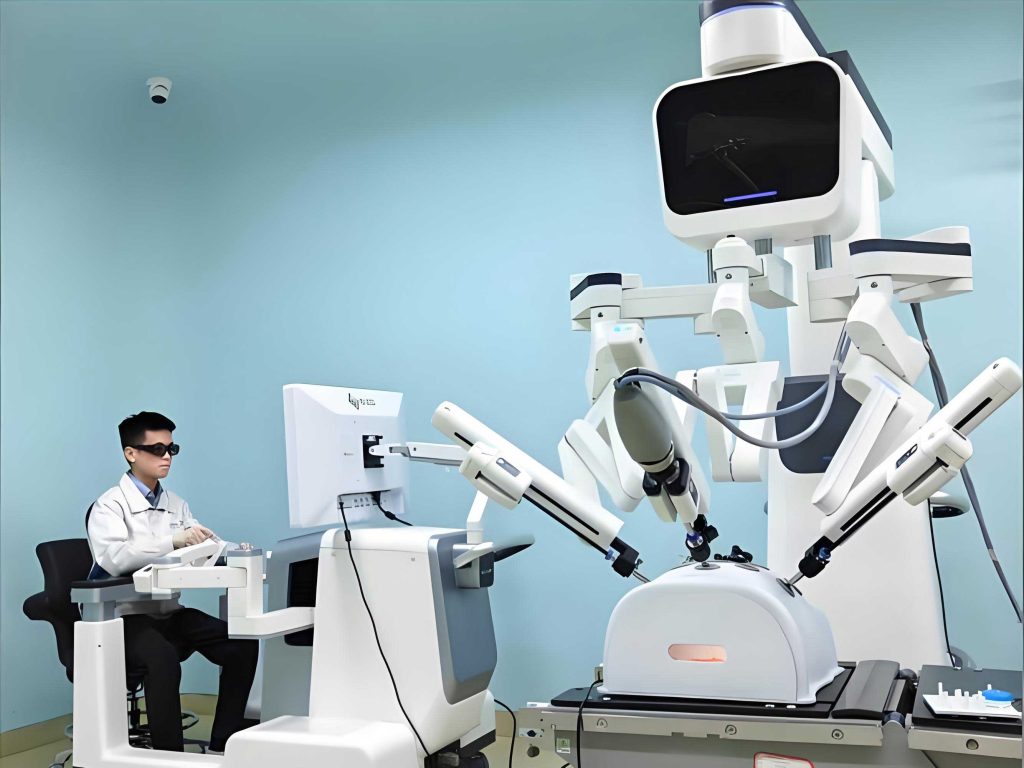
The foundation of any robust technology foresight study is reliable data. Academic publications and patent documents serve as two complementary proxies for research activity and innovation output, respectively. While journal papers often represent fundamental research and early-stage concepts, patents are closer indicators of applied technological development and commercial intent. By integrating and analyzing both datasets, a more holistic and accurate picture of the technological landscape can be formed, surpassing the limitations of analyses based on a single source. In this study, we harness this combined approach. Data was sourced from the Web of Science (WoS) core collection for scholarly articles and the Derwent Innovations Index (DII) for patent documents. The search strategy focused on the core theme of “medical robot*”, covering a ten-year period from 2009 to 2018 to capture a significant evolutionary timeline. After rigorous cleaning and filtering to retain only relevant records, the final dataset pertaining to the target region comprised 41 research articles and 61 patent families.
The initial step involved processing the unstructured text data from the abstracts of these papers and patents. Using natural language processing techniques, a domain-specific stop-word list was created. Feature extraction was then performed using the Term Frequency-Inverse Document Frequency (TF-IDF) method. This algorithm weights the importance of a word in a document relative to its frequency across the entire corpus, effectively vectorizing the text. The TF-IDF weight for a term \(t\) in document \(d\) from corpus \(D\) is calculated as:
$$ \text{tf-idf}(t, d, D) = \text{tf}(t, d) \times \text{idf}(t, D) $$
where the term frequency \(\text{tf}(t, d)\) is often the raw count of \(t\) in \(d\), and the inverse document frequency \(\text{idf}(t, D)\) is computed as:
$$ \text{idf}(t, D) = \log \frac{|D|}{|\{d \in D : t \in d\}|} $$
This process transforms each abstract into a numerical vector, enabling computational analysis.
Before diving into specific key technologies, a foundational taxonomy for the broader field of medical robotics was established. This was achieved through a synthesis of literature review and expert consultation, distilling the domain into major and minor categories. The taxonomy, presented in Table 1, provides a structured framework for subsequent, more granular analysis.
| Major Category | Sub-category |
|---|---|
| Components & Actuation | Force/Torque Sensors |
| Tactile Sensors | |
| Proximity/Distance Sensors | |
| Vision Sensors | |
| Structures & Control | Arm & Hand Mechanisms |
| Parallel Mechanisms | |
| Mobile Robot Platforms | |
| Specialized Medical Robot Types | Surgical Robots |
| Rehabilitation Robots | |
| Service Robots for Hospitals | |
| Health-assistive Robots | |
| System Integration & Intelligence | Human-Robot Interaction (HRI) |
| Telesurgery/Remote Operation | |
| Multi-robot Coordination | |
| Robot Modeling & Simulation | |
| Perception & Planning | Visual Information Processing |
| Tactile & Haptic Feedback | |
| Path Planning & Algorithms | |
| Emerging Foundation Technologies | Wearable Robotics |
| Internet-of-Things (IoT) & Big Data | |
| Micro/Nano Robotic Systems | |
| AI & Machine Learning |
With the data prepared and categorized, the core task of identifying specific key technologies commenced. We employed a Latent Dirichlet Allocation (LDA) model, a powerful unsupervised generative probabilistic model used for topic discovery. The LDA model treats each document as a mixture of a small number of topics, and each topic as a probability distribution over words. Given a corpus of \(M\) documents with vocabulary size \(V\), LDA assumes the following generative process for each document \(d\):
1. Choose \(N_d \sim \text{Poisson}(\xi)\).
2. Choose \(\theta_d \sim \text{Dir}(\alpha)\), where \(\theta_d\) is the topic distribution for document \(d\).
3. For each of the \(N_d\) words \(w_{dn}\):
a. Choose a topic \(z_{dn} \sim \text{Multinomial}(\theta_d)\).
b. Choose a word \(w_{dn}\) from \(p(w_{dn} | z_{dn}, \beta)\), a multinomial probability conditioned on the topic \(z_{dn}\).
Here, \(\alpha\) is the parameter of the Dirichlet prior on the per-document topic distributions, and \(\beta\) is the parameter of the Dirichlet prior on the per-topic word distribution. The goal of the model is to infer the latent variables \(\theta\) and \(z\).
We applied the LDA algorithm to the combined abstract corpus, iteratively testing different numbers of potential topics. Guided by expert judgment on interpretability and coherence, the optimal model configuration yielded nine distinct technological themes. For each discovered topic, the model provided a list of the most probable keywords. Expert panels then analyzed these keyword lists to assign a descriptive name to each topic, defining them as primary key technology directions for medical robotics development in the region. A sample of the model output is shown in Table 2.
| Topic ID | Identified Key Technology Theme (Primary Direction) | Representative High-Probability Keywords |
|---|---|---|
| 1 | Robot-Assisted Treatment & Therapy | study, system, sensitivity, robot-assisted, treatment, method |
| 2 | Robotic Fingertip Sensor Technology | force, stress, sensor, fingertip, grasping, determination |
| 3 | Robotic Force Feedback Analysis | robot, force feedback, soft tissue, graphical interface, deformation |
| 4 | Fast-Response Bio-inspired Robotic Platforms | fish-like, fast-response, platform, float, control algorithm |
| 5 | Path Planning for Portable Massage Robots | path planning, portable, massage, robot, parameters, feasibility |
| 6 | Robotic-Assisted Vascular & Tissue Transplantation | surgery, fixation, motion, resolution, low-dose, immunosuppressive, vein |
| 7 | Robotic Rotary Actuation & Drive Mechanisms | rotating, roller, rod, joint, gear, coil, magnetic drive |
| 8 | Lower-Limb Rehabilitation & Training Robotics | rehabilitation, training, joint, limb, patient, leg, lower, gait |
| 9 | Robotic Visual Scanning & Registration | mark, scanning, visual, registration, bone, model, trajectory |
The final step involved contextualizing these identified key technologies within the broader regional innovation ecosystem. This was accomplished by comparing the LDA-derived technology themes against internal databases cataloging funded research projects, technical reports, and innovation records. This comparative analysis, supported by expert evaluation, revealed the region’s unique research profile. Two primary gaps were identified: Robotic Rotary Actuation & Drive Mechanisms and Robotic Visual Scanning & Registration. Concurrently, two distinctive, strength-oriented research directions emerged: IoT-based Rehabilitation Robots for Hemiplegic Patients and Brain-Computer Interface (BCI) Controlled Exoskeletons for Stroke Rehabilitation. This mapping is crucial for strategic planning.
To formulate a concrete strategic roadmap, a SWOT (Strengths, Weaknesses, Opportunities, Threats) analysis was conducted, synthesizing the internal technological profile with the external environment. The results are summarized in Table 3.
| Strengths (S) | Weaknesses (W) | |
|---|---|---|
| Internal |
|
|
| Opportunities (O) | Threats (T) | |
|---|---|---|
| External |
|
|
From the SWOT matrix, the SO (Strengths-Opportunities) growth strategy is the most advantageous. It involves leveraging internal research strengths to capitalize on powerful external tailwinds like policy support and market demand. This leads to the final, prioritized set of future research and development directions for medical robotics, categorized by strategic intent (Table 4).
| Strategic Priority | Future R&D Direction in Medical Robotics | Basis for Selection |
|---|---|---|
| Core Support |
|
Identified as existing key technologies with demonstrated research activity; alignment with SO strategy to solidify leadership. |
| Nurture & Develop |
|
Identified as critical technological gaps; investment required to build foundational capabilities and ensure long-term competitiveness in medical robot development. |
| Specialized Cultivation |
|
Identified as unique regional research strengths with high innovative potential; offers a path to differentiated expertise and market positioning in the global medical robot landscape. |
In conclusion, the convergence of urgent global health needs and strong policy impetus has created a pivotal moment for medical robotics. The systematic methodology applied here—integrating bibliometric and patent analysis with advanced topic modeling and expert validation—provides a clear, evidence-based framework for identifying technological priorities. For regions and institutions aiming to contribute to this field, the strategic imperative is threefold: to support core areas of existing competency, to nurture foundational technologies where gaps exist, and to aggressively cultivate unique, interdisciplinary specializations that promise future leadership. By following such a roadmap, the evolution of medical robot technology can be accelerated, transforming them from supportive tools into central pillars of a safer, more efficient, and more accessible healthcare system for all.