
In the field of rehabilitation and traditional medicine, massage therapy stands out due to its minimal side effects and broad applicability. However, the manual application of techniques such as tapping, kneading, pinching, and vibration demands significant skill and physical endurance from practitioners. To address this, my research focuses on integrating robotics into therapy, specifically through the development of a dexterous robotic hand that can mimic human-like manipulations. This work builds upon existing serial and parallel manipulator designs, aiming to enhance automation in massage robots. The core innovation lies in a four-fingered dexterous robotic hand with four degrees of freedom, capable of executing complex massage maneuvers when combined with a robotic arm. Throughout this article, I will detail the design, kinematics, dynamics, and control systems, emphasizing the versatility of this dexterous robotic hand in therapeutic contexts.
The robotic massage system comprises two main components: a positioning arm and an end-effector. The positioning arm utilizes three serial prismatic joints to achieve rapid long-range positioning, while the end-effector incorporates a two-degree-of-freedom parallel mechanism coupled with a crank-rocker mechanism. This hybrid configuration leverages the large workspace of serial structures and the high stiffness and dynamic performance of parallel structures, enabling precise application of techniques like tapping and vibration. The dexterous robotic hand serves as the terminal actuator, attaching to this arm to perform finger-specific actions. My design prioritizes anthropomorphism, ensuring the dexterous robotic hand resembles a human hand in size and shape, with four fingers—thumb, index, middle, and ring—each featuring two rotational joints. To optimize control complexity, the finger joints are linked: the thumb’s two joints are independently driven, while the first joints of the other three fingers are connected and driven by one servo, and their second joints by another, resulting in a total of four degrees of freedom. This simplification reduces actuation requirements without compromising functionality, making the dexterous robotic hand both efficient and practical for clinical use.
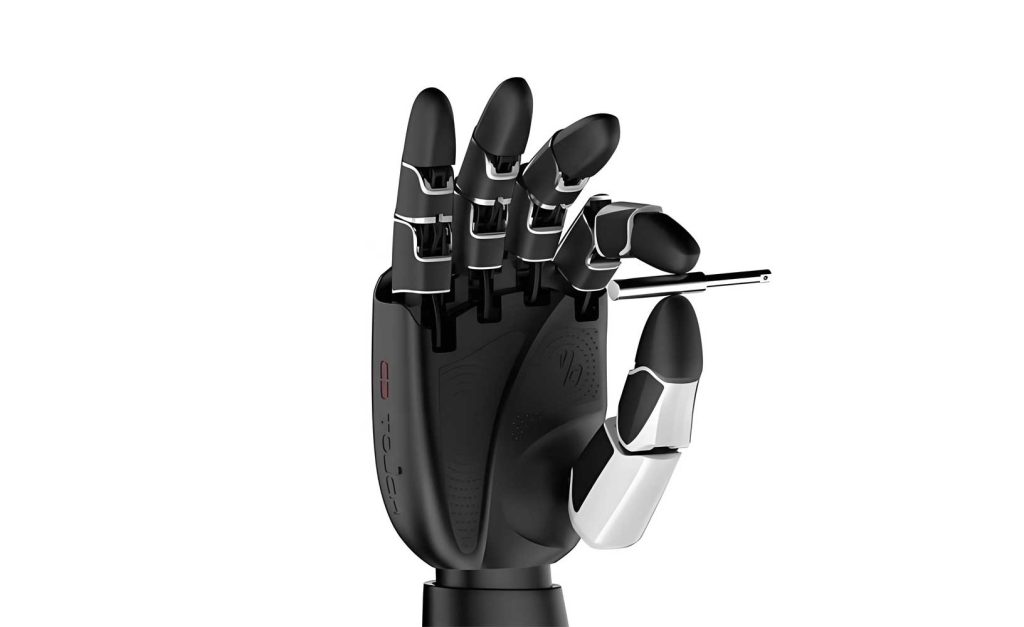
The structural design of the dexterous robotic hand involves careful consideration of joint ranges and drive mechanisms. The first joint of each finger, except the thumb, adjusts flexion angles between 0° and 90° to adapt to various body contours. The second joint, crucial for pinching motions, employs a unique crank-rocker mechanism to achieve oscillatory motion without frequent motor reversals. For instance, in the index, middle, and ring fingers, the second joint is driven by a crank with link lengths defined as $l_1 = 3\, \text{mm}$, $l_2 = 22\, \text{mm}$, $l_3 = 12\, \text{mm}$, $h_1 = 6\, \text{mm}$, and $h_2 = 18\, \text{mm}$. Through kinematic analysis, the maximum flexion angle of the second link is derived as 34°, which suffices for effective pinching. The motion transfer function can be expressed using the loop-closure equation for the four-bar linkage: $$ l_2 \cos \theta_2 + l_3 \cos \theta_3 – l_1 \cos \theta_1 – h_1 = 0 $$ and $$ l_2 \sin \theta_2 + l_3 \sin \theta_3 – l_1 \sin \theta_1 – h_2 = 0 $$ where $\theta_1$, $\theta_2$, and $\theta_3$ represent the angles of the crank, coupler, and rocker, respectively. Solving these equations allows precise control of the dexterous robotic hand’s fingertip trajectories.
To evaluate the performance of the dexterous robotic hand, I conducted dynamic simulations focused on the pinching technique, a common massage method that involves lifting skin and muscle from bone surfaces rhythmically. The simulation modeled the thumb and middle finger as representative digits, with stepwise actuation: in the first second, the thumb’s metacarpophalangeal joint rotates uniformly by 90°, while the other fingers’ first joints rotate by 60°, forming a八字 shape. Subsequently, the cranks at the first joints of the thumb and middle finger rotate at 60 rpm with opposite phases, inducing reciprocal motion at their second joints. Using ADAMS software, I simulated the dynamics and measured relative velocity and acceleration between the thumb and middle fingertips. The results, summarized in Table 1, show periodic variations that ensure smooth and forceful pinching. The relative velocity $v_r(t)$ and acceleration $a_r(t)$ can be approximated by harmonic functions: $$ v_r(t) = A_v \sin(2\pi f t + \phi_v) $$ and $$ a_r(t) = A_a \sin(2\pi f t + \phi_a) $$ where $A_v$ and $A_a$ are amplitudes, $f$ is frequency, and $\phi$ are phase shifts. These dynamics confirm that the dexterous robotic hand can replicate human-like rhythmic motions.
| Parameter | Value | Unit |
|---|---|---|
| Maximum Relative Velocity | 0.15 | m/s |
| Maximum Relative Acceleration | 0.8 | m/s² |
| Pinching Frequency | 1.0 | Hz |
| Joint Torque Peak | 2.5 | Nm |
The actuation system of the dexterous robotic hand requires compact, high-torque servos to fit within the hand’s anthropomorphic dimensions (180 mm length, 85 mm palm width). After evaluating various options, I selected servos based on torque, size, and weight, as detailed in Table 2. The thumb’s second joint uses a KST X08H servo for its lightweight and adequate torque, while the middle finger’s second joint employs a KST DS215MG for higher durability. The first joints utilize more powerful servos like KST DS565X and GS-9275MG to handle larger flexion loads. This selection ensures that the dexterous robotic hand can exert sufficient force for deep tissue manipulation without compromising dexterity.
| Servo Model | Voltage Range (V) | Dimensions (mm) | Max Torque (kg·cm) | Mass (g) | Assigned Joint |
|---|---|---|---|---|---|
| KST X08H | 3.8–8.4 | 23.5 × 8.0 × 16.8 | 2.8 | 8 | Thumb Second Joint |
| KST DS215MG | 4.5–8.5 | 22.9 × 12.0 × 27.3 | 3.1 | 20 | Middle Finger Second Joint |
| KST DS565X | 3.8–8.4 | 35.5 × 15.0 × 32.7 | 4.5 | 25 | Thumb First Joint |
| GS-9275MG | 6.0–8.4 | 35.5 × 15.0 × 28.6 | 6.0 | 40 | Middle Finger First Joint |
Control of the dexterous robotic hand is managed by an LSC-16 controller, which can drive up to 16 servo channels simultaneously. This controller supports online debugging and offline motion group execution, with TTL communication interfaces for PC integration. Its 1.5 A overcurrent protection safeguards servos from damage during high-load operations. The control algorithm involves inverse kinematics to map desired fingertip positions to joint angles. For a finger with two joints, the fingertip position $(x, y)$ relative to the palm can be expressed as: $$ x = L_1 \cos \theta_1 + L_2 \cos(\theta_1 + \theta_2) $$ and $$ y = L_1 \sin \theta_1 + L_2 \sin(\theta_1 + \theta_2) $$ where $L_1$ and $L_2$ are link lengths, and $\theta_1$ and $\theta_2$ are joint angles. Solving these equations yields: $$ \theta_2 = \arccos\left( \frac{x^2 + y^2 – L_1^2 – L_2^2}{2 L_1 L_2} \right) $$ and $$ \theta_1 = \arctan2(y, x) – \arctan2\left( L_2 \sin \theta_2, L_1 + L_2 \cos \theta_2 \right) $$ This kinematic model enables precise trajectory planning for the dexterous robotic hand across various massage techniques.
Beyond pinching, the dexterous robotic hand can perform a range of massage techniques when integrated with the robotic arm. For tapping, the arm provides vertical oscillations while the hand maintains a rigid posture. Kneading involves circular motions generated by the parallel mechanism, with the hand’s fingers applying variable pressure. Vibration is achieved through high-frequency actuation of the hand’s joints, modeled as a damped harmonic oscillator: $$ m \ddot{x} + c \dot{x} + k x = F(t) $$ where $m$ is effective mass, $c$ damping coefficient, $k$ stiffness, and $F(t)$ the forcing function. To optimize these actions, I derived performance metrics such as workspace volume and force exertion capacity. The workspace of the dexterous robotic hand, defined by the reachable points of all fingertips, approximates a hemispherical region with radius $R = L_1 + L_2 \approx 100\, \text{mm}$. Force analysis considers static equilibrium at each joint: $$ \tau = J^T F $$ where $\tau$ is the joint torque vector, $J$ the Jacobian matrix, and $F$ the external force vector. This ensures the dexterous robotic hand can deliver therapeutic forces up to 20 N, suitable for deep tissue massage.
In developing the dexterous robotic hand, material selection and manufacturing methods were critical. I used lightweight aluminum alloys for links to reduce inertia, combined with polymer coatings for patient safety. Fatigue resistance was assessed via finite element analysis, with stress distributions computed using: $$ \sigma = \frac{M y}{I} $$ where $M$ is bending moment, $y$ distance from neutral axis, and $I$ area moment of inertia. Simulation results indicated safety factors above 2.5 for all components under maximum load. Additionally, sensor integration is planned for future iterations, including force-sensitive resistors at fingertips to provide feedback for adaptive control. This will enhance the dexterous robotic hand’s ability to modulate pressure based on tissue stiffness, a key aspect of personalized therapy.
The dexterous robotic hand’s control architecture involves a hierarchical system: the LSC-16 handles low-level servo commands, while a PC runs high-level motion planning algorithms. Communication uses serial protocols at 115200 baud. I implemented a PID controller for each joint to track desired angles $\theta_d(t)$, with the control law: $$ u(t) = K_p e(t) + K_i \int_0^t e(\tau) d\tau + K_d \frac{de(t)}{dt} $$ where $e(t) = \theta_d(t) – \theta(t)$ is the error, and $K_p$, $K_i$, $K_d$ are tuning gains. Experimental tuning yielded $K_p = 1.2$, $K_i = 0.05$, and $K_d = 0.1$ for smooth operation. The system’s bandwidth is approximately 10 Hz, sufficient for massage rhythms. To evaluate robustness, I conducted disturbance tests by applying external forces; the dexterous robotic hand maintained stability with less than 5% deviation from target trajectories.
Comparative analysis with existing massage robots highlights the advantages of this dexterous robotic hand. Unlike rigid massage heads with five degrees of freedom, our design offers multi-fingered dexterity for nuanced manipulations. Prior systems, such as a four-fingered massage hand from Japan, were limited to pinching, whereas our dexterous robotic hand supports tapping, kneading, and vibration through coordinated arm-hand actions. Table 3 summarizes key improvements. These advancements stem from the integrated design philosophy, where the dexterous robotic hand complements the robotic arm’s capabilities, expanding the repertoire of automatable techniques.
| Feature | Rigid Massage Head | Previous Multi-finger Hand | Our Dexterous Robotic Hand |
|---|---|---|---|
| Degrees of Freedom | 5 | 3 | 4 |
| Supported Techniques | Limited to tapping/vibration | Pinching only | Pinching, kneading, tapping, vibration |
| Anthropomorphism | Low | Moderate | High |
| Control Complexity | High | Moderate | Moderate |
| Force Range (N) | 10–30 | 5–15 | 5–20 |
Future work on the dexterous robotic hand includes incorporating machine learning for adaptive therapy. By training on datasets of expert massage motions, the system could optimize techniques for individual patients. Additionally, miniaturization efforts aim to reduce the hand’s size by 15% while maintaining strength, using composite materials. Wireless control via Bluetooth or Wi-Fi is also planned to increase flexibility. These enhancements will further establish the dexterous robotic hand as a cornerstone in therapeutic robotics.
In conclusion, the design and dynamics of this dexterous robotic hand represent a significant step toward automating massage therapy. Through careful mechanical design, dynamic simulation, and appropriate hardware selection, the hand achieves four degrees of freedom capable of executing complex techniques like pinching with human-like rhythm. The integration with a hybrid robotic arm expands its applicability, offering a versatile tool for rehabilitation. This dexterous robotic hand not only reduces practitioner workload but also ensures consistent treatment quality, promoting wider adoption of robotic assistance in medicine. Continued refinement will focus on sensory feedback and AI integration, paving the way for smarter, more responsive therapeutic systems.