
As a robotics application development engineer, I have dedicated my career to teaching humanoid robots how to navigate and interact with our world. The journey of humanoid robots from mere科幻 concepts to tangible entities in events like national sports openings and international expos is a testament to rapid technological advancement. In this article, I will share my first-person perspective on the intricacies of developing humanoid robots, emphasizing the role of engineers as their human mentors. The term “humanoid robot” will be frequently explored, as it encapsulates the essence of machines designed to mimic human form and intelligence.
The core of humanoid robot development lies in what we call “embodied intelligence” or “具身智能” in some contexts. This concept refers to a humanoid robot’s ability to perceive its environment through sensors, process that information via computational models, make autonomous decisions, and execute actions—all while continuously learning and iterating. For instance, in industrial settings, a humanoid robot might be tasked with assembling components, requiring precise coordination and adaptation. The process can be summarized by a fundamental loop: Perception → Computation → Decision → Action → Learning. This loop is iterative, enabling the humanoid robot to improve over time. To quantify this, consider the following mathematical representation of the decision-making process:
$$ \text{Action} = \arg\max_{a \in A} \sum_{s’} P(s’ \mid s, a) \cdot U(s’) $$
Here, \( s \) represents the current state perceived by the humanoid robot, \( a \) is an action from the set \( A \), \( P(s’ \mid s, a) \) is the probability of transitioning to a new state \( s’ \), and \( U(s’) \) is the utility of that state. This equation highlights how a humanoid robot evaluates potential outcomes to choose optimal actions, akin to human reasoning.
In my daily work, I focus on programming and debugging these systems. One critical aspect is sensor integration, where a humanoid robot fuses data from cameras, LiDAR, inertial measurement units (IMUs), and tactile sensors. This fusion can be modeled using Bayesian filtering techniques, such as the Kalman filter for linear systems or the extended Kalman filter for nonlinear cases. For example, the state estimation for a humanoid robot’s limb position might involve:
$$ \hat{x}_{k|k-1} = F_k \hat{x}_{k-1|k-1} + B_k u_k $$
$$ P_{k|k-1} = F_k P_{k-1|k-1} F_k^T + Q_k $$
where \( \hat{x} \) is the estimated state vector (e.g., position and velocity), \( F_k \) is the state transition matrix, \( u_k \) is the control input, \( P \) is the error covariance, and \( Q_k \) is the process noise covariance. Such formulas underpin the real-time responsiveness of a humanoid robot in dynamic environments.
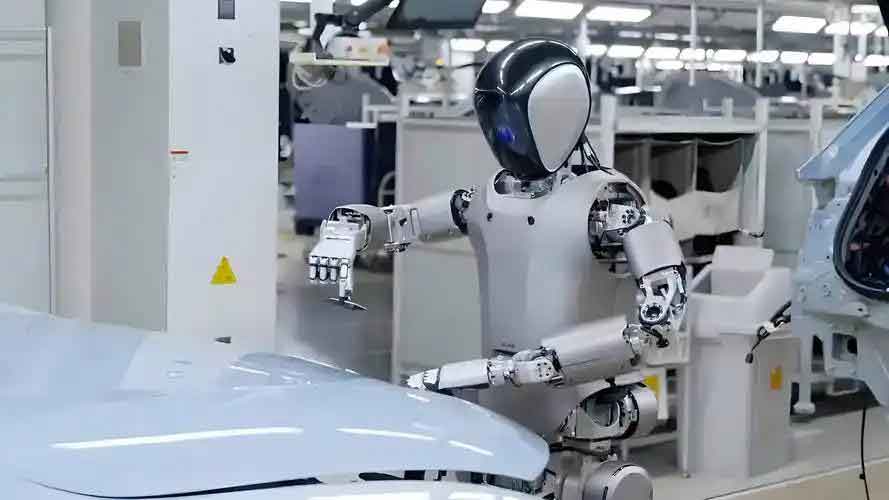
Beyond theoretical models, the practical development of a humanoid robot involves numerous components and subsystems. Below is a table summarizing key hardware and software elements that define a modern humanoid robot:
| Component Category | Specific Elements | Function in Humanoid Robot |
|---|---|---|
| Actuation | Electric motors, hydraulic actuators, pneumatic systems | Provide movement for joints and limbs, enabling locomotion and manipulation. |
| Sensing | Cameras (RGB, depth), LiDAR, IMUs, force-torque sensors, microphones | Gather environmental data for perception, allowing the humanoid robot to understand its surroundings. |
| Computation | Central processing units (CPUs), graphics processing units (GPUs), neural processing units (NPUs) | Run algorithms for perception, planning, and control, serving as the “brain” of the humanoid robot. |
| Software | Operating systems (e.g., ROS), machine learning frameworks, simulation tools | Facilitate programming, testing, and deployment of behaviors for the humanoid robot. |
| Power | Lithium-ion batteries, power management systems | Supply energy for sustained operation of the humanoid robot, impacting mobility and endurance. |
| Structural | Lightweight alloys, carbon fiber composites, 3D-printed parts | Form the skeleton of the humanoid robot, balancing strength, weight, and flexibility. |
As the field evolves, the role of a robotics application development engineer has expanded. In 2022, robotics engineering technicians were officially recognized as a new profession, reflecting the growing demand for expertise in humanoid robot development. Over the past three years, we have seen iterations in humanoid robot morphology and technology, leading to specialized roles such as perception engineers, locomotion specialists, and AI ethicists. This diversification is driven by the increasing complexity of tasks assigned to humanoid robots, from industrial automation to domestic assistance.
One of the most challenging aspects of teaching a humanoid robot is locomotion and balance. Humanoid robots must mimic bipedal walking, which involves solving high-dimensional control problems. The dynamics can be described using the Lagrangian formulation for a multi-body system:
$$ L = T – V $$
$$ \frac{d}{dt} \left( \frac{\partial L}{\partial \dot{q}_i} \right) – \frac{\partial L}{\partial q_i} = \tau_i $$
where \( L \) is the Lagrangian, \( T \) is kinetic energy, \( V \) is potential energy, \( q_i \) are generalized coordinates (e.g., joint angles), and \( \tau_i \) are generalized forces. For a humanoid robot, this translates to maintaining stability while walking, often achieved through control algorithms like zero-moment point (ZMP) theory. The ZMP condition ensures that the humanoid robot does not tip over, and it can be expressed as:
$$ x_{\text{ZMP}} = \frac{\sum_{i} m_i ( \ddot{z}_i + g ) x_i – \sum_{i} m_i \ddot{x}_i z_i}{\sum_{i} m_i ( \ddot{z}_i + g )} $$
Here, \( m_i \) is the mass of segment \( i \), \( g \) is gravity, and \( x_i, z_i \) are coordinates. This formula is pivotal in gait planning for a humanoid robot, enabling it to navigate uneven terrain autonomously.
In industrial applications, a humanoid robot like the one I mentor is programmed for tasks such as welding, packaging, or quality inspection. This requires integrating computer vision algorithms for object recognition. A common approach uses convolutional neural networks (CNNs), where the output for classifying an object in an image can be modeled as:
$$ y = \sigma \left( W^{(L)} \cdot \text{ReLU} \left( W^{(L-1)} \cdots \text{ReLU} \left( W^{(1)} x + b^{(1)} \right) \cdots + b^{(L-1)} \right) + b^{(L)} \right) $$
with \( x \) as the input image tensor, \( W^{(l)} \) and \( b^{(l)} \) as weights and biases at layer \( l \), ReLU as the activation function, and \( \sigma \) as softmax for classification. Such models allow a humanoid robot to identify tools or components on an assembly line, adapting its actions accordingly.
The learning capability of a humanoid robot is central to its evolution. Reinforcement learning (RL) is often employed, where the humanoid robot learns optimal policies through trial and error. The Bellman equation captures this:
$$ V^\pi(s) = \mathbb{E}_\pi \left[ \sum_{k=0}^\infty \gamma^k r_{t+k+1} \mid s_t = s \right] $$
where \( V^\pi(s) \) is the value function under policy \( \pi \), \( \gamma \) is a discount factor, and \( r \) is the reward. By maximizing cumulative rewards, a humanoid robot can master complex tasks, such as playing sports or assisting in healthcare. This iterative learning mirrors how humans acquire skills, albeit accelerated through computational power.
To illustrate the progression of humanoid robot technologies, consider the following table that outlines key milestones and trends over recent years:
| Year | Technological Advancements | Impact on Humanoid Robot Development |
|---|---|---|
| 2022 | Formal recognition of robotics engineering as a profession; rise of modular designs. | Standardized career paths accelerated innovation, allowing humanoid robots to be more customizable. |
| 2023 | Advances in actuator efficiency (e.g., tendon-driven systems); improved battery energy density. | Humanoid robots achieved longer operational times and more natural movements, enhancing practicality. |
| 2024 | Integration of large language models (LLMs) for natural language processing; simulation-to-real transfer learning. | Humanoid robots gained better human-robot interaction abilities, with reduced real-world training costs. |
| 2025 | Widespread use of embodied AI frameworks; expansion into service industries like retail and eldercare. | Humanoid robots became more autonomous and versatile, moving beyond industrial niches into daily life. |
My hands-on experience involves coding in environments like ROS (Robot Operating System) and using simulation software to test algorithms before deployment. For instance, to plan a path for a humanoid robot avoiding obstacles, I might implement a rapidly exploring random tree (RRT) algorithm, which probabilistically explores the configuration space. The growth of the tree can be described by:
$$ q_{\text{rand}} = \text{RandomSample}() $$
$$ q_{\text{near}} = \text{Nearest}(T, q_{\text{rand}}) $$
$$ q_{\text{new}} = \text{Steer}(q_{\text{near}}, q_{\text{rand}}) $$
where \( T \) is the tree, and \( \text{Steer} \) extends toward \( q_{\text{rand}} \) within constraints. This ensures the humanoid robot can navigate cluttered spaces safely—a critical skill for real-world deployment.
Moreover, the societal implications of humanoid robots are profound. As they become more prevalent, ethical considerations around employment, privacy, and safety emerge. For example, in manufacturing, a humanoid robot might collaborate with human workers, requiring robust safety protocols to prevent accidents. This collaboration can be optimized using game theory models, where the human and humanoid robot interact as agents in a stochastic game:
$$ \Pi_i(s) = \max_{a_i \in A_i} \left\{ r_i(s, a_i, a_{-i}) + \gamma \sum_{s’} P(s’ \mid s, a_i, a_{-i}) \cdot \Pi_i(s’) \right\} $$
Here, \( \Pi_i \) is the value for agent \( i \) (human or robot), \( a_{-i} \) denotes actions of others, and \( r_i \) is the reward. Such frameworks help design symbiotic workflows, ensuring that the humanoid robot augments rather than replaces human capabilities.
Looking ahead, the future of humanoid robots is intertwined with advancements in AI and materials science. We anticipate humanoid robots with more dexterous manipulators, capable of fine motor tasks like surgery or crafting. Energy efficiency will also improve, possibly through biomimetic designs that reduce power consumption. The ultimate goal is to create a humanoid robot that can seamlessly integrate into human societies, assisting in everything from education to emergency response.
In conclusion, as a robotics application development engineer, I see myself as a bridge between human ingenuity and machine potential. Teaching a humanoid robot involves not just programming code, but instilling a form of artificial cognition that respects the nuances of our world. Each breakthrough, from better sensors to more efficient algorithms, brings us closer to a future where humanoid robots are commonplace partners. The journey is complex, but the rewards—enhanced productivity, improved quality of life, and new frontiers of exploration—are immense. Through continuous innovation and ethical stewardship, the era of humanoid robots will undoubtedly transform our lives in ways we are only beginning to imagine.
To further elucidate the technical landscape, here is a summary of common performance metrics for evaluating a humanoid robot, which I use in my development cycles:
| Metric Category | Specific Metrics | Description and Relevance to Humanoid Robot |
|---|---|---|
| Mobility | Walking speed (m/s), step length variability, energy consumption per distance | Measures how efficiently and stably the humanoid robot moves, crucial for real-world deployment. |
| Manipulation | Grasp success rate, force control accuracy, object recognition accuracy | Assesses the humanoid robot’s ability to interact with objects, key for industrial or service tasks. |
| Perception | Sensor latency (ms), localization error (cm), scene understanding F1-score | Evaluates how well the humanoid robot perceives its environment, impacting autonomous decision-making. |
| Learning | Convergence time in reinforcement learning, generalization error to new tasks | Indicates the adaptability of the humanoid robot, enabling it to handle unforeseen scenarios. |
| Reliability | Mean time between failures (MTBF), maintenance cycles, software bug rate | Ensures the humanoid robot operates consistently over time, reducing downtime and costs. |
These metrics guide the iterative refinement process, where each version of a humanoid robot becomes more capable and reliable. The formulas and tables presented here only scratch the surface; the field is rich with interdisciplinary insights from mechanics, computer science, and cognitive psychology. As I continue to teach humanoid robots, I am constantly reminded that our goal is not to create mere machines, but intelligent entities that can learn, adapt, and collaborate—ushering in a new age of human-robot synergy.