
This article presents the design, analysis, and validation of a novel quadrupedal platform—affectionately termed a robot dog—engineered for traversing the complex, unstructured terrains of the lunar surface. The core innovation lies in its actively deformable trunk, a mechanism that enables this robot dog to dynamically adapt its morphology and gait strategy to confront specific environmental challenges, moving beyond the limitations of static-bodied platforms.
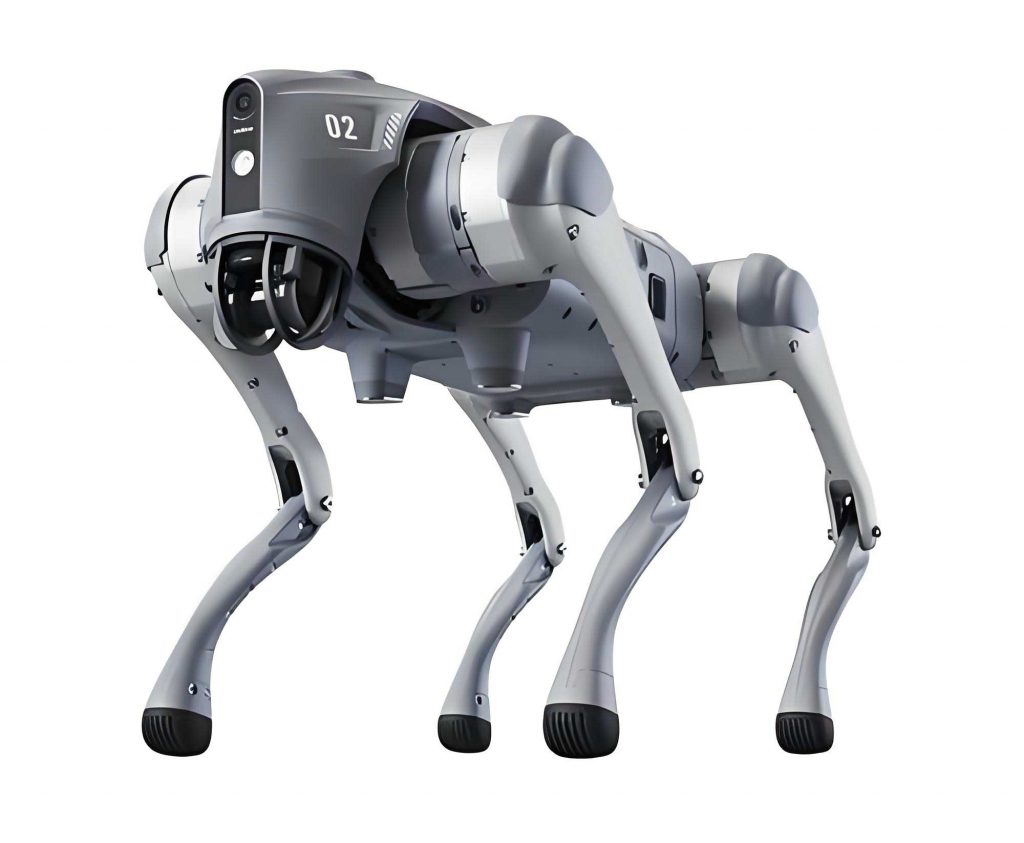
The lunar regolith presents a formidable suite of hazards: it is loose, prone to sinkage, adhesive, and sculpted into extreme topographies like craters, ridges, and steep slopes. Traditional wheeled rovers risk entrapment, while legged systems, though agile, can suffer from dynamic instability and discrete, sinkage-inducing footfalls. Our approach for this robot dog synthesizes the best of both worlds through a holistic design philosophy. We integrate a kinematically singular, closed-chain torso with specialized wheel-leg propulsion units. This fusion grants the robot dog the continuous, rolling contact beneficial for efficiency and sinkage mitigation, coupled with the discrete, high-clearance stepping capability essential for obstacle negotiation. The transformative trunk is the keystone, allowing this robot dog to reconfigure itself from a wide, stable base to a narrow, passable profile or a low, stable silhouette, effectively giving it multiple “personalities” for different missions. This article will detail the mechanical synthesis of this versatile robot dog, its kinematic principles, planned gait strategies, and simulation-based performance validation.
Configurational Design of the Deformable Robot Dog
The robot dog is conceived as a modular assembly of two primary subsystems: the Deformable Trunk Core and four identical Wheel-Leg Propulsion Modules. This modularity simplifies analysis, control, and potential repair. The overall kinematic skeleton features 30 revolute joints, with 5 designated as active drives (one for the trunk and one per propulsion module), yielding a system with 5 controllable degrees of freedom.
The Wheel-Leg Propulsion Module
Addressing lunar soil mechanics required a departure from conventional wheels or legs. We developed a Wheel-Leg module based on a planar single-degree-of-freedom six-bar linkage. This module inherently exhibits two primary poses—a rectangular and a kite shape—during its cyclic motion. By attaching a specifically profiled, “odd-shaped” foot to one of the linkage’s ground-contact members, we create a structure that rolls. This design ensures near-continuous line contact with the ground, distributing load to reduce sinkage risk, while the profile’s geometry helps mitigate soil adhesion. Crucially, a single actuator per module drives this hybrid wheel-leg motion, providing the robot dog with efficient rolling on benign terrain and the ability to “step over” or “climb onto” obstacles, all while maintaining a relatively steady vertical center of mass.
The Dual-Symmetric Bricard Mechanism Trunk
The torso of the robot dog is a Dual-Symmetric Bricard 6R spatial mechanism. This single-degree-of-freedom, overconstrained closed chain is renowned for its bifurcating motion paths and ability to fold compactly and deploy into expansive, load-bearing structures—ideal properties for an adaptive robot dog body. The mechanism consists of six links connected sequentially by revolute joints. Its defining feature is dual symmetry about two planes. Using the modified Grubler-Kutzbach criterion for spatial mechanisms, the mobility is confirmed as:
$$ F = d(n – g – 1) + \sum_{i=1}^{g} f_i + v $$
where $d=5$ (order of the screw system), $n=6$ (links), $g=6$ (joints), $f_i=1$ (for all revolute joints), and $v=0$ (no redundant constraints in a single loop). Thus, $F = 5(6-6-1) + 6 + 0 = 1$. This single degree of freedom allows the entire complex trunk deformation of the robot dog to be controlled by just one actuator.
The specific dimensional parameters used in our robot dog prototype, satisfying the dual-symmetric condition, are listed below:
| Trunk Parameter | Symbol | Value (mm) |
|---|---|---|
| Primary Link Length | $k$ | 470 |
| Secondary Link Length | $c_1$ | 420 |
| Joint Offset | $r$ | $\frac{40\sqrt{2}+3}{47}k$ |
Kinematic Analysis and Morphology Planning for the Robot Dog
The motion of the trunk, governed by the input angle $\theta_2$ at the driving joint, allows our robot dog to adopt three distinct morphological classes. We strategically operate along the dual-symmetric motion branch, avoiding kinematic bifurcations, within the range $\theta_2 \in [-40^\circ, 220^\circ]$.
Planned Morphologies
1. Quadrilateral (Narrow) Morphology: At $\theta_2 = 0^\circ$ or $180^\circ$, the trunk collapses into a flat, parallelogram shape. The Wheel-Leg modules are oriented at $45^\circ$. This gives the robot dog its minimum width, optimal for squeezing through narrow crevasses or passages. The $180^\circ$ configuration represents a flipped state, endowing the robot dog with a self-righting capability.
2. Hexagonal (Low) Morphology: At $\theta_2 = 90^\circ$, the trunk forms a symmetric hexagon. The Wheel-Leg modules are parallel to the ground. This configuration minimizes the robot dog‘s overall height and centers its mass low for maximum static and dynamic stability, ideal for high-speed traversal or operations in low-clearance environments.
3. Transitional Morphology: For all other $\theta_2$ values, the robot dog is in a continuously deforming state. This is the most agile form, where the trunk is neither flat nor hexagonal, enabling deliberate shifts in support polygons and center-of-mass position to tackle extreme, non-periodic obstacles.
Dimensional Variation and Mobility
The overall footprint and height of the robot dog are functions of $\theta_2$. Let $P(x_0, y_0, z_0)$ be a key point on the mechanism. The effective dimensions in a global coordinate frame can be derived through forward kinematics. The approximate bounding sizes are:
- X-direction (Length): $X_{size}(\theta_2) = \sqrt{x_{xs}^2 + y_{xs}^2 + z_{xs}^2}$
- Y-direction (Width): $Y_{size}(\theta_2) = \frac{1}{2}\sqrt{x_{ys}^2 + y_{ys}^2 + z_{ys}^2}$
- Z-direction (Height): $Z_{size}(\theta_2) = z_{max} – z_{bottom}$
where the components $x_{xs}, y_{xs}, …$ are trigonometric functions of $\theta_2$ and the other dependent joint angles ($\theta_1, \theta_3, \theta_4$), which are themselves determined by the dual-symmetry constraint equations. Analysis shows that $X_{size}$ is largest in the hexagonal morphology, $Y_{size}$ is largest in the quadrilateral morphology, and $Z_{size}$ peaks during the transitional phase, offering maximum ground clearance.
The net traction force for the robot dog in rolling mode arises from the friction vectors at each Wheel-Leg contact point. For a given module drive angle $\beta_i$, the angle $\sigma_i$ between its friction force and the intended direction of motion is:
$$ \sigma_i = \arctan\left( \frac{\sqrt{2} \cos\beta_i \cdot w}{q + v} \right) $$
where $w = 4H\cos\beta_i + 3L\sin\beta_i$, $q = 4H$, $v = L\sin 2\beta_i$, $H$ is the contact height, and $L$ is a characteristic length. Coordinating the four $\beta_i$ angles allows for omnidirectional motion control of the robot dog.
Gait Strategies and Obstacle Negotiation for the Adaptive Robot Dog
The morphologies enable two overarching gait families for the robot dog: Universal Gaits for benign terrain and Environment-Adaptive Gaits for specific obstacles.
Universal Gaits
These are used on relatively flat lunar plains (maria). By coordinating the phases of the four Wheel-Leg module drives, the robot dog can achieve:
Directional Rolling: All modules cooperate to produce linear motion. Different phase configurations yield movement along different body axes, providing omnidirectional capability.
Steering: Differential driving forces between left and right side modules, or between front and rear modules, cause the robot dog to turn. The radius of curvature can be modulated from very large to pivot-like turns by altering phase differences.
| Gait Type | Phase Configuration | Robot Dog Motion |
|---|---|---|
| Forward/Backward | Adjacent pairs in phase, pairs anti-phase | Straight-line traversal |
| Crabbing | Left/Right pairs in phase, pairs anti-phase | Lateral movement |
| Point Turn | Left side modules vs. Right side modules anti-phase | On-the-spot rotation |
Environment-Adaptive Gaits & Obstacle Analysis
Here, the robot dog uses its trunk deformation actively to overcome discrete obstacles.
1. Slope Climbing: The odd-shaped foot profile provides grip. The maximum static climbable slope angle $\theta_{max}$ is determined by the coefficient of static friction $\mu_s$: $\theta_{max} = \arctan(\mu_s)$. For lunar simulant with $\mu_s \approx 0.5$, $\theta_{max} \approx 26.6^\circ$. The required motor torque $T_{climb}$ for a slope angle $\theta$ is derived from force balance:
$$ T_{climb} = F_N \cos\theta \cdot p \cos\theta – \frac{G r_0 \cos\theta_0}{4} – F_N \sin\theta (L\sin\beta + H – p\sin\theta) $$
where $F_N$ is the normal force on the leading module, $G$ is weight, $r_0$ and $\theta_0$ are geometric parameters, $L$ is wheelbase, $H$ is height, and $p$ is a contact point variable.
2. Trench Crossing: The maximum trench width $W_{max}$ the robot dog can cross is primarily limited by the length of the odd-shaped foot $j_2$, as the foot must hook onto the far edge. In transitional morphology, the reach can be extended by body stretching: $W_{max} \approx j_2 + \Delta X_{size}(\theta_2)$.
3. Vertical Step Climbing: This is the most demanding maneuver. The robot dog uses its front Wheel-Leg modules to hook onto the step top and then a combination of module drive and trunk deformation to pull the body up. Force analysis during the critical “front-hooked” phase reveals the condition to prevent rear-wheel slippage:
$$ F_{SB} \leq \mu F_{NB} $$
where $F_{SB}$ and $F_{NB}$ are the friction and normal force at the rear contact. The maximum surmountable step height $h_{max}$ is a significant fraction of the robot dog‘s own height, especially in the transitional morphology where the body can “arch” to improve clearance.
The following table summarizes the gait-terrain adaptation strategy for the versatile robot dog:
| Lunar Terrain Type | Preferred Robot Dog Morphology | Adaptive Gait Strategy |
|---|---|---|
| Open Plains / Maria | Hexagonal (Low-Stability) | Universal Gaits (Directional, Steering) |
| Narrow Cracks / Rilles | Quadrilateral (Narrow) | Universal Gaits + Precise Steering |
| Low-Overhead Caves / Ledges | Hexagonal (Low-Profile) | Crab-wise Motion, Slow Rolling |
| Crater Rims / Slopes | Any (Transition preferred) | Slope Climbing Gait |
| Rocky Fields / Debris | Transitional (High-Clearance) | Adaptive Stepping, Body Arching |
Dynamics Simulation and Performance Validation
To validate the capabilities of our robot dog concept, a detailed virtual prototype was built and tested in a simulated lunar environment. Key physical parameters and simulation settings are listed below.
| Virtual Prototype Parameter | Symbol | Value (mm) |
|---|---|---|
| Wheel-Leg Module Width | $j_1$ | 215 |
| Odd-Shaped Foot Length | $j_2$ | 180 |
| Mounting Offset 1 | $k_1$ | 85 |
| Mounting Offset 2 | $k_4$ | 95 |
| Simulation Terrain | Static Friction Coeff. ($\mu_s$) | Stiffness (N/m) |
|---|---|---|
| Level Ground | 0.5 | 10,000 |
| Slope | 0.9 | 15,000 |
| Trench Edge | 0.9 | 14,000 |
| Vertical Wall | 0.8 | 20,000 |
All simulations employed a closed-loop control strategy where the robot dog‘s actuators were commanded based on terrain sensing and desired gait.
Simulation Results
1. Universal Gait Validation: The robot dog successfully demonstrated omnidirectional travel and smooth steering. Trajectory plots confirmed stable, periodic motion. The relationship between drive motor phase difference and the resulting turn radius was mapped, showing the robot dog‘s agility.
2. Slope Climbing (20°): The robot dog ascended a 20° slope without slip in all three morphologies. The torques calculated from simulation closely matched the values predicted by the analytical model $T_{climb}$, validating the traction model for this robot dog.
3. Trench Crossing:
- Quadrilateral Morphology: Max width = 180 mm (limited by $j_2$).
- Hexagonal Morphology: Max width = 180 mm.
- Transitional Morphology: Max width = 220 mm. This 22% increase showcases the clear benefit of trunk deformation for the robot dog in extending its reach.
4. Vertical Step Climbing:
- Quadrilateral Morphology: Max height = 100 mm.
- Hexagonal Morphology: Max height = 120 mm.
- Transitional Morphology: Max height = 144 mm. This represents a step-height-to-body-height ratio of approximately 80%, a remarkable capability for a wheel-leg hybrid robot dog, achieved through optimal body arching in the transitional state.
Conclusion
This work has presented the comprehensive development of a novel, transformable-trunk quadruped—a highly adaptable robot dog designed for lunar surface exploration. The synthesis of a dual-symmetric Bricard mechanism torso with purpose-built wheel-leg modules creates a platform that transcends the traditional mobility trade-offs. The robot dog can actively morph between narrow, low, and extended body configurations, enabling a rich library of universal and environment-adaptive gaits. Kinematic and static force analyses provided the theoretical foundation for its motion and obstacle-surmounting capabilities. Extensive dynamic simulations in a realistically modeled lunar environment conclusively validated the design. The robot dog demonstrated proficient omnidirectional mobility, stable slope climbing, and, most impressively, a significant enhancement in trench-crossing width and vertical step height when utilizing its transitional morphology. This research confirms the immense potential of active body deformation as a paradigm for next-generation planetary rovers. The presented robot dog offers a viable and innovative solution for navigating the extreme and varied terrains awaiting in the era of deep space exploration.