
In the quest to create machines capable of traversing the unstructured and rugged terrains found in natural environments, legged robots present a compelling advantage over their wheeled counterparts. Their inherent ability to step over obstacles and adapt their footholds grants them superior mobility in complex landscapes. Among the various configurations of legged robots, quadrupedal systems offer an excellent balance between stability, payload capacity, and mechanical complexity when compared to bipeds or multi-legged platforms like hexapods. This balance makes the quadrupedal bionic robot a focal point of robotics research, aiming to replicate the efficient and robust locomotion observed in nature.
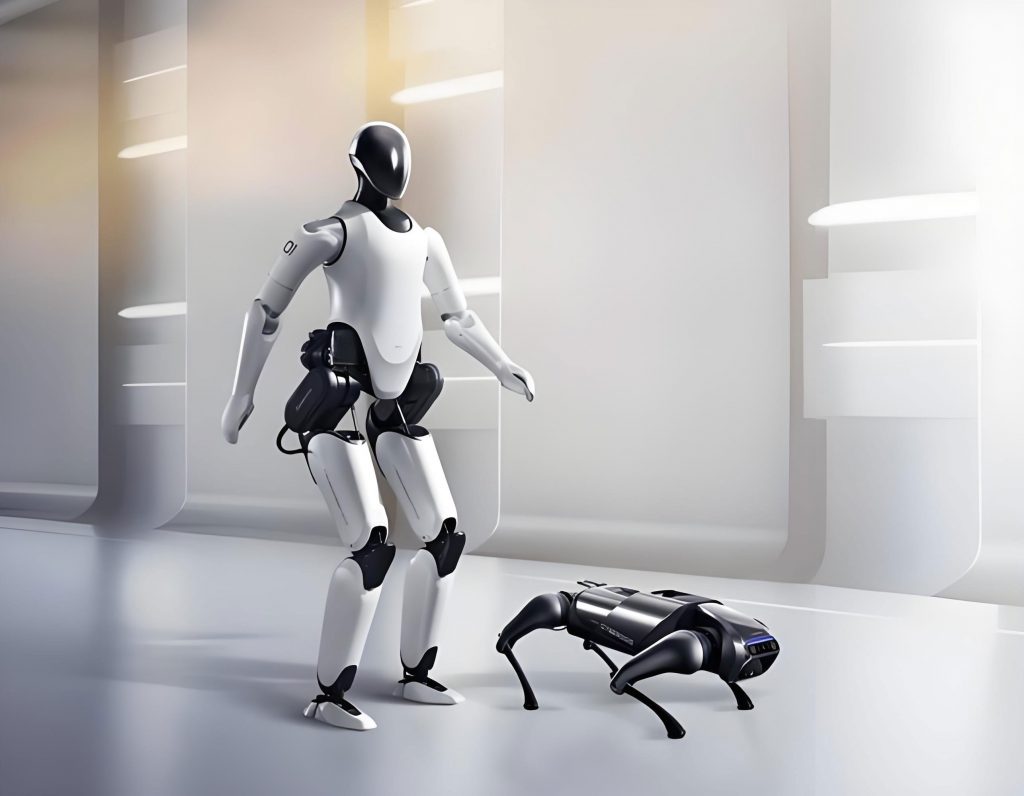
The performance of any quadruped bionic robot is fundamentally dictated by the design and capabilities of its individual leg units. The leg acts as the primary interface between the machine’s body and the ground, responsible for generating propulsion, supporting weight, and absorbing impacts. Therefore, a deep investigation into a single leg’s structure and kinematics is not merely a preliminary step but a crucial platform for understanding and optimizing the entire robot’s gait, stability, and energy efficiency. This article details the process of designing and analyzing a single leg for a bionic robot, drawing inspiration from mammalian anatomy and culminating in a comprehensive kinematic simulation.
Foundations in Bionic Design
The most sophisticated and proven designs for terrestrial locomotion are found in the animal kingdom. Quadruped mammals, through millennia of evolution, have developed highly optimized leg structures that allow for running, jumping, and agile maneuvering. An anatomical study reveals a common blueprint: a leg typically consists of three main segments—the thigh (femur), the shank (tibia/fibula), and the foot—connected by three primary joints: the hip, the knee, and the ankle. Each joint provides one or more degrees of freedom (DOF), enabling complex spatial movement. A key feature, especially in cursorial (running) animals, is the presence of elastic elements like tendons (e.g., the Achilles tendon) which store and release energy during the gait cycle, improving efficiency and damping shocks.
When translating this biological blueprint into a bionic robot, engineers must make pragmatic decisions regarding the number of active degrees of freedom. A fully biomimetic leg might aim for 4 or more active DOFs. However, for a rugged, field-deployable bionic robot, considerations like mechanical simplicity, control complexity, weight, and the need for resilience (e.g., the ability to stand up after a fall) become paramount. A 3-DOF active configuration, often supplemented by a passive compliant element, is a widely adopted and effective compromise. This configuration typically includes two DOFs at the hip joint (allowing for forward/backward swing and side-to-side abduction/adduction) and one DOF at the knee joint. The ankle function is frequently realized through a passive spring-damper system connecting the shank to the foot, emulating the biological role of tendons.
The following table summarizes a comparison between biological joints and their common engineering counterparts in a bionic robot leg:
| Biological Joint | Primary Function | Common Robotic Implementation | Key Feature |
|---|---|---|---|
| Hip | Attaches leg to torso; provides major propulsion and leg swing. | 2 Active DOFs (Pitch & Roll/Yaw) | Determines step length and body posture. |
| Knee | Flexion/extension of the lower leg. | 1 Active DOF (Pitch) | Lifts the foot, adjusts leg height. |
| Ankle | Foot orientation, energy storage/return, impact absorption. | Passive Spring-Damper System | Provides compliance, reduces peak forces. |
Structural Design of the Bionic Leg
Guided by the bionic principles outlined above, the single leg for our bionic robot was designed with a 3-DOF active configuration. All actuation is achieved using precision electric linear actuators (electric cylinders). This choice offers advantages in control precision, force output, and the ability to hold position efficiently. To minimize the leg’s inertia and overall weight—a critical factor for dynamic motion and energy consumption—all structural components are fabricated from 6061 aluminum alloy. The design incorporates topological optimization, resulting in lattice-like, lightweight yet stiff links.
The leg comprises four main parts: the hip housing, the thigh link, the shank link, and the foot. The hip joint integrates two orthogonal electric cylinders to produce the pitch (forward/backward swing) and roll (sideways swing) motions. The knee joint is driven by a single electric cylinder acting on a four-bar linkage mechanism to produce flexion and extension. Finally, a passive compliant joint is implemented between the shank and the foot using a linear compression spring. This spring mimics the elastic function of biological tendons, cushioning the impact during foot strike and enabling potential energy recovery during dynamic gaits like trotting or bounding. The key design parameters of the leg segments are summarized below:
| Component | Length (mm) | Material | Primary Function |
|---|---|---|---|
| Thigh Link | 381 | 6061 Aluminum | Connects hip to knee, defines major leg length. |
| Shank Link | 300 | 6061 Aluminum | Connects knee to foot, completes leg kinematics. |
| Passive Spring | Variable | Steel (Spring) | Provides axial compliance at the foot. |
Kinematic Modeling and Analysis
To control the bionic robot and plan its footsteps, a precise mathematical model of the leg’s motion is essential. Kinematics deals with the geometry of motion without considering the forces that cause it. For the primary sagittal-plane motion (forward/backward leg swing), we can model the leg as a planar 2-revolute-joint (2R) serial chain. We establish coordinate frames as follows: a body-fixed frame {B} at the robot’s torso center, and a leg base frame {1} at the hip pitch joint. The goal is to find the relationship between the joint angles and the position of the foot tip (point P) relative to the body.
Let $l_1$ and $l_2$ be the lengths of the thigh and shank links, respectively. Let $\theta_1$ be the hip pitch angle (measured from the vertical axis) and $\theta_2$ be the knee pitch angle (measured relative to the thigh extension). The forward kinematics equation, giving the foot position $(x, y)$ in the sagittal plane relative to the hip joint, is derived from simple trigonometry:
$$
\begin{bmatrix} x \\ y \end{bmatrix} = \begin{bmatrix} -\cos\theta_1 & -\cos(\theta_2 – \theta_1) \\ -\sin\theta_1 & -\sin(\theta_2 – \theta_1) \end{bmatrix} \begin{bmatrix} l_1 \\ l_2 \end{bmatrix}
$$
For inverse kinematics—calculating the required joint angles to place the foot at a desired $(x, y)$ position—we can use geometric methods. The distance $d$ from the hip joint to the desired foot point is $d = \sqrt{x^2 + y^2}$. Using the law of cosines on the triangle formed by the thigh, shank, and line $d$, we can solve for the angles:
$$
\theta_2 = \pi – \arccos\left( \frac{l_1^2 + l_2^2 – d^2}{2 l_1 l_2} \right)
$$
$$
\theta_1 = \arctan2(y, x) – \arctan2\left( l_2 \sin\theta_2, l_1 + l_2 \cos\theta_2 \right)
$$
However, our actuators are linear electric cylinders, not direct rotary drives. Therefore, we must establish the relationship between the joint angles ($\theta_1$, $\theta_2$) and the corresponding electric cylinder displacements ($\Delta l_1$, $\Delta l_2$). This relationship is governed by the specific geometry of the actuator mounting points on the links. For the hip pitch joint, analysis of the mounting triangle yields:
$$
(l_{10} + \Delta l_1)^2 = l_{11}^2 + l_{12}^2 – 2 l_{11} l_{12} \cos(\theta_1 + \gamma)
$$
where $l_{10}$ is the nominal cylinder length, $l_{11}$ and $l_{12}$ are fixed mounting distances, and $\gamma$ is a constant installation angle. Similarly, for the knee joint modeled as a four-bar linkage, the relationship follows the form:
$$
(l_{20} + \Delta l_2)^2 = l_{21}^2 + l_{22}^2 – 2 l_{21} l_{22} \cos(\beta)
$$
where $\beta$ is an intermediate angle related to $\theta_2$ by $\theta_2 = \beta + \beta_0 + \beta_1$ (with $\beta_0$ and $\beta_1$ as constant linkage angles).
Using the specific numerical parameters for our bionic robot leg, we can compute the working ranges. The tables below summarize the geometric constants and the resulting joint and workspace ranges.
| Parameter | Symbol | Value (mm or deg) |
|---|---|---|
| Thigh Length | $l_1$ | 381 mm |
| Shank Length | $l_2$ | 300 mm |
| Hip Actuator Nominal Length | $l_{10}$ | 291 mm |
| Knee Actuator Nominal Length | $l_{20}$ | 295 mm |
| Joint | Actuator Stroke ($\Delta l$) | Joint Angle Range ($\theta$) |
|---|---|---|
| Hip Pitch | 0 – 26 mm | 69.6° – 119.8° |
| Knee Pitch | 0 – 50 mm | 62.5° – 161.5° |
With the joint ranges defined, we can map the entire reachable workspace of the foot tip in the sagittal plane by evaluating the forward kinematics equation across all valid angle pairs $(\theta_1, \theta_2)$. This workspace represents all possible points the foot can touch relative to the hip joint. The simulation confirms a large and practical workspace, allowing for significant stride length and ground clearance, which is essential for a versatile bionic robot. The workspace is bounded by curves corresponding to the minimum and maximum extensions of the leg, forming a teardrop-shaped region that validates the sufficiency of the design for stable and flexible locomotion.
Conclusion and Perspective
This work has detailed the systematic design and analysis of a single leg for a quadruped bionic robot. The process began by extracting fundamental principles from mammalian anatomy, leading to the adoption of a 3-degree-of-freedom active configuration supplemented by a passive compliant ankle. This design balances biomimetic inspiration with engineering pragmatism, aiming for robustness, simplicity, and functional performance. A comprehensive kinematic model was developed, linking the high-level foot trajectory goals to the specific displacements of the electric cylinder actuators. The simulation of the foot’s workspace, derived from the kinematic equations and actuator limits, demonstrates that the proposed leg structure offers a wide and flexible range of motion, capable of supporting various gaits and terrain adaptations.
The successful design of this leg unit forms the cornerstone for the development of a complete quadruped bionic robot. The kinematic model derived here is the first critical step towards implementing sophisticated motion controllers for walking, trotting, and obstacle negotiation. Future work will naturally progress from this single-leg analysis to the integration of four such legs into a full-body system. This involves studying body-level dynamics, equilibrium control, and inter-leg coordination to generate stable and efficient gaits. Furthermore, the dynamic interaction between the passive compliant element and the ground during high-speed motions will be a key area of investigation, pushing the capabilities of the bionic robot closer to the agility and efficiency observed in its biological counterparts. The leg design presented herein provides a solid, analytically-verified mechanical foundation for these next stages of advanced bionic robot development.