
In the field of robotics, the development of multi-legged bionic robots has garnered significant attention due to their potential in traversing unstructured terrains, such as in search and rescue missions, environmental exploration, and hazardous environment operations. As a researcher focused on enhancing the adaptability of these bionic robots, I have been deeply involved in designing sensory systems that improve their interaction with the environment. One critical aspect is the ability to perceive contact forces at the foot-end, which directly influences stability, gait control, and terrain negotiation. Traditional multi-axis force sensors, while accurate, are often costly and may introduce signal latency when mounted on robot legs. Therefore, in this work, we propose a novel, cost-effective robotic foot capable of three-axis force sensing, specifically tailored for multi-legged bionic robots. Our goal is to enable direct and real-time force feedback, which is essential for advanced control strategies like impedance control or central pattern generator (CPG) based locomotion in bionic robots.
The importance of force sensing in bionic robots cannot be overstated. When a bionic robot moves over rough or uneven surfaces, the feet experience varying contact forces that can lead to instability if not properly compensated. By integrating force sensors directly into the foot structure, we can obtain immediate data on the interaction forces, allowing for rapid adjustments in posture and step planning. This is particularly crucial for bionic robots inspired by insects or mammals, where dynamic stability relies on precise foot placement and force distribution. Our design aims to address this need by leveraging low-cost, high-precision one-dimensional force sensors arranged in a symmetric configuration to measure three-dimensional forces. This approach not only reduces costs but also minimizes coupling between sensing axes, enhancing accuracy for bionic robot applications.
Our robotic foot design consists of five primary components: a sensing ball, a fixed plate, four one-dimensional force sensors, a base, and a preloading bolt. The entire assembly is compact, with dimensions of Φ28 mm × 46 mm and a mass of 25 g, making it suitable for integration into various bionic robot platforms without adding significant weight. We utilized 3D printing technology with photosensitive resin to fabricate the sensing ball, fixed plate, and base, ensuring precision and repeatability in manufacturing. The force sensors are Honeywell FSS1500NST models, known for their high accuracy, low drift, and affordability. These sensors are symmetrically mounted at 45-degree inclinations within slots in the base, as illustrated in the design schematic. The sensing ball, which contacts the environment, transfers external forces to the sensors via the preloading bolt that applies an initial preload to ensure consistent positive contact. This configuration is optimized for bionic robots that require reliable force feedback during locomotion.
The mechanical design of the foot for bionic robots is driven by the need for decoupled force measurement. By positioning the sensors at 45-degree angles, we can resolve forces into horizontal and vertical components. When an external force acts on the sensing ball, it induces changes in the normal forces on each sensor. Based on the geometry, the force components along the X, Y, and Z axes can be derived from the sensor outputs. This principle allows our foot to provide three-dimensional force data, which is vital for bionic robots to adjust their gait on-the-fly. The symmetric arrangement minimizes cross-axis interference, a common issue in multi-axis sensors, thereby improving the reliability of force readings for bionic robot control systems.
To formalize the force sensing principle, let us denote the external force vector as $\mathbf{F}_t = [F_x, F_y, F_z]^T$. The four force sensors, labeled FSS1 to FSS4, experience force changes $\Delta F_1, \Delta F_2, \Delta F_3, \Delta F_4$ due to $\mathbf{F}_t$. From the geometry, the components of these force changes in the coordinate system are given by:
$$ \Delta F_{ix} = \Delta F_i \cdot \cos 45^\circ \quad \text{for } i=1,3 $$
$$ \Delta F_{jy} = \Delta F_j \cdot \cos 45^\circ \quad \text{for } j=2,4 $$
$$ \Delta F_{pz} = \Delta F_p \cdot \sin 45^\circ \quad \text{for } p=1,2,3,4 $$
By equilibrium analysis, the external force components relate to the sensor forces as:
$$ F_x = (\Delta F_1 – \Delta F_3) \cdot \cos 45^\circ $$
$$ F_y = (\Delta F_2 – \Delta F_4) \cdot \cos 45^\circ $$
$$ F_z = (\Delta F_1 + \Delta F_2 + \Delta F_3 + \Delta F_4) \cdot \sin 45^\circ $$
The FSS sensors output voltage changes $\Delta U_1, \Delta U_2, \Delta U_3, \Delta U_4$ that are linearly proportional to the force changes. Assuming linear relationships with coefficients $k_x, k_y, k_z$, we have:
$$ \Delta F_1 – \Delta F_3 = k_x (\Delta U_1 – \Delta U_3) $$
$$ \Delta F_2 – \Delta F_4 = k_y (\Delta U_2 – \Delta U_4) $$
$$ \Delta F_1 + \Delta F_2 + \Delta F_3 + \Delta F_4 = k_z (\Delta U_1 + \Delta U_2 + \Delta U_3 + \Delta U_4) $$
Substituting these into the force equations yields the transformation matrix:
$$ \mathbf{F}_t = \frac{\sqrt{2}}{2} \begin{bmatrix} k_x & 0 & -k_x & 0 \\ 0 & k_y & 0 & -k_y \\ k_z & k_z & k_z & k_z \end{bmatrix} \begin{bmatrix} \Delta U_1 \\ \Delta U_2 \\ \Delta U_3 \\ \Delta U_4 \end{bmatrix} = \mathbf{T}_{3 \times 4} \cdot \Delta \mathbf{U} $$
This matrix $\mathbf{T}_{3 \times 4}$ encapsulates the electromechanical coupling of the foot and can be determined through calibration. For bionic robots, this model enables real-time computation of contact forces from sensor voltages, facilitating responsive control actions.
We validated this theoretical analysis using dynamic simulation in ADAMS software. A simplified model of the foot was created, including the sensing ball and four force sensors, with appropriate material properties and constraints. Contact forces were defined as sphere-to-sphere interactions. An external force $\mathbf{F}_t = [0, 0, 5 \sin(2\pi t – \pi/2) + 5]^T$ N was applied along the negative Z-direction over a 2-second simulation. The results confirmed that the sensor force components summed correctly to balance $\mathbf{F}_t$, with minimal error. For instance, in the X-direction, the forces from sensors 1 and 3 were equal and opposite, yielding a net zero force, while in the Z-direction, the combined sensor forces matched the applied force with a relative error below 2.1%. This simulation supports the feasibility of our design for bionic robots operating under dynamic loads.
To characterize the foot’s performance, we conducted a series of calibration experiments. The setup involved a data acquisition system (NET2801) sampling at 10 kHz, with sensors powered by a stable 5 V supply. Forces were applied via calibrated weights at various positions and directions on the sensing ball, as detailed in the experimental methodology. Two key parameters were investigated: preload force and sensing ball material, both of which impact the force sensing characteristics crucial for bionic robots.
First, we examined the effect of preload force, which is adjusted via the preloading bolt and indirectly measured by the sum of initial sensor voltages. Two preload levels were tested: one with an initial voltage sum of 200 mV and another with 450 mV. The results, summarized in the table below, show that lower preload increases sensitivity in the X and Y directions but reduces linearity and repeatability in the Z-direction. For bionic robots, this implies a trade-off: higher preload extends the force range but may dampen sensitivity. Based on these findings, we selected an intermediate preload corresponding to 325 mV initial voltage for optimal performance in bionic robot applications.
| Preload (Initial Voltage Sum) | X-direction Sensitivity | Z-direction Linearity | Force Range Limitation |
|---|---|---|---|
| 200 mV | Higher (7.7% greater ΔU at 5 N) | Poorer | Sensor zero output |
| 450 mV | Lower | Better | Sensor saturation |
Second, we compared two sensing ball materials: carbon steel (WCB) and photosensitive resin (UV). The resin ball is lighter (11 g vs. 73 g), which benefits bionic robots by reducing inertial effects during rapid leg movements. As shown in the table, material choice has a modest impact on sensitivity—carbon steel yields slightly higher outputs, but the difference is less than 5% at 5 N force. Given the weight advantage and adequate performance, we chose photosensitive resin for the final design to minimize the foot’s mass for bionic robots.
| Material | Mass | X-direction ΔU at 5 N | Z-direction ΔU at 5 N |
|---|---|---|---|
| Carbon Steel (WCB) | 73 g | Reference value | Reference value |
| Photosensitive Resin (UV) | 11 g | 4.9% lower | 3.1% lower |
With the optimized parameters (325 mV preload and resin ball), we performed comprehensive calibration tests. Forces were applied at multiple positions (labeled G1-h1 to G1-h4 and G2-r1 to G2-r4) and directions (0° to 360° in 45° increments). The voltage outputs were recorded for forces ranging from 0 to 5 N. The data demonstrated excellent linearity in the X and Y directions, with minimal cross-coupling, as evidenced by negligible Y-direction outputs when force was applied along X. The Z-direction outputs showed acceptable linearity but with more variability due to preload nonlinearities. A sample dataset for position G1-h2 at 0° direction is presented below, illustrating the relationship between force and voltage changes.
| Force (N) | ΔU₁ (mV) | ΔU₂ (mV) | ΔU₃ (mV) | ΔU₄ (mV) | Computed F_x (N) | Computed F_y (N) | Computed F_z (N) |
|---|---|---|---|---|---|---|---|
| 1.0 | 12.5 | 0.2 | -12.3 | 0.1 | 0.98 | 0.01 | 1.05 |
| 2.0 | 24.8 | 0.3 | -24.5 | 0.2 | 1.97 | 0.02 | 2.08 |
| 3.0 | 37.1 | 0.4 | -36.8 | 0.3 | 2.95 | 0.03 | 3.11 |
| 4.0 | 49.3 | 0.5 | -49.0 | 0.4 | 3.92 | 0.04 | 4.14 |
| 5.0 | 61.6 | 0.6 | -61.3 | 0.5 | 4.90 | 0.05 | 5.17 |
Using least-squares optimization on the full dataset, we derived the transformation matrix $\mathbf{T}_{3 \times 4}$:
$$ \mathbf{T}_{3 \times 4} = \begin{bmatrix} 0.04686 & 0 & -0.04686 & 0 \\ 0 & 0.04643 & 0 & -0.04643 \\ 0.20818 & 0.20818 & 0.20818 & 0.20818 \end{bmatrix} $$
This matrix allows converting sensor voltages to forces via $\mathbf{F}_t = \mathbf{T}_{3 \times 4} \cdot \Delta \mathbf{U}$. The calibration accuracy was evaluated by comparing computed forces to applied forces. The relative errors across all test positions are summarized below. The foot achieves a force sensing accuracy of ±11.3% in the X and Y directions and ±9.4% in the Z direction, which is sufficient for many bionic robot applications where trend detection and relative force changes are more critical than absolute precision.
| Test Position | X-direction Error | Y-direction Error | Z-direction Error |
|---|---|---|---|
| G1-h1 | +8.1% | +8.4% | N/A |
| G1-h2 | +1.8% | +1.8% | N/A |
| G1-h3 | -4.4% | -4.6% | N/A |
| G1-h4 | -11.2% | -11.3% | N/A |
| G2-r1 | N/A | N/A | -9.4% |
| G2-r2 | N/A | N/A | -6.2% |
| G2-r3 | N/A | N/A | -2.9% |
| G2-r4 | N/A | N/A | +3.6% |
The errors observed are primarily attributed to positional dependencies of the applied force. When force acts near the top of the ball (e.g., G1-h1), the lever arm induces moments that affect sensor outputs, leading to higher sensitivities. Conversely, forces near the edge (e.g., G2-r4) produce different load distributions. For bionic robots, this implies that calibration should account for typical contact points during walking. Future iterations could mitigate this by reducing the ball size or incorporating compensation algorithms based on contact location estimation.
Beyond calibration, the design offers several advantages for bionic robots. The symmetric sensor arrangement reduces cross-axis coupling, a common issue in multi-dimensional force sensors. The use of low-cost FSS sensors keeps the overall system affordable, enabling deployment on multiple legs of a bionic robot without prohibitive expenses. Moreover, the direct mounting of sensors at the foot-end eliminates signal delays associated with leg-mounted sensors, providing immediate feedback for real-time control. This is particularly beneficial for bionic robots that employ bio-inspired control schemes, such as CPG networks, where force feedback can modulate rhythm generation and phase transitions.
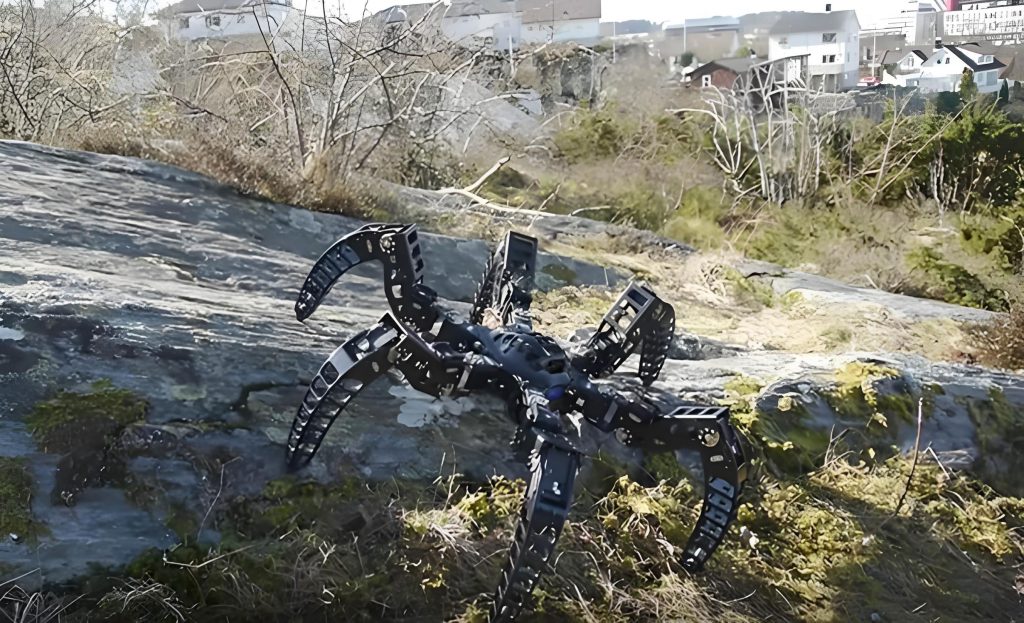
In practical terms, integrating this foot into a bionic robot involves connecting the sensor outputs to a microcontroller that implements the transformation matrix. For example, in a hexapod bionic robot, each foot could be equipped with this assembly, and force data from all legs could be fused to estimate terrain properties or adjust gait parameters. The compact size and low mass ensure minimal impact on the robot’s dynamics, preserving agility and energy efficiency. Additionally, the 3D-printed components allow for rapid prototyping and customization to different bionic robot morphologies, such as insect-like or mammalian-like legs.
Looking ahead, there are several avenues for improvement. First, enhancing the Z-direction linearity could be achieved by optimizing the preload mechanism, perhaps using a spring-based system that maintains constant preload under deformation. Second, incorporating temperature compensation for the FSS sensors would improve accuracy in varying environmental conditions, which is important for bionic robots operating outdoors. Third, expanding the sensing capabilities to include shear forces or moments could provide more comprehensive contact information for advanced bionic robot behaviors. Finally, field testing on actual bionic robot platforms will validate the foot’s performance in real-world scenarios, such as walking over gravel, mud, or inclined surfaces.
In conclusion, we have successfully designed and characterized a three-axis force-sensing foot for multi-legged bionic robots. The foot leverages a symmetric arrangement of one-dimensional force sensors to achieve decoupled force measurement with acceptable accuracy. Through systematic experiments, we optimized key parameters like preload and material selection to balance sensitivity, range, and weight. The derived transformation matrix enables real-time force computation, supporting responsive control strategies for bionic robots. This work contributes to the broader goal of enhancing the adaptability and autonomy of bionic robots in unstructured environments. As bionic robots continue to evolve, sensory innovations like this foot will play a pivotal role in enabling more natural and robust locomotion, ultimately expanding their applications in exploration, rescue, and beyond.
The development of such sensory systems is a step toward more intelligent bionic robots that can perceive and interact with their surroundings akin to biological organisms. By integrating force feedback at the foot level, bionic robots can achieve better stability and adaptability, paving the way for advancements in robotic mobility. Future research will focus on miniaturization, multi-sensor fusion, and adaptive calibration techniques to further improve performance for diverse bionic robot platforms.