
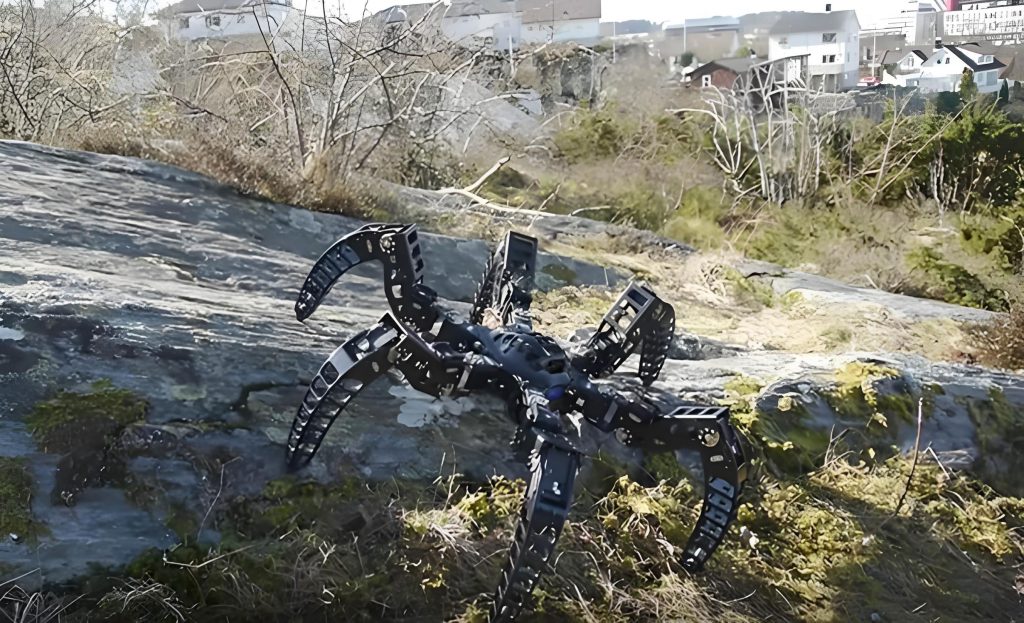
The study and development of multi-joint bionic robots represent a vibrant frontier in the field of biomimetics. Inspired by the elegant and efficient locomotion of biological snakes, engineers and researchers have long been fascinated by the potential of serpentine robots. This bionic robot offers unique advantages in traversing complex, unstructured terrains where traditional wheeled or tracked vehicles fail. Their slender, segmented bodies allow them to perform a variety of gaits, with lateral undulation, or serpentine motion, being one of the most iconic and effective for propulsion. This article delves into the complete process of designing, modeling, simulating, and experimentally testing a modular multi-joint bionic robot, with a core focus on implementing and analyzing locomotion based on the Serpenoid curve.
The fundamental challenge in creating an effective bionic snake robot lies in translating the biological principles of snake motion into a robust mechanical and control architecture. Biological snakes propel themselves by generating propagating body waves that interact with environmental irregularities to produce thrust. For a robotic counterpart, this requires a design that balances structural integrity with the necessary degrees of freedom for dynamic movement, a control system capable of coordinating multiple actuators in a harmonious wave, and a physical implementation that effectively manages friction—the critical interaction between the robot and the ground which enables forward motion.
Mathematical Foundation: The Serpenoid Curve
The cornerstone of generating snake-like undulatory motion in robotics is the Serpenoid curve, a mathematical model that describes a蜿蜒 (meandering) path. This curve provides a parametric framework for planning the body posture of a multi-joint bionic robot over time. The curve is defined by its tangential angle, which varies along the arc length of the body. The standard form of the Serpenoid curve is given by:
$$ \delta(s) = \alpha \cos(\beta s) + \gamma s $$
where \( s \) is the arc length along the body curve, \( \delta(s) \) is the angle of the tangent relative to a global axis at point \( s \), \( \alpha \) is the amplitude coefficient governing the side-to-side swing magnitude, \( \beta \) is the spatial frequency determining the number of waves along the body, and \( \gamma \) is the curvature bias or turning parameter. The Cartesian coordinates of the curve can be derived by integrating the tangent angle:
$$
x(s) = \int_0^s \cos(\delta(\sigma)) \, d\sigma, \quad y(s) = \int_0^s \sin(\delta(\sigma)) \, d\sigma
$$
For a discrete bionic robot composed of \( N \) rigid links (or joints) connected by active hinges, the Serpenoid curve must be discretized. The desired relative rotation angle \( \theta_i \) for the \( i \)-th joint (connecting link \( i \) and \( i+1 \)) at time \( t \) can be derived from the continuous curve. A common and effective discretization for lateral undulation is given by:
$$ \theta_i(t) = A \sin(\omega t + (i-1)\phi) + C $$
Here, \( A \) corresponds to the maximum joint angle (related to \( \alpha \)), \( \omega \) is the temporal frequency of the wave, \( \phi \) is the phase shift between successive joints (related to \( \beta \)), and \( C \) can be used for directional control (related to \( \gamma \)). This sinusoidal formulation creates the propagating wave essential for the motion of the multi-joint bionic robot. The parameters \( A \) and \( \phi \) are critical for gait efficiency, determining the stride length and the number of waves present on the robot’s body simultaneously.
Mechanical Architecture and Structural Design
The physical embodiment of the bionic robot is a modular, serial chain of links. The design is partitioned into three functional sections: the head module, multiple body segment modules, and the tail module. Each body segment module houses an actuator (typically a servo motor) which provides the active rotational degree of freedom between adjacent links. The head module is designed to carry sensory payloads such as cameras, ultrasonic distance sensors, or environmental monitors, while the tail module often contains the primary power source to balance the weight distribution of the bionic robot.
Key design considerations for the body segment include:
- Weight and Rigidity: The links must be lightweight to reduce inertial forces and power consumption, yet rigid enough to withstand bending moments and ground reaction forces without excessive deflection.
- Actuator Integration: Servos must be securely mounted with precise alignment to ensure the calculated joint angles are accurately realized. The housing must also facilitate heat dissipation.
- Inter-module Connection: The connection between links must provide robust mechanical coupling for torque transmission while minimizing unwanted friction in the rotational axis. The use of bearings at joint pivots is highly advantageous.
- Ground Interaction Surface: The underside of each module needs a specialized surface to manage friction. Passive wheels, skids, or compliant pads can be used to create anisotropic friction—low resistance along the body’s longitudinal axis and high resistance laterally—which is crucial for converting body undulation into net forward motion.
A critical step in the design process is structural analysis. Finite Element Analysis (FEA) is performed on the body segment model, typically applying a static load at the point where the servo horn connects. The goal is to evaluate the Von Mises stress distribution, which predicts yielding according to the maximum distortion energy theory. The analysis identifies stress concentration areas, such as sharp internal corners or thin sections. For instance, a high stress concentration at a 90-degree bend in the link would necessitate a design modification, such as adding a fillet or increasing material thickness at that point, to ensure the structural integrity of the bionic robot during dynamic operation.
System Framework and Control Methodology
The operational intelligence of the bionic robot is managed by an embedded system. A central microcontroller (e.g., STM32, Arduino, or ESP32) serves as the brain, executing the gait control algorithms and processing sensor data. The system framework integrates several key components:
| System Module | Primary Function | Bionic Analogy |
|---|---|---|
| Main Controller (MCU) | Gait generation, servo control, sensor fusion, decision logic. | Central Nervous System |
| Servo Motor Drivers | Provide precise PWM signals to control the angular position of each joint servo. | Muscles & Motor Neurons |
| Inertial Measurement Unit (IMU) | Measure orientation, acceleration. Used for posture stabilization and feedback control. | Vestibular System |
| Environmental Sensors (Ultrasonic, IR, Sound) | Perceive obstacles, detect living beings, or sense audio cues for reactive behaviors. | Sensory Organs (Eyes, Ears) |
| Power Management Unit | Regulate voltage and distribute power from the battery to all electronic components. | Circulatory System |
The control logic for achieving basic Serpenoid-based locomotion follows a state machine or cyclic routine. The core algorithm continuously updates the target angle for each servo based on the equation \( \theta_i(t) = A \sin(\omega t + (i-1)\phi) \). This is often implemented using a pre-computed gait table for efficiency. A simplified control flow is as follows:
- Initialization: Set parameters \( A \), \( \omega \), \( \phi \). Define the number of phases (e.g., 10-12) in one wave cycle.
- Gait Table Lookup: For the current phase index, read the set of joint angles \( \{\theta_1, \theta_2, …, \theta_N\} \) from a stored table.
- Servo Command: Convert each angle \( \theta_i \) to a corresponding PWM pulse width and send it to the respective servo driver.
- Phase Update & Delay: Increment the phase index (or update time \( t \)), apply a short controlled delay to set the wave speed, and loop back to step 2.
This open-loop control generates the fundamental undulation. More advanced bionic robot implementations incorporate closed-loop feedback from the IMU to maintain a desired heading or from distance sensors to enable obstacle avoidance by dynamically modulating the turning parameter \( C \) or \( \gamma \).
Simulation-Based Analysis of Gait Parameters
Before physical construction, simulation tools like CoppeliaSim (formerly V-REP), MATLAB/Simulink, or Webots are invaluable for analyzing the effects of gait parameters on the bionic robot’s motion. A dynamic model of the robot is created, and the joint angles are driven by the Serpenoid control law. The simulated environment allows for the precise isolation and study of parameters \( \alpha \) (or \( A \)) and \( \beta \) (related to \( \phi \)) without the confounding factors of imperfect hardware or uneven friction.
The impact of these parameters can be summarized as follows:
| Parameter | Increase in Value | Decrease in Value | Primary Effect on Bionic Robot Motion |
|---|---|---|---|
| Amplitude (A or α) | Larger | Smaller | Governs the lateral swing magnitude. Larger A creates more pronounced “S” shapes, potentially increasing stride length but also raising energy consumption and the risk of instability or self-collision. |
| Spatial Frequency (β or Phase Shift φ) | Larger β / Smaller φ | Smaller β / Larger φ | Controls the number of body waves. A smaller φ (larger β) packs more wave periods along the body, leading to a higher frequency, quicker undulation, but potentially smaller amplitude per joint. A larger φ creates longer, smoother waves. |
| Curvature Bias (γ or C) | Positive/Negative Value | Zero | Introduces a constant steering offset. A non-zero γ causes the entire body wave to curve, resulting in turning motion. The sign of γ determines the turning direction (left or right). |
Simulations vividly demonstrate these effects. For example, holding \( \beta \) and \( \gamma \) constant while increasing \( \alpha \) will show a bionic robot tracing a path with wider, more aggressive lateral deviations. Conversely, increasing \( \beta \) while holding \( \alpha \) constant results in a path with more frequent but shallower undulations. These simulations are crucial for selecting parameter ranges that produce stable and efficient locomotion before testing on the physical bionic robot prototype.
Prototype Fabrication and Experimental Gait Testing
With a validated design and simulated gait parameters, the next phase is physical realization. Additive manufacturing (3D printing) is exceptionally suited for producing the custom, lightweight link geometries of the bionic robot. Materials like PLA, ABS, or more advanced composites offer a good balance of strength, weight, and printability. Post-processing, such as sanding bearing surfaces and ensuring precise hole alignment, is critical for smooth operation.
Experimental testing focuses on validating the simulated gait models and quantifying real-world performance metrics like speed, stability, and turning radius. A key experimental variable is the ground interaction mechanism. Two common prototypes are built and compared:
- Model A (Isotropic Low Friction): Uses ball casters or low-friction pads on the ventral side. This minimizes resistance in all directions.
- Model B (Anisotropic Friction): Uses passive wheels aligned with the body’s longitudinal axis. These wheels roll freely forward/backward (low friction) but resist lateral sliding (high friction).
Theoretical models of snake locomotion emphasize the necessity of anisotropic friction for effective lateral undulation. The propagating body wave pushes laterally against ground protrusions (or, in the robot’s case, the high lateral friction of the wheels). With isotropic, low friction (Model A), the lateral push simply slides the body segment sideways without generating substantial net forward thrust. The bionic robot may writhe in place with little progression.
Experimental data typically confirms this. Tests are conducted where both bionic robot models are programmed with identical Serpenoid gait parameters (\(A\), \(\omega\), \(\phi\)). Their displacement over a fixed time period is measured. A representative summary of findings might look like this:
| Prototype Model | Ventral Surface | Gait Parameters (A, φ) | Average Speed (cm/s) | Observation & Gait Efficiency |
|---|---|---|---|---|
| Model A | Ball Casters | A=60°, φ=45° | ~ 2.0 cm/s | Pronounced body oscillation, but significant lateral slip. Low efficiency; much kinetic energy is wasted in non-propulsive motion. |
| Model B | Passive Wheels | A=60°, φ=45° | ~ 5.5 cm/s | Body wave engages effectively with wheels. Clear forward propulsion per wave cycle. Higher gait efficiency. |
| Model B (Optimized) | Passive Wheels | A=30°, φ=60° | ~ 7.0 cm/s | Smoother, longer wavelength. Reduced lateral oscillation losses, improved forward thrust generation. Optimal efficiency for this design. |
The experiments also involve testing specialized maneuvers derived from the Serpenoid framework:
- Turning: Achieved by applying a constant offset \( C \) to the joint angles on one side of the body or by introducing a non-zero \( \gamma \) in the curve calculation.
- Rolling/Concertina: For traversal in tightly constrained spaces, a different set of non-serpenoid joint angle sequences are used to anchor part of the body while extending the front, then pulling the rear forward.
- Reactive Behaviors: Integrating sensor data, the bionic robot can switch from a cruising “serpentine gait” to a “freeze” or “coil” posture upon detecting sound or a nearby object, enhancing its biomimetic realism.
Conclusion and Future Perspectives
The journey from the mathematical elegance of the Serpenoid curve to a functional, slithering bionic robot encapsulates the interdisciplinary nature of advanced robotics. This work detailed the integral stages: deriving the motion model, designing a mechanically sound modular structure, implementing a centralized control system, simulating parameter effects, and finally, conducting empirical tests that highlight the critical role of managed friction. The bionic robot, when equipped with an anisotropic underside (like passive wheels) and driven by optimized Serpenoid parameters, successfully demonstrates efficient lateral undulation, closely mimicking its biological inspiration.
The field of serpentine bionic robots continues to evolve rapidly. Future research directions are abundant:
- Enhanced Mobility: Incorporating vertical bending joints to enable climbing and three-dimensional motion, moving beyond planar locomotion.
- Advanced Materials & Actuation: Utilizing soft robotics principles with pneumatic artificial muscles or shape memory alloys to create more compliant, safer, and even more lifelike bionic robot bodies.
- Intelligent, Adaptive Control: Employing machine learning algorithms to allow the bionic robot to autonomously identify terrain characteristics and adapt its gait parameters (\(A\), \(\phi\), \(\gamma\)) in real-time for optimal efficiency and stability.
- Swarm Intelligence: Coordinating multiple bionic snake robots to work collaboratively on tasks like search and rescue or environmental inspection, drawing inspiration from collective biological behaviors.
In conclusion, the multi-joint bionic snake robot serves as a profound example of how principles from biology, mathematics, mechanical engineering, and computer science converge to create machines with unprecedented capabilities. The Serpenoid curve provides a powerful and versatile foundation for governing the motion of these fascinating bionic robots, paving the way for their application in exploration, disaster response, and complex inspection tasks where no other vehicle can go.