
The field of robotics has witnessed significant advancements in the development of bionic robots, particularly those designed for unstructured environments. Among these, legged robots offer superior mobility compared to their wheeled counterparts. This article delves into the detailed kinematic analysis of a novel leg mechanism designed for a bionic quadruped robot. The proposed design employs a serial-parallel hybrid architecture, aiming to synergize the advantages of both serial and parallel topologies to achieve a favorable balance between workspace, payload capacity, and structural stiffness, which are critical for the operational efficacy of any bionic robot in challenging terrains.
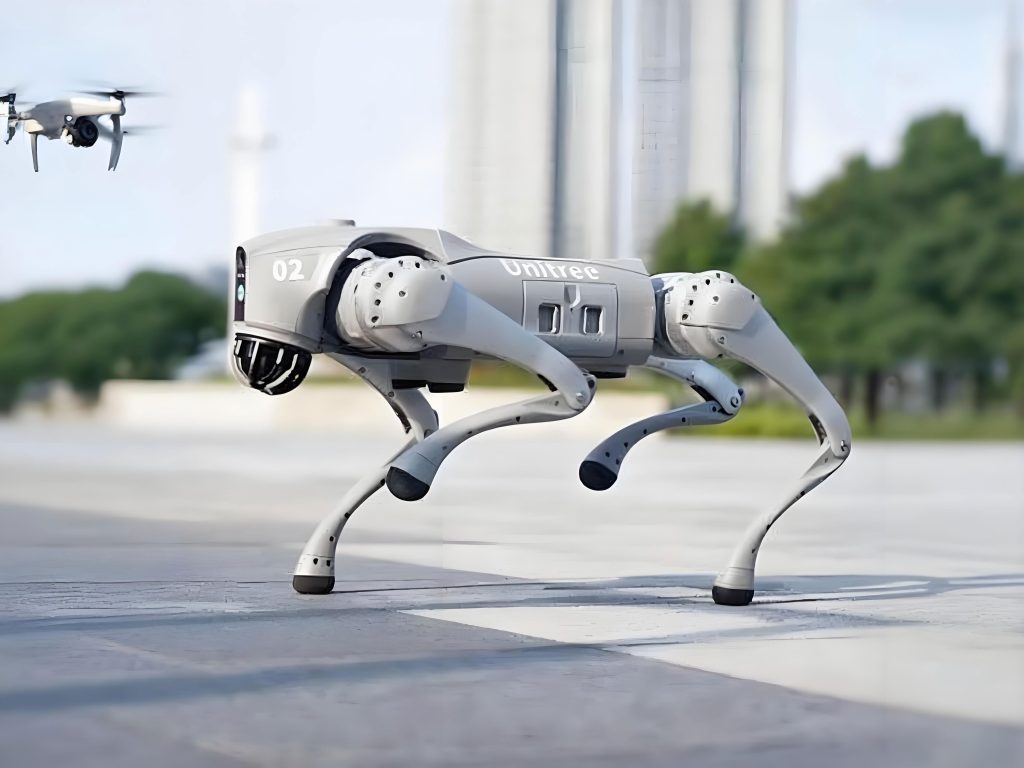
The overall architecture of the bionic quadruped robot comprises a main body and four identical leg assemblies. Each leg is a sophisticated integration of a planar parallel mechanism and a serial side-swing mechanism. The parallel subsystem is responsible for the primary sagittal plane motions (forward/backward swing and lifting/lowering) and is constructed using a parallelogram linkage actuated by two linear electric cylinders. This configuration inherently provides mechanical advantage and rigidity. A key feature is the use of a scaled, or pantograph, structure within the parallelogram, which amplifies the foot-end displacement for a given actuator stroke, thereby expanding the effective workspace without compromising structural integrity—a vital consideration for a dynamic bionic robot. The serial subsystem consists of a third linear electric cylinder that drives the entire parallel mechanism in a lateral swinging motion about an axis attached to the robot’s torso, enabling side-stepping and turning maneuvers.
| Symbol | Description | Value / Relation |
|---|---|---|
| $l_1$ | Length of Drive Cylinder 1 (HG) | Variable (350-500 mm) |
| $l_2$ | Length of Drive Cylinder 2 (CF) | Variable (350-500 mm) |
| $l_3$ | Length of Drive Cylinder 3 (MN) | Variable (280-340 mm) |
| $a$ | Length QC = AB | 140 mm |
| $b$ | Length QA = BC | 270 mm |
| $c$ | Length BD | 400 mm |
| $O-XYZ$ | Base Coordinate Frame | Attached to robot torso |
| $D (X_D, Y_D, Z_D)$ | Foot-end Reference Point Coordinates | Output of Forward Kinematics |
The kinematic model is foundational for controlling the bionic robot. We establish a coordinate frame $O-XYZ$ fixed to the robot’s torso at the hip joint, with the $X$-axis aligned with the side-swing rotation axis. A detailed schematic defines all relevant links and angles. The rotation matrix for the side-swing motion about the $X$-axis by an angle $\theta_{10}$ is:
$$ R(x, \theta_{10}) = \begin{bmatrix} 1 & 0 & 0 \\ 0 & \cos\theta_{10} & -\sin\theta_{10} \\ 0 & \sin\theta_{10} & \cos\theta_{10} \end{bmatrix} $$
where $\theta_{10}$ is derived from the geometry of the serial side-swing mechanism:
$$ \theta_{10} = \theta_{11} – \frac{\pi}{2} + \arccos\left( \frac{i^2 + j^2 – l_3^2}{2 i j} \right) $$
Here, $i$, $j$, and $\theta_{11}$ are fixed geometric parameters.
Forward Kinematics: This solves for the foot-end position $D(X_D, Y_D, Z_D)$ given the actuator lengths $l_1$, $l_2$, $l_3$. The analysis is decomposed. First, the planar parallel mechanism’s motion in the $XOZ$ plane (ignoring side-swing) is solved using vector loop closure. The position of $D$ in this local plane $(x_D, 0, z_D)$ is:
$$ \begin{bmatrix} x_D \\ 0 \\ z_D \end{bmatrix} = \begin{bmatrix} b \cos\theta_1 + (a+c)\cos(\theta_1+\theta_2) \\ 0 \\ b \sin\theta_1 + (a+c)\sin(\theta_1+\theta_2) – h \end{bmatrix} $$
The intermediate angles $\theta_1$ and $\theta_2$ are functions of the actuator lengths:
$$ \theta_1 = \theta_5 + \theta_8 + \arccos\left( \frac{d^2 + f^2 – l_1^2}{2 d f} \right) $$
$$ \theta_2 = 2\pi – \theta_1 + \theta_7 – \arccos\left( \frac{a^2 + e^2 – l_2^2}{2 a e} \right) $$
where $\theta_5, \theta_7, \theta_8, d, e, f, h$ are constant geometric parameters. Finally, the global foot-end position is obtained by applying the side-swing rotation:
$$ \begin{bmatrix} X_D \\ Y_D \\ Z_D \end{bmatrix} = R(x, \theta_{10}) \begin{bmatrix} x_D \\ 0 \\ z_D \end{bmatrix} = \begin{bmatrix} x_D \\ -x_D \sin\theta_{10} \\ x_D \cos\theta_{10} \end{bmatrix} $$
Note that $z_D$ is incorporated within $x_D$’s calculation from the local plane. The complete, explicit global coordinates are:
$$ \begin{aligned} X_D &= b \cos\theta_1 + (a+c)\cos(\theta_1+\theta_2) \\ Y_D &= -\left[ b \cos\theta_1 + (a+c)\cos(\theta_1+\theta_2) \right] \sin\theta_{10} \\ Z_D &= \left[ b \cos\theta_1 + (a+c)\cos(\theta_1+\theta_2) \right] \cos\theta_{10} \end{aligned} $$
This formulation provides the complete spatial mapping for the bionic robot‘s foot.
Inverse Kinematics: This solves for the required actuator lengths given a desired foot-end position $(X_D, Y_D, Z_D)$. From the global coordinates, we can extract $\theta_{10}$ and the effective planar coordinate $x_D$:
$$ \theta_{10} = \arctan2(-Y_D, Z_D), \quad x_D = X_D $$
From $x_D$ and the geometric constants, the angles $\theta_1$ and $\theta_2$ for the planar mechanism can be solved numerically or analytically from the planar equations. Subsequently, the actuator lengths are computed directly:
$$ l_1 = \sqrt{ f^2 + d^2 – 2 f d \cos(\theta_3 – \theta_8) } $$
$$ l_2 = \sqrt{ a^2 + e^2 – 2 a e \cos(\theta_4 + \theta_7) } $$
$$ l_3 = \sqrt{ i^2 + j^2 – 2 i j \cos\left( \theta_{10} – \theta_{11} + \frac{\pi}{2} \right) } $$
where $\theta_3$ and $\theta_4$ are directly related to $\theta_1$ and $\theta_2$ via the fixed geometry ($\theta_3 = \theta_1 – \theta_5$, $\theta_4 = 2\pi – \theta_1 – \theta_2 + \theta_7$). This inverse solution is crucial for trajectory planning and control of the bionic quadruped robot.
The workspace of the leg mechanism, defining all reachable points by the foot, is a paramount performance metric for a bionic robot. Using the forward kinematics equations and the specified actuator stroke limits ($350 \text{ mm} \leq l_1, l_2 \leq 500 \text{ mm}$, $280 \text{ mm} \leq l_3 \leq 340 \text{ mm}$), we employ the Monte Carlo method. Millions of random actuator length combinations within their limits are generated, and the corresponding foot-end positions are calculated and plotted. Analysis of the resulting point clouds in the sagittal ($XOZ$) and frontal ($YOZ$) planes confirms a substantial workspace. The leg can achieve a stride length exceeding 0.5 m and a lift height over 0.3 m, which meets the demanding locomotion requirements for a versatile bionic robot operating over obstacles and irregular ground.
The velocity Jacobian matrix $J$ establishes the differential relationship between the joint (actuator) velocity space and the Cartesian (foot-end) velocity space, fundamental for motion control and force analysis of the bionic robot. It is derived by differentiating the kinematic equations. The foot-end velocity $\dot{X} = [\dot{X}_D, \dot{Y}_D, \dot{Z}_D]^T$ is related to the angular velocities of the intermediate virtual joints:
$$ \dot{X} = J_1 \begin{bmatrix} \dot{\theta}_1 \\ \dot{\theta}_2 \\ \dot{\theta}_{10} \end{bmatrix}, \quad \text{where} \quad J_1 = \begin{bmatrix} -b s_1 – (a+c)s_{12} & -(a+c)s_{12} & 0 \\ -(b c_1 + (a+c)c_{12}) s_{10} & -(a+c)c_{12} s_{10} & -x_D c_{10} \\ (b c_1 + (a+c)c_{12}) c_{10} & (a+c)c_{12} c_{10} & -x_D s_{10} \end{bmatrix} $$
(Here, $s_1=\sin\theta_1$, $c_{12}=\cos(\theta_1+\theta_2)$, etc., and $x_D = X_D$). The actuator velocities are related to the rates of their corresponding angles:
$$ \begin{bmatrix} \dot{l}_1 \\ \dot{l}_2 \\ \dot{l}_3 \end{bmatrix} = J_2 \begin{bmatrix} \dot{\theta}_3 \\ \dot{\theta}_4 \\ \dot{\theta}_{10} \end{bmatrix}, \quad J_2 = \begin{bmatrix} \frac{d f \sin(\theta_3-\theta_8)}{l_1} & 0 & 0 \\ 0 & \frac{a e \sin(\theta_4+\theta_7)}{l_2} & 0 \\ 0 & 0 & \frac{i j \sin(\theta_{10}-\theta_{11}+\pi/2)}{l_3} \end{bmatrix} $$
The geometric constraints provide a simple mapping: $\dot{\theta}_3 = \dot{\theta}_1$, $\dot{\theta}_4 = -\dot{\theta}_1 – \dot{\theta}_2$, or in matrix form $[\dot{\theta}_3, \dot{\theta}_4, \dot{\theta}_{10}]^T = J_3 [\dot{\theta}_1, \dot{\theta}_2, \dot{\theta}_{10}]^T$ with $J_3$ being a constant matrix. Combining these, the complete Jacobian $J$ is:
$$ \dot{X} = J \dot{L}, \quad \text{where} \quad J = J_1 J_3^{-1} J_2^{-1} \quad \text{and} \quad \dot{L} = [\dot{l}_1, \dot{l}_2, \dot{l}_3]^T $$
This matrix $J$ is essential for resolving forces at the foot of the bionic robot back to the actuator torques during static or dynamic analysis.
To rigorously verify the derived kinematic model and its implementation, a virtual prototype simulation was conducted using Adams software. A detailed CAD model of the single leg mechanism was imported, and appropriate joints and motion constraints were applied. A smooth foot-end trajectory based on the zero-impact principle was prescribed to minimize inertial forces during ground contact—a critical aspect for stable and efficient gait generation in a bionic quadruped robot. The trajectory for the swing phase ($0 \leq t \leq T$) is given by:
$$ \begin{aligned} y(t) &= \frac{6S}{T^5}t^5 – \frac{15S}{T^4}t^4 + \frac{10S}{T^3}t^3 – \frac{S}{2} \quad &\text{(Horizontal)} \\ z(t) &= -\frac{64H}{T^6}t^6 + \frac{192H}{T^5}t^5 – \frac{192H}{T^4}t^4 + \frac{64H}{T^3}t^3 \quad &\text{(Vertical)} \end{aligned} $$
with stride length $S=0.5$ m, step height $H=0.3$ m, and cycle time $T=2$ s. The simulation produced the velocity profiles for the three electric cylinders over a complete gait cycle.
Simultaneously, the theoretical actuator velocities were computed using the inverse kinematics and the Jacobian matrix within a Matlab environment. The comparative results are summarized below, highlighting the consistency between simulation and theory:
| Performance Metric | Simulation (Adams) | Theory (Matlab) | Agreement |
|---|---|---|---|
| Cylinder 1 ($l_1$) Velocity Profile | Continuous, smooth curve | Continuous, smooth curve | Excellent |
| Cylinder 2 ($l_2$) Velocity Profile | Continuous, smooth curve | Continuous, smooth curve | Excellent |
| Cylinder 3 ($l_3$) Velocity Profile | Continuous, smooth curve | Continuous, smooth curve | Excellent |
| Maximum Absolute Error | $< 1 \times 10^{-3} \, \text{m/s}$ | High Precision | |
The velocity error between the simulated and theoretical results remained within $\pm 1 \times 10^{-3}$ m/s throughout the motion cycle. These minor discrepancies are attributable to numerical solver tolerances in Adams and discrete data sampling. The exceptional agreement validates the correctness of the derived kinematic equations, the inverse kinematics solution, the workspace analysis, and the velocity Jacobian for this novel serial-parallel hybrid leg design. This successful verification establishes a reliable foundation for subsequent critical analyses required to realize a fully functional bionic robot, including detailed static force analysis, full dynamic modeling, gait optimization, and overall mechanical structure refinement. The integration of parallel and serial elements, as demonstrated, presents a compelling design pathway for achieving robust and agile locomotion in next-generation bionic quadruped robots intended for real-world applications.