
In the field of robotics, bionic robots have garnered significant attention due to their exceptional adaptability to complex environments. Among these, the hexapod bionic robot stands out as a quintessential example, offering superior stability and flexibility compared to wheeled robots. This adaptability makes hexapod bionic robots ideal for applications such as lunar exploration, disaster rescue, and environmental monitoring, where they can carry various sensors like cameras and radar. However, designing and controlling these bionic robots involves challenges related to mechanical structure, gait planning, and motion stability. In this article, we explore the gait design and motion research of a hexapod bionic robot, focusing on structural optimization, gait parameters, kinematics analysis, and simulation studies. We aim to provide insights into improving the performance and stability of bionic robots through systematic modeling and analysis.
The design of a hexapod bionic robot begins with its mechanical structure, which directly impacts static stability. We consider two common layouts: hexagonal and rectangular. Using static stability margin analysis, we evaluate how fuselage dimensions affect stability. The static stability margin, denoted as $h$, is defined as the shortest distance from the projection of the center of gravity to the support polygon formed by the feet in contact with the ground. For a bionic robot with a hexagonal layout, parameters such as $a$, $b$, and $c$ represent fuselage dimensions, and $L$ is the leg length. The stability margin can be derived as follows: first, calculate the angle $\alpha$ using $$\alpha = \arctan\left(\frac{c}{2L + a + (b-a)/2}\right).$$ Then, the stability margin is $$h = \left(L + \frac{b}{2}\right) \sin \alpha.$$ By setting $c = 80\,\text{mm}$ and $L = 70\,\text{mm}$, we analyze the relationship between $h$ and dimensions $a$ and $b$. The results indicate that decreasing $a$ and increasing $b$ enhances stability, but excessively large $b$ can lead to increased weight and reduced payload capacity. Therefore, an optimal balance is essential for bionic robot design.
| Layout Type | Interference Condition | Stability Margin Trend |
|---|---|---|
| Hexagonal | Low interference | Higher with optimized dimensions |
| Rectangular | High interference | Lower due to geometric constraints |
Based on this analysis, we adopt a hexagonal layout for our bionic robot. The mechanical structure is designed using Solidworks, featuring a tripod leg configuration with three links: coxa, femur, and tibia. This design allows for a larger foot workspace while minimizing interference. The bionic robot is controlled by an Arduino board and equipped with sensors for real-time feedback. The structural parameters are summarized in the table below, which highlights key dimensions critical for motion performance.
| Structural Parameter | Value (mm) |
|---|---|
| Coxa Length $l_1$ | 43.35 |
| Femur Length $l_2$ | 75.98 |
| Tibia Length $l_3$ | 120.28 |
| Body Width $L_m$ | 122.24 |
| Body Width $L_b$ | 156.28 |
| Body Length $C$ | 84.32 |
Gait planning is pivotal for the locomotion of a hexapod bionic robot. We define key parameters: support phase $T_s$ (when the leg contacts the ground), swing phase $T_p$ (when the leg is lifted), gait cycle $T = T_s + T_p$, duty factor $\beta = T_s / T$, stride $s$, and velocity $V = s / T_s$. For periodic gaits, such as wave gaits, the duty factor is uniform across all legs, i.e., $\beta_i = \beta$ for $i = 1,2,\ldots,6$. Wave gaits ensure stability by preventing adjacent legs on the same side from swinging simultaneously, expressed as $t_i = t_{i+2} + T_p$. Additionally, symmetry requires $t_i = t_{i+1} + T/2$ for $i = 1,3,5$. By varying $\beta$, we derive different gait patterns, as shown in the table below, which summarizes gait characteristics based on the duty factor.
| Duty Factor $\beta$ | Gait Characteristics |
|---|---|
| $0 < \beta < 1/2$ | Body may experience airborne states |
| $\beta = 1/2$ | Always three legs support the ground (tripod gait) |
| $1/2 < \beta < 2/3$ | Alternates between three and four legs supporting |
| $\beta = 2/3$ | Always four legs support the ground (quadruped gait) |
| $2/3 < \beta < 5/6$ | Alternates between four and five legs supporting |
| $\beta = 5/6$ | Always five legs support the ground (wave gait) |
| $5/6 < \beta < 1$ | Alternates between five and six legs supporting |
| $\beta = 1$ | Static state |
Among these, the tripod gait ($\beta = 1/2$) offers the highest speed, as velocity $V$ is inversely proportional to $T_s$ when stride $s$ is constant. The wave gait ($\beta = 5/6$) provides the best stability due to more legs in support. For obstacle avoidance, we design two gaits: turning gait and lateral gait. The turning gait involves legs rotating around the body center for directional change, while the lateral gait moves the body sideways with one set of legs supporting and another swinging linearly. These gaits enhance the adaptability of the bionic robot in complex terrains.
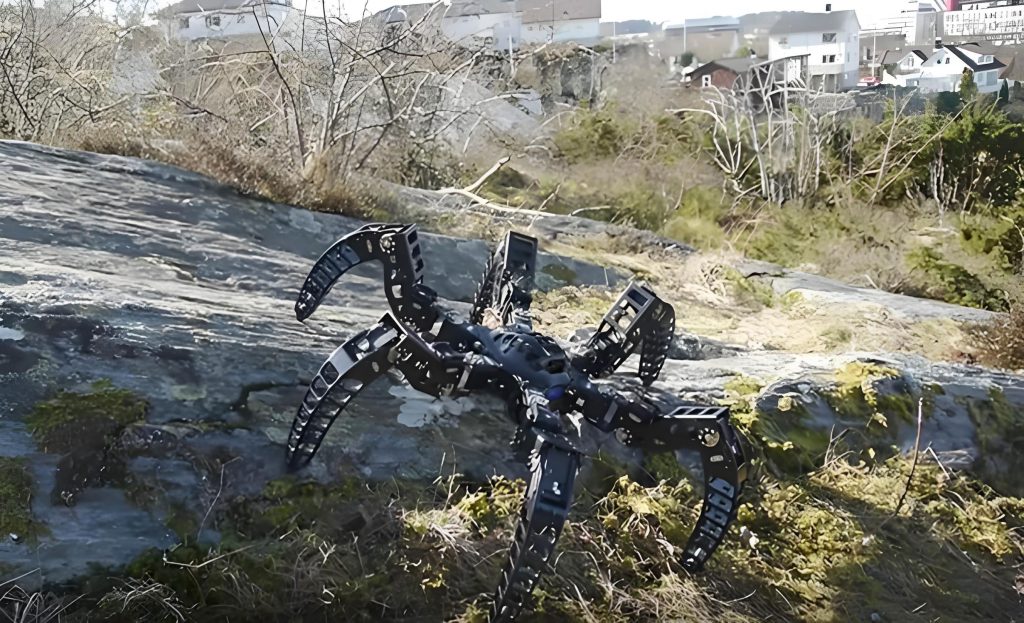
Kinematic analysis is essential for controlling the hexapod bionic robot. We use the Denavit-Hartenberg (D-H) method to model each leg as a serial chain with three revolute joints: root (coxa), hip (femur), and knee (tibia). The D-H parameters are listed in the table below, where $a_{i-1}$ is the link length, $\alpha_{i-1}$ is the twist angle, $d_i$ is the offset, and $\theta_i$ is the joint angle.
| Link | $a_{i-1}$ | $\alpha_{i-1}$ | $d_i$ | $\theta_i$ |
|---|---|---|---|---|
| 1 | 0 | 0° | 0 | $\theta_1$ |
| 2 | $l_1$ | 90° | 0 | $\theta_2$ |
| 3 | $l_2$ | 0° | 0 | $\theta_3$ |
| 4 | $l_3$ | 0° | 0 | 0 |
The transformation matrix from frame $i-1$ to frame $i$ is given by $$T_i^{i-1} = \begin{bmatrix} \cos\theta_i & -\sin\theta_i & 0 & a_{i-1} \\ \cos\alpha_{i-1}\sin\theta_i & \cos\alpha_{i-1}\cos\theta_i & -\sin\alpha_{i-1} & -d_i\sin\alpha_{i-1} \\ \sin\alpha_{i-1}\sin\theta_i & \sin\alpha_{i-1}\cos\theta_i & \cos\alpha_{i-1} & d_i\cos\alpha_{i-1} \\ 0 & 0 & 0 & 1 \end{bmatrix}.$$ Substituting the parameters, we derive the forward kinematics for the foot position relative to the base frame: $$\begin{bmatrix} p_x \\ p_y \\ p_z \end{bmatrix} = \begin{bmatrix} c_1 c_{23} l_3 + c_1 (c_2 l_2 + l_1) \\ s_1 c_{23} l_3 + s_1 (c_2 l_2 + l_1) \\ s_{23} l_3 + s_2 l_2 \end{bmatrix},$$ where $s_m = \sin\theta_m$, $c_m = \cos\theta_m$, $s_{mn} = \sin(\theta_m + \theta_n)$, and $c_{mn} = \cos(\theta_m + \theta_n)$. For inverse kinematics, given the foot position $(p_x, p_y, p_z)$, we solve for joint angles: $$\theta_1 = \arctan\left(\frac{p_y}{p_x}\right),$$ $$\theta_2 = \arccos\left(\frac{p_z}{\sqrt{K^2 + p_z^2}}\right) – \varphi,$$ $$\theta_3 = -\arccos\left(\frac{K c_2 + p_z s_2 – l_2}{l_3}\right),$$ with $K = c_1 p_x + s_1 p_y – l_1$ and $\varphi = \arcsin\left(\frac{K^2 + p_z^2 + l_2^2 – l_3^2}{\sqrt{4 l_2 (K^2 + p_z^2)}}\right)$. These equations enable precise control of the bionic robot’s leg movements.
Simulation studies validate our design and gait planning for the hexapod bionic robot. Using MATLAB, we analyze the foot workspace by setting joint angle limits: $\theta_1 \in [-45°, 45°]$, $\theta_2 \in [-30°, 100°]$, and $\theta_3 \in [-120°, -30°]$. The foot reachable space is plotted in 3D, showing symmetry in the X-Y and Y-Z planes, with a larger lower region in the X-Z plane, consistent with practical bionic robot leg motion. For trajectory planning, we combine polynomial and linear equations for swing and support phases. In the swing phase ($t \in [0, T/2]$), with lift height $H = 50\,\text{mm}$, stride $L = 120\,\text{mm}$, and cycle $T = 1\,\text{s}$, the foot trajectory in x and z directions is defined by fifth-order polynomials. For example, in x-direction: $$x(t) = L \left(\frac{256}{T^5} t^5 – \frac{320}{T^4} t^4 + \frac{112}{T^3} t^3 – \frac{4}{T^2} t^2 – \frac{1}{2}\right),$$ and in z-direction for $t \in [0, T/4]$: $$z(t) = H \left(-\frac{128}{T^3} t^3 + \frac{48}{T^2} t^2\right).$$ The support phase ($t \in [T/2, T]$) uses a linear equation: $x(t) = L(-2t/T + 1/2)$ with $z = 0$. The resulting closed displacement curve shows minor discontinuities at touch-down and lift-off, which can be mitigated with cushioning pads in a physical bionic robot.
We further simulate the hexapod bionic robot in Simulink to study motion performance and stability. For forward gait with tripod pattern, parameters are set as lift height $50\,\text{mm}$, stride $60\,\text{mm}$, cycle $1\,\text{s}$, and duration $5\,\text{s}$. The joint angular velocities for leg 3 indicate that the hip joint requires the highest servo speed. To examine joint torques under different speeds, we apply Lagrangian dynamics. For a swinging leg treated as an RRR chain, the Lagrangian $L$ is the sum of kinetic and potential energies: $L = K_1 + K_2 + K_3 – P_1 – P_2 – P_3$. Using the second Lagrange equation: $$T_i = \frac{d}{dt}\left(\frac{\partial L}{\partial \dot{q}_i}\right) – \frac{\partial L}{\partial q_i},$$ where $T_i$ is the torque at joint $i$, and $q_i$ are generalized coordinates. With masses $m_1 = 0.06\,\text{kg}$, $m_2 = 0.08\,\text{kg}$, $m_3 = 0.03\,\text{kg}$, and link lengths as before, we compute torques for strides of $60\,\text{mm}$, $80\,\text{mm}$, and $100\,\text{mm}$. The results show that root joint torque increases with speed, highlighting its role in enhancing bionic robot velocity. The hip joint torque peaks near $0.9\,\text{N·m}$, crucial for stable swing motion.
| Stride (mm) | Root Joint Max Torque (N·m) | Hip Joint Max Torque (N·m) | Knee Joint Max Torque (N·m) |
|---|---|---|---|
| 60 | 0.15 | 0.85 | 0.10 |
| 80 | 0.20 | 0.88 | 0.12 |
| 100 | 0.25 | 0.90 | 0.15 |
For obstacle avoidance gaits, we analyze stability using instantaneous static stability margin $S_m$, defined as the minimum distance from the gravity center projection to the support polygon edges: $S_m = \min(S_{m1}, S_{m2}, S_{m3})$. With lift height $50\,\text{mm}$ and strides of $60\,\text{mm}$, $80\,\text{mm}$, and $100\,\text{mm}$, we simulate lateral and turning gaits. The lateral gait shows large fluctuations in $S_m$ that are sensitive to speed variations, while the turning gait exhibits smaller, more consistent $S_m$ values with minimal speed impact. This suggests that turning gait is more stable for bionic robots under variable-speed disturbances, such as in rough terrain. Implementing these gaits on a physical hexapod bionic robot confirms smooth and stable motion, aligning with simulation predictions.
In conclusion, our research on hexapod bionic robot gait design and motion analysis demonstrates the importance of structural optimization, gait parameter selection, and kinematic modeling. We show that a hexagonal layout with optimized dimensions improves static stability, and tripod gait offers high speed while wave gait ensures robustness. The D-H based kinematics enables accurate foot positioning, and trajectory planning with polynomials and lines facilitates smooth locomotion. Simulations reveal that joint torques, particularly at the root joint, scale with speed, and turning gaits provide superior stability during obstacle avoidance. These findings contribute to the development of adaptive and efficient bionic robots for real-world applications. Future work may focus on integrating machine learning for autonomous gait adaptation and enhancing energy efficiency in hexapod bionic robots.