
The pursuit of creating mobile machines capable of navigating the unpredictable and often hazardous landscapes of other planets, disaster zones, or underground complexes has long been a driving force in robotics. Among the various platforms, wheeled robots stand out for their efficiency and speed on relatively flat terrain. However, their fundamental geometry—dictated by chassis design and wheel diameter—becomes a severe limitation when confronted with unstructured, obstacle-ridden environments. This inherent weakness sparked my journey into the realm of bionics, seeking inspiration from nature’s masterpieces of locomotion.
Bionic robots represent an advanced frontier in this field. By studying the movement principles of biological organisms, we can distill design insights that endow machines with remarkable properties: adaptability, robustness, and versatile mobility. My research focused on a particular challenge: enhancing the obstacle-crossing capability of a wheeled platform without sacrificing its innate advantages. The solution emerged not from modifying the wheels, but from reimagining the robot’s core—its torso. Observing felids like cheetahs, renowned for their explosive speed and agility, revealed the critical role of a flexible, articulate spine. Their torsos undergo significant extension, flexion, and bending, coordinating with limbs to achieve stable, high-performance movement across varied ground. This observation became the cornerstone of my design philosophy: a bionic robot with a dynamically reconfigurable torso.
This article chronicles the development and analysis of a novel four-wheeled mobile robot, named “Torso-Bio,” whose primary innovation lies in its parallel-mechanism-based bionic torso. The core of this bionic torso is a 2-SPR/UPR(vA)/SPS parallel mechanism, a non-symmetric design incorporating a reconfigurable hinge with a variable axis (vA). This ingenious component allows the entire mechanism to switch between distinct kinematic phases—termed the R-phase and U-phase—effectively changing its degrees of freedom on demand. This reconfigurability is key to the bionic robot’s versatility. In one configuration, it provides the precise motions needed for stable, legged-style climbing; in another, it offers greater translational freedom for posture adjustment on slopes or during complex maneuvers. By driving this parallel torso, the Torso-Bio robot can decouple and independently control the relative motion between its front and rear wheel modules, generating lifelike postural changes that dramatically improve its adaptability.
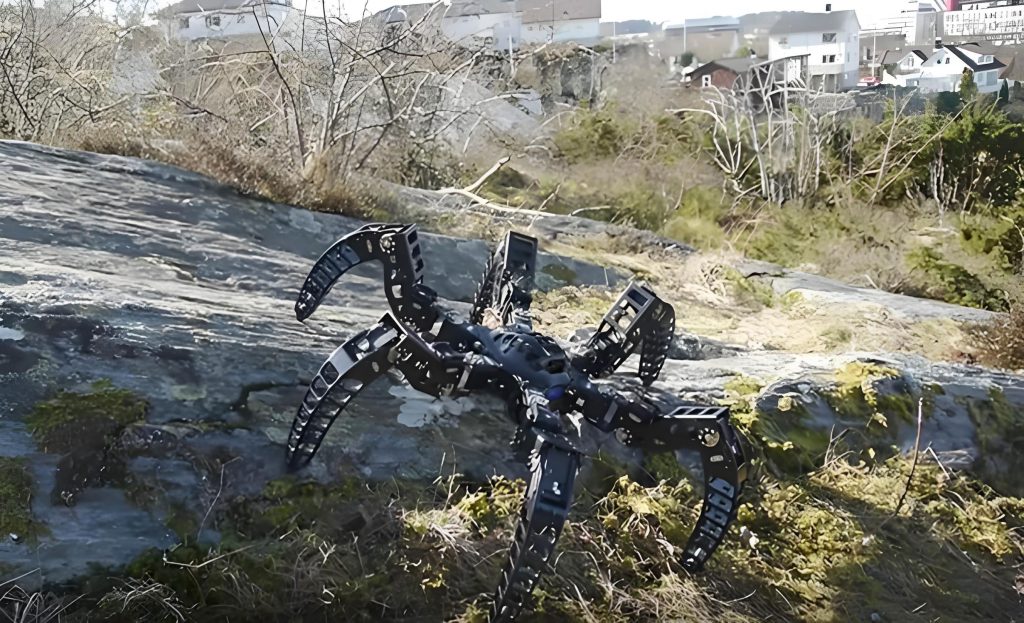
The journey began with a detailed kinematic analysis of the core 2-SPR/UPR(vA)/SPS parallel mechanism. Establishing its screw matrix and applying the Grübler-Kutzbach formula confirmed its variable mobility: three degrees of freedom (2 rotations and 1 translation) in the R-phase, and four degrees of freedom (2 rotations and 2 translations) in the U-phase. The inverse kinematic solutions, derived using the closed-loop vector method, provide the necessary mapping from desired torso posture to required actuator inputs. Given the complexity of the forward kinematics for a parallel mechanism, a Particle Swarm Optimization (PSO) algorithm was employed to solve this problem numerically, with results validated against the inverse solution. To understand motion transmission, the Finite and Instantaneous Screw (FIS) theory was applied to establish the velocity Jacobian matrix, linking actuator velocities to the moving platform’s twist.
A critical performance metric for any bionic robot is its workspace—the volume of space its end-effector can reach. For the Torso-Bio’s torso, this defines the range of possible bending and stretching motions. By combining boundary-searching simulations in SolidWorks with point-cloud processing in MATLAB, the reachable workspace for the R-phase was visualized and quantified. It forms a continuous, symmetrical伞-shaped volume with no internal voids, calculated to be approximately \(4.8911 \times 10^7 \, \text{mm}^3\). The additional translational workspace gained in the U-phase was also analyzed, confirming the mechanism’s substantial and flexible operational range, essential for a functional bionic torso.
However, a dexterous bionic torso introduces a new challenge: stability. As the torso deforms, the robot’s overall center of gravity (COG) shifts. For a bionic robot performing leg-like lifting maneuvers, this can quickly lead to instability and tipping. To address this, a dedicated COG adjustment device was integrated into the torso’s central structure. This device features a circular guide rail with a movable counterweight, allowing for active compensation of COG shifts during motion.
To effectively control this system, a mathematical model for stability analysis was developed. The robot’s mass was partitioned into five logical regions (four wheel modules and the central torso assembly with the adjustment device). The COG coordinates \((x_{COG}, y_{COG}, 0)\) projected onto the ground plane are given by:
$$
x_{COG} = \frac{\sum_{i=1}^{4} G_i x_{T_i} + G_C x_{center}}{\sum_{i=1}^{4} G_i + G_C}, \quad y_{COG} = \frac{\sum_{i=1}^{4} G_i y_{T_i} + G_C y_{center}}{\sum_{i=1}^{4} G_i + G_C}
$$
where \(G_i\) and \((x_{T_i}, y_{T_i})\) are the weight and ground contact coordinates of the \(i\)-th wheel, and \(G_C\), \((x_{center}, y_{center})\) represent the adjustable central mass. The static stability margin \(d_{min}\) is then defined as the shortest distance from the projected COG to the boundary of the support polygon formed by the grounded wheels. For a triangular support polygon during a one-wheel-lifted stance, defined by points \(T_1, T_3, T_4\), \(d_{min}\) is calculated as:
$$
d_{min} = \frac{|A x_{COG} + B y_{COG} + C|}{\sqrt{A^2 + B^2}}, \quad \text{where } A = y_{T_3} – y_{T_4}, \quad B = x_{T_4} – x_{T_3}, \quad C = x_{T_3}y_{T_4} – x_{T_4}y_{T_3}.
$$
Mapping \(d_{min}\) against \((x_{COG}, y_{COG})\) for a typical lifting gait created a stability landscape. This map is crucial for planning: for any desired torso/wheel pose, it shows the resultant stability margin, and conversely, for a required margin, it reveals the set of viable COG locations. The dynamic stability during slow, deliberate “static walking” was assessed using the Zero-Moment Point (ZMP) criterion. For steady motion, the ZMP coincides with the projected COG. The control strategy for the bionic robot thus involves solving an optimization problem: during a maneuver, adjust the COG (via the counterweight and wheel displacements) to maintain \(d_{min}\) above a safe threshold while minimizing actuator effort.
An optimization framework based on the Beetle Antennae Search (BAS) algorithm was implemented for this purpose. The objective function \(V_{min}\) combined the total linear actuator displacement \(\Delta P\) in the parallel legs and the rotational travel \(\theta_{wheel}^R\) of the rear wheels for support polygon adjustment:
$$
V_{min} = k_1 \cdot |\theta_{wheel}^R| + k_2 \cdot |\Delta P|
$$
with \(k_1\) and \(k_2\) as weighting coefficients. The algorithm successfully converges to energy-efficient adjustment sequences, ensuring the bionic robot remains stable with minimal control effort.
| Gait Phase | Primary Action | Key Actuator Commands (C: Counterweight, R: Torso Pitch, L1/L2/L3: Leg Actuators) |
|---|---|---|
| 1. Lift Right Front | Shift COG left-rear; lift wheel. | C+: Rotate CCW; R-: Pitch torso down at front. |
| 2. Extend RF Wheel | Place wheel atop obstacle. | L2 extend, L1/L3 contract. |
| 3. Shift & Lift Left Front | Plant RF wheel; shift COG; lift LF wheel. | C+; R back to neutral; R- to lift LF. |
| 4. Extend LF Wheel | Place LF wheel atop obstacle. | L1/L2/L3 return to neutral length. |
| 5. Lift Right Rear | Shift COG left-front; lift RR wheel. | C-; R+ to pitch torso up at front. |
| 6. Extend RR Wheel | Swing RR wheel forward onto obstacle. | L2 contract, L1 extend. |
| 7. Shift & Lift Left Rear | Plant RR wheel; shift COG; lift LR wheel. | C+; R to neutral; R+ to lift LR. |
| 8. Complete Climb | Place LR wheel atop obstacle. | L1/L2 return to neutral. |
The structural integrity of this bionic robot is paramount. Static analysis began with the wheeled mode, where the SPS limb of the parallel mechanism primarily acts as a load-bearing strut to enhance rigidity. The force \(F_{SPS}\) it must provide is derived from moment equilibrium about a wheel axis:
$$
F_{SPS} = \frac{ \frac{G(R_2 – R_1)}{2} – F_{UPR}r_{UPR} + F_{SPR}r_{SPR} }{ r_{SPS} } = \frac{k_{SPS}}{r_{SPS}}
$$
Here, \(k_{SPS}\) is an installation constant determined by geometry and weight. For climbing, a force analysis at the point where a wheel contacts a vertical obstacle determines the non-slip condition. The traction force \(F_P\) must not exceed the maximum static friction: \(k_T N_P \geq F_P\), where \(k_T\) is the coefficient of friction and \(N_P\) the normal force. Solving the equilibrium equations yields the climbing criterion, which informs the selection of wheel materials with sufficient grip.
Finite Element Analysis (FEA) in ANSYS confirmed the design’s mechanical soundness. Under load, the maximum von Mises stress of ~9.65 MPa and a maximal deformation of ~8.28×10⁻³ mm were both located at the reconfigurable vA joint—the most complex element. These values are well within the yield strength of structural steel, validating the material choice and general structural design for this bionic robot.
The ultimate test of a bionic robot lies in its performance. Comprehensive tests for the Torso-Bio’s obstacle-crossing capability were conducted. A gait sequence for climbing a vertical step, detailed in the table above, was devised and simulated. The bionic robot successfully climbed a step twice its wheel diameter. Similarly, a trench-crossing gait was planned and executed, with the robot clearing a trench half its body length. Dynamic simulations in ADAMS provided further validation, showing all actuator forces and torques within acceptable limits. The COG trajectory remained smooth, and energy consumption data highlighted the most demanding actuators, providing insights for future optimization.
| Performance Metric | Simulation Result | Significance |
|---|---|---|
| Max Vertical Obstacle | 2 × Wheel Diameter | Far exceeds standard wheeled robot limit (~0.5 × Wheel Diameter). |
| Max Trench Width | 0.5 × Body Length | Demonstrates exceptional reach and coordination. |
| Peak Actuator Stress | ~9.65 MPa (vA joint) | Well below yield strength of structural steel, confirming safety factor. |
| Actuator Energy Use | Highest in SPR limbs during climb | Identifies focus for efficiency improvements in the bionic drive system. |
Beyond discrete obstacles, continuous rough terrain demands adaptability. In the V-REP simulation environment, the Torso-Bio was equipped with distance sensors on its front. A control algorithm was implemented where the height difference between left and right sensor readings directly modulated the extension of the corresponding parallel torso actuators. This created a “body-flexing” behavior, allowing the bionic robot to passively conform its torso to undulating ground, significantly smoothing its COG trajectory compared to a rigid-body robot. To enable autonomous navigation in complex settings, a 3D lidar (simulated SIM350) was integrated. The bionic robot successfully performed real-time terrain mapping and modeling, using this environmental awareness to plan paths and adjust its torso posture preemptively.
In conclusion, the Torso-Bio project demonstrates a successful paradigm for mobile robot enhancement through torso-centric bionics. By integrating a reconfigurable parallel mechanism as a dynamic, spine-like torso, this bionic robot effectively merges the speed of wheeled locomotion with the superior obstacle negotiation of legged systems. The theoretical framework encompassing variable kinematics, stability-aware COG control, structural analysis, and intelligent terrain adaptation provides a comprehensive foundation for this class of machines. The bionic robot proves capable of traversing severe discontinuities like high steps and wide trenches while also smoothly conforming to continuous rough terrain. Future work will focus on physical prototyping, energy system optimization leveraging the bionic robot’s dynamic motions, and the development of more advanced algorithms for fully autonomous reconfiguration and operation in real-world, unpredictable environments. The fusion of parallel mechanisms with bionic principles, as embodied in the Torso-Bio, opens a promising path toward highly mobile and resilient robots for exploration, search and rescue, and planetary science.