
The pursuit of agile, stable, and adaptable locomotion in unstructured terrain remains a central challenge in robotics. While wheeled and tracked vehicles excel on prepared surfaces, their mobility is severely limited in environments characterized by obstacles, soft ground, or discontinuous paths. In contrast, legged animals traverse such complex terrains with remarkable ease and efficiency. This observation has fueled significant research into bionic robot designs, particularly quadrupedal platforms, which offer an optimal balance between mechanical simplicity, stability, payload capacity, and dynamic potential compared to bipedal or multi-legged (>4) counterparts. The development of a robust, responsive, and compact control system is paramount to unlocking the agile capabilities inherent in a bionic robot design. This work presents the comprehensive design and experimental validation of a high-performance embedded control system for a small-scale, biomimetically inspired quadruped bionic robot.
Traditional small-scale legged robots often employ microcontrollers like the Atmel AVR series or Digital Signal Processors (DSPs). While capable, these platforms can face limitations in processing speed, peripheral connectivity, and memory capacity when tasked with coordinating numerous actuators, processing data from multiple sensors (inertial measurement units, distance sensors, etc.), and executing complex gait algorithms in real-time. To address these demands, we architected a control system centered on an ARM Cortex-M3 core, specifically the STM32F103VCT6 microcontroller. This 32-bit RISC processor operates at up to 72 MHz, features substantial Flash and SRAM, and offers a rich set of communication interfaces (USART, SPI, ADC). This foundation provides the necessary computational bandwidth and extensibility for advanced control of our sophisticated bionic robot.
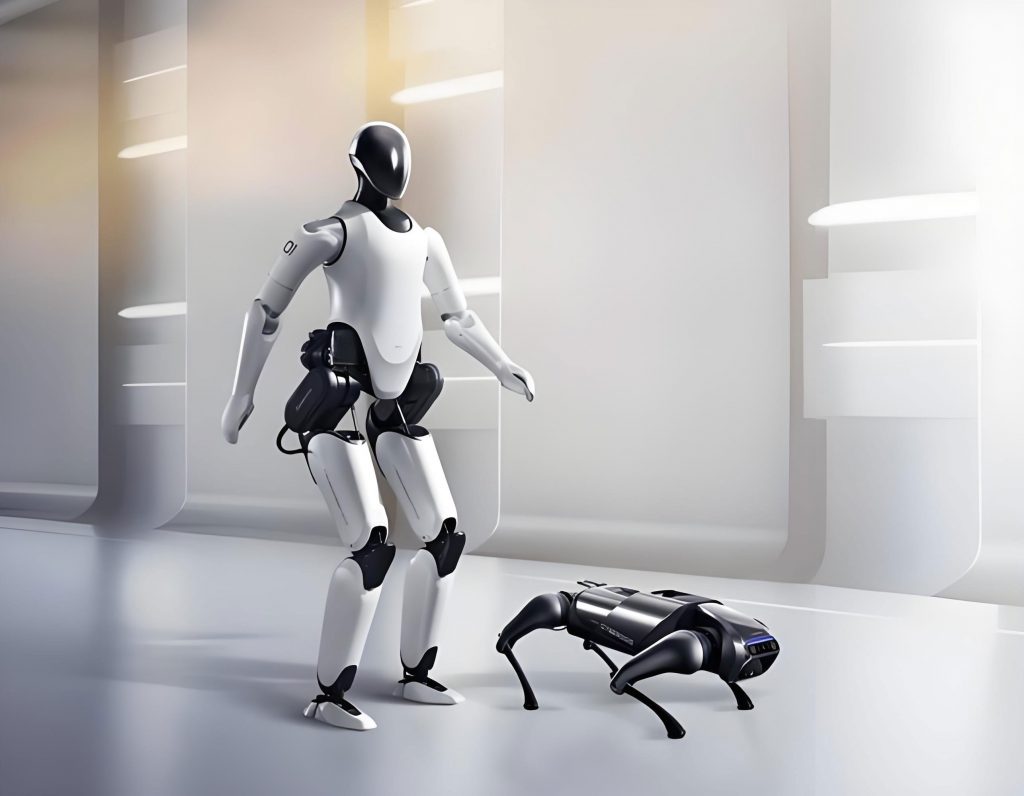
The mechanical design of our bionic robot is inspired by the limb morphology of quadruped mammals, emphasizing dexterity and multi-directional mobility. The robot possesses four identical legs arranged in symmetrical pairs. A key feature distinguishing our design from many conventional quadrupeds is the inclusion of a multi-degree-of-freedom foot. Each leg is configured as a serial kinematic chain with four active joints: hip abduction/adduction, hip flexion/extension, knee flexion/extension, and ankle flexion/extension. This grants each limb significant workspace and the ability to conform to uneven ground. All sixteen joints are actuated by Dynamixel AX-12A smart serial servo motors, which integrate position feedback, torque control, and a daisy-chainable communication bus, significantly simplifying the hardware interconnect. The robot’s body thus possesses a total of 16 active degrees of freedom, enabling complex whole-body motions and adaptive gait strategies essential for a versatile bionic robot.
A fundamental requirement for controlling any articulated bionic robot is a precise kinematic model. We define the forward kinematics to calculate the foot-end position $^O\mathbf{P}_{foot}$ in the body-fixed coordinate frame {O} given the joint angles. For a given leg (e.g., Left Front), the Denavit-Hartenberg (D-H) parameters are established as shown in the table below, where $\alpha_i$ is the hip joint angle, $\beta_i$ is the thigh (lift) joint, $\gamma_i$ is the knee joint, and $\phi_i$ is the ankle joint. $L_1$, $L_2$, and $L_3$ represent the lengths of the hip link, thigh, and shank, respectively.
| Joint $i$ | $\theta_i$ | $d_i$ | $a_i$ | $\alpha_i$ (D-H) |
|---|---|---|---|---|
| 1 (Hip) | $\alpha$ | 0 | 0 | $-90^\circ$ |
| 2 (Thigh) | $\beta$ | 0 | $L_1$ | $0^\circ$ |
| 3 (Knee) | $\gamma$ | 0 | $L_2$ | $0^\circ$ |
| 4 (Ankle) | $\phi$ | 0 | $L_3$ | $0^\circ$ |
The homogeneous transformation matrix from the foot frame to the body frame is derived by cascading the individual joint transforms:
$$ ^O\mathbf{T}_{4} = ^O\mathbf{T}_{1}(\alpha) \cdot ^1\mathbf{T}_{2}(\beta) \cdot ^2\mathbf{T}_{3}(\gamma) \cdot ^3\mathbf{T}_{4}(\phi) $$
The resulting foot position $^O\mathbf{P}_{foot} = [P_x, P_y, P_z]^T$ is extracted from the fourth column of $^O\mathbf{T}_{4}$. The forward kinematics equations are:
$$
\begin{aligned}
P_x &= -L_1 \sin\beta – L_2 \sin(\beta+\gamma) – L_3 \sin(\beta+\gamma+\phi) \\
P_y &= -\sin\alpha \left[ L_1 \cos\beta + L_2 \cos(\beta+\gamma) + L_3 \cos(\beta+\gamma+\phi) \right] \\
P_z &= -\cos\alpha \left[ L_1 \cos\beta + L_2 \cos(\beta+\gamma) + L_3 \cos(\beta+\gamma+\phi) \right]
\end{aligned}
$$
Inverse kinematics (IK) for a 4-DOF limb aiming to reach a specific foot position $[P_x, P_y, P_z]^T$ is underdetermined, leading to a redundancy. To resolve this and simplify real-time computation for our bionic robot, we impose a kinematic constraint coupling the knee and ankle joints, emulating a biological synergy: $\phi = k \gamma$. For trotting and walking gaits, we set $k=1$, effectively making the shank and foot move in a coordinated manner. This reduces the effective unknowns. The solution is derived geometrically:
- Hip Yaw ($\alpha$): This angle is determined directly from the projection of the foot point onto the body’s YZ-plane.
$$ \alpha = \text{atan2}(P_y, P_z) $$ - Thigh and Knee Angles ($\beta, \gamma$): We define an intermediate variable $D$ representing the distance from the hip joint to the foot projection in the leg plane.
$$ D = \sqrt{P_y^2 + P_z^2} $$
The problem reduces to solving for a 2-link planar arm (thigh + combined shank-foot of length $L_{eff}=L_2+L_3$) reaching point $(P_x, D)$. Using the law of cosines on the triangle formed by $L_1$, $L_{eff}$, and the distance from hip to foot $R=\sqrt{P_x^2+D^2}$:
$$ \cos(\pi – \gamma) = -\cos\gamma = \frac{R^2 – L_1^2 – L_{eff}^2}{2 L_1 L_{eff}} $$
Thus,
$$ \gamma = \arccos\left( \frac{L_1^2 + L_{eff}^2 – R^2}{2 L_1 L_{eff}} \right) $$
Next, $\beta$ is found using the two-argument arctangent function to account for the correct quadrant:
$$ \beta = \text{atan2}(P_x, D) – \text{atan2}\left( L_{eff} \sin\gamma, L_1 + L_{eff} \cos\gamma \right) $$ - Ankle Angle ($\phi$): According to our constraint,
$$ \phi = \gamma $$
This analytical IK solution is computationally efficient and ensures a unique pose for the bionic robot‘s leg given a desired foot position, which is crucial for stable gait generation.
The embedded control system is the central nervous system of the bionic robot. Its design priorities were high-speed computation for real-time servo control and sensor fusion, low power consumption, and a rich I/O set for expansion. The STM32F103VCT6 microcontroller was selected as the core. The hardware architecture comprises several key subsystems:
- Power Management: A single 11.1V Li-Po battery supplies the system. Voltage regulators provide stable 5V for the servo bus and 3.3V for the microcontroller and digital sensors.
- Processing Core: The ARM Cortex-M3 handles all control algorithms, gait sequencing, and sensor data processing.
- Actuation Interface: Sixteen AX-12A servos are connected in a daisy chain to a single half-duplex USART (USART2) configured for TTL serial communication at 1 Mbps. A level-shifting circuit ensures signal compatibility.
- Communication Interface: A second USART (USART1) is connected to a wireless serial module (e.g., HC-05 Bluetooth or NRFL01+), enabling bidirectional communication with a remote host PC or ground station for teleoperation, gait uploads, and data telemetry.
- Sensory Input: The system integrates multiple sensors for autonomous behavior:
- An Inertial Measurement Unit (IMU, e.g., SDI-MAHRS) connected via SPI or I2C provides roll, pitch, yaw (RPY) angles and accelerometer/gyroscope data for body stabilization.
- Analog-to-Digital Converter (ADC) channels are allocated for infrared proximity sensors and system voltage monitoring.
- A pulse-width modulation (PWM) input captures data from an ultrasonic rangefinder.
The software architecture for the bionic robot is built around a modular, interrupt-driven framework to ensure responsive control. The main operational flow is as follows:
- Initialization: The system boots, initializing clocks, GPIOs, USARTs, SPI, ADC, and timers. Servo IDs are verified, and initial positions are set.
- Main Control Loop: The core loop runs at a fixed frequency (e.g., 100 Hz). It performs:
- Sensor Data Acquisition: Polling/reading data from the IMU, distance sensors, and battery monitor.
- State Estimation: Fusing IMU data to estimate the body’s orientation and stability.
- Gait Engine: Based on the current gait (trot, walk, turn) and commands from the wireless link, the engine calculates the target foot trajectory for the next control cycle using the inverse kinematics model.
- Servo Command Generation: The target joint angles for all 16 servos are packaged into Dynamixel commands.
- Servo Synchronization: A critical aspect for stable locomotion of the bionic robot is the synchronous movement of all joints. Instead of sending 16 individual angle commands sequentially—which would introduce significant phase lag—we utilize the Dynamixel “SYNC_WRITE” broadcast instruction. This instruction packet, sent via USART2, contains the start address (goal position), data length, and then a sequence of Servo ID + data pairs for all servos. The broadcast ID (0xFE) ensures all servos on the bus receive and execute the new position commands nearly simultaneously, minimizing inter-joint coordination error. The packet structure is summarized below:
| Field | Byte 1 | Byte 2 | Byte 3 | Byte 4 | Bytes 5-6 | Bytes 7-8 | … | Byte N |
|---|---|---|---|---|---|---|---|---|
| Description | 0xFF | 0xFF | 0xFE | Packet Length | SYNC_WRITE Inst. | Start Addr. | … | Checksum |
| Value Example | Header | Header | Broadcast ID | Var. | 0x83 | 0x1E | Data for Servo 1,2,…,16 | CRC |
- Wireless Communication Handler: An interrupt service routine (ISR) for USART1 processes incoming wireless commands (e.g., “start trot”, “turn left”, “stop”) and queues outgoing telemetry data (sensor readings, system status).
- Safety Monitor: A background routine checks for system faults: low battery voltage, servo overload errors, or loss of wireless connection, triggering a safe stop procedure if necessary.
To validate the mechanical design, kinematic model, and the performance of the embedded control system for our bionic robot, we conducted a series of simulation and physical experiments.
Gait Planning & Simulation: A trotting gait was chosen for initial validation due to its dynamic stability and speed. Using MATLAB and the SimMechanics toolbox, a full dynamic model of the bionic robot was constructed. Foot trajectories for the swing and stance phases were planned using cycloidal functions to ensure smooth velocity and acceleration profiles. The simulation solved the inverse kinematics in real-time to generate the joint angle trajectories for a complete gait cycle. The simulated motion showed stable, periodic leg coordination.
Physical Experimentation: The joint angle sequences from the simulation were translated into look-up tables and programmed into the STM32’s Flash memory. The physical bionic robot was placed on a flat laboratory floor. The control system executed the pre-programmed trotting gait. A high-speed camera was used for qualitative motion analysis, and the onboard IMU logged the body’s orientation angles (Roll, Pitch, Yaw) during locomotion.
Results and Analysis: The physical bionic robot successfully executed stable, continuous trotting gaits, matching the simulated motion profiles. The key metric for stability is the oscillation of the body’s orientation. The IMU data for a representative 10-second trotting sequence is summarized below:
| Orientation Angle | Mean Value (Deg.) | Standard Deviation (Deg.) | Peak-to-Peak Amplitude (Deg.) |
|---|---|---|---|
| Roll ($\phi$) | -0.5 | 1.8 | 7.2 |
| Pitch ($\theta$) | 1.2 | 2.1 | 8.5 |
| Yaw ($\psi$) | 0.1 | 0.9 | 3.7 |
The small standard deviations and bounded amplitudes, particularly in roll and pitch, indicate that the bionic robot maintained good stability during locomotion. The yaw angle showed minimal drift, confirming effective straight-line travel. The successful replication of the simulated gait in hardware validates the accuracy of the derived inverse kinematics and the precision of the embedded control system’s servo synchronization. The system’s real-time performance was confirmed by the absence of observable jitter or lag in leg movements, demonstrating that the ARM Cortex-M3 processor adequately handled the computational load of gait generation and synchronous servo control for this complex bionic robot.
This work presented the integrated design and validation of a sophisticated embedded control system for a biomimetically inspired quadruped bionic robot. The four-degree-of-freedom limb design provides a substantial workspace and dexterity. The analytical inverse kinematics solution, simplified by a biologically plausible joint coupling constraint, enables efficient real-time foot trajectory tracking. The core achievement is the implementation of a high-performance control architecture based on the ARM Cortex-M3 microcontroller. This system leverages the processor’s computational speed and peripheral set to execute synchronous, low-latency control of 16 smart servos via an optimized communication protocol while concurrently acquiring and processing data from multiple stability and environmental sensors.
Experimental results demonstrated that the bionic robot could execute stable trotting gaits with minimal body orientation oscillation. The close agreement between simulated and physical locomotion confirms the fidelity of the kinematic models and the effectiveness of the control hardware and software. The designed system provides a robust and extensible platform. The available processing headroom and I/O capabilities pave the way for implementing more advanced features crucial for a fully autonomous bionic robot, such as sensor-based reflex controllers, adaptive gait transitions for rough terrain, and higher-level navigation algorithms. Future work will focus on integrating these intelligent behaviors, further refining the mechanical design for dynamic performance, and testing the bionic robot in increasingly challenging, unstructured environments.