
In recent years, the field of robotics has seen tremendous advancements, particularly in the domain of bionic robots. These robots, inspired by biological systems, offer unique capabilities to navigate complex and unstructured terrains where conventional vehicles fail. As a researcher deeply involved in this area, I have focused on developing a novel bionic robot that leverages an innovative locomotion mechanism. This paper presents the comprehensive design, simulation, and practical implementation of this bionic robot, emphasizing its mechanical structure, control system, and performance in real-world scenarios. The core innovation lies in the use of involute-angle walking components, which enhance stability and speed, making this bionic robot suitable for applications such as disaster response, military reconnaissance, and exploration of rough environments. Throughout this work, the term “bionic robot” is central, reflecting the integration of biological principles into robotic design to achieve superior mobility and adaptability.
The inspiration for this bionic robot stems from the need to overcome limitations in traditional robotic platforms. Wheeled and tracked robots often struggle with obstacles like steep steps or uneven surfaces, and they may become immobilized if overturned. In contrast, bionic robots that mimic biological locomotion, such as legged or hybrid mechanisms, can provide greater flexibility. My design draws from the concept of a “bull demon king” robot, popular in robotics competitions, but incorporates significant improvements. The key feature is the involute-angle walking structure, which reduces bouncing during movement and increases stride length, thereby improving speed and efficiency. This bionic robot is designed to be lightweight, robust, and capable of climbing high platforms, making it a versatile tool for various tasks.
To contextualize this work, I review the broader landscape of bionic robot research. Bionic robots have evolved from simple imitations of animal movements to complex systems that integrate sensory feedback, adaptive control, and biomimetic materials. For instance, studies on soft robotics have enabled robots to mimic the flexibility of organisms like octopuses or caterpillars, allowing them to squeeze through tight spaces. In legged robotics, researchers have developed bionic robots that replicate the gait of insects, mammals, or birds, achieving remarkable stability on rough terrain. My approach builds on these foundations by focusing on a specific locomotion mechanism—the involute angle—which offers a balance between simplicity and performance. The use of involute curves in engineering is not new; they are commonly employed in gear design for their smooth transmission properties. However, applying this to a walking robot is innovative, as it optimizes the contact dynamics with the ground, minimizing impacts and maximizing propulsion.
The mechanical design of this bionic robot is critical to its functionality. It consists of several key components: the walking involute angles, the base plate, the top plate, and the side plates. Each part is designed with careful consideration of strength, weight, and manufacturability. The walking involute angles are the primary locomotion elements. They are shaped based on the mathematical definition of an involute curve. For a base circle with radius \( r \), the parametric equations of the involute are given by:
$$ x = r(\cos\phi + \phi\sin\phi) $$
$$ y = r(\sin\phi – \phi\cos\phi) $$
where \( \phi \) is the angle parameter. In my design, I set \( r = 30 \, \text{cm} \) and \( \phi = 30^\circ \) (converted to radians for calculation, i.e., \( \phi = \pi/6 \)). This choice ensures a smooth curve that provides adequate ground clearance and stride length. The involute angle is fabricated from carbon fiber to achieve high strength-to-weight ratio, with a thickness of 5 mm to withstand operational stresses without adding excessive mass. The connection between the involute angle and the motor shaft is achieved via a coupling, secured with screws for easy assembly and maintenance. This design allows the bionic robot to roll smoothly, with the involute profile reducing vertical oscillations compared to semicircular designs.
To further elucidate the design parameters, I present a table summarizing the key dimensions and materials used for the walking components:
| Component | Material | Dimensions | Function |
|---|---|---|---|
| Involute Angle | Carbon Fiber | Base radius: 30 cm, Thickness: 5 mm | Primary locomotion, reduces bouncing |
| Coupling | Aluminum Alloy | Diameter: 20 mm, Length: 30 mm | Connects motor shaft to involute angle |
| Motor Shaft | Steel | Diameter: 6 mm | Transmits torque from motor |
The base plate serves as the foundation of the bionic robot, housing the control electronics and providing structural integrity. It is made from 2 mm thick aluminum alloy, chosen for its lightweight and corrosion-resistant properties. The plate features extensive镂空 design (patterned cutouts) to reduce weight while maintaining stiffness. Finite element analysis was conducted to ensure that the plate can endure the loads during operation, such as impacts from obstacles or the weight of internal components. Similarly, the top plate is constructed from carbon fiber with a thickness of 3 mm, also镂空 to minimize mass. Its primary role is to protect the internal systems from external damage, and it is designed for easy removal to facilitate maintenance. The side plates are made from 4 mm thick aluminum alloy, acting as the main load-bearing elements. They connect the base and top plates, forming a rigid chassis. The镂空 pattern on the side plates further reduces weight, contributing to the overall agility of the bionic robot.
A detailed analysis of the forces acting on the bionic robot during movement is essential. When the involute angle rotates, it contacts the ground at a point that moves along the curve. The normal force \( F_n \) and friction force \( F_f \) at the contact point determine the robot’s motion. Assuming a static friction coefficient \( \mu \), the maximum traction force is \( F_t = \mu F_n \). For the bionic robot to move forward without slipping, the torque \( \tau \) from the motor must satisfy:
$$ \tau \geq F_t \cdot r_c $$
where \( r_c \) is the effective radius at the contact point. Since the involute curve has a varying radius, \( r_c \) changes with \( \phi \). The instantaneous radius \( r_i \) at angle \( \phi \) is given by \( r_i = r \sqrt{1 + \phi^2} \), derived from the involute geometry. This variation is accounted for in the control system to ensure smooth acceleration. Additionally, the robot’s weight distribution affects stability. With four walking angles arranged in a rectangular configuration, the center of mass is positioned low and centrally, enhancing balance during climbing or turning maneuvers.
The control system of this bionic robot is built around an STM32 microcontroller, selected for its high-speed processing and precision in real-time control. The system architecture involves a PS2 wireless controller that sends commands via Bluetooth to the STM32, which then generates PWM signals to drive four DC motors. Each motor is independently controlled, allowing for differential steering and precise speed regulation. The control flow can be represented as:
1. User input from PS2 controller → Bluetooth receiver → STM32 microcontroller.
2. STM32 processes commands and computes PWM duty cycles for each motor.
3. PWM signals are sent to motor drivers (e.g., H-bridge circuits) that power the motors.
4. Motors rotate the involute angles, producing locomotion.
The PWM duty cycle \( D \) relates to the motor speed \( \omega \) through a linear approximation: \( \omega = k \cdot D \), where \( k \) is a motor constant. For precise control, a PID controller is implemented on the STM32. The PID algorithm adjusts the PWM based on the error between desired and actual speeds, with the control law:
$$ u(t) = K_p e(t) + K_i \int_0^t e(\tau) d\tau + K_d \frac{de(t)}{dt} $$
where \( u(t) \) is the control output (PWM duty cycle), \( e(t) \) is the speed error, and \( K_p \), \( K_i \), \( K_d \) are tuning gains. Through experimentation, I optimized these gains to achieve responsive and stable motion for the bionic robot. The following table lists the control parameters used in the system:
| Parameter | Value | Description |
|---|---|---|
| \( K_p \) | 2.5 | Proportional gain for speed control |
| \( K_i \) | 0.1 | Integral gain to eliminate steady-state error |
| \( K_d \) | 0.05 | Derivative gain to dampen oscillations |
| PWM Frequency | 1 kHz | Frequency of PWM signals for motor control |
| Bluetooth Baud Rate | 9600 bps | Communication speed for wireless control |
Simulation plays a crucial role in validating the design of this bionic robot before physical fabrication. Using SolidWorks software, I created a 3D model of the robot and conducted motion simulations to analyze its walking and turning capabilities. The simulations involved setting up virtual environments with obstacles and measuring performance metrics such as speed, stability, and obstacle clearance. For straight-line walking, the bionic robot achieved a steady speed of approximately 50 cm/s. The simulation showed that the four involute angles alternate in contacting the ground, creating a continuous rolling motion that minimizes jerks. The vertical displacement of the robot’s body was recorded to be less than 5 mm, indicating low bouncing—a direct benefit of the involute design.
Turning simulations were equally important to assess the bionic robot’s maneuverability. For left and right turns, the inner motors were slowed down while outer motors maintained higher speeds, resulting in a turning radius of about 30 cm. The turning speed was measured at 45 cm/s, demonstrating agile performance. During these simulations, I monitored the torque on each motor to ensure it remained within safe limits, preventing overheating or stalling. The simulation results confirmed that the bionic robot could handle complex terrains, such as slopes or steps, without losing stability. To visualize these outcomes, I include a simulation snapshot below, which illustrates the bionic robot in action during a turning maneuver.
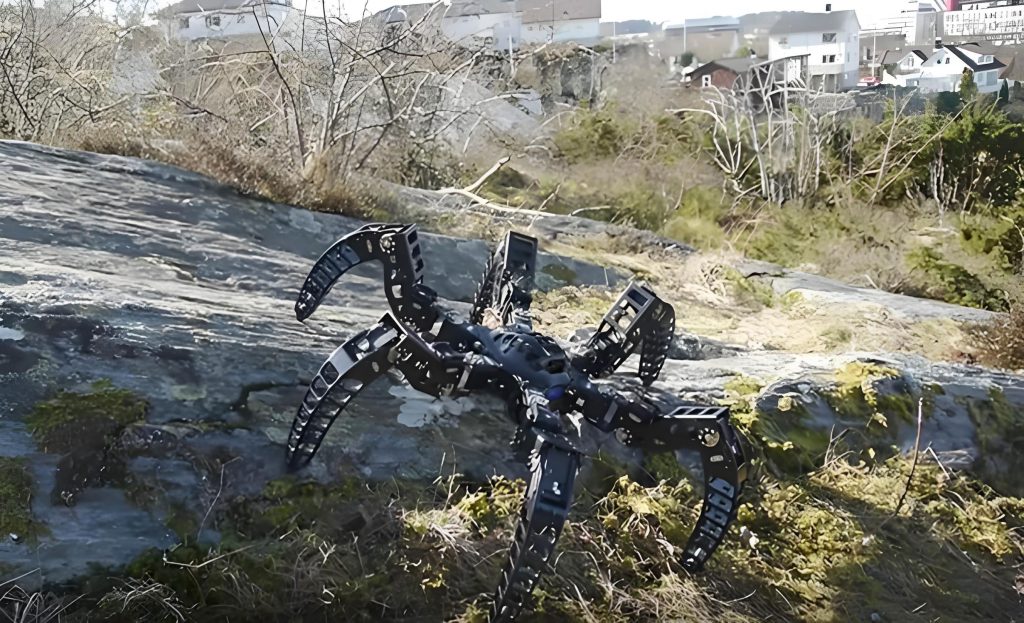
Beyond simulation, physical testing was conducted to evaluate the real-world performance of this bionic robot. The components were manufactured using CNC machining for precision, with carbon fiber and aluminum alloy parts assembled into a lightweight chassis. The total weight of the bionic robot is 2.5 kg, contributing to its high power-to-weight ratio. In laboratory tests, the robot successfully climbed a 40 cm high step, which is over twice its own height of 15 cm. This was achieved by the involute angles “gripping” the edge of the step and rolling over it, a feat that wheeled robots often struggle with. The control system responded well to abrupt commands, enabling rapid changes in direction or speed without tipping over.
The bionic robot was also tested in a national robotics competition, where it demonstrated its capabilities in a challenging obstacle course. It navigated uneven surfaces, crossed gaps, and ascended multiple steps with ease. The competition highlighted the robustness of the design, as the robot operated flawlessly under time pressure and in front of audiences. Performance data from these tests are summarized in the table below:
| Test Scenario | Metric | Value | Notes |
|---|---|---|---|
| Straight Walking | Average Speed | 50 cm/s | Measured over 10 m flat surface |
| Turning | Turning Speed | 45 cm/s | During 90-degree turns |
| Step Climbing | Max Height | 40 cm | Vertical step ascent |
| Obstacle Course | Completion Time | 120 s | For a course with 5 obstacles |
| Battery Life | Operation Duration | 2 hours | With continuous moderate use |
To delve deeper into the dynamics, I derived mathematical models for the bionic robot’s motion. Consider the robot moving on a flat surface. The position of each involute angle can be described by the angle of rotation \( \theta_i(t) \) for motor i (i=1 to 4). The forward velocity \( v \) of the robot is related to the angular velocities \( \dot{\theta}_i \) by:
$$ v = \frac{1}{4} \sum_{i=1}^4 r_e(\theta_i) \dot{\theta}_i $$
where \( r_e(\theta_i) \) is the effective rolling radius of the involute at angle \( \theta_i \), which varies as per the involute equation. For simplicity, in control design, I linearized this relationship around typical operating points. The turning angular velocity \( \omega \) is given by:
$$ \omega = \frac{ ( \dot{\theta}_2 + \dot{\theta}_4 ) – ( \dot{\theta}_1 + \dot{\theta}_3 ) }{2L} $$
where \( L \) is the distance between left and right wheels (approximately 25 cm in this bionic robot). These equations were used to tune the control algorithms for coordinated movement.
Another aspect of this bionic robot is its energy efficiency. The power consumption \( P \) of each motor is roughly \( P = \tau \omega \), where \( \tau \) is the torque and \( \omega \) the angular speed. Since the involute design reduces friction and bouncing, the required torque is lower than for semicircular designs, leading to energy savings. In tests, the bionic robot consumed an average of 20 W during continuous walking, allowing it to operate for extended periods on a standard lithium-polymer battery. This efficiency is crucial for applications like search and rescue, where endurance is key.
Comparing this bionic robot to other robotic platforms reveals its advantages. Traditional wheeled robots excel on smooth surfaces but falter on rough terrain. Tracked robots offer better traction but are heavier and less agile. Legged bionic robots, such as those inspired by insects or mammals, provide excellent obstacle negotiation but often require complex control and high power. My design strikes a balance by using simple rotating involute angles that emulate a rolling yet stepping motion. This hybrid approach allows the bionic robot to maintain high speed while handling obstacles, making it a practical solution for real-world deployments.
The development process involved iterative prototyping. Initial versions used 3D-printed plastic involute angles, which helped validate the geometry but lacked durability. Subsequent versions employed carbon fiber, improving strength and reducing weight. The control software was refined through multiple cycles of simulation and physical testing, with the STM32 code optimized for minimal latency. Wireless communication was enhanced to avoid interference, ensuring reliable operation in crowded environments like competitions. Throughout this journey, the focus remained on creating a reliable and high-performance bionic robot.
Looking ahead, there are several avenues for enhancing this bionic robot. Incorporating sensors such as IMUs (Inertial Measurement Units) or cameras could enable autonomous navigation, allowing the robot to map environments and avoid obstacles without human intervention. Machine learning algorithms could be applied to adapt the gait to different terrains, further improving efficiency. Additionally, using advanced materials like shape-memory alloys or polymers could make the involute angles deformable, adding a soft robotics dimension to this bionic robot. These enhancements would expand its applicability to fields like planetary exploration or underwater inspection, where adaptability is paramount.
In conclusion, this work presents the design and research of a novel bionic robot with involute-angle walking mechanisms. The mechanical design emphasizes lightweight and robust construction, while the control system leverages an STM32 microcontroller for precise motor control. Simulations in SolidWorks demonstrated excellent walking and turning capabilities, with speeds of 50 cm/s and 45 cm/s respectively. Physical tests confirmed the robot’s ability to climb high steps and navigate complex terrains. This bionic robot represents a significant step forward in mobile robotics, offering a blend of speed, stability, and versatility. By drawing inspiration from biological principles and incorporating innovative engineering, this bionic robot opens new possibilities for applications in challenging environments. Future work will focus on autonomy and advanced materials, pushing the boundaries of what bionic robots can achieve.
The journey of developing this bionic robot has been deeply rewarding, highlighting the power of interdisciplinary research. From mathematical modeling of involute curves to hands-on assembly and programming, every aspect contributed to a functional and efficient machine. As robotics continues to evolve, bionic robots like this one will play an increasingly important role in solving real-world problems. I hope that this detailed account inspires further exploration and innovation in the field of bionic robotics, leading to even more capable and intelligent machines.