
The relentless pursuit of understanding our universe drives humanity to explore celestial bodies beyond our own. Deep space exploration, encompassing missions to asteroids, moons, and planets, presents formidable challenges that traditional robotic systems struggle to overcome. Conventional wheeled or legged rovers face significant limitations when navigating extreme terrains such as lava tubes, sheer cliffs, loose regolith, and rugged craters. Furthermore, the weak gravitational fields of small bodies and the non-structured, uncertain nature of extraterrestrial environments demand exceptional adaptability and resilience. In this context, the field of bionics offers a powerful paradigm, drawing inspiration from nature’s ingenious solutions to complex locomotion problems. Bionic robots, designed by mimicking the structures, movements, and mechanisms of living organisms, have emerged as a promising avenue to extend our reach into the most hostile corners of the solar system.
This article provides a first-person perspective review of the current state and prospects of bionic robots for deep space exploration. We focus on the biomimetic principles, configuration characteristics, and performance parameters that define these innovative machines. The discussion is structured around two primary categories derived from their locomotion strategy and morphological inspiration: Body-Twisting Robots and Limbed-Crawling Robots. We will dissect their advantages, limitations, and the key technological hurdles that must be cleared for their successful deployment. Throughout, we will employ comparative tables and analytical models to synthesize the information, aiming to provide a clear roadmap for future development in this exciting interdisciplinary field.
Taxonomy and Fundamentals of Bionic Robots for Space
The evolution of bionic robots can be seen in three stages: imitation of movement structure/form, imitation of biological motion mechanisms, and imitation of systemic behavior. For space applications, current research primarily resides in the first two stages, focusing on replicating specific animal morphologies and actuation principles to achieve superior mobility. For planetary and small-body surfaces, the most relevant bio-inspired locomotion forms include crawling, climbing, slithering, and rolling. Jumping, while potentially useful, often entails high energy costs and control complexity for stable landing, making it less mature for systematic exploration. Therefore, the most actively developed bionic robots for deep space fall into the two broad classes mentioned earlier.
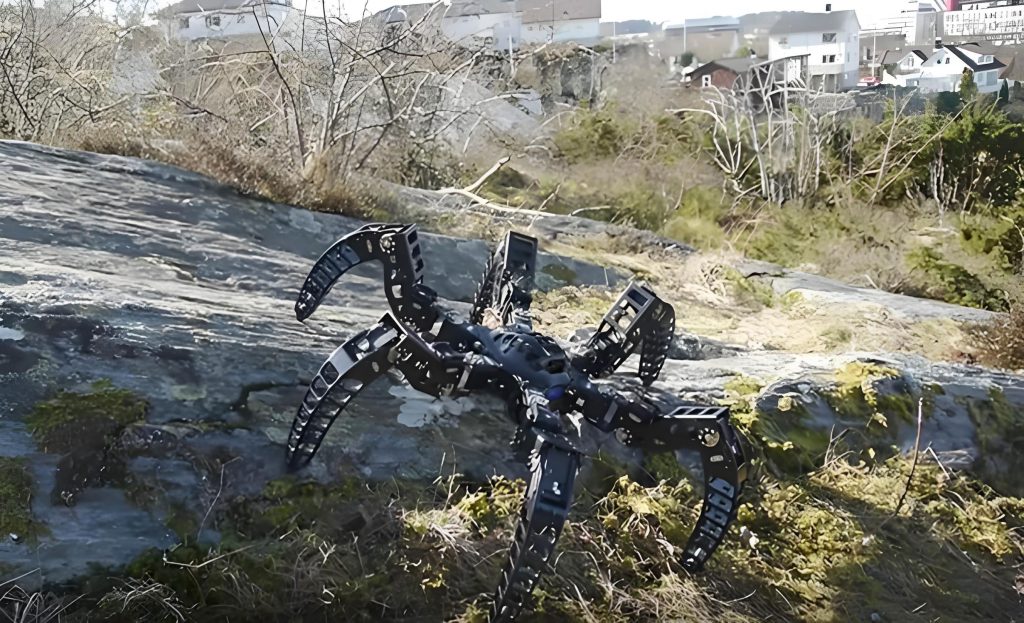
Body-Twisting Robots are characterized by their ability to generate propulsion through continuous, wave-like deformations of their main body, emulating limbless creatures like worms, snakes, or even plant roots. This category offers high degrees of freedom and exceptional flexibility, allowing navigation through tight spaces and compliant interaction with unpredictable terrain. Limbed-Crawling Robots, on the other hand, mimic legged animals or arthropods. They utilize distinct, articulated limbs for support and propulsion. While sometimes perceived as less flexible than their body-twisting counterparts, advanced limb designs—particularly those incorporating specialized feet for adhesion or grasping—provide unparalleled capabilities for climbing vertical surfaces or traversing granular media. The following table summarizes the core characteristics of these categories and their sub-types.
| Category | Sub-Type | Biomimetic Principle | Target Organism | Primary Advantages | Primary Disadvantages | Target Terrain |
|---|---|---|---|---|---|---|
| Body-Twisting Robot | Invertebrate Soft Robot | Continuous deformation of muscle-like soft actuators; peristaltic or elongation-based motion. | Earthworm, Slug, Vine | High flexibility, safe interaction, ability to navigate narrow passages. | Low structural stiffness, challenging modeling/control, low technology readiness level (TRL). | Sand, crevasses, lava tubes, loose soil. |
| Flexible Vertebrate Robot | Serial linkage of rigid segments with joints; concertina or serpentine motion. | Snake | High redundancy, good payload capacity, precise motion. | Complex control, large mass/volume due to many actuators. | Rugged surfaces, tunnels, underwater environments. | |
| Limbed-Crawling Robot | Claw/Gripper-Foot Robot | Mechanical interlocking with surface asperities using spines or hooks. | Beetle, Bat, Lizard | Strong adhesion on rough surfaces, mechanically simple. | Slow speed, potential for wear/damage on feet. | Cliffs, rocky outcrops, boulder fields. |
| Rolling-Crawling Robot | Multi-modal locomotion switching between rolling for speed and legged crawling for obstacle negotiation. | Spider (golden-wheel), Pill bug | Energy-efficient rolling, good speed on flats, adaptable gait. | Compromised design for dual-mode, lower precision. | Mixed terrain: flat plains with scattered obstacles. |
In-Depth Analysis of Body-Twisting Bionic Robots
This class of bionic robots leverages the entire body as a propulsion mechanism. Their design often incorporates novel materials and actuation methods to achieve life-like motion.
Invertebrate Soft Robots
These robots are typically constructed from compliant materials like silicone elastomers, with elastic moduli comparable to biological tissues. Their soft bodies allow them to withstand large deformations, absorb impacts, and safely interact with delicate environments. Actuation is often achieved via pneumatic or hydraulic channels, tendon-driven systems, or smart materials like Dielectric Elastomer Actuators (DEAs) and shape memory alloys (SMAs).
A prominent example is the soft burrowing robot inspired by plants and burrowing animals. It uses a process of “eversion” or “growth” from the tip, where an internal folded membrane is turned inside-out by internal pressure, allowing the robot to extend forward. This is combined with fluidization of granular media (like soil or sand) using directed air jets at the head to reduce resistance. The robot’s body can also steer using asymmetrical tip shapes or tendon control. The fundamental mechanics of soil penetration can be modeled by considering the pressure required to overcome soil compaction and friction. A simplified force balance at the tip during static penetration can be expressed as:
$$ F_{tip} = \sigma_c \cdot A_{tip} + \mu \cdot \sigma_n \cdot A_{side} $$
where $F_{tip}$ is the required actuation force, $\sigma_c$ is the compressive strength of the soil, $A_{tip}$ is the cross-sectional area of the tip, $\mu$ is the soil friction coefficient, $\sigma_n$ is the normal stress on the side of the body, and $A_{side}$ is the contact area along the side. The soft robot minimizes $A_{side}$ and $\sigma_n$ through its compliant contact and fluidization techniques, significantly reducing $F_{tip}$ compared to a rigid drill. Another concept is an area-of-effect soft robot designed for micro-gravity asteroid surfaces. It uses large, petal-like soft limbs for locomotion and electrostatic adhesion to prevent rebound and enable surface attachment on regolith. While highly innovative, the major challenges for space-grade soft bionic robots include material susceptibility to radiation and extreme temperatures, the integration of rigid electronics, and the development of reliable predictive models and ground-testing standards.
Flexible Vertebrate Robots (Snake Robots)
These are hyper-redundant manipulators composed of multiple rigid segments connected by active joints, typically offering one or two degrees of freedom (pitch and yaw) per segment. This discrete-joint approach provides higher stiffness and payload capacity than fully soft robots, at the cost of increased mechanical complexity. Their serpentine locomotion allows them to traverse a wide variety of terrains. A key advancement is the use of specialized gaits and shell designs. For instance, a screw-propelled snake robot utilizes a helical outer shell. In loose terrain, the helix digs in and rotates to propel the robot forward via Archimedes’ screw principle, which is highly effective in weak gravity where traction is limited. On hard ground, it can switch to a rolling or sidewinding gait. The screw propulsion torque can be approximated by:
$$ \tau \approx F_{thrust} \cdot \frac{p}{2\pi} $$
where $\tau$ is the required motor torque, $F_{thrust}$ is the desired propulsion force, and $p$ is the pitch of the helix. The thrust force itself depends on the geometry of the screw and the properties of the granular medium. More advanced concepts for exploring icy moon crevasses or lava tubes involve autonomous snake robots several meters long, capable of 3D mapping and deciding their own gait configuration and path planning. While offering exceptional terrain access, challenges include managing the heat generated from friction during screw propulsion, the high power demand for many actuators, and the complexity of autonomous control in completely unknown, constrained environments.
In-Depth Analysis of Limbed-Crawling Bionic Robots
This category enhances traditional legged robotics with biologically-inspired features, primarily focused on the foot-ground interaction to solve specific extraterrestrial challenges.
Claw/Gripper-Foot Robots
These bionic robots are designed for vertical or near-vertical climbing on rocky surfaces, a capability crucial for exploring cliffs, crater walls, and cave interiors. The core technology is a foot mechanism that can reliably grip surface asperities. Inspired by the claws of beetles, bats, or lizards, these are often passive or underactuated systems. A seminal development is the “microspine” gripper—an array of dozens of small, compliant hooks made of hardened steel. Each spine is independently compliant, allowing the array to engage with multiple microscopic ledges on a rock surface, distributing the load and ensuring that if one spine slips, others maintain grip. The grip strength is probabilistic and depends on the surface roughness. The expected attachment force $F_{attach}$ for an array on a given surface can be modeled as:
$$ F_{attach} = N \cdot P_{engage} \cdot f_{spine} $$
where $N$ is the number of spines, $P_{engage}$ is the probability that a spine successfully finds and engages a usable asperity (a function of surface roughness and spine geometry), and $f_{spine}$ is the average failure force of a single spine. These grippers are integrated into multi-limbed robots, enabling them to scale rocky walls. Some robots use symmetric, radially-arranged spine arrays that open and close like a gripper, which is simpler to control but may offer less conformability. The primary challenges for these bionic robots are slow climbing speed, high energy consumption due to the need to maintain grip, and wear and tear on the delicate spine elements.
Rolling-Crawling Robots
This hybrid class of bionic robot seeks to combine the energy efficiency of rolling on flat terrain with the obstacle-crossing ability of legged locomotion. The biomimetic inspiration comes from creatures like the golden-wheel spider or the pill bug, which can curl into a ball and roll down dunes. The robot’s design is typically symmetric, with a central spherical or cylindrical body housing electronics and a rolling drive mechanism (e.g., an internal pendulum or shifting mass). Multiple legs are arranged around the body. For crawling, the legs extend and operate in a coordinated gait. For rolling, the legs retract close to the body to form a relatively smooth surface, and the internal mechanism induces a tumble. The key dynamics parameter is the transition between states. To initiate a roll from rest on a slope, the robot’s center of mass (COM) must be displaced beyond the contact point with the ground. The condition for tipping is:
$$ h \cdot \sin(\theta) > b \cdot \cos(\theta) $$
where $h$ is the height of the COM above the ground, $b$ is the horizontal distance from the COM to the contact point, and $\theta$ is the slope angle. The robot must actively reconfigure its legs or internal mass to satisfy this inequality. The advantage is long-range mobility with low energy expenditure, especially downhill. However, control during rolling is difficult, navigation is imprecise, and the dual-purpose design often forces compromises in the optimality of either the crawling or rolling subsystem.
Comparative Review of International Research Efforts
The development of bionic robots for space is a global endeavor, with different regions emphasizing various approaches based on their scientific goals and technological expertise. The following table synthesizes representative projects, highlighting their focus and maturity.
| Category | Representative Focus | Key Characteristics | Approximate TRL |
|---|---|---|---|
| Body-Twisting (International) | Soft Burrowers & Growers | Pneumatic/eversion-based locomotion for soil penetration; low-mass, compliant systems for asteroid surfaces. | 2-4 (Lab Prototypes) |
| Articulated Snake Robots | High-DOF, modular systems for extreme terrain (lava tubes, ice fissures); some with screw propulsion. | 4-5 (Field Tested Prototypes) | |
| Limbed-Crawling (International) | Microspine Climbers | Multi-limbed robots (quadruped, hexapod) with advanced foot mechanics for vertical rock climbing. | 5-6 (Advanced Prototypes) |
| Hyundai Multi-Modal Robots | Exploration of rolling-crawling trade-offs for efficient long-range planetary travel. | 3-4 (Concept & Early Prototypes) | |
| Body-Twisting (Domestic) | Bio-Inspired Soft Hybrids | Robots combining soft bodies with rigid legs for multi-modal (walking, crawling, rolling) mobility in lava tubes. | 3-4 (Lab Prototypes) |
| Articulated Serpentine Platforms | Development of modular snake-like robots with 2-DOF joints, focusing on kinematic design and basic control. | 3-4 (Lab Prototypes) | |
| Limbed-Crawling (Domestic) | Adhesive & Gripping Feet | Research into spine-based gripper design, attachment modeling, and integration onto legged chassis for cliff ascent. | 3-4 (Lab Prototypes) |
| Multi-Modal Mobility | Design and prototyping of robots inspired by spiders or insects that can switch between crawling and rolling. | 3-4 (Lab Prototypes) |
International efforts often feature larger-scale, system-level prototypes aimed at specific mission concepts (e.g., exploring Enceladus’s fissures), pushing higher TRLs through field testing in analog environments. The research breadth is wide, encompassing advanced autonomy and perception stacks integral to the bionic robot platform. Domestic research has shown rapid growth, producing innovative concepts and working prototypes. The focus often lies on specific biomimetic mechanisms—such as a novel spine gripper design or a soft-rigid hybrid body—with detailed modeling and bench-top validation. The path towards higher TRL, involving full system integration, rigorous environmental testing (thermal, vacuum, radiation), and demonstration in relevant analogue sites, remains a key area for future development.
Key Enabling Technologies and Challenges
The realization of a functional, mission-ready bionic robot for deep space hinges on overcoming a suite of interconnected technological challenges. These extend far beyond mere mechanical mimicry.
- Biomimetic Design and Modeling: Moving from inspiration to engineering requires predictive models. This involves complex, often non-linear, dynamics of soft bodies or multi-limbed systems interacting with granular and irregular terrains. High-fidelity simulation tools that couple structural deformation, actuator dynamics, and terrain mechanics are essential. For a limb with a gripper foot, the model must encompass the limb’s kinematics, the compliance of the gripper, and the stochastic nature of surface adhesion.
- Materials and Manufacturing: The extreme environment of space demands materials that are not only functional (e.g., compliant, sticky, strong) but also resistant to UV radiation, atomic oxygen, wide temperature swings, and dust abrasion. Advances in space-grade soft polymers, additive manufacturing for integrated structures (like sensor-embedded limbs), and durable coatings for wear parts (like microspines) are critical. The search for effective, passive dry adhesives that work in vacuum and dust remains a holy grail for climbing bionic robots.
- Autonomy and Intelligence: Communication delays make direct teleoperation impractical. The bionic robot must be self-reliant. This necessitates advanced autonomy: real-time 3D terrain perception and reconstruction using lidar and cameras, gait adaptation and path planning based on perceived terrain features, and fault detection/recovery. For a snake robot in a lava tube, this means deciding autonomously whether to use sidewinding, concertina, or screw-drive gaits based on tunnel diameter and floor consistency.
- Power and Energy Management: Bionic actuation—especially for many joints or soft actuators—can be power-hungry. Limited mass and volume constrain battery size. Therefore, innovative solutions are needed: high-efficiency actuators (e.g., hybrid hydraulic-electric), opportunistic use of environment for mobility (e.g., rolling down slopes), low-power electronics, and novel power sources like stretchable solar skins or radioisotope power systems (RPS) for long-duration missions.
- System Integration and Robustness: Integrating sensors, computers, actuators, and power systems into the often irregular and constrained form factor of a bionic robot is a major engineering challenge. The system must be robust to single-point failures. Modular, reconfigurable designs (e.g., a snake robot that can detach a segment) can enhance robustness but add complexity. Thorough testing in environmental chambers and planetary analog sites (like lava tubes or deserts) is non-negotiable to prove reliability.
The performance of a bionic robot can be conceptualized as an optimization problem constrained by mission parameters (mass $M$, volume $V$, power $P$) and environment ($E$):
$$ \text{Maximize } \Psi = f(\text{Mobility}, \text{Science Return}, \text{Duration}) $$
$$ \text{Subject to: } g(M, V, P, E, \text{Reliability}) \leq \text{Resource Budget} $$
where $\Psi$ is the overall mission utility. The design of the bionic robot is the primary variable that links mobility performance within the harsh constraint envelope.
Future Perspectives and Conclusion
The future of bionic robots in deep space exploration is intrinsically linked to the ambition of the missions themselves. As we target more extreme environments—the subsurface oceans of icy moons, the permanent shadowed regions of lunar poles, the canyons of Mars—the limitations of conventional rovers become starkly apparent. Bionic robots, with their inherent adaptability, offer a compelling pathway forward.
We anticipate several convergent trends. First, there will be a move towards multi-functional and reconfigurable bionic robots. A single platform might transform from a rolling sphere for transit to a walking explorer for detailed investigation, or a snake robot might reconfigure its modules to act as a manipulator arm for sampling. Second, collectives or swarms of simple bionic robots could work cooperatively, covering large areas, sharing power, or physically assisting one another to overcome large obstacles, thus distributing risk and increasing mission resilience. Third, the integration of advanced smart materials—self-healing polymers, materials with tunable stiffness, or improved electro-adhesive skins—will make future robots more robust and capable.
In conclusion, the field of bionic robots for deep space is transitioning from foundational research and proof-of-concept demonstrations towards technology maturation and mission-specific development. The unique advantages of body-twisting and advanced limb-crawling architectures provide solutions to critical mobility gaps in planetary exploration. While significant challenges in autonomy, power, reliability, and environmental hardening remain, the progress to date is substantial. By continuing to bridge the disciplines of biology, robotics, materials science, and aerospace engineering, the next generation of bionic robots will not only mimic life but will become essential partners in extending the human presence to the most distant and fascinating landscapes of our solar system.