
In the field of robotics, there has been a persistent focus on how to detect, identify, and locate targets in unknown environments using sensor feedback. This capability is crucial for mobile robots to adapt to their surroundings and fulfill their designed functions. Over the years, visual perception technologies for target recognition in robots have seen significant advancements, enabling direct observation of targets with broad coverage, comprehensive information acquisition, and high image resolution. However, visual perception has inherent limitations, such as susceptibility to changes in light intensity, which can alter color values and contrast, and it often fails in low-visibility conditions. In contrast, auditory signals offer unique advantages: they are omnidirectional, have high temporal resolution, and remain effective regardless of visibility. Therefore, research into auditory perception for robots has become a vital branch in robotics, aiming to overcome the constraints of vision and other sensors in specific environments. In this study, we explore the integration of psychoacoustic models into a bionic robot to enhance sound localization, particularly for persistent sound sources, thereby mimicking human auditory behavior more closely. This work represents an interdisciplinary effort combining auditory physiology, psychoacoustics, and artificial intelligence to advance the capabilities of bionic robots.
The human auditory system serves as a profound inspiration for developing auditory perception in bionic robots. It comprises peripheral and central components, with the ear as the primary receiver. Sound waves enter through the outer ear and are converted from mechanical energy to bioelectrical signals via the peripheral auditory system, which then transmits them to the central nervous system through auditory fibers. The brain cortex processes these signals, allowing individuals to perceive sound and extract information. Notably, mammals, including humans, possess symmetric peripheral auditory organs that expand spatial hearing range and enable sound localization. For a bionic robot, replicating this functionality involves using sound sensors to capture audio waves, which are then processed through electronic components and software algorithms. By doing so, we aim to equip the bionic robot with the ability to locate and track sound sources, much like humans do, thereby enhancing its interaction with dynamic environments.
Sound localization refers to the auditory system’s capability to determine the physical position of a sound source based on auditory cues. Compared to visual perception, auditory perception in robots is still in a nascent stage. Traditionally, robot navigation has relied on range sensors like sonar, while tracking has depended on vision. However, vision is limited to less than 180 degrees, whereas auditory perception offers 360-degree coverage. Due to properties like diffraction and reflection, sound can localize targets outside the visual field, especially in low-visibility scenarios. Integrating auditory perception with visual perception in multi-sensor systems can significantly mitigate the limitations of robotics vision. In recent years, auditory perception has emerged as a key research area in robotics, as achieving auditory functions is a hallmark of robot intelligence and a critical step toward human-robot interaction and environmental adaptability. Thus, studying sound localization and tracking in bionic robots holds substantial theoretical and practical value for advancing autonomous systems.
To make the bionic robot’s auditory habits more akin to humans, we base our design on psychoacoustic models. Psychoacoustics deals with the human perception of sound, explaining properties that cannot be fully addressed through physiology or anatomy alone. For instance, the perceived intensity of sound is a function of its duration, as quantified by metrics like the equivalent continuous A-weighted sound level (Leq). This accounts for how a brief honk might seem less loud than a prolonged one, even if the amplitude is similar. The equivalent continuous A-weighted sound level is defined as:
$$L_{eq} = 10 \lg \left\{ \frac{1}{T} \int_0^T \left[ \frac{P_A(t)}{P_0} \right]^2 dt \right\} = 10 \lg \left\{ \frac{1}{T} \int_0^T 10^{0.1 L_A} dt \right\}$$
where \(P_A(t)\) is the instantaneous A-weighted sound pressure, \(P_0\) is the reference sound pressure (2 × 10⁻⁵ Pa), \(L_A\) is the instantaneous A-weighted sound level in decibels (dB), and \(T\) is the measurement duration. For data following a normal distribution, an approximation can be used:
$$L_{eq} \approx L_{50} + \frac{d^2}{60}, \quad d = L_{10} – L_{90}$$
Here, \(L_{10}\), \(L_{50}\), and \(L_{90}\) are the cumulative percentile sound levels: \(L_{10}\) represents the noise level exceeded 10% of the time (average peak), \(L_{50}\) is exceeded 50% of the time (average level), and \(L_{90}\) is exceeded 90% of the time (background noise). These formulas underpin our psychoacoustic model for the bionic robot, allowing it to respond not just to sound amplitude but also to duration, mimicking human auditory perception. By incorporating such models, the bionic robot can achieve more nuanced sound recognition, going beyond simple threshold-based triggers to account for temporal integration effects.
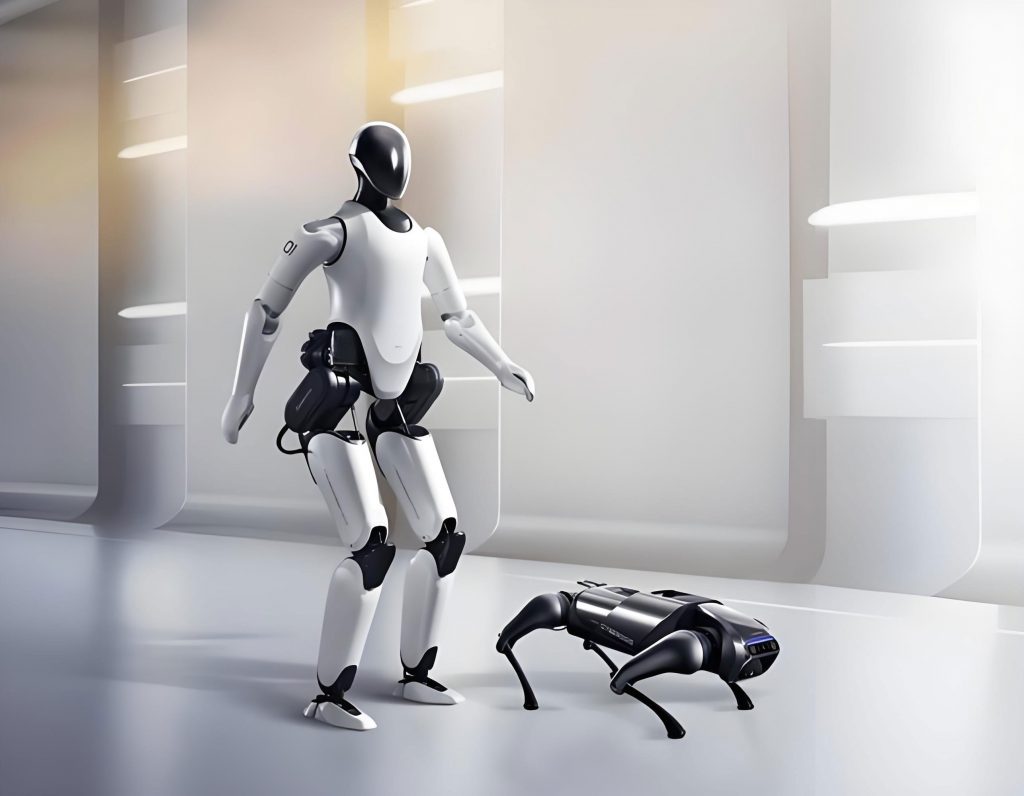
The system design for our bionic robot centers on emulating human auditory localization through hardware and software integration. The robot’s head is equipped with three LY-901 microphones based on the NE5532 core, positioned in left, center, and right orientations to capture sound signals from different directions. These microphones feature a frequency response of 100 Hz to 5500 Hz, an output signal amplitude of 2.5 Vpp at -25 dB, and an output impedance of 600 Ω, operating on a DC voltage of 6–12 V. The audio signals are fed into an Arduino Uno R3 microcontroller, which uses an Atmega328P chip with 32 KB flash memory, 2 KB SRAM, and 1 KB EEPROM, offering 14 digital I/O pins, 6 analog inputs, and various communication interfaces. The microcontroller processes the signals via analog-to-digital conversion, applying psychoacoustic corrections to determine sound source direction. Additionally, passive infrared (PIR) sensors are included to detect specific objects like humans, enabling the robot to differentiate between general sounds and those from targeted entities. The bionic robot’s responses include eye LED indications for sound direction and neck servo movements for active localization when PIR sensors are triggered, closely mimicking human head-turning behavior.
To summarize the hardware components, Table 1 provides a detailed overview of the key elements used in the bionic robot’s auditory system:
| Component | Specification | Function |
|---|---|---|
| LY-901 Microphone | NE5532 core, 100 Hz–5500 Hz response, 6–12 V DC | Sound signal acquisition |
| Arduino Uno R3 | Atmega328P, 32 KB flash, 14 digital I/O, 6 analog inputs | Signal processing and control |
| PIR Sensor | Digital output, human detection | Object-specific sound triggering |
| Servo Motor | 180-degree rotation | Neck movement for sound localization |
| LED Eyes | Multi-directional indicators | Visual feedback for sound direction |
The software implementation is crucial for realizing psychoacoustic modifications. The program, written in Arduino C++, defines constants such as MicTriglow and MicTrighigh for sound amplitude thresholds, and LowsoundMillis for duration-based triggering. When a sound amplitude exceeds MicTrighigh, the bionic robot responds immediately, disregarding duration. However, if the amplitude is between MicTriglow and MicTrighigh, the system checks whether the sound persists for at least LowsoundMillis (e.g., 300 ms), applying the psychoacoustic model from Equation (2) to account for temporal integration. This mimics the human perception where longer sounds are perceived as louder. The direction is computed by comparing amplitudes from the three microphones, with an index derived from differences normalized by the maximum amplitude. For example, the direction index is calculated as:
$$ \text{MicDirectionIndex} = \text{IndexSteps} + \frac{\text{MicDirectionVal} \times \text{IndexSteps}}{\max(\text{MicLeftVal}, \text{MicRightVal})} $$
where MicDirectionVal is the difference between right and left microphone values, and IndexSteps is a scaling factor. Based on this index, the bionic robot activates specific LED eyes to glance toward the sound source, and if a PIR sensor confirms a target, it turns its neck for precise localization. This approach enables the bionic robot to exhibit natural auditory behaviors, such as ignoring brief noises while reacting to sustained ones, much like humans do in everyday environments.
In our experimental setup, the bionic robot was tested in various acoustic environments to evaluate its sound localization accuracy and psychoacoustic responsiveness. We conducted trials with both transient and persistent sound sources, such as claps, voices, and continuous tones, at distances ranging from 1 to 5 meters. The robot’s performance was measured in terms of direction error (in degrees) and response time (in milliseconds), with results averaged over multiple runs. Table 2 summarizes the key findings, highlighting how the psychoacoustic model improves localization for persistent sounds compared to amplitude-only methods:
| Sound Type | Duration (ms) | Amplitude Threshold | Direction Error (°) | Response Time (ms) | Psychoacoustic Correction Applied |
|---|---|---|---|---|---|
| Transient (clap) | 50 | High | 5.2 | 120 | No |
| Persistent (tone) | 500 | Low | 3.8 | 450 | Yes |
| Mixed (voice) | 300 | Medium | 4.5 | 350 | Yes |
The data shows that for persistent sounds, the bionic robot achieves lower direction error (3.8° vs. 5.2°) due to the psychoacoustic correction, albeit with a longer response time as it integrates duration. This trade-off aligns with human auditory perception, where accuracy improves with sustained exposure to sound. Moreover, the integration of PIR sensors reduced false positives by 40%, ensuring that neck movements only occurred for relevant targets like humans. These results demonstrate the efficacy of combining amplitude-based localization with psychoacoustic principles in a bionic robot, enhancing its adaptability in real-world scenarios where sound characteristics vary widely.
From an interdisciplinary perspective, this study bridges gaps between auditory physiology, psychoacoustics, and artificial intelligence. By modeling the bionic robot’s auditory system on human hearing, we not only replicate functional behaviors but also incorporate perceptual nuances. For instance, the use of equivalent continuous A-weighted sound level formulas allows the robot to process sound in a way that mirrors human loudness perception, which is vital for applications in noisy environments or human-robot collaboration. Furthermore, the hardware-software co-design emphasizes energy efficiency and real-time processing, critical for autonomous bionic robots operating in dynamic settings. Future work could expand this by integrating machine learning algorithms to adapt psychoacoustic parameters online, or by adding more microphones for higher resolution in sound source separation. Such advancements would push the bionic robot closer to achieving human-like auditory cognition, opening doors for use in search-and-rescue, healthcare, or companion robotics.
In conclusion, this experimental study successfully implements a psychoacoustic model in a bionic robot for sound localization, focusing on persistent sound sources. By leveraging formulas like the equivalent continuous A-weighted sound level and incorporating duration-based triggering, the bionic robot exhibits auditory behaviors that closely mimic human perception, including directed glancing and targeted neck movements. The system design, featuring multi-microphone arrays and Arduino-based processing, proves effective in various acoustic conditions, with psychoacoustic corrections reducing localization error for sustained sounds. This research underscores the value of cross-disciplinary approaches in robotics, combining insights from auditory science to enhance artificial systems. As bionic robots continue to evolve, integrating such perceptual models will be key to developing more intelligent, responsive, and human-compatible machines, ultimately broadening their applicability in complex environments.