
The evolution of robotics has propelled machines from controlled industrial settings into complex and challenging environments, including disaster zones, battlefields, and the interface between land and water. Executing tasks in such transitional areas, particularly within amphibious contexts like shallow waters, mudflats, and beaches, presents profound challenges for robotic design. These challenges demand innovative solutions for locomotion, adaptability, and control that traditional single-environment robots cannot address. Consequently, amphibious bionic robots have emerged as a critical field of study, drawing inspiration from nature’s masters of dual-domain life.
Amphibious animals, products of millennia of natural selection, exhibit remarkable adaptability at the land-water interface. By applying principles from bionics, materials science, robotics, and control theory, researchers aim to develop machines capable of emulating this adaptability. This review synthesizes recent advancements in amphibious bionic robots, focusing on four core areas: body configurations and propulsion mechanisms, dynamic modeling of locomotion, control strategies for multi-environment operation, and an analysis of persistent challenges and future trajectories. The overarching goal is to provide a structured overview of how the field is addressing the fundamental problem of efficient and stable mobility across media with drastically different physical properties.
1. Morphological Configurations and Propulsion Mechanisms
The primary challenge in amphibious robot design lies in the effective integration or transformation of propulsion mechanisms suitable for both terrestrial and aquatic environments. Current designs are predominantly categorized by their actuation strategies, which often combine principles observed in various animals.
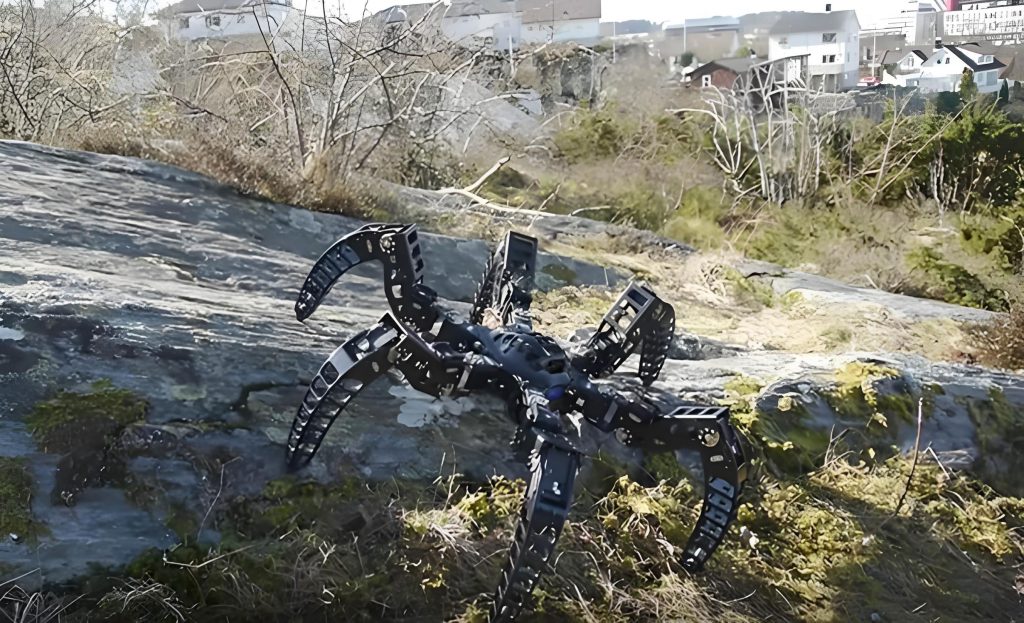
1.1 Legged Propulsion Bionic Robots
Inspired by multi-limbed creatures like crabs, lobsters, and salamanders, these bionic robots use rhythmic leg movements. Their key advantage is high adaptability to irregular terrain, as their bodies are separated from the ground. However, they often suffer from mechanical complexity, large size, and limited swimming capability, typically being confined to crawling on underwater surfaces. Early examples include the Ariel AULV for mine countermeasures and the BUR-001 robotic lobster. A notable modern example is Pleurobot, a highly articulated salamander-inspired bionic robot capable of swimming, crawling, and walking. Recent trends incorporate soft actuators, leading to robots like a pneumatic quadruped and a sea urchin-inspired robot with tubular feet, highlighting a move towards compliance and adaptability in bionic design.
1.2 Wheel-Leg/Fin Hybrid Propulsion Bionic Robots
This category seeks to merge the efficiency of wheels on land with effective aquatic propulsion. A seminal platform is the RHex series, which uses six rotating C-shaped legs for robust terrestrial locomotion. The AQUA bionic robot extended this concept by having interchangeable C-legs for land and paddles for swimming, though manual switching was required. Subsequent designs like “Ninja Legs” and the Whegs series integrated the mechanisms into transformable limbs. Significant contributions from Chinese institutes include several prototypes from Shenyang Institute of Automation, the AmphiHex-I with its deformable foot-flipper composites, and the AmphiRobot which combines pectoral fins with wheel-paddles. The FroBot bionic robot uses a unique dual swinging-leg mechanism with specialized wheels and flexible flippers for both environments.
1.3 Serpentine Propulsion Bionic Robots
Mimicking the versatile locomotion of snakes, these bionic robots use multi-segmented, articulated bodies. Their elongated, low-profile form offers good ground conformity and stability. Locomotion on land often relies on anisotropic friction or passive wheels, while in water, they generate thrust through body undulations similar to eels. Prominent examples include the ACM-R5, the AmphiBot series, the commercial “Velox” with undulating pectoral fins, and China’s “Explorer III.”
1.4 Spherical Amphibious Bionic Robots
Characterized by a sealed spherical shell enclosing all mechanisms, these bionic robots offer inherent balance, omnidirectional mobility, and excellent sealing. Motion is typically achieved by shifting the internal center of mass. Early designs like Rollo used an internal driving car, while others like GroundBot employ a pendulum mechanism. Research at Beijing University of Aeronautics and Astronautics (BHQ series) and Beijing University of Posts and Telecommunications (BYQ series) has advanced various driving principles, including vectorial water-jet propulsion from extending legs in one spherical amphibious bionic robot.
The table below summarizes the key characteristics, advantages, and disadvantages of these primary amphibious bionic robot configurations.
| Propulsion Type | Terrestrial Mode | Aquatic Mode | Key Advantages | Key Disadvantages |
|---|---|---|---|---|
| Legged | Multi-legged walking/crawling | Crawling on substrate, paddling | High terrain adaptability, good obstacle crossing | Slow speed, complex mechanics, poor free-swimming |
| Wheel-Leg/Fin Hybrid | Wheeled or C-leg rolling | Paddling, fin undulation, propeller | Good speed on land, adaptable propulsion | Mechanical complexity, control challenges, potential interference |
| Serpentine | Lateral undulation, rolling | Body/Fin undulation (angulliform) | Compact, stable, good ground conformity | Complex multi-DOF control, limited speed/payload |
| Spherical | Rolling via CoM shift | Rolling on bed, jet propulsion | Excellent sealing, no overturning, omnidirectional | Nonholonomic constraints, complex modeling, underactuation |
2. Dynamic Modeling of Amphibious Locomotion
Understanding and modeling the interaction between the bionic robot’s propulsion mechanism and the environment (ground, water, granular media) is fundamental for design optimization and model-based control.
2.1 Terrestrial Locomotion Modeling
Research falls into two main strands: biomechanical studies of biological prototypes and theoretical modeling of robotic systems.
- Biomechanics-Based Studies: These investigations measure biological motion to uncover principles. For instance, studies on snake locomotion established the importance of anisotropic skin friction (higher coefficient normal to the body than tangential), formalized by models like the Serpenoid curve. Research on lizards and turtles moving in granular media (like sand) has led to the development of models such as Resistive Force Theory (RFT) to predict forces and motion in yielding environments. RFT models the drag force on a segment moving in granular media as proportional to its velocity, with different coefficients for motion normal and tangential to the segment:
$$ d\mathbf{F} = – (C_{\perp} \mathbf{v}_{\perp} + C_{\parallel} \mathbf{v}_{\parallel}) \, dl $$
where $C_{\perp}$ and $C_{\parallel}$ are resistive coefficients, and $\mathbf{v}_{\perp}$, $\mathbf{v}_{\parallel}$ are velocity components. - Robot-Based Dynamic Modeling: This involves creating kinematics and dynamics models for specific bionic robot designs. For legged or hybrid robots, this often involves inverse kinematics for gait generation and Newton-Euler or Lagrangian dynamics to account for forces. For serpentine bionic robots, modeling is more advanced. Two primary modeling assumptions exist:
- Non-holonomic (No Side-slip) Constraint: Assumes lateral motion is prevented, often modeled using wheel-like constraints. The kinematics can be derived from the Serpenoid curve body shape.
- Anisotropic Friction Model: A more general dynamics approach uses different Coulomb friction coefficients for lateral and longitudinal directions on each link. The dynamics for a planar snake robot with $n$ links can be expressed using Lagrangian formulation with external friction forces:
$$ \mathbf{M}(\mathbf{q})\ddot{\mathbf{q}} + \mathbf{C}(\mathbf{q}, \dot{\mathbf{q}})\dot{\mathbf{q}} = \mathbf{B}\boldsymbol{\tau} + \mathbf{J}^T(\mathbf{q})\boldsymbol{\lambda}_{f} $$
where $\mathbf{q}$ are generalized coordinates, $\mathbf{M}$ is the inertia matrix, $\mathbf{C}$ accounts for Coriolis forces, $\mathbf{B}$ is the actuator mapping matrix, $\boldsymbol{\tau}$ are joint torques, and $\boldsymbol{\lambda}_{f}$ are ground friction forces dependent on anisotropic coefficients.
2.2 Aquatic Locomotion Modeling
Modeling hydrodynamics is crucial for efficient underwater propulsion in bionic robots. Approaches include mathematical theories, experimental fluid dynamics, and Computational Fluid Dynamics (CFD).
- Mathematical Theories: For bio-inspired swimming, two main theoretical frameworks exist. Reactive Force Theory emphasizes inertial effects in inviscid flow and includes:
- Elongated Body Theory (EBT): For bodies with small lateral amplitude compared to length, thrust $T$ is related to the lateral momentum shed into the wake:
$$ T \approx \frac{d}{dt} \int_{body} m(x) w(x,t) \, dx \bigg|_{tail} $$
where $m(x)$ is the virtual mass per unit length and $w(x,t)$ is the lateral velocity. - Wave Plate Theory: Models the fin/body as a deforming plate, solving the surrounding potential flow.
Resistive Force Theory, used for low Reynolds number or near-substrate swimming, models viscous drag forces similar to the terrestrial granular version but with hydrodynamic coefficients.
- Elongated Body Theory (EBT): For bodies with small lateral amplitude compared to length, thrust $T$ is related to the lateral momentum shed into the wake:
- Experimental and CFD Studies: Particle Image Velocimetry (PIV) and high-speed videography are used to measure real flow fields and kinematics. CFD simulations solve the Navier-Stokes equations numerically to analyze parameters like Strouhal number ($St = fA/U$, where $f$ is frequency, $A$ is tail amplitude, $U$ is speed), which is critical for optimizing thrust and efficiency. These studies help refine the design of fins and undulating bodies for bionic robots.
3. Motion Control Strategies in Multi-Environment Operation
Effective control is essential for a bionic robot to transition smoothly and operate robustly in both media. Common strategies are as follows.
3.1 Model-Based Control
This method relies on precise kinematic and dynamic models of the bionic robot. Controllers are designed using these models to achieve accurate trajectory tracking. For example, a serpentine bionic robot’s path can be controlled by solving inverse kinematics based on a predefined body curve. While powerful, this approach requires accurate models and can be computationally intensive for real-time control in complex, uncertain environments.
3.2 Biomimetic Morphology-Based Control
This straightforward method directly copies the periodic shape changes of animals. The joint angles $\phi_i$ of a snake-like bionic robot, for instance, are often commanded to follow a Serpenoid curve pattern:
$$ \phi_i(t) = \alpha \sin(\omega t + (i-1)\beta) + \gamma $$
where $\alpha$ is amplitude, $\omega$ is frequency, $\beta$ is phase difference between joints, and $\gamma$ is a turning offset. Similarly, fish-like bionic robots control fin rays with traveling wave equations. This method is simple to implement but offers limited adaptability and closed-loop performance.
3.3 Central Pattern Generator (CPG) Based Control
Inspired by neural circuits in vertebrates, CPGs are networks of coupled oscillators that generate rhythmic signals for locomotion. They are exceptionally suited for bionic robots due to their inherent stability, ease of gait transition, and ability to integrate sensory feedback. A common oscillator model (e.g., Hopf or Matsuoka) for each joint $i$ is:
$$ \ddot{x}_i + \omega_i^2 x_i = \epsilon \dot{x}_i (\mu – x_i^2 – \dot{x}_i^2/\omega_i^2) + \sum_{j \neq i} k_{ij} (x_j – x_i) $$
where $x_i$ is the oscillator state, $\omega_i$ the frequency, $\mu$ the amplitude, $\epsilon$ a convergence factor, and $k_{ij}$ coupling weights. High-level commands (e.g., speed, direction) modulate only a few parameters ($\omega_i$, $\mu$), inducing global gait changes. This approach has been successfully deployed on bionic robots like Pleurobot and AmphiRobot to achieve seamless walking-swimming transitions and adaptive locomotion.
The table below compares these control paradigms for amphibious bionic robots.
| Control Method | Principle | Advantages for Bionic Robot | Challenges |
|---|---|---|---|
| Model-Based | Uses explicit kinematic/dynamic models | High accuracy, enables advanced control theory | Requires precise model; computationally heavy; fragile to model uncertainty |
| Morphology-Based | Direct replication of biological motion patterns | Simple to implement, intuitive parameter tuning | Limited adaptability; poor disturbance rejection; open-loop nature |
| CPG-Based | Decentralized network of neural oscillators | Natural rhythm generation; smooth gait transitions; easy sensory integration; robust | Oscillator parameter tuning can be complex; relationship between high-level commands and gait not always explicit |
4. Key Challenges and Future Development Trends
Despite significant progress, the field of amphibious bionic robots faces several intertwined challenges that must be overcome to achieve robust, practical deployment.
4.1 Persistent Key Challenges
- Unified Propulsion Mechanism Design: Most current amphibious bionic robots use additive or switchable mechanisms, leading to complexity, weight, and control difficulties. Achieving efficient, simple, and unified propulsion across media remains a core design challenge.
- System Modeling in Complex Media: Theoretical models often simplify environmental interactions. Developing comprehensive dynamics models that accurately predict bionic robot performance in realistic, heterogeneous, and deformable substrates (e.g., mud, sand, vegetated water) is extremely difficult but essential.
- Autonomous Multi-Modal Control: Enabling a bionic robot to autonomously sense its environment and smoothly transition between optimal locomotion modes (e.g., from swimming to walking) without destabilization is a major control hurdle. This requires tight integration of perception, decision-making, and low-level gait generation.
4.2 Future Development Trends
- Innovative Hybrid and Soft Mechanisms: Future amphibious bionic robots will likely feature more tightly integrated hybrid drives and incorporate soft robotics principles. Using compliant, deformable materials and structures can enhance adaptability, improve interaction with the environment, and lead to more animal-like, robust locomotion in a bionic robot.
- Advanced Modeling and Simulation: Leveraging high-fidelity, multi-physics simulations combining granular dynamics, computational fluid dynamics (CFD), and flexible multibody dynamics will be crucial for virtual prototyping and optimizing bionic robot designs before physical realization.
- Proprioceptive and Exteroceptive Control: The next generation of amphibious bionic robots will employ sophisticated sensory fusion (inertial, force, vision, buoyancy) with intelligent controllers (e.g., deep reinforcement learning integrated with CPGs). This will allow for real-time adaptation of gait parameters and autonomous mode switching based on immediate terrain and hydrodynamic feedback, moving towards fully autonomous operation of the bionic robot.
5. Summary and Conclusion
Amphibious bionic robots represent a vibrant and challenging frontier at the intersection of robotics, biology, and engineering. This review has outlined the spectrum of morphological designs—from legged and hybrid to serpentine and spherical—each with distinct trade-offs for operating in water, on land, and in transitional zones. It has explored the dynamic modeling approaches necessary to understand locomotion physics in both terrestrial and aquatic regimes, highlighting the gap between simplified models and complex reality. Furthermore, it has compared prevalent control strategies, noting the particular promise of bio-inspired methods like CPG networks for generating robust, adaptable rhythms in a bionic robot.
The path forward is clear: breakthroughs are needed in creating simple yet highly adaptive propulsion mechanisms, developing unified dynamic theories for multi-phase environments, and implementing intelligent, sensor-driven autonomous control. As material science, fabrication techniques, and artificial intelligence continue to advance, the vision of capable, versatile amphibious bionic robots performing critical tasks in exploration, environmental monitoring, and disaster response moves closer to reality. The continued study of biological prototypes will remain an invaluable source of inspiration, guiding the evolution of these remarkable machines.