
The evolution of warfare and the increasing complexity of battlefield environments demand robotic systems with superior adaptability, resilience, and functionality. Traditional robotic platforms often struggle in unstructured terrains, highlighting a critical gap between engineering capabilities and operational needs. In this context, the natural world offers a vast repository of inspiration. Through eons of evolution, biological organisms have developed exquisitely optimized morphological structures, movement strategies, and sensory-processing mechanisms to thrive in diverse and challenging environments. The interdisciplinary field of bionic robotics seeks to harness these biological principles, translating them into engineered systems. However, the translation from biological inspiration to functional engineering design is not trivial. It requires a systematic framework that can abstract, model, and implement biological “solutions” across domains. This is where Design Morphology emerges as a critical theoretical and methodological backbone. This article explores the current state and progress of military bionic robot development through the lens of Design Morphology, analyzing how this systematic approach facilitates the creation of next-generation autonomous systems for defense applications.
Design Morphology, in its modern interpretation, transcends traditional aesthetic-focused form studies. It constitutes a systematic discipline for the architectural analysis of design domains, investigating the relationships between the components, elements, and the holistic form of an object to inspire innovation. For bionic robot design, it is the science of extracting, formalizing, and re-embodying the “morphology” of biological systems—encompassing both form (morphé, the physical structure) and principle (logos, the underlying function, behavior, and logic). The process is inherently cross-disciplinary, fusing insights from biology, engineering, materials science, neuroscience, and information science. The core challenge lies in the analogical transfer from the biological domain (source) to the engineering domain (target). A generalized process model for bio-inspired design morphology can be conceptualized as follows:
1. Biological Inspiration Sourcing: Identifying a biological organism (the “biological mentor”) possessing a desired capability relevant to the military bionic robot’s intended function (e.g., robust locomotion, efficient propulsion, adaptive sensing).
2. Abstraction and Modeling: Analyzing the biological system to abstract its key morphological principles. This involves dissecting the form-structure-behavior-function relationships and creating mathematical, kinematic, dynamic, or control models. This step transforms qualitative biological observation into quantifiable engineering parameters.
3. Analogical Transfer and Embodiment: Mapping the abstracted principles to engineering solutions. This involves selecting appropriate materials, actuators, sensors, and structural designs to physically instantiate the biological principle in the bionic robot platform.
4. Integration and Evaluation: Integrating the bionic components into a cohesive system and evaluating its performance against the desired military operational metrics (e.g., speed, payload, endurance, terrain adaptability).
This process can be symbolically represented as a mapping function:
$$ F_{des}(S_{eng}) \approx \Phi(S_{bio}) $$
where $S_{bio}$ represents the set of features/principles from the biological system, $\Phi$ is the abstraction and analogical transfer function, and $S_{eng}$ is the set of engineered features in the bionic robot, yielding the desired design function $F_{des}$.
Military bionic robots represent a specialized subset of bionic robots where the driving requirements are defined by defense needs: operating in hostile, unpredictable environments; performing reconnaissance, logistics, combat support, or Explosive Ordnance Disposal (EOD) tasks; and maintaining stealth, survivability, and reliability. The application of Design Morphology in this sector accelerates innovation by providing a structured path from biological insight to deployable military asset. The following sections review progress categorized by the primary operational domain of the bionic robot.
Terrestrial Bionic Robots
Land-based operations present challenges like rubble, slopes, stairs, and soft ground. Biological inspiration for terrestrial bionic robots is drawn from a wide range of legged, jumping, and crawling organisms.
| Biological Mentor | Morphological Principle Abstracted | Engineering Embodiment (Example Bionic Robot) | Potential Military Function |
|---|---|---|---|
| Cheetah, Dog (Quadrupeds) | Dynamic stability through compliant leg sequencing; spine flexion for stride length. | Boston Dynamics’ BigDog, Spot; MIT Cheetah. Use of hydraulic/ electric actuators with advanced control for terrain adaptation. | Logistics (mule), Reconnaissance, Sentry/Patrol. |
| Human (Biped) | Balanced upright locomotion, versatile limb use for manipulation. | Boston Dynamics’ Atlas, Honda’s ASIMO. Complex full-body dynamics control, multi-modal perception. | EOD, Infrastructure manipulation in contested areas, Combat support. |
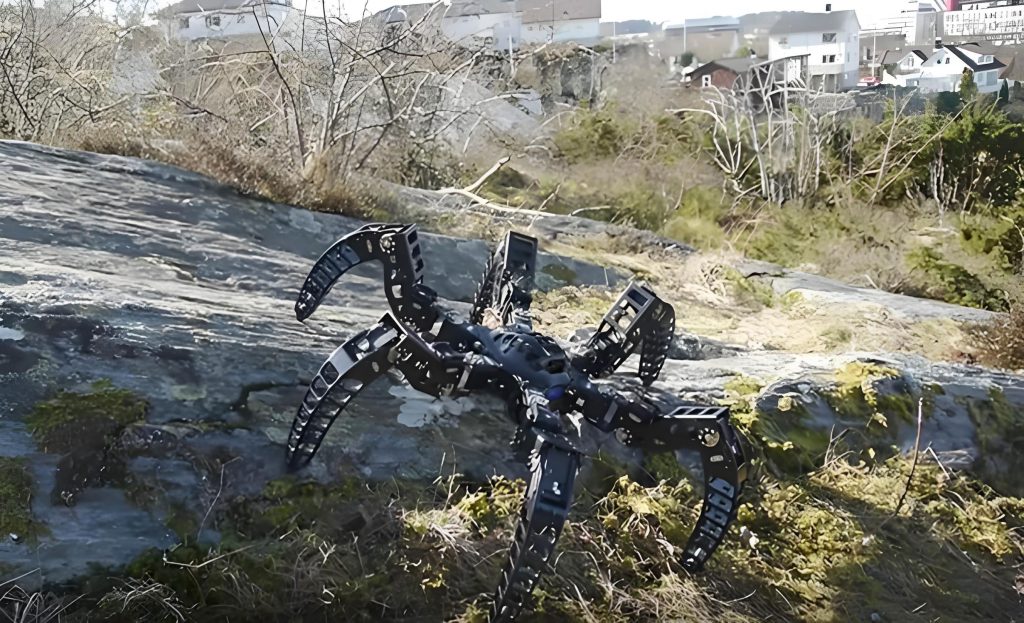
| Cockroach, Spider (Multi-legged) | Static stability with many legs, rapid scurrying via tripod gaits, distributed sensing. | Harvard’s Ambulatory MicroRobot (HAMR), Festo’s BionicANT. Small-scale, robust, collaborative behaviors. | Swarm reconnaissance within structures, payload delivery in confined spaces. |
| Kangaroo, Locust (Jumpers) | Elastic energy storage and release in tendons/springs for powerful jumps. | Festo’s BionicKangaroo, EPFL’s locust-inspired jumper. Use of pneumatic muscles or torsion springs. | Surmounting large obstacles (walls, trenches) rapidly. |
| Snake, Worm (Crawlers) | Undulatory locomotion, high degrees of freedom enabling movement through narrow, complex passages. | CMU’s Snake Robots, earthworm-inspired soft robots. Serially linked modules or pneumatic soft actuators. | Inspecting pipes/conduits, search in collapsed structures, covert surveillance. |
| Gecko, Squirrel (Climbers) | Adhesion via van der Waals forces (gecko) or claw-hook mechanisms; dynamic grasping for climbing. | Stanford’s gecko-inspired grippers and climbers, RiSE robot. Micro-structured adhesives, underactuated gripping feet. | Vertical surface reconnaissance, urban warfare, placement of sensors. |
The design morphology for a dynamic legged bionic robot, for instance, often involves analyzing the spring-mass-damper model of animal legs:
$$ F_{leg} = k(\Delta x) + c\dot{x} $$
where $F_{leg}$ is the leg force, $k$ is the stiffness, $\Delta x$ is the compression, $c$ is the damping coefficient, and $\dot{x}$ is the compression velocity. Implementing this via series elastic actuators (SEA) in robots like Spot is a direct result of this bio-inspired morphological modeling.
Aquatic Bionic Robots
Underwater missions require efficiency, maneuverability, low acoustic signature, and robustness to pressure. Fish and marine mammals provide exquisite models for propulsion and control.
| Biological Mentor | Morphological Principle Abstracted | Engineering Embodiment (Example Bionic Robot) | Potential Military Function |
|---|---|---|---|
| Tuna, Mackerel (Carangiform swimmers) | High-efficiency, high-speed propulsion via body-caudal fin (BCF) undulation; streamlined form. | RoboTuna (MIT), TunaBot (UVA). Multi-joint body driven by actuators, mimicking thunniform motion. | High-speed underwater dash, long-range reconnaissance. |
| Ray, Manta (Median/Paired fin swimmers) | Highly maneuverable and stable propulsion via large pectoral fin flapping; low turbulence. | MantaDroid (NUS), Festo’s AquaRay. Flexible pectoral fins driven by harmonic mechanisms. | Covert seabed surveys, mine detection, stable underwater observation platform. |
| Salamander, Turtle (Limbed swimmers) | Multi-modal locomotion (swimming and walking) using limb-like flippers; amphibious capability. | Salamander Robot (EPFL), U-CAT (turtle-inspired). Limb/Fin actuators with gait transition control algorithms. | Amphibious beach reconnaissance, littoral zone operations. |
| Jellyfish, Octopus (Soft-body swimmers) | Pulsatile jet propulsion or peristaltic motion; extreme deformability and resilience. | Jellyfish robots (e.g., Festo’s AquaJelly), Octopus-inspired soft robots. Dielectric elastomer actuators (DEA) or pneumatic chambers. | Close-range inspection of ship hulls, delicate underwater manipulation, robust operation in cluttered environments. |
The hydrodynamics of a flapping foil, central to many aquatic bionic robots, can be analyzed using reduced-order models. The thrust ($T$) generated by an oscillating foil can be related to its motion parameters:
$$ T \propto \rho f^2 A^2 C_T(\theta, Re, St) $$
where $\rho$ is fluid density, $f$ is flapping frequency, $A$ is the amplitude of motion, and $C_T$ is a thrust coefficient dependent on pitch angle $\theta$, Reynolds number $Re$, and Strouhal number $St$. Optimizing these parameters based on biological observation is a key task in the morphological design process for such bionic robots.
Aerial/Space Bionic Robots
Aerial platforms benefit from bio-inspired designs offering agility, hovering capability, and efficiency in confined spaces, crucial for urban or indoor military operations.
| Biological Mentor | Morphological Principle Abstracted | Engineering Embodiment (Example Bionic Robot) | Potential Military Function |
|---|---|---|---|
| Insect (Fly, Bee) | Exceptional maneuverability and hovering via high-frequency wing flapping; clap-and-fling mechanism for lift. | RoboBee (Harvard), DelFly (TU Delft). Piezoelectric or electromagnetic actuators driving ultra-lightweight wings. | Micro-scale indoor reconnaissance, swarm operations for mapping, payload delivery. |
| Hummingbird | Sustained hovering and agile flight via complex wing kinematics (pitching, sweeping, pronation/supination). | AeroVironment’s Nano Hummingbird. Complex transmission systems to replicate figure-eight wingstroke. | Stealthy close-range surveillance, station-keeping for observation. |
| Bird (Seagull, Pigeon) | Efficient gliding and soaring; adaptive wing morphing (span, sweep, camber) for flight control. | Festo’s SmartBird, PigeonBot (Stanford). Mechanisms for active wing articulation using artificial feathers and joints. | Long-endurance surveillance, efficient long-range deployment, perching for persistent monitoring. |
| Maple Seed (Samara) | Passive autorotative descent for stability and dispersion. | Samara-inspired mono-wing micro air vehicles. Simple, single-wing rotating design. | Low-cost, disposable sensor deployment over wide areas. |
The aerodynamics of flapping wings for a micro bionic robot involves unsteady flow mechanisms. A simplified quasi-steady model often used in initial design estimates the average lift ($\bar{L}$) as:
$$ \bar{L} = \frac{1}{2} \rho C_L(\alpha) \bar{U}^2 S $$
where $C_L$ is the lift coefficient (a function of effective angle of attack $\alpha$), $\bar{U}$ is the average wingtip velocity, and $S$ is the wing area. The Design Morphology process involves tuning wing shape (aspect ratio, camber), kinematics (stroke plane, angle of attack profile), and frequency to maximize lift-to-power ratio, directly inspired by insect flight studies.
Challenges and Future Trajectories in Design Morphology for Bionic Robots
Despite significant progress, several challenges persist at the frontier of Design Morphology for military bionic robots.
1. Holistic System Integration vs. Component Mimicry: Many current bionic robots successfully mimic an isolated biological feature (e.g., a gait, a wingstroke) but fall short of replicating the integrated, tightly coupled sensing-actuation-control intelligence of their biological counterparts. The future lies in holistic morphological integration—designing the body (materials, structure), brain (control algorithms, learning), and interaction modalities as a unified system. This includes embodied intelligence, where control is distributed and morphological computation (using the body’s physical properties to simplify control) plays a larger role.
2. Multi-Functional and Adaptive Morphology: Biological organisms excel at multi-functionality (a limb for walking, grasping, and swimming) and adaptation (changing stiffness, shape, or gait). Next-generation military bionic robots will require similar capabilities. This drives research into:
– Variable Stiffness Actuators (VSAs) and Soft Robotics: To safely interact with environments and absorb impacts.
– Shape-Morphing Structures: Wings that change area and camber, bodies that elongate or compress for different terrains.
– Multi-Modal Locomotion: A single bionic robot capable of flying, perching, walking, and swimming, inspired by animals like waterfowl or flying fish. The design challenge is creating a unified morphological framework that enables these transformations without excessive weight or complexity penalty. A performance metric for such adaptability could be formulated as:
$$ A_{robot} = \frac{\sum_{i=1}^{N} P_i(M_i)}{\Gamma(W, C)} $$
where $A_{robot}$ is the adaptability index, $P_i$ is the performance in mode $i$, $M_i$ is the morphological configuration for mode $i$, $W$ is weight, $C$ is control complexity, and $\Gamma$ is a penalty function. The goal of Design Morphology is to maximize $A_{robot}$.
3. Energy Autonomy and Efficiency: The energy density of batteries remains a primary constraint. Future morphological design must prioritize energetic efficiency from the ground up, drawing inspiration from the metabolic efficiency of animals. This includes:
– Passive dynamic walking/running mechanisms that minimize active control energy.
– Energy harvesting and storage within the structure (e.g., elastic elements).
– Morphological designs optimized for specific duty cycles (e.g., burst speed vs. endurance cruising).
4. Swarm Intelligence and Collaborative Morphologies: The military potential of large numbers of simple, inexpensive bionic robots operating as a collective is immense. Design Morphology here extends from the individual agent’s form to the “morphology” of the swarm. This involves:
– Designing individual bionic robot morphology for swarm-specific functions (communication relay, sensor node, active actuator).
– Developing physical interaction mechanisms (docking, linking) to form ad-hoc macro-structures (bridges, barriers, climbing scaffolds), inspired by ants or bees.
– Creating control paradigms where desired collective behavior emerges from simple local rules and interactions, a morphological principle of distributed systems.
5. Cross-Domain Knowledge Formalization and AI-Augmented Design: A major bottleneck is the efficient sourcing and formalization of biological knowledge for engineering use. Future trends point towards:
– Large-scale, structured biological databases tagged for engineering-relevant morphological features.
– AI and machine learning models trained on biological and engineering data to suggest novel bio-inspired design concepts, perform analogical mapping, and even optimize morphological parameters. This transforms Design Morphology into a more predictive science, where computational tools actively participate in the creative synthesis of new bionic robot forms.
Conclusion
Design Morphology provides the essential systematic framework for advancing the field of military bionic robots. By moving beyond superficial imitation to a deep analysis of form-function-behavior principles in biology, it enables the principled transfer of nature’s solutions to engineering challenges. As reviewed, this approach has yielded significant innovations across terrestrial, aquatic, and aerial domains, producing bionic robots with remarkable capabilities for defense applications. The future trajectory of this field is directed towards more integrated, adaptive, energy-efficient, and intelligent systems, often operating in collaborative swarms. Overcoming the existing challenges will require even tighter fusion of biology, engineering, materials science, and computer science. In this endeavor, Design Morphology will evolve from a descriptive and analytical tool into a generative, AI-augmented partner in the creative process, fundamentally accelerating the development of the next generation of military bionic robots and redefining the possibilities for autonomous systems in defense and security.