
As I reflect on the rapid transformations in the global technology landscape, I am struck by the monumental strides China has made in electronics and robotics. From attending industry conferences to analyzing market reports, I have witnessed firsthand how these sectors are reshaping economies and societies. In this article, I will delve into the key developments, using data-driven insights, tables, and formulas to elucidate the trends. My focus will frequently return to the concept of “China robot,” as this domain exemplifies the nation’s drive toward innovation and industrial prowess.
The electronics industry in China has long been a cornerstone of its economic growth. Recent data from top-tier enterprises highlights a trajectory of expansion and refinement. For instance, the collective performance of leading firms reveals significant scales, with revenues soaring and profitability enhancing. To encapsulate this, consider the following table summarizing key metrics from the premier electronics companies:
| Metric | Value (in trillions of CNY, unless noted) | Growth Rate (compared to previous period) |
|---|---|---|
| Total Main Business Revenue | 2.2 | 12.4% |
| Total Profit | 0.1194 | 40%+ |
| Total Assets | 2.3 | 15% |
| R&D Investment | 0.1051 | 5.7% |
| Number of Patents (in thousands) | 157 | Increase of 24 |
This table illustrates not only the sheer size but also the improving efficiency and innovation capacity. The sales profit margin, for example, can be expressed mathematically. If we denote total revenue as \( R \) and total profit as \( P \), the sales profit margin \( M \) is given by:
$$ M = \frac{P}{R} \times 100\% $$
For these enterprises, \( M \approx 5.4\% \), which is a full percentage point above the industry average, indicating superior operational effectiveness. Moreover, the asset turnover ratio, a measure of how efficiently assets are used to generate revenue, is calculated as:
$$ \text{Asset Turnover} = \frac{R}{\text{Total Assets}} $$
With values around 0.9, it reflects robust management practices. Such metrics underscore the maturation of China’s electronics sector, setting a foundation for ventures into advanced fields like robotics.
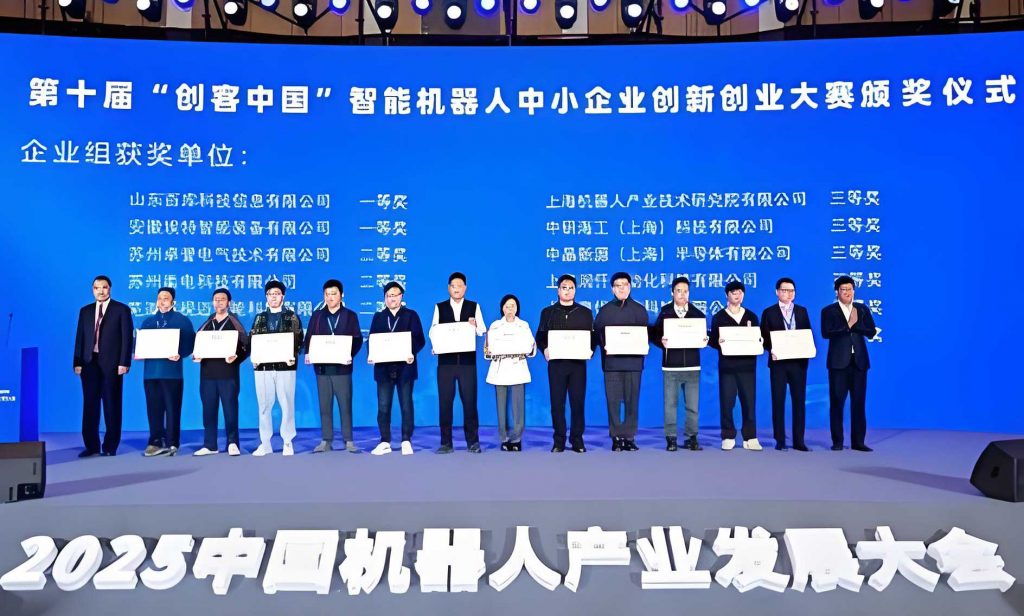
Transitioning to the robotics arena, the term “China robot” has become synonymous with rapid adoption and ambitious planning. I recall discussions at forums where experts projected exponential growth, driven by policy support and market demand. The government’s initiatives, such as the “13th Five-Year Plan,” aim to cultivate a competitive robotics ecosystem. Specifically, targets include establishing 3 to 5 internationally leading enterprises and 8 to 10 industrial clusters by 2020. This vision for “China robot” is not just aspirational; it is backed by tangible actions, like funding for automation in sectors like automotive and aerospace.
The growth trajectory of “China robot” can be modeled using a compound annual growth rate (CAGR) formula. If the market size \( S \) grows at a rate \( r \) over time \( t \), the future size \( S_f \) from an initial size \( S_i \) is:
$$ S_f = S_i \times (1 + r)^t $$
Given that the “China robot” market is expected to maintain a growth rate of at least 30% annually for the next three decades, we can project its expansion. For instance, if the current market size is normalized to 1 unit, after 30 years, it would be:
$$ S_f = 1 \times (1 + 0.30)^{30} \approx 1 \times 1.30^{30} $$
Calculating this yields approximately 261.99 units, showcasing the massive potential. This aligns with observations that China has become the world’s largest robotics market, absorbing a significant portion of global production. The integration of “China robot” into traditional industries is accelerating, driven by needs for efficiency and precision.
To further dissect the interplay between electronics and robotics, consider the innovation outputs. The electronics firms are pivotal in supplying components like sensors, chips, and software that empower robotics systems. Their R&D investments, as shown in the table, fuel advancements that benefit “China robot” development. For example, the number of patents, especially inventions, indicates a growing intellectual property base. We can quantify innovation intensity using the R&D-to-revenue ratio:
$$ \text{R&D Intensity} = \frac{\text{R&D Investment}}{\text{Revenue}} \times 100\% $$
In the electronics sector, this intensity stands at 4.8%, significantly higher than the industry average, demonstrating a commitment to technological progress that spills over into robotics.
The convergence of manufacturing, software, and services is another critical trend. In my analysis, I see “China robot” initiatives leveraging this fusion to create smart factories and automated solutions. This can be expressed through a synergy equation, where the overall output \( O \) from integrated systems exceeds the sum of individual contributions from hardware \( H \), software \( S_w \), and services \( S_v \):
$$ O = \alpha H + \beta S_w + \gamma S_v + \delta (H \cdot S_w \cdot S_v) $$
Here, \( \alpha, \beta, \gamma \) are coefficients representing the base efficiencies, and \( \delta \) captures the multiplicative effect of integration. In practice, this means that “China robot” deployments in sectors like electronics manufacturing yield higher productivity gains.
Moreover, the global context cannot be ignored. As China advances its “China robot” capabilities, it faces challenges such as technological dependencies and international competition. However, the domestic market scale provides a buffer and a testing ground. To illustrate market share dynamics, we can use a Herfindahl-Hirschman Index (HHI) formula to assess concentration in the robotics industry:
$$ \text{HHI} = \sum_{i=1}^{N} s_i^2 $$
where \( s_i \) is the market share of firm \( i \). With goals to nurture multiple leading enterprises, the “China robot” sector may evolve toward moderate concentration, fostering competition while achieving scale.
In terms of economic impact, the contribution of electronics and robotics to GDP can be modeled. If we denote the value-added \( V \) from these sectors, and total GDP as \( G \), the share \( \sigma \) is:
$$ \sigma = \frac{V}{G} \times 100\% $$
Current estimates suggest this share is rising, driven by exports and domestic adoption of “China robot” solutions. The export dimension is particularly noteworthy; electronics and robotics products from China are gaining global traction. For instance, the export delivery value for top electronics firms is substantial, and similar trends are emerging for “China robot” exports, albeit from a smaller base.
Looking ahead, the synergy between artificial intelligence (AI) and robotics will redefine “China robot” applications. AI algorithms enhance robot autonomy and adaptability, leading to smarter systems. This can be encapsulated in a learning curve model, where the cost \( C \) of robot deployment decreases with cumulative production \( Q \):
$$ C = C_0 \cdot Q^{-b} $$
Here, \( C_0 \) is the initial cost, and \( b \) is the learning rate. As “China robot” production scales, costs may decline, accelerating adoption across industries like healthcare, logistics, and agriculture. My observations suggest that Chinese firms are investing heavily in AI-driven robotics, positioning themselves at the forefront of this revolution.
To provide a comprehensive view, let’s examine another table that contrasts key indicators for the electronics and robotics sectors in China:
| Sector | Annual Growth Rate (Projected) | Market Size (Estimated, in billions USD) | Primary Drivers |
|---|---|---|---|
| Electronics (Overall) | 10-15% | 1500+ | Consumer demand, innovation, exports |
| Robotics (“China Robot”) | 30%+ | 50+ (and rising rapidly) | Automation needs, policy support, tech integration |
This table underscores the dynamism of “China robot” relative to the broader electronics landscape. The higher growth rate reflects its nascent stage and vast potential. In my discussions with industry peers, we often emphasize that “China robot” is not just about industrial machines; it encompasses service robots, collaborative robots (cobots), and specialized systems for diverse applications.
The innovation ecosystem supporting “China robot” is bolstered by academic research, venture capital, and government grants. Patent data reveals a surge in robotics-related filings, with many focused on areas like machine vision and control systems. We can model innovation diffusion using the Bass diffusion model, which predicts adoption over time:
$$ N(t) = \frac{m(1 – e^{-(p+q)t})}{1 + \frac{q}{p} e^{-(p+q)t}} $$
where \( N(t) \) is the cumulative number of adopters by time \( t \), \( m \) is the market potential, \( p \) is the coefficient of innovation, and \( q \) is the coefficient of imitation. For “China robot,” both \( p \) and \( q \) are likely high, given proactive policies and network effects in industrial clusters.
Furthermore, the role of standards cannot be overlooked. China is increasingly participating in international standard-setting for technologies like IoT and cloud computing, which underpin “China robot” systems. This enhances compatibility and global competitiveness. In financial terms, the return on investment (ROI) for robotics deployments can be calculated as:
$$ \text{ROI} = \frac{\text{Net Benefits} – \text{Costs}}{\text{Costs}} \times 100\% $$
Case studies in automotive and electronics manufacturing show ROI figures exceeding 20% within a few years, incentivizing further investment in “China robot” solutions.
As I ponder the future, I believe that sustainability will become integral to “China robot” development. Energy-efficient designs and circular economy principles are gaining traction. We can express this through an environmental impact equation, where the total carbon footprint \( F \) of robot production and operation is:
$$ F = \sum_{i} e_i \cdot c_i $$
with \( e_i \) as energy consumption per component and \( c_i \) as carbon intensity. Innovations in materials and power management aim to minimize \( F \), aligning with global green initiatives.
In conclusion, the interplay between China’s electronics prowess and its burgeoning robotics sector—epitomized by “China robot”—is shaping a new industrial paradigm. Through data analysis and mathematical modeling, we see patterns of growth, integration, and innovation that promise to propel China to leadership in high-tech domains. The journey involves challenges, but the momentum is undeniable. As I continue to monitor these trends, I am optimistic about the transformative potential of “China robot” in driving economic and social progress.
To reinforce this, let’s consider a final formula that captures the holistic growth of “China robot” within the electronics ecosystem. If we define a composite index \( I \) that combines factors like market size \( M_s \), innovation output \( I_o \), and policy support \( P_s \), we might have:
$$ I = w_1 \cdot \ln(M_s) + w_2 \cdot I_o + w_3 \cdot P_s $$
where \( w_1, w_2, w_3 \) are weights reflecting relative importance. Over time, \( I \) shows an upward trend, signaling robust development. This encapsulates my firsthand observations and analyses, highlighting why “China robot” remains a focal point in global technology discourse.