
A curriculum reform study from Xi’an Innovation College of Yan’an University examines how humanoid robot technology can be integrated into the teaching of Digital Electronics, a core foundation course for electronic information majors. The study, authored by Wang Haijun, Wang Peixue, and Liu Yuyu, argues that humanoid robot technology offers a powerful bridge between abstract digital concepts and visible, applied engineering problems. By embedding humanoid robot cases, projects, simulation tasks, and revised assessment methods into the course, the reform seeks to strengthen students’ practical ability, innovation awareness, and interdisciplinary understanding. The study reports improvements in student performance, project quality, and learning interest, while also identifying persistent challenges such as limited hardware resources and uneven student preparation. The reform positions humanoid robot technology not as a distant research topic but as a concrete teaching vehicle for digital electronics, logic circuits, microcontrollers, sensors, and signal processing.
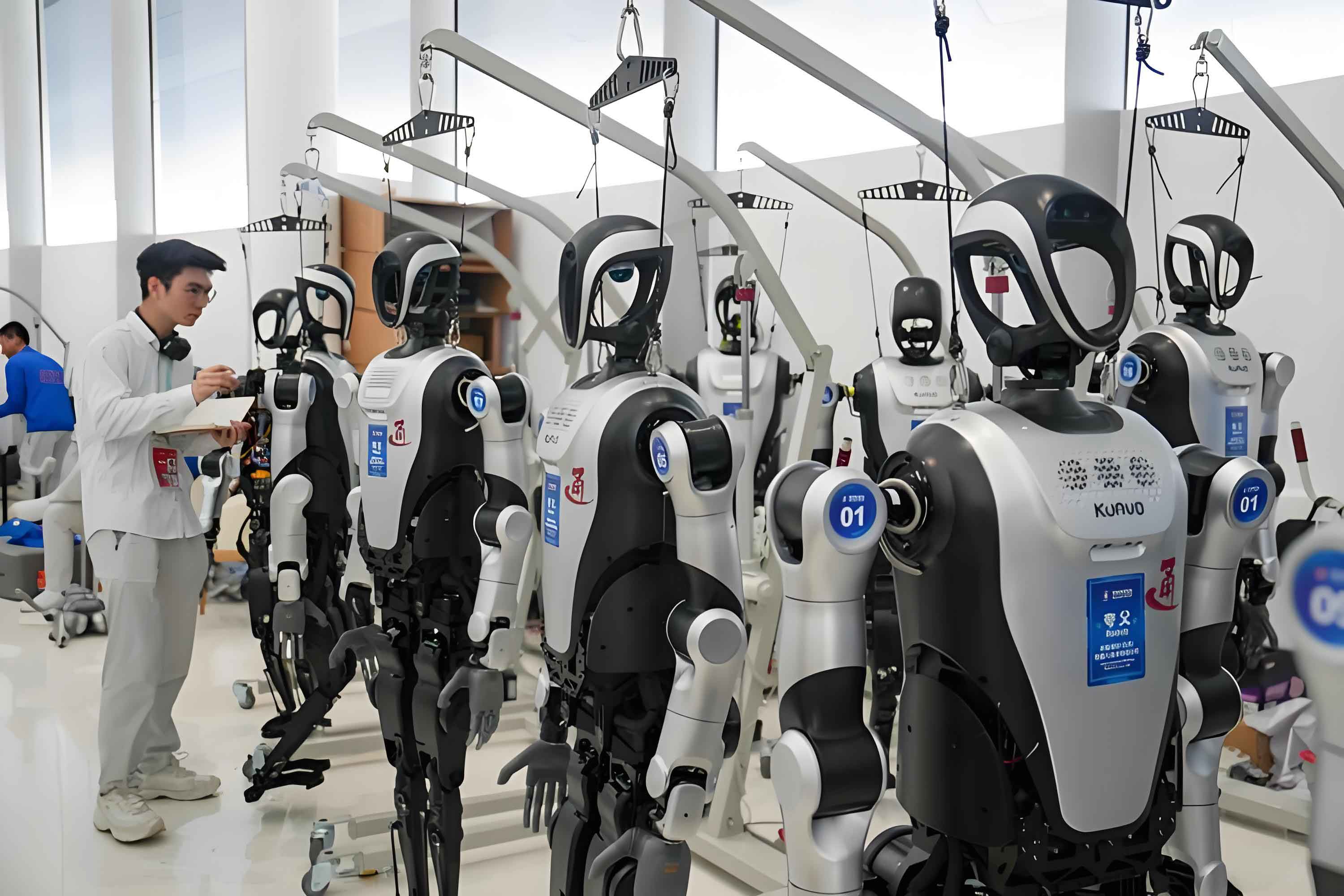
- Overview: Why Humanoid Robot Technology Matters in Digital Electronics Education
In an era of rapid technological development, humanoid robot technology has emerged as a highly forward-looking field. It brings together mechanical engineering, electronic information technology, computer science, and other disciplines into a single system that displays advanced intelligence and human-like behavior. Humanoid robot technology is not simply a collection of independent parts. It depends on coordinated hardware, software, sensing, decision-making, and actuation. As a foundational core course for electronic information majors, Digital Electronics provides essential theoretical and practical support for many high-technology fields. The study argues that integrating humanoid robot technology into Digital Electronics has strong practical teaching value and theoretical guidance significance.
On one hand, humanoid robot technology can make abstract and difficult digital electronics knowledge more vivid. Concepts such as logic gates, combinational circuits, sequential circuits, counters, registers, microcontrollers, and analog-to-digital conversion can be connected to real applications in humanoid robot systems. When students see how digital electronics enables a humanoid robot to sense, decide, and act, the subject becomes more than a set of formulas and circuit diagrams. It becomes a living engineering discipline. This connection can greatly stimulate learning interest and curiosity. On the other hand, the integration supports the cultivation of compound talent. Graduates who understand digital electronics principles and can apply them to humanoid robot development, maintenance, and testing are better aligned with industrial upgrading and the demand for diversified technical skills. The study also notes that this direction matches the applied talent training goal of Xi’an Innovation College of Yan’an University.
Internationally, universities and research institutions began exploring interdisciplinary education earlier. Some institutions have tried to integrate humanoid robot projects into electronic engineering courses. These efforts often use practice-oriented teaching and allow students to participate in the robot development process. However, the study observes that systematic integration of course knowledge still has room for improvement. In China, attention to combining frontier technology with foundation courses has increased in recent years, and many universities have carried out similar teaching reform experiments. Yet most reform practices focus on robot competition coaching. They have not deeply penetrated regular course teaching. Teaching method innovation, assessment system adaptation, and routine curriculum integration remain areas that need further exploration. The proposed reform therefore aims to move humanoid robot technology from occasional competition activity into the daily structure of Digital Electronics learning.
- The Technical Connection Between Humanoid Robot Systems and Digital Electronics
The study explains that the hardware system of a humanoid robot is like its physical body. It includes a precise mechanical skeleton, a rich variety of sensors, and efficient actuators. The sensor system may include vision, hearing, touch, and other sensing functions. The actuators include motors, servos, and related drive components. For these hardware devices to be driven accurately, controlled in a coordinated way, and operated smoothly, digital electronics plays an important role. From the software perspective, a humanoid robot includes a robot operating system, motion control algorithms, intelligent decision programs, and other key elements. At the底层 level, digital signal processing, complex logic operations, and data storage and reading all depend on digital electronics. The word “底层” is not used in the English news report; the meaning is that foundational digital operations support higher-level robot functions.
- Vision sensing and analog-to-digital conversion: A vision sensor collects large amounts of image data. These data must pass through digital circuits for high-speed sampling, quantization, and encoding. They are then converted into digital signals that later algorithms can analyze and recognize. This analog-to-digital conversion helps a humanoid robot perceive and understand its environment.
- Motion control and actuation: A microcontroller unit, or MCU, uses a preset motion trajectory algorithm to generate precise pulse signal sequences. These signals drive motors and servos at expected speeds and angles. The result is smooth and natural limb movement in a humanoid robot.
- Perception processing: The sensor system continuously sends large amounts of data. Digital electronics supports filtering, screening, and identification of useful information. This helps a humanoid robot judge its environment in real time.
- Decision logic: In the core decision system, intelligent logic modules built from digital logic circuits combine with perception information to make decisions. These decisions guide the next actions of the humanoid robot.
In this way, Digital Electronics is not an isolated course. It is deeply connected to the sensing, thinking, and acting loop of a humanoid robot. The study emphasizes that digital electronics appears in key links of humanoid robot operation, including signal acquisition, data processing, control signal generation, and logic decision-making. For students, understanding this connection can transform humanoid robot technology from a fascinating but distant topic into a visible application of the course content.
- Problems in Current Digital Electronics Teaching
The study identifies several long-standing problems in the current teaching of Digital Electronics. These problems limit the ability of the course to cultivate applied ability and innovation. The first problem is the disconnect between teaching content and practical application. The course emphasizes theoretical knowledge, and its theoretical system is complete. However, laboratory teaching is often limited to verification experiments at the circuit-building level. Students find it difficult to connect classroom knowledge with complex and changing real-world application scenarios. As a result, teaching content and practical application remain separated. Humanoid robot technology can provide a missing link, but only if it is integrated systematically rather than added as an isolated demonstration.
The second problem is the single teaching method. Traditional instruction in Digital Electronics is mainly teacher-centered. Even when some teaching reforms adopt online and offline blended models, the reform is often limited to theory. Students remain in a passive listening state. Blackboard work, presentation slides, and auxiliary videos can clearly present theoretical derivation, but students lack opportunities for independent exploration. When facing a frontier application field such as humanoid robot technology, which is highly interesting and requires strong practice, a single lecture method can easily cool student enthusiasm. It is difficult to motivate students to actively explore the application potential contained in digital electronics. Teaching effectiveness remains limited.
The third problem is the incomplete assessment method. The existing assessment system for Digital Electronics focuses on theoretical knowledge. A final closed-book examination usually occupies a dominant position, supplemented by attendance, regular performance, and laboratory scores. Subjective questions generally revolve around concepts, circuit analysis, small circuit design, and simple circuit calculation. They rarely involve deep analysis of practical project cases such as humanoid robot systems or practical operation assessment. Students tend to memorize theoretical knowledge. They neglect the cultivation of knowledge application and innovative thinking, as well as the ability to connect what they learn with frontier technology. After graduation, they find it difficult to adapt to real combat needs. The study argues that assessment reform must accompany content and method reform; otherwise, students will continue to optimize for examinations rather than for engineering capability.
- Reform Goals and Guiding Principles
The teaching reform aims to break old patterns and reshape the teaching model of Digital Electronics. It seeks to help students deeply master the digital electronics knowledge and skills required by humanoid robot technology. Through project practice, the reform aims to comprehensively train students’ hands-on operation ability. It also seeks to cultivate students’ ability to use digital electronics to solve complex engineering problems in humanoid robot systems. Examples include optimizing robot motion control circuit architectures and significantly improving the efficiency of perception data processing. At the same time, the reform attaches importance to igniting innovative thinking and cultivating teamwork spirit. These qualities help students face future challenges brought by the iterative updating of humanoid robot technology. The ultimate goal is to continuously supply high-quality talent for the development of related industries.
- Close integration of theory and practice: Course knowledge instruction and humanoid robot project practice should advance together. Students should understand why theory guides practice and why practice supports deeper understanding of theory. This creates a positive cycle of learning by doing and doing by learning.
- Application-oriented learning: The reform uses humanoid robot applications as a guiding thread. Knowledge points are arranged according to application order and teaching logic, helping students build a coherent knowledge system.
- Student-centered development: The reform emphasizes independent exploration, group cooperation, project responsibility, and iterative improvement. The teacher becomes a guide and facilitator rather than the only source of knowledge.
- Assessment for comprehensive growth: Evaluation should measure not only memory and calculation but also practice, project outcomes, teamwork, communication, and documentation.
The study presents these principles as a response to the problems of disconnection, passive learning, and narrow assessment. The humanoid robot is used as a shared context that connects multiple digital electronics topics into a meaningful whole. Instead of studying combinational logic, sequential logic, microcontrollers, and sensors as separate islands, students encounter them as parts of a humanoid robot’s perception-decision-execution loop.
- Teaching Reform Strategies Driven by Humanoid Robot Applications
The study proposes a set of reform strategies covering content optimization, teaching method innovation, and assessment improvement. These strategies are designed to work together. Content provides the humanoid robot context. Methods provide active learning pathways. Assessment provides feedback and incentives. The reform is not simply a matter of adding humanoid robot videos or occasional demonstrations. It requires reorganizing knowledge, redesigning activities, and aligning evaluation with applied ability.
- Optimizing teaching content with humanoid robot cases: At the beginning of the course, the reform suggests showing hot application videos of humanoid robots. The study mentions the 2025 Spring Festival Gala performance by Hangzhou Unitree Technology robots, where the humanoid robot dance performance created a striking scene. Rescue and emergency simulation scenes are also suggested. These can capture student attention and stimulate strong curiosity about the digital electronics behind the scenes. When teaching combinational logic circuits, the reform introduces a humanoid robot hand motion control case. It analyzes how logic gates can be used to design circuits that convert finger grasping commands. In the sequential logic circuit section, robot walking gait control is used as a vivid example. Counters and registers are explained through their key role in generating periodic control signals. In this way, abstract circuit knowledge corresponds directly to humanoid robot actions, greatly reducing the difficulty of understanding.
- Integrating course knowledge points: The reform attempts to break the limitations of traditional textbook chapters. It constructs a new knowledge reception system guided by applications. Using humanoid robot technology applications as the main line, it sets teaching order according to the smooth workflow of perception, decision, and execution. Relevant knowledge points are taught step by step according to application order and teaching rules. This also helps students build a knowledge system. For example, sensor interface circuit design, digital signal processing algorithms, and microcontroller programming are organically integrated. Students are guided to build a complete robot information acquisition, processing, and response knowledge chain. They can understand how digital electronics cooperates in each link to produce intelligent humanoid robot operation. This improves comprehensive application ability and strengthens the knowledge system.
- Project-driven teaching: The reform designs a series of practical projects covering different functional modules of a humanoid robot. Examples include a simple humanoid robot facial expression control system and an autonomous obstacle avoidance mobile platform that gives the robot the ability to move through complex environments. Students are scientifically grouped. Each group takes responsibility for one project. They are responsible for the entire process from project requirement analysis, scheme design, circuit building, to debugging and optimization.
- Virtual simulation teaching: Teachers make use of professional simulation software such as Proteus, Multisim, and MATLAB. These tools create a near-real virtual working scene for a humanoid robot. Students can freely design and boldly test digital electronic circuits in the virtual environment. They simulate robot motion control and perception feedback processes. They are free from concerns about hardware damage and component shortage. They can repeatedly debug and optimize circuit parameters and pursue continuous improvement. For example, when simulating a humanoid robot visual tracking system digital circuit, students can continuously change input image features and flexibly adjust circuit parameters. They observe the output tracking effect and intuitively feel how circuit performance changes affect results. This greatly improves design ability and effectively reduces teaching cost, while improving teaching safety and repeatability.
- Group cooperative learning: Students are grouped scientifically according to ability differences, personality, initiative, and organizational ability. Each group is controlled at four to six members. Group members must have clear division of labor and close cooperation. For example, some are responsible for hardware building, some for software programming, some for document organization and recording project growth, and some for testing and optimization. They regularly exchange progress and solve problems together. In a humanoid robot music performance project, students good at circuit design focus on making the instrument sound circuit. Students skilled in programming carefully write the music playback program. Through cooperation, they complete a wonderful robot performance. This process cultivates teamwork and communication ability, promotes knowledge sharing, and pushes overall learning effectiveness to a new height.
The study presents these strategies as mutually reinforcing. Humanoid robot cases make content relevant. Project-driven learning makes students responsible for outcomes. Virtual simulation removes some physical constraints. Group cooperation mirrors real engineering practice. Together, they aim to transform Digital Electronics from a lecture-heavy course into an applied learning environment.
- Assessment Reform and Process Evaluation
The reform abandons the dominant model of a single theoretical examination. It builds a diversified assessment system that includes theoretical knowledge, practical ability, project outcomes, and teamwork. The study provides specific weight ranges. Theoretical knowledge accounts for thirty to forty percent. Practical ability accounts for thirty to forty percent. Project outcomes account for ten to twenty percent. Teamwork accounts for ten to twenty percent. In theoretical knowledge assessment, humanoid robot application context questions can be included so that students apply what they learn. Practical ability is strictly assessed through experimental operations and project defense. Project outcomes are scored according to key dimensions such as project innovation, functional completeness, and stability. Teamwork focuses on reasonable division of labor, effective communication, and collaborative problem solving. This provides a comprehensive and objective evaluation of student learning outcomes and allows assessment results to reflect student growth.
Assessment component Weight range Focus in the humanoid robot integrated course Theoretical knowledge 30%-40% Digital electronics concepts, logic circuits, and application-context questions connected to humanoid robot systems Practical ability 30%-40% Experimental operation, circuit building, debugging, and project defense related to humanoid robot functions Project outcomes 10%-20% Innovation, functional completeness, and stability of humanoid robot module projects Teamwork 10%-20% Division of labor, communication, and collaborative problem solving in humanoid robot group work The reform also strengthens process evaluation. Classroom performance accounts for ten to twenty percent. Project progress accounts for thirty to forty percent. Laboratory reports account for thirty to forty percent. These are fully included in the process evaluation category. The purpose is to examine participation, hands-on initiative, writing, and documentation. It reflects active learning, active practice, and comprehensive abilities such as document writing and formatting. In class, students are encouraged to ask questions and participate in discussions, and their contributions are recorded. Project progress is checked regularly, and problems are fed back in time. Laboratory reports require detailed records of experimental purposes, steps, problems, and solutions. This helps students develop the habit of recording their learning process.
By combining diversified indicators and process evaluation, the reform attempts to align assessment with the humanoid robot integrated curriculum. Students are not only asked whether they can solve a circuit problem. They are also asked whether they can collaborate, build, simulate, debug, document, present, and improve a humanoid robot related project. This broader assessment model supports the goal of cultivating applied and innovative talent.
- Practical Case Analysis: Experimental Group and Control Group
The study selects two classes in an electronic information major. One class is set as the experimental group and implements the reform plan. The other class is used as the control group and follows traditional teaching. This allows comparison. In the experimental group, the teaching process begins with a humanoid robot popular science lecture. The study describes this as a knowledge lighthouse that lights the fire of student interest. In the middle stage, students are carefully grouped according to their strengths, and project-driven teaching is implemented. Virtual simulation software is provided to assist practice. Regular project reports share experience and disclose problems. In the later stage, a project achievement exhibition and defense meeting are organized. Diversified assessment and process evaluation run through the whole process. The control group follows the inherent order of textbook chapters. It mainly uses teacher lectures and simple verification experiments. It adopts traditional assessment.
Dimension Experimental group using humanoid robot integrated reform Control group using traditional teaching Opening stage Humanoid robot popular science lecture to build interest and context Textbook chapter sequence and teacher-led introduction Learning organization Project-driven grouping, virtual simulation, regular project reports Teacher lectures and simple verification experiments Final activity Project achievement exhibition and defense Traditional review and final examination Assessment Diversified indicators and process evaluation Traditional theoretical assessment Reported result Final examination average nearly 10 points higher than control group Lower final examination average than experimental group Reported project outcome Stronger innovation, such as a more intelligent humanoid robot gesture recognition system Less evidence of similar innovation reported Reported learning interest More than 80% of students interested in the course Approximately 25% interested in the course After one semester of teaching practice, the study compares final examination scores, project completion, and learning interest survey results. The experimental group’s final examination average score is nearly ten points higher than that of the control group. The score advantage is significant. The experimental group also shows stronger innovation ability in practical projects. The study gives the example of designing a more intelligent humanoid robot gesture recognition system. The learning interest survey shows that more than eighty percent of students in the experimental group are interested in the course. This far exceeds the approximately twenty-five percent interest level in the control group. The study concludes that the teaching reform significantly improves student learning outcomes and subjective initiative.
These results do not mean that the reform is free of problems. They indicate that when humanoid robot technology is used as an organizing context, students may become more engaged and more capable in projects. The comparison also suggests that assessment and teaching method changes are important. If the course had introduced humanoid robot videos but retained a purely theoretical examination, the same improvement might not have occurred. The reform’s strength lies in the combination of content, method, and evaluation.
- Challenges Exposed and Improvement Measures
The study acknowledges that the path of practical exploration is not smooth. Several typical problems emerged during teaching. One problem is that the number of humanoid robot hardware devices is relatively small. This limits student practice time, causes queuing, and increases workload. Another problem is that some students have a weak foundation. In the early stage of the project, they find it difficult to quickly adapt to the pace of interdisciplinary knowledge integration. These challenges are important because they affect equity, access, and learning effectiveness. A reform that depends on humanoid robot hardware must address resource constraints. A reform that combines multiple disciplines must also support students who need more time to build prerequisites.
- Expanding hardware resources: The study reports that the institution immediately took improvement measures. It actively seeks school-enterprise cooperation to expand hardware equipment. This aims to reduce waiting time and give more students direct access to humanoid robot platforms.
- Introducing blended online and offline teaching: The reform introduces a new blended teaching model. Basic preview materials are pushed before class. Online question-and-answer tutoring is opened after class. This ensures that students at different levels can keep up with the learning pace in the teaching reform.
- Supporting interdisciplinary transition: Because humanoid robot projects require knowledge from mechanics, electronics, programming, and control, students with weaker foundations may need additional scaffolding. The blended approach provides just-in-time support and reduces the initial shock of cross-disciplinary integration.
- Maintaining project momentum: Regular project reports and process evaluation help teachers detect problems early. When groups face hardware shortages or knowledge gaps, feedback can be provided before the final project stage.
These improvement measures reflect a realistic view of curriculum reform. The study does not present humanoid robot integration as a simple solution. Instead, it recognizes that hardware, student preparation, and instructional support must be managed. The combination of enterprise cooperation and blended learning is presented as a practical response. It also suggests that humanoid robot technology integration can be sustainable only when resources and support systems evolve alongside teaching design.
- Conclusions and Outlook
By deeply integrating humanoid robot technology into the teaching of Digital Electronics, the study reports progress in teaching content, teaching methods, assessment methods, and other key aspects. Teaching content has been successfully transformed into cases and integrated modules, making knowledge vivid. Innovative teaching methods aim to unlock student enthusiasm and practical potential. Improved assessment methods more accurately measure the development of comprehensive student quality. Students’ theoretical foundation in digital electronics becomes more solid. They also begin to stand out in practical applications of humanoid robot technology, building a strong foundation for future career development. The reform demonstrates that humanoid robot technology can serve as a meaningful carrier for digital electronics education when it is connected to course knowledge, project practice, and evaluation.
Looking to the future, humanoid robot technology will move toward greater intelligence and flexibility. The study suggests that the institution will further expand the breadth and depth of interdisciplinary integration. It may introduce frontier knowledge from biology, psychology, and other fields to improve humanoid robot design. It will strengthen international exchange and cooperation, learn advanced teaching concepts and refined technology, and develop more open and challenging practical projects. These efforts are intended to help cultivate outstanding talent who can lead in the humanoid robot era.
The broader significance of the reform lies in its model. A foundational course such as Digital Electronics can be renewed by connecting it to a frontier system like a humanoid robot. The humanoid robot provides a compelling application context. Digital electronics provides the enabling logic. Project work provides the learning engine. Assessment provides the feedback loop. When these elements align, students can move from passive listening to active building. They can see how logic gates, counters, registers, microcontrollers, sensors, and signal conversion contribute to a humanoid robot’s ability to perceive, decide, and act. The study therefore presents humanoid robot technology not merely as a topic to be admired but as a practical route for curriculum reform, applied talent cultivation, and engineering education innovation.
- Selected Research Context Cited by the Study
The study draws on recent discussions of humanoid robot sensors, dual-arm workspace analysis, logistics applications, intelligent bipedal platforms, and practical training reform. These research strands reflect the growing interest in humanoid robot technology across sensing, control, application, and education. The curriculum reform builds on this broader context by translating technical progress into teaching content for Digital Electronics. It also indicates that humanoid robot technology is not confined to a single discipline. It connects electronic information, mechanical design, computer science, control algorithms, and human factors. For Digital Electronics education, this interdisciplinary character is an opportunity. It allows the course to remain foundational while becoming more relevant to emerging industries.
At the same time, the study implies that future work should continue to examine how humanoid robot technology can be integrated without overcrowding the curriculum. Digital Electronics has its own knowledge system and learning objectives. Humanoid robot cases should support those objectives, not replace them. The reform’s approach of using perception, decision, and execution as an application thread offers one way to maintain coherence. Another direction is to develop more modular projects so that students can begin with simple digital circuits and gradually progress to more complex humanoid robot behaviors. Virtual simulation can support this progression, while physical hardware can be used for final validation. Blended learning can prepare students before class and support them after class. Process evaluation can capture effort, collaboration, and iterative improvement.
The study ultimately recommends continued deepening of course teaching reform and the cultivation of high-quality innovative talent. It presents humanoid robot technology as a catalyst for teaching renewal in Digital Electronics. The humanoid robot is visible, engaging, and demanding. It requires students to combine theory, design, simulation, debugging, teamwork, and communication. These are precisely the capabilities needed in modern engineering practice. By linking a foundational electronics course to humanoid robot applications, the reform offers a concrete path for improving student achievement, practical ability, and learning interest while preparing graduates for a technology landscape in which humanoid robot systems may become increasingly common.