
The Second World Humanoid Robot Games concluded its final competition day on August 26, bringing a technology-and-sport gathering to a complete close. The closing ceremony marked the end of an event that placed the humanoid robot at the center of public attention, not as a laboratory prototype alone, but as a machine required to run, turn, react, recover, cooperate, and serve in environments that demand real-time perception and decision-making. Across track, tennis, combat, garden, hotel, and home-inspired arenas, the humanoid robot demonstrated a level of physical control, autonomy, and scenario adaptability that signals a broader transition from isolated technical demonstrations toward high-intensity performance and complex real-world tasks.
On the track, the humanoid robot ran like an arrow released from a bow, accelerated with visible balance, and turned with increasing agility. On the tennis court, a humanoid robot exchanged high-frequency rallies with a human athlete, saved difficult balls, and even returned to standing after falling. In combat events, the humanoid robot connected movements into coherent sequences. In garden, hotel, and home scenarios, the humanoid robot navigated complicated surroundings and completed long-process tasks with precision. Taken together, these moments formed more than a collection of impressive displays. They offered a clear mirror of how far the humanoid robot has moved from advanced laboratories into strenuous motion and complicated real-world settings.
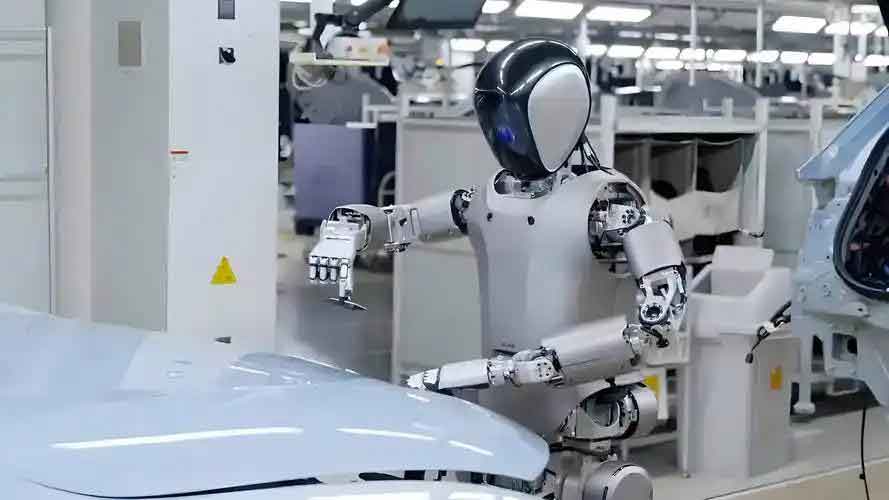
The event carried special weight because it tested the humanoid robot across two very different dimensions. One dimension was athletic performance: speed, balance, endurance, explosive power, coordination, and recovery. The other dimension was practical service: perception, understanding, planning, interaction, and autonomous completion of multi-step tasks. The humanoid robot was not judged only by whether it could move. It was judged by whether it could move intelligently, adapt to unstructured conditions, and avoid dependence on continuous human intervention. That combination is central to the future of the humanoid robot industry.
-
A Closing Day That Put The Humanoid Robot Under Competitive Pressure
The final competition day completed a schedule that repeatedly placed the humanoid robot in situations where failure was visible and success required integrated engineering. A humanoid robot cannot sprint, turn, and stop without tightly coordinated perception, balance control, joint actuation, thermal management, and energy use. It cannot rally with a human tennis player without predicting ball trajectory, estimating opponent intention, and adjusting its own posture within fractions of a second. It cannot work in a garden, hotel, or home without converting sensory data into actionable plans. The Second World Humanoid Robot Games therefore functioned as a public stress test for the humanoid robot, revealing both progress and remaining challenges.
The closing ceremony provided a formal end to the competition, but the meaning of the event extends beyond medals and rankings. The humanoid robot emerged as a platform for testing motion-control algorithms, embodied intelligence, multi-robot coordination, and autonomous task execution. Each event produced data that can feed future algorithm iteration. Each failure, correction, and recovery added evidence about where the humanoid robot is strong and where it still needs improvement. The competition thus served as a bridge between laboratory benchmarks and real-world deployment.
Throughout the event, the humanoid robot was asked to handle conditions that are difficult to reproduce fully in simulation. Real surfaces vary. Lighting changes. Human behavior is unpredictable. Objects are placed in unexpected positions. Communication may be limited. A humanoid robot that performs well under such conditions is closer to becoming a useful assistant, worker, or service partner. The Second World Humanoid Robot Games made that gap between simulation and reality visible, and it showed that the humanoid robot is beginning to cross it.
-
Athletic Events Reveal Advances In Humanoid Robot Motion Control And Physical Limits
The track and field events provided some of the clearest evidence of progress. In the 100-meter race, the TianGong humanoid robot from the Beijing Humanoid Robot Innovation Center achieved a time of 8.85 seconds, surpassing the human record held by Usain Bolt. In the 1500-meter final, the TianZhuo team won with a remarkable time of 2 minutes 21.63 seconds, more than one minute faster than the human men’s 1500-meter world record of 3 minutes 26.00 seconds. In standing high jump, 100-meter, 400-meter, and other events, the humanoid robot also delivered performances that exceeded human best results, refreshing public understanding of motion control and physical limits.
Event Humanoid Robot Result Human Reference Or Comparison Technical Meaning 100-meter race TianGong humanoid robot from the Beijing Humanoid Robot Innovation Center finished in 8.85 seconds Faster than the human record held by Usain Bolt High-speed locomotion, balance, and rapid acceleration by the humanoid robot 1500-meter final TianZhuo team won in 2 minutes 21.63 seconds More than one minute faster than the human men’s 1500-meter world record of 3 minutes 26.00 seconds Endurance, gait efficiency, and sustained thermal and energy management for the humanoid robot Standing high jump, 100-meter, 400-meter, and other events Humanoid robot performances surpassed human best results Human best results used as reference Explosive power, motion planning, and physical control of the humanoid robot Human-robot tennis Humanoid robot served, returned, saved balls, rose quickly after a fall, and achieved more than 100 consecutive rallies First public human-robot tennis confrontation and a world record for consecutive rallies Perception, prediction, dynamic interaction, and recovery by the humanoid robot Cheerleading team event Humanoid robot demonstrated autonomous odometry and state estimation without an external base station, multi-robot swarm control, and stable reproduction of jumps and turns No external base station required Collective autonomy and coordinated performance by multiple humanoid robot units Han Gang, a motion-control algorithm expert at the Beijing Humanoid Robot Innovation Center, analyzed the source of these improvements. According to Han Gang, the enhancement of humanoid robot motion performance essentially comes from the deep integration of motion-control large models and reinforcement-learning algorithms. The humanoid robot running posture displayed during competition was not simply hand-coded step by step. Instead, it was an optimal solution autonomously evolved by algorithms after millions of iterations in a virtual physical world. This posture effectively reduced joint torque and heat dissipation losses, achieving maximization of energy conversion efficiency.
That explanation is important for understanding why the humanoid robot is advancing so quickly in athletic tasks. Traditional robotics often relies on carefully designed controllers and explicit models. Reinforcement learning allows the humanoid robot to discover control policies through large-scale trial and error in simulation. When those policies transfer to physical hardware, the humanoid robot can achieve movements that are difficult to design manually. The result is not only faster running but also more natural transitions, better balance recovery, and more efficient use of limited onboard energy.
The humanoid robot also demonstrated that athletic performance is not only about raw speed. A 100-meter sprint requires explosive acceleration and stable deceleration. A 1500-meter race requires sustained efficiency and thermal control. Jumping events require precise force generation and landing stability. Each event stresses a different part of the humanoid robot architecture. The fact that the humanoid robot could surpass human best results in multiple events indicates that the hardware platform, control algorithms, and simulation-to-reality pipeline are maturing together.
-
Human-Versus-Humanoid Robot Tennis Expands The Boundary Of Dynamic Interaction
One of the most striking moments of the games was the world’s first public human-robot tennis confrontation. In this event, the humanoid robot achieved serving, returning, saving balls, and even standing up quickly after a fall. It also set a world record by sustaining more than 100 consecutive rallies with a human player. This was not a scripted demonstration in a controlled laboratory setting. It was a competitive, high-dynamic exchange that required the humanoid robot to perceive, predict, and act under constant uncertainty.
Wang He, founder and chief technology officer of Galaxy General Robot, said that complex high-dynamic sports such as tennis place extremely high demands on the humanoid robot’s perception, prediction, and dynamic game capabilities. Tennis requires the humanoid robot to track a fast-moving ball, estimate its trajectory, anticipate the opponent’s next action, move into position, and generate an appropriate return stroke. Each of these steps must occur within a tight time window. A fall or a missed step can interrupt the entire rally. The humanoid robot’s ability to recover from a fall and continue is therefore as significant as its ability to hit a winning shot.
Wang He added that safely and sustainably completing high-intensity competition and scenario tasks will become an inevitable trend for humanoid robot events and technology development. That statement captures a shift in the field. The humanoid robot is no longer evaluated only by whether it can complete a single controlled motion. It is increasingly evaluated by whether it can sustain performance, adapt to changing conditions, and remain safe when interacting with people. The tennis event demonstrated that the humanoid robot is entering a stage where dynamic interaction with humans is becoming a realistic test case.
The human-robot tennis confrontation also highlighted the importance of recovery. In real-world applications, a humanoid robot will not always remain upright. It may stumble on uneven ground, collide with an obstacle, or lose balance while carrying an object. The ability to stand up quickly and resume a task is essential for practical deployment. By showing this capability in public competition, the humanoid robot demonstrated a level of resilience that moves it closer to reliable everyday operation.
-
Team Performances Demonstrate Swarm Coordination For The Humanoid Robot
Collective events carried technical significance that may be less obvious than sprinting or tennis but is equally important for the future of the humanoid robot. Xu Zhiyuan, head of the motion-control department at the Beijing Humanoid Robot Innovation Center, pointed to the cheerleading event as an example. The humanoid robot team achieved three major capability loops. The first was autonomous odometry and state estimation without an external base station. The second was multi-robot swarm cooperative control under unified scheduling by a platform hub. The third was stable reproduction of high-difficulty movements such as jumps and turns.
These three capabilities matter because many real-world deployments will involve more than one humanoid robot. In a hotel, several humanoid robots may need to coordinate deliveries, cleaning, and guest assistance. In a cultural tourism venue, a group of humanoid robots may need to perform synchronized shows or guide visitors. In a commercial space, multiple humanoid robots may need to share maps, avoid collisions, and divide tasks. The cheerleading event tested whether the humanoid robot could act as part of a coordinated system rather than as an isolated machine.
Xu Zhiyuan noted that the competition validated the humanoid robot’s ability to perform cluster shows without a base station. This capability lays a technical foundation for event activities, cultural tourism, commercial scenarios, and other applications. The absence of an external base station is particularly important because real environments rarely offer ideal infrastructure. A humanoid robot that can estimate its own position and state autonomously is more flexible, easier to deploy, and less dependent on expensive external positioning systems.
The team event therefore expanded the definition of humanoid robot performance. Speed and strength remain important, but coordination, communication, and collective autonomy are also essential. The humanoid robot must be able to work with other humanoid robots, with human operators, and with broader digital systems. The Second World Humanoid Robot Games provided a public platform for testing those interactions under competitive pressure.
-
Real-World Scenarios Test The Humanoid Robot As A Useful Assistant
If athletic events tested the humanoid robot’s physical limits, scenario competitions directly examined its ability to integrate into real production and daily life. These scenarios were designed to reflect the messy, unpredictable conditions that a humanoid robot would face outside a laboratory. The humanoid robot had to perceive its surroundings, interpret human behavior, make decisions, and complete tasks without constant human control.
In the outdoor garden scenario, the humanoid robot faced a real environment with green trees and uneven road surfaces. The humanoid robot was able to scan and identify a camping cart carrying prohibited items such as a cassette stove, and it provided a voice prompt. It could also automatically recognize uncivil behavior, such as a person lying on a seat, and offer civilized persuasion. These tasks required more than object detection. The humanoid robot needed to understand context, apply rules, and interact with people in a socially appropriate manner.
Liu Rujie, a relevant person in charge at Fujitsu Research and Development (China), told reporters that the garden scenario is a good technical testing ground. It allows researchers to compare differences between laboratory simulation environments and real environments, find shortcomings during actual operation, and accumulate valuable measured data for subsequent algorithm iteration. That feedback loop is critical for the humanoid robot. Simulation can generate large amounts of data, but reality introduces noise, irregularity, and unexpected events that must be handled by the humanoid robot in real time.
In the home scenario, the humanoid robot demonstrated the ability to complete high-complexity long-process tasks such as folding clothes and tidying up. These tasks attracted crowds and admiration because they are familiar to humans yet difficult for machines. Folding clothes requires manipulation, visual recognition, spatial reasoning, and sequential planning. Tidying requires object categorization, placement decisions, and error recovery. A humanoid robot that can perform such tasks autonomously is moving closer to becoming a practical household assistant.
Scenario Humanoid Robot Capability Demonstrated Evaluation Focus Garden Scanned and identified a camping cart with prohibited items such as a cassette stove, issued a voice prompt, recognized uncivil behavior of lying on a seat, and offered civilized persuasion Autonomous perception, rule understanding, outdoor navigation, and human interaction by the humanoid robot Home Folded clothes, tidied objects, and completed high-complexity long-process tasks Long-horizon autonomy, manipulation, and practical household service by the humanoid robot Library Work scenario tasks Service integration and autonomous execution by the humanoid robot Hotel Work scenario tasks Service integration and autonomous execution by the humanoid robot Emergency firefighting Work scenario tasks High-risk scenario response and autonomous capability of the humanoid robot The games also included library, hotel, and emergency firefighting scenarios. Each of these settings imposes different requirements. A library may require quiet operation, precise navigation, and careful object handling. A hotel may require guest interaction, delivery, and coordination with service workflows. Emergency firefighting may require rapid response, hazard recognition, and operation in dangerous conditions. By placing the humanoid robot in multiple work scenarios, the event tested whether the technology can generalize across domains rather than succeed only in a single narrow task.
The scenario competitions showed that the humanoid robot is moving from preset scripts toward autonomous problem-solving. A preset script can work in a fixed environment, but it breaks down when objects move, lighting changes, or people behave unexpectedly. Autonomous perception and decision-making allow the humanoid robot to adapt. The games made this distinction visible by designing tasks that required the humanoid robot to respond to real conditions rather than follow a memorized sequence.
-
Autonomy Rules Reshape How The Humanoid Robot Is Evaluated
The rules of the scenario competitions placed strong emphasis on autonomy and practicality. Gong Xiao, a committee member of the organizing committee and deputy director of the China Software Testing Center, pointed out that the games stipulated a score weight of 1.0 for fully autonomous methods, while teleoperation methods received only 0.5. The coefficient difference was therefore double. This rule was designed to guide the humanoid robot away from dependence on human intervention and toward genuine autonomous perception and decision-making, so that the humanoid robot can become a helpful assistant for humans.
Operation Mode Score Weight Purpose Of The Rule Fully autonomous 1.0 Encourage the humanoid robot to perceive, decide, and act independently Teleoperation 0.5 Discourage excessive reliance on human intervention This scoring design is significant because teleoperation can make a humanoid robot appear more capable than it really is. A human operator can compensate for poor perception, unstable balance, or weak planning. In a competition, teleoperation may help complete a task, but it does not prove that the humanoid robot can work independently. By assigning a lower weight to teleoperation, the organizers pushed teams to demonstrate autonomy. The humanoid robot had to rely on its own sensors, models, and decision-making processes to earn the highest score.
The emphasis on autonomy also reflects the needs of real deployment. In a hotel, a home, a library, or an emergency scene, human operators may not be available to control every movement. The humanoid robot must handle routine decisions on its own. It must recognize when a task is complete, when an obstacle blocks progress, and when a new plan is needed. The competition rules therefore aligned technical evaluation with practical requirements. The humanoid robot that scores highest is not necessarily the one with the most human assistance, but the one that can operate safely and effectively on its own.
Gong Xiao’s statement points to a broader principle: the value of the humanoid robot depends on its ability to reduce human workload rather than add to it. A humanoid robot that requires constant supervision is difficult to scale. A humanoid robot that can perceive its environment, make decisions, and ask for help only when necessary is more likely to be adopted. The scenario competition rules made this principle explicit and measurable.
-
Embodied Large Models And Generalization Point To The Next Stage Of The Humanoid Robot
Wang He analyzed that the leap in scenario difficulty powerfully tested the true capability boundary of embodied large models. The humanoid robot has the potential for “one brain, many uses.” Although the humanoid robot currently still faces bottlenecks in data collection and cost-effectiveness in unfamiliar scenarios, the improvement of model generalization ability will rapidly reduce the training cost for new tasks. The humanoid robot is accelerating away from preset scripts and moving from the competition test field toward broad real-world application scenarios.
The concept of “one brain, many uses” is central to the future of the humanoid robot. In the past, a robot often needed to be reprogrammed for each new task. An embodied large model aims to provide a shared intelligence that can transfer across tasks. A humanoid robot that can fold clothes may also be able to tidy a room, organize a shelf, or assist in a hotel. A humanoid robot that can navigate a garden may also be able to navigate a library or an emergency site. Generalization reduces the need to build a new system for every environment.
Data collection remains a major challenge. The humanoid robot needs diverse experiences to learn robust behavior. Real-world data is expensive to collect, and simulation data may not perfectly match reality. Cost-effectiveness is another challenge. The humanoid robot must be affordable enough to deploy at scale while still providing reliable performance. The games helped identify these bottlenecks by pushing the humanoid robot into unfamiliar and complex situations. Each scenario revealed where more data, better models, or improved hardware is needed.
Generalization ability, often described as the capacity to draw inferences from one instance and apply them to others, will be essential for lowering training costs. If a humanoid robot can transfer knowledge from one task to another, then new tasks can be learned with less data and less human effort. That would accelerate deployment across industries. The humanoid robot would become more like a general-purpose platform and less like a single-purpose machine. The Second World Humanoid Robot Games provided evidence that this transition is underway, even if important challenges remain.
-
From Arena Records To Industry Lessons: What The Humanoid Robot Showed The World
The games produced a set of lessons that extend beyond the competition itself. The humanoid robot demonstrated that motion-control large models and reinforcement learning can produce efficient, high-performance movement. The humanoid robot showed that dynamic interaction with humans, including tennis rallies and recovery from falls, is becoming feasible. The humanoid robot proved that multiple units can coordinate without an external base station. The humanoid robot revealed that real-world scenarios such as gardens, homes, libraries, hotels, and emergency firefighting demand autonomy, perception, and long-process task execution. These lessons point to a common direction: the humanoid robot is becoming more capable, more independent, and more adaptable.
The event also showed that competition can serve as a powerful driver of innovation. Athletic events create clear benchmarks. Scenario events create practical tests. Autonomy scoring creates incentives. Together, they push teams to improve hardware, software, and system integration. The humanoid robot is a complex system, and progress in one area can be limited by weakness in another. A fast humanoid robot with poor perception cannot work in a garden. A capable manipulator with weak balance cannot fold clothes reliably. The games forced teams to address the whole system rather than optimize a single component.
The humanoid robot industry is often described in terms of future potential, but the Second World Humanoid Robot Games made that potential more concrete. The humanoid robot ran, turned, rallied, recovered, coordinated, scanned, prompted, persuaded, folded, tidied, and navigated. These actions are not yet perfect, and the humanoid robot still faces challenges in unfamiliar environments. Nevertheless, the direction is clear. The humanoid robot is moving from controlled demonstrations toward real-world usefulness.
Another important lesson concerns safety and sustainability. As the humanoid robot becomes faster and stronger, safety becomes more critical. A humanoid robot that can sprint at high speed or interact with a human tennis player must also be able to avoid harm. A humanoid robot that works in a home or hotel must operate safely around people, furniture, and fragile objects. Wang He’s observation that safely and sustainably completing high-intensity competition and scenario tasks will become an inevitable trend reflects this reality. Performance without safety is not deployable. Speed without sustainability is not useful.
The humanoid robot also demonstrated the importance of recovery and robustness. In tennis, the humanoid robot stood up after falling. In garden scenarios, it had to handle uneven ground. In home scenarios, it had to manage long tasks with many steps. These situations require the humanoid robot to detect errors, recover, and continue. Robustness is often less visible than a record-breaking sprint, but it is essential for practical operation. The games provided a stage where robustness could be tested publicly.
-
Conclusion: The Humanoid Robot Takes Another Step Toward Everyday Life
The cheers of the arena have temporarily subsided, but the pace of development in the humanoid robot industry has not stopped. From the刷新 of athletic limits to breakthroughs in diverse scenarios, the Second World Humanoid Robot Games witnessed an astonishing transformation in technology and outlined a future blueprint of human-machine coexistence and intelligent empowerment. The humanoid robot is no longer only a symbol of advanced research. It is becoming a measurable, testable, and increasingly practical platform for service, work, and interaction.
The event showed that the humanoid robot can learn from simulation, transfer skills to the physical world, and adapt to demanding conditions. It showed that the humanoid robot can interact with humans in dynamic sports and respond to social rules in public spaces. It showed that the humanoid robot can work in teams, coordinate without external positioning, and perform synchronized actions. It showed that the humanoid robot can handle long-process tasks that require manipulation, planning, and persistence. These capabilities are the foundation for future applications in homes, hotels, libraries, gardens, emergency response, cultural tourism, commercial spaces, and beyond.
Challenges remain. Data collection for embodied large models is still costly. Generalization across unfamiliar scenarios is not yet complete. Cost-effectiveness must improve before large-scale deployment. Safety and reliability must be proven over long periods. The humanoid robot must become easier to train, easier to maintain, and easier to integrate into existing workflows. The games did not solve all these challenges, but they clarified them. They turned abstract technical questions into visible tasks and measurable outcomes.
The humanoid robot is moving from the laboratory to the arena, from the arena to the workplace, and from the workplace to everyday life. The Second World Humanoid Robot Games marked a point where athletic performance, autonomous decision-making, and real-world scenario capability converged. The humanoid robot that ran, rallied, recovered, coordinated, and served during the event offers a preview of a future in which intelligent machines work alongside humans. The path ahead is still demanding, but the direction is no longer uncertain. The humanoid robot has taken another significant step toward becoming a useful, safe, and capable partner in human society.