
In the second half of 2024, the humanoid robot sector has remained intensely active, yet the market has still not welcomed a second listed humanoid robot company. The first mover, UBTECH Robotics, has now entered a phase of more stable operations, and its research vitality continues to improve, sending a positive signal to the domestic robot industry. The company’s experience offers a rare window into how a humanoid robot business can move from ambitious research to practical deployment, from public demonstrations to factory work, and from a single product line to a broader technology ecosystem.
Walker S, described as a robot worker, is the answer UBTECH has presented to the world after twelve years of research and development in humanoid robots. In early July, UBTECH announced a cooperation with FAW-Volkswagen Qingdao Branch. Under this cooperation, Walker S will enter the production line application scenarios of FAW-Volkswagen’s national-level intelligent manufacturing demonstration factory in Qingdao. The humanoid robot will carry out work such as bolt tightening, parts installation, and parts transfer during automobile manufacturing. This is not a simple display. It is a test of whether a humanoid robot can operate inside a real industrial process, where precision, repeatability, safety, and coordination with human workers and existing equipment all matter.
Why is automobile manufacturing a proving ground for the humanoid robot? Yi Peng, head of NIO’s prospective manufacturing engineering humanoid robot team, explained in a public speech that automobile manufacturing has a high level of industrial digital intelligence. Massive data helps with the construction of large models and the development of embodied intelligence. At the same time, automobile manufacturing can be compatible with other industrial manufacturing scenarios, so the application of a humanoid robot in automobile manufacturing has a natural generalization advantage. FAW-Volkswagen Qingdao Branch is the third automobile factory to reach cooperation with UBTECH after NIO and Dongfeng Liuzhou Motor. UBTECH’s official media has steadily updated footage of the robot’s work, inviting industry insiders to witness the process and breakthroughs of humanoid robot integration into industrial production and daily life.
Within the humanoid robot industry, UBTECH can be described as a high-performing student that combines commercial strength, technical potential, and brand voice. In a dialogue, Jiao Jichao, vice president of UBTECH and executive dean of its research institute, discussed the scenery along the road of humanoid robot development. His account focused not only on technical milestones but also on the commercial discipline required to keep a humanoid robot program alive long enough to mature.
1. Self-Sustaining Capability: The First Step Toward Sustainable Humanoid Robot Development
By the end of 2023, the Walker series humanoid robots had gone through five iterations. Behind this record is a long process of funding and technical accumulation. Jiao Jichao looked back on the early days of UBTECH and recalled that the company began with servo drivers and gradually expanded into motion control, perception, and other technologies. These technologies generated revenue from various industries and ensured that the humanoid robot project had a stable supply of research funding. For any humanoid robot company, this point is critical. A humanoid robot is not a short-term product. It requires repeated prototype iterations, testing, failure analysis, and redesign. Without a self-sustaining revenue engine, a humanoid robot program can easily become a demonstration that never reaches scale.
Jiao Jichao said that, to date, UBTECH has designed and produced more than forty different servo drivers. It has achieved batch production of servo drivers from small torque to large torque and has applied them on a large scale across different robot series. This achievement matters because servo drivers are among the most fundamental components of a humanoid robot. They influence joint movement, force control, energy efficiency, reliability, and cost. If a humanoid robot company cannot understand or control these core components, it will struggle to optimize the whole system. UBTECH’s early work in servo drivers therefore became both a source of revenue and a foundation for later humanoid robot development.
At the same time, UBTECH’s early small humanoid robot Alpha allowed its technology to be tested by the market. Alpha helped the company understand what customers would accept, what functions could be delivered, and what engineering compromises were necessary. This market validation laid a foundation for the research and development of large humanoid robots. The path from Alpha to Walker, and later to Walker S, reflects a gradual accumulation of capability rather than a sudden leap. Each stage created knowledge that could be reused in the next stage.
The research and development difficulty of a large humanoid robot is not on the same order as that of a small humanoid robot. A large humanoid robot is an integration of multiple disciplines. A seemingly ordinary action may represent months of effort by a research and development team. Take upright walking as an example. When a humanoid robot walks upright, its joints are in a fully extended state, which reduces the space available for maintaining balance and places high demands on the rationality of planning algorithms. In the process of algorithm iteration and optimization across several prototype generations, UBTECH developed a stable and mature gait planning method. It uses a virtual foot model and an inverted pendulum model to generate planning data for the body and feet. At the same time, based on abundant full-body sensors, it developed a multidimensional force-position hybrid controller, improving the humanoid robot’s ability to adapt to complex terrain and external impacts.
Beyond motion control and perception technologies, UBTECH also focuses on positioning and navigation, autonomous decision-making, voice interaction, and hand-eye coordination. It is one of the very few companies globally with full-stack humanoid robot technologies. The full-stack approach includes robotics technologies such as robot motion planning and control technology and servo drivers. It includes artificial intelligence technologies such as computer vision and voice interaction technology. It includes robot and artificial intelligence integration technologies such as SLAM, visual servo operation, and human-robot interaction technology. It also includes a robot operating system application framework. This full-stack capability is important because a humanoid robot cannot be assembled from isolated breakthroughs. The components must work together in real time, under real conditions, with real consequences if something fails.
A patent analysis report on humanoid robot technology shows that UBTECH ranks first globally in the number of effective humanoid robot patents and the average annual number of patent applications over the past five years. This ranking does not by itself guarantee commercial success, but it does indicate the depth of technical investment required to remain competitive in the humanoid robot field. For a humanoid robot company, patents are not only legal assets. They are also evidence of repeated problem-solving in motion, perception, interaction, and system integration.
Jiao Jichao explained that the UBTECH research institute set the mass production and deployment of humanoid robots as a goal very early. From both software and hardware perspectives, it decomposed technologies and gradually developed them in-house. In the next step, UBTECH will carry out a new round of transformation and upgrading in three areas: reducing volume, improving appearance fluidity, and increasing power density. These goals reflect the practical demands of a humanoid robot that must eventually work alongside people. A humanoid robot cannot be only capable. It must also be compact enough, efficient enough, and visually acceptable enough for real environments.
UBTECH has been listed for more than half a year, and people still discuss the striking listing ceremony at the Hong Kong Stock Exchange at the end of 2023. That was the first time in human history that a humanoid robot struck a gong at a listing ceremony, and it was a milestone in the acceleration of the global humanoid robot commercialization process. The event was not merely symbolic. It placed a humanoid robot at the center of a highly controlled public moment, where timing, stability, and precision were visible to everyone.
The preparation for the listing ceremony felt like yesterday. Jiao Jichao explained that the team faced limited time and limited understanding of the site environment and process. They also needed to ensure that the humanoid robot maintained stable gait while walking from below the stage to the stage, accurately reached the gong, and made the gong-striking action exactly at the moment of listing. To address these technical difficulties, the team adjusted the humanoid robot’s gait planning within a short period and introduced human-like walking planning in its legs, improving the naturalness and flexibility of walking and ensuring stable gait. UBTECH also optimized the humanoid robot’s sensing, navigation, and system scheduling solutions to ensure that it could walk smoothly to the designated position and complete the gong strike at the determined moment. This episode shows that a humanoid robot’s value is often tested in public before it is tested at scale in industry.
2. Enhancing Generalization: Leading Humanoid Robot Players Bet on Large Models
Large models allow a humanoid robot to possess stronger generalization and adaptability in actual scenarios. Among the several functional modules of a humanoid robot, decision-making is the most abstract and the most difficult to develop. It requires reasoning over multidimensional perceptual information, and this is precisely what large models are good at. A large model improves the knowledge completeness of a humanoid robot. When abstract task decomposition and reasoning are involved, the large model plays a role similar to the central nervous system, improving the generalization and universality of the humanoid robot. In other words, the large model helps a humanoid robot move beyond fixed scripts and toward more flexible behavior.
Like similar companies in the field, UBTECH is very optimistic about end-to-end reinforcement learning algorithm research. UBTECH custom-develops modules for multimodal perception, motion control, positioning and navigation, and more. It converts lightweight large models into self-developed deep learning small models and applies them to humanoid robots to form end-to-end AI capabilities. This approach reflects a practical understanding of deployment. A large model in a data center may be powerful, but a humanoid robot must carry its intelligence in a physical body with limited power, computing, and space. The ability to compress, adapt, and integrate models is therefore as important as the ability to train them.
Jiao Jichao shared UBTECH’s recent research results. To train large models to understand scenes, UBTECH uses simulation scenes and real data to build embodied intelligence data. It aligns sensor data with the robot’s corresponding actions and trains a multimodal planning large model to output plans. UBTECH applies large language models to solve the problem of insufficient generalization and difficult adaptation when a robot performs precise motions in complex environments. Compared with pure text large models, multimodal large models have stronger scene understanding ability. They can extract semantic information and make reasonable inferences combined with scenes. In addition, adding the robot’s specific actions into training enables the multimodal large model to understand action instructions and achieve planning capabilities with stronger generalization.
This technology optimizes the decision-making, reasoning, and task control processes of humanoid robots. It provides a practical path for their generalization and universality. In April this year, Walker S at the Baidu AI Developer Conference demonstrated generalized grasping, object sorting, and voice interaction. It was one of the very few international demonstrations of an AI large model plus humanoid robot application in a real scenario. The significance of this demonstration lies in the combination. A humanoid robot that can see, understand, decide, and act in an open environment is more useful than a humanoid robot that can only repeat a single motion.
In recent years, UBTECH has continuously improved the control system performance of humanoid robot operation and walking. Based on high-fidelity simulation environments and multimodal sensing-control datasets, it develops an end-to-end learning control framework. Combining teleoperation and imitation learning, the humanoid robot’s dual arms achieve generalized grasping of different objects and generalized execution of different actions. Through reinforcement learning and large-scale parallel simulation training, UBTECH achieves fine manipulation for shaft-hole assembly and high-performance bipedal walking. These capabilities are not abstract research topics. They are the building blocks of a humanoid robot that can perform useful work in manufacturing, logistics, inspection, and eventually service environments.
The importance of generalization can be seen in the difference between a demonstration and a deployment. In a demonstration, the environment can be prepared, the objects can be placed in known positions, and the task can be repeated. In a deployment, the humanoid robot must deal with variation. Parts may arrive in different orientations. Lighting may change. Human workers may move nearby. Machines may produce unexpected disturbances. A humanoid robot that relies on rigid programming will fail when conditions change. A humanoid robot that uses large-model reasoning, multimodal perception, and learned control has a better chance of adapting. This is why leading humanoid robot players are betting on large models, and why UBTECH’s work in this area is closely watched.
| Technology Layer | Examples | Role in Humanoid Robot Development |
|---|---|---|
| Robotics technology | Motion planning and control; servo drivers | Enables stable movement, joint control, and physical interaction |
| Artificial intelligence technology | Computer vision; voice interaction | Supports perception, understanding, and communication |
| Robot-AI integration technology | SLAM; visual servo operation; human-robot interaction | Connects perception and action in real environments |
| Robot operating system application framework | System scheduling and application framework | Coordinates software, hardware, and task execution |
3. Practice Sharpens the Blade: Humanoid Robots Face Public Scrutiny
In the future, humanoid robots will have broad application scenarios, attracting large amounts of capital. Practitioners expect that capacity expansion of humanoid robots can bring economies of scale and thereby reduce unit costs. However, at the current stage, high research and development costs and production costs make many observers hesitate. Capacity expansion is a paradox. Aggressive mass production may ultimately result in the outcome of being praised but not purchased. The commercialization prospects of humanoid robots still have many uncertainties, requiring companies to have the endurance to sit patiently through a cold period.
Some experts estimate that the humanoid robot industry will have a hundred-billion-level development space. At the 2024 World Artificial Intelligence Conference, almost every robot company claimed to have entered embodied intelligence, and dozens of humanoid robots were available for visitors to observe. But when asked about cost reduction and efficiency improvement, or when asked when mass production would happen, most companies in the industry chose to change the subject. The hotter the concept of humanoid robots becomes, the greater the pressure on research and development teams. Cost and market dilemmas are like the Sword of Damocles hanging over the humanoid robot, ready to strangle it in the cradle. This tension is part of the reality of the humanoid robot sector. Excitement at conferences does not automatically translate into stable orders, reliable products, and profitable operations.
UBTECH has taken a step forward. To a certain extent, the listing ceremony involving a humanoid robot continued UBTECH’s style of daring to create a large stage for robot products. The company has repeatedly placed its humanoid robot in highly visible situations, not only to attract attention but also to subject the technology to public scrutiny. A humanoid robot that can perform in a controlled laboratory may still fail on a public stage. A humanoid robot that can perform on a public stage may still fail in a factory. Each escalation of visibility brings new engineering requirements.
In fact, UBTECH’s products entered public view very early. In 2016, 540 Alpha robots performed simultaneously on China Central Television’s Spring Festival Gala and were included in Guinness Records. In addition, Walker X, the panda robot Youyou, and other humanoid robots have been used multiple times at events of worldwide attention, including the China Pavilion at Dubai Expo, the Beijing Winter Olympics, and the Chengdu Universiade. These displays brought UBTECH a great deal of attention and allowed more people to truly know and understand humanoid robots. They also created a public expectation that the humanoid robot would eventually move from performance to practical work.
Jiao Jichao explained that these application scenarios are highly difficult. The fact that UBTECH humanoid robots can represent the country in showcasing the latest technological innovation achievements is a kind of affirmation. At the same time, the products and technologies received a very rare test. In a short time, UBTECH broke through multiple key core technologies and accumulated rich application experience. This year, UBTECH has focused on key manufacturing fields such as automobiles and 3C, improving the tool operation and task execution capabilities of humanoid robots. In addition, UBTECH is currently developing a bionic humanoid robot for family companionship scenarios. This dual direction, industrial work and family companionship, reflects the long-term scope of the humanoid robot market.
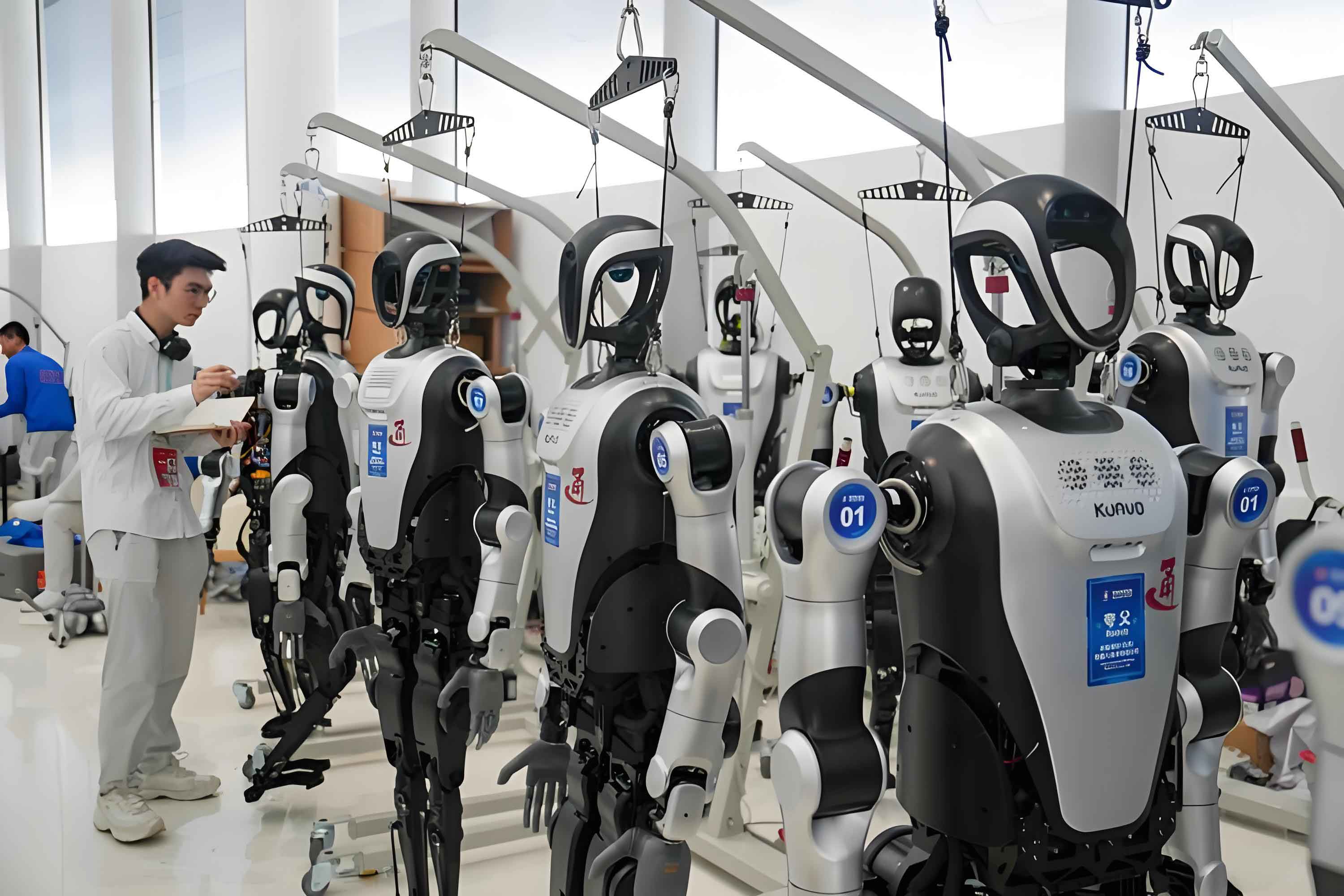
Jiao Jichao shared that, for promoting humanoid robots in industrial scenarios, UBTECH’s plan is divided into three stages. From 2023 to 2024, UBTECH used new energy vehicle manufacturing scenarios as the entry point for humanoid robots in industrial scenarios, achieving testing of large humanoid robots in handling, quality inspection, and other industrial scenarios. From 2025 to 2027, UBTECH’s large humanoid robots will gradually expand to medium-difficulty tasks. The focus will be on building applications in three to five specialized scenarios, gradually achieving scale commercialization, and horizontally expanding to consumer electronics manufacturing and other industries and application scenarios. From 2028 to 2033, UBTECH’s large humanoid robots will further expand to more complex task scenarios, possess more than ten skills, and become multi-task general-purpose industrial humanoid robots. This staged plan is a practical response to the gap between humanoid robot capability and humanoid robot commercialization.
| Stage | Period | Focus | Expected Development |
|---|---|---|---|
| 1 | 2023-2024 | New energy vehicle manufacturing as entry point for industrial scenarios | Testing large humanoid robots in handling, quality inspection, and other industrial scenarios |
| 2 | 2025-2027 | Expand to medium-difficulty tasks; build three to five specialized scenarios | Gradual scale commercialization; horizontal expansion to consumer electronics manufacturing and other industries and application scenarios |
| 3 | 2028-2033 | Expand to more complex task scenarios | Possess more than ten skills; become a multi-task general-purpose industrial humanoid robot |
4. A Long Road with Clear Signals for the Humanoid Robot Industry
The humanoid robot industry is not a dead end. The experience of UBTECH suggests that the journey is difficult, but it is also becoming more structured. The company began with servo drivers, moved through small humanoid robots such as Alpha, built large humanoid robots through the Walker series, and eventually placed Walker S in automobile factories. It combined revenue-generating component businesses with long-horizon humanoid robot research. It developed full-stack technologies across robotics, artificial intelligence, robot-AI integration, and operating system frameworks. It invested in large models and end-to-end learning to improve generalization. It also staged its industrial deployment plan instead of promising immediate mass adoption. These elements form a practical framework for humanoid robot development.
For the broader humanoid robot sector, the absence of a second listed humanoid robot company does not mean a lack of opportunity. It indicates that the barriers are high. A successful humanoid robot company needs patient capital, technical depth, real-world validation, and a commercial engine that can survive the long research cycle. The humanoid robot is not a product that can be created by a single breakthrough in one laboratory. It requires the integration of mechanical design, electronics, control theory, perception, artificial intelligence, system software, safety engineering, and manufacturing know-how. Each of these areas can become a bottleneck. Each of them must be improved simultaneously for the humanoid robot to become useful outside a controlled demonstration.
UBTECH’s case also shows that public exposure can be a double-edged sword. A humanoid robot on stage can inspire audiences and attract talent. It can also reveal every instability, every delay, and every failure. The first humanoid robot gong strike at a listing ceremony was a symbolic achievement. The movement of Walker S into automobile manufacturing is a more demanding test. Bolt tightening, parts installation, and parts transfer are not performances. They are tasks with quality standards, cycle times, and safety requirements. If a humanoid robot can perform them reliably, it can begin to justify its cost. If it cannot, the industry must continue to improve.
The next phase of humanoid robot development will likely be defined by several questions. Can the humanoid robot reduce its volume without losing power? Can it improve appearance fluidity while maintaining structural strength? Can it increase power density while managing heat and energy consumption? Can it use large models for reasoning without depending on excessive computing resources? Can it learn from simulation and transfer that learning to the real world? Can it work safely alongside people? UBTECH’s stated next steps, including reducing volume, improving appearance fluidity, and increasing power density, directly address some of these questions. Its research into lightweight models and end-to-end AI addresses others.
The humanoid robot market is often discussed in terms of scale and speed. Yet the UBTECH experience suggests that patience and sequencing matter just as much. A humanoid robot company must first build self-sustaining capability. It must then invest in full-stack technology. It must use large models and multimodal learning to improve generalization. It must validate the humanoid robot in public and industrial scenarios. It must expand from simple tasks to medium-difficulty tasks and eventually to complex tasks. It must move from specialized scenarios to general-purpose capabilities. This sequence is not glamorous, but it is realistic.
As Jiao Jichao’s account suggests, the humanoid robot is moving from display to labor, from laboratory to production line, and from concept to commercial test. Walker S in automobile factories represents a concrete step. The development of a bionic humanoid robot for family companionship represents a longer-term ambition. The continued work on servo drivers, motion control, perception, navigation, decision-making, voice interaction, and hand-eye coordination represents the underlying foundation. The humanoid robot is not yet a mass-market product, but it is no longer only a dream. Practice has already proven that the humanoid robot is not a dead end. It is a difficult but real industrial path.
For UBTECH and the wider humanoid robot ecosystem, the task now is to keep improving reliability, cost, and adaptability while expanding the boundaries of what a humanoid robot can do. The company’s cooperation with FAW-Volkswagen Qingdao Branch, following cooperation with NIO and Dongfeng Liuzhou Motor, shows that automobile manufacturing remains a key testing ground. The humanoid robot must learn to handle variation, work safely, and deliver measurable value. The industry’s enthusiasm is high. The pressure is also high. But the signal from UBTECH is positive: a humanoid robot can be developed with discipline, tested in public, and deployed in stages. The road may be long, but it is not a dead end.