
Contemporary artificial intelligence research is undergoing a profound conceptual shift. For decades, the dominant model treated intelligence as a form of abstract computation, something that could be separated from the physical body and implemented in any sufficiently powerful symbol-processing system. That model, often described as computational-representationalism, assumed that cognition is essentially the manipulation of internal representations according to formal rules. In recent years, however, a growing body of philosophical, cognitive-scientific, and robotic research has challenged this assumption. The emerging alternative is embodied intelligence: the view that intelligent behavior arises from the continuous coupling of an agent with its environment, and that the body is not merely a vehicle for the brain but a constitutive condition of cognition itself.
This shift has made the humanoid robot a particularly important object of study. The humanoid robot is not simply a machine designed to look like a person. It is a physical system that integrates perception, action, learning, and interaction in a body that is meant to operate in environments built for human beings. Because the humanoid robot brings together engineering, cognitive science, and phenomenology, it exposes both the promise and the limits of the embodied turn. It also raises a fundamental question: can an artificial system achieve genuine embodiment, or can it only simulate the external appearance of embodied intelligence? The humanoid robot stands at the center of that question.
A recent analysis by philosopher He Jing of East China Normal University argues that the movement from classical artificial intelligence to embodied intelligence is not a minor methodological adjustment but an ontological and epistemological transformation. The analysis distinguishes three constitutive dimensions of embodiment: sensorimotor embodiment, situated embodiment, and interactive embodiment. It then uses the humanoid robot as a frontier case to examine how far artificial systems can approximate human embodied cognition and where they remain fundamentally different. The humanoid robot, in this view, is not the completed form of embodied intelligence. It is a revealing experimental and philosophical device that shows the structural tension between body, intelligence, and world.
- I. From Computation and Representation to Embodiment
Cognitive science emerged in the mid-twentieth century as a multidisciplinary field spanning philosophy, psychology, neuroscience, artificial intelligence, and linguistics. Its central concern could be described as a contemporary version of the Kantian question: how is knowledge possible? Yet its methods and objects have expanded dramatically through empirical research. The field has never possessed a single unified paradigm. Instead, it has hosted competing models and research programs. From the 1960s onward, the most influential included computationalism, symbolism, representationalism, and cognitivism. Although these approaches differ in technical emphasis, they share a philosophical premise: cognition is representation. The mind is understood as an internal information-processing system, while the body is reduced to a sensory and motor transmission device rather than a constitutive element of cognitive generation.
Computationalism is the classic expression of this non-embodied tradition. It claims that cognition is symbol manipulation and that thought can be formally expressed through Turing-style computation. The approach was encouraged by the success of von Neumann computers in simulating reasoning tasks. Its representative statement is the physical symbol system hypothesis advanced by Allen Newell and Herbert Simon, which holds that the necessary and sufficient condition for intelligence is the operation of formalized symbols. On this view, cognition is rule-driven information processing whose basic units are semantically interpretable symbols. Whether the carrier is a human brain or a computer, the system can be abstracted as an algorithmic system in the Turing sense.
From the late 1970s onward, connectionism challenged the formal-logical architecture of computationalism. Connectionism denied that cognition can be reduced to symbol-operation rules. It instead described cognition as state activation and weight change in neural networks. The cognitive system became a parallel distributed system capable of pattern recognition and dynamic change over time. Connectionism emphasized emergence: higher-level cognitive capacities are not directly encoded in the system but arise as nonlinear results of interactions among lower-level neural units. Research on artificial neural networks developed on this basis, attempting to reconstruct the non-rule-based and non-symbolic aspects of human cognition by simulating neuronal connectivity.
Despite its departure from logical symbol manipulation, connectionism did not fully escape the non-embodied paradigm. It still treated cognition as information processing inside the brain and the body as an input-output channel rather than a constitutive basis of cognition. Cognitivism and representationalism shared this assumption. Cognitivism viewed cognition as the rule-governed manipulation of internal representations, while representationalism defined cognition as the capacity to process internal symbol systems and treated formal logical precision as the guarantee of theoretical adequacy. Across these approaches, the core assumption remained intact: cognition is representation. The body was marginalized or ignored. Yet non-embodied models proved inadequate when explaining everyday perception, motor control, and complex social behavior.
In the landmark work What Computers Can’t Do, Hubert Dreyfus offered a deep critique of the cognitivist paradigm then dominant in artificial intelligence research. Drawing on Martin Heidegger and Maurice Merleau-Ponty, Dreyfus argued that classical artificial intelligence, especially symbol-based systems, reduced cognition to information processing dependent on rules detached from concrete situations. This was an error at both ontological and epistemological levels. He rejected the analogy that the brain is a computer and insisted that cognitive capacities are not grounded in symbolic representation but in the continuous, dynamic practical relationship between body and world.
For Dreyfus, higher-order abstract capacities such as reasoning, logical operations, language, and conceptual manipulation are not self-sufficient. They depend on lower-order, non-representational, pre-reflective bodily capacities. In other words, the foundation of human intelligence lies in how the body skillfully copes with the world in specific situations. This view poses a fundamental challenge to non-embodied cognitive science. If cognition is indeed rooted in bodily experience, situational embeddedness, and skillful coping, then the claim that cognition is representation lacks theoretical sufficiency and explanatory universality.
Pattern recognition offers a clear example. It is often treated as one of the basic capacities of human cognition: the ability to integrate, classify, and interpret structured information from the environment. In traditional artificial intelligence, pattern recognition is frequently simplified into a logical operation involving precisely specified inputs, rule-based data processing, and stable outputs. Yet such models often fail at real-world perceptual tasks. In everyday life, human perception emerges within an open, ambiguous, and inexhaustible background. What we “see” is not an isolated object in an objective world but a figure that emerges from a background through the intertwining of situation and bodily experience. This phenomenological structure of perception cannot be reconstructed by a logical program alone.
Dreyfus therefore criticized the classical input-processing-output model for ignoring the fundamental role of embodiment and situatedness in cognition. For him, pattern recognition is not a static information conversion process. It is a generative process based on the body and continuous interaction with the world. Through the sensorimotor system, the subject responds, adjusts, and adapts within an environment, allowing meaning structures to form dynamically. This process is characterized by pre-reflective and operative intentionality: before explicit representation, the subject has already generated and constructed meaning through bodily action in a situation. Perception is thus not a passive mapping of an external objective world but a result of bodily action in the world.
In a collaborative study, computer scientist Oliver Selfridge and psychologist Ulric Neisser attempted to improve digital computer performance in pattern recognition by introducing heuristic rules. They hoped that heuristic strategies would allow computers not only to respond passively to input data but also to generate recognition hypotheses more actively, thereby simulating certain anticipatory mechanisms in human cognition. During this attempt, they recognized that traditional formal logic and algorithmic models cannot fully reproduce the mechanism of vague anticipation that human cognition depends on. When facing complex, ambiguous, or incomplete information, a subject can still make effective perceptual judgments based on experience, background knowledge, and expectations about the environment. This capacity is not built on explicit rules but is a dynamic, situated form of understanding. Selfridge and Neisser further suggested that human pattern recognition does not rely only on sensory input processing but also on experiential schemas and predictive capacities intertwined with it. This vague anticipation allows the subject to maintain cognitive flexibility and sensitivity in uncertain and ambiguous situations.
This means that if an artificial intelligence system is to possess human-like generality and adaptability, it must move beyond the limits of symbolism and formal logic and rethink the deep coupling between body, perception, and action. In this context, the embodied research paradigm emerged from dialogue and cooperation between philosophical reflection and empirical science. Researchers rediscovered insights from the phenomenological tradition concerning the body, perception, and the world, while also paying close attention to empirical studies of the body in cognitive science, neuroscience, and artificial intelligence. Through this interdisciplinary convergence and theoretical renewal, embodied cognition gradually developed into an independent and influential research paradigm. It not only challenged traditional views of mind but also provided a new theoretical foundation for understanding and building more complex and adaptive artificial intelligence systems.
- II. Three Constitutive Dimensions of Embodied Intelligence
The turn from non-embodied to embodied cognition is not merely a change of research strategy. It is a paradigm shift at the ontological and epistemological levels. Embodied cognition holds that intelligence is not an information-processing mechanism or formal logical structure inside the brain. It is a dynamic process that emerges from continuous sensorimotor loops between an agent and its environment. This process is embodied, extended, and situation-dependent. Its occurrence and maintenance are necessarily rooted in an embodied situation: a body-environment system constituted by morphological constraints, proprioceptive feedback, and environmental affordances.
This implies that the body structure of an agent not only limits possible actions but also participates in meaning generation in a pre-reflective and non-representational way. The subject’s capacity to perceive, judge, and act in the world does not originate in abstract reasoning but in pre-intentional perceptual regulation formed by the body in a specific environment. Intelligence should therefore be understood as a phenomenon emerging from the body’s dealings with situations, not as something contained within a closed structure inside the cognitive system. Embodied cognition thus emphasizes not only the dependence of cognitive processes on the body but also the capacity of the cognitive system to continuously reconstruct its own states during action-oriented real-time interaction.
The paradigm revolution brought by embodied cognition challenges the epistemological foundation of artificial intelligence. It also pushes the field toward a deeper ontological reflection: what form of embodiment can constitute the condition for the emergence of intelligence? How does dynamic coupling between agent and environment shape cognitive possibilities through perception, meaning, and interaction? To address these questions, the analysis distinguishes three dimensions: sensorimotor embodiment as the basis of cognition, situated embodiment as the mechanism of meaning generation, and interactive embodiment as the paradigm of socially generated cognition. These dimensions reveal the mechanisms of intelligence and point toward the ontological future of artificial intelligence.
| Dimension of Embodiment | Core Claim | Key Theoretical Resources | Implication for Artificial Intelligence | Relevance to the Humanoid Robot |
|---|---|---|---|---|
| Sensorimotor Embodiment | Cognition originates in sensorimotor loops between body and world. | Merleau-Ponty, Brooks, Pfeifer and Bongard, Hauser | Intelligence cannot be separated from bodily morphology and action. | The humanoid robot must coordinate perception, balance, and motion through its physical structure. |
| Situated Embodiment | Meaning arises from affordances and situated coupling with an environment. | Gibson, Krichmar, ecological psychology | Systems must adapt to open, ambiguous, and changing contexts. | The humanoid robot must operate in human-built environments rather than closed laboratories. |
| Interactive Embodiment | Meaning is co-constructed between agents through embodied interaction. | Husserl, Merleau-Ponty, De Jaegher and Di Paolo, Breazeal, Belpaeme | Social cognition requires participation, legibility, and negotiability. | The humanoid robot must participate in shared meaning-making with humans and other agents. |
Sensorimotor embodiment is the most basic dimension of embodied cognition. It emphasizes that cognition originates in sensorimotor loops between subject and world, with the body as the interface. In Phenomenology of Perception, Merleau-Ponty argued that the body is not a passive device receiving sensory input. It possesses an original perceptual structure and is primordially present in the world, forming the basis of interaction between subject and world. The intentional body coordinates with its surroundings through a series of pre-reflective perceptual-action patterns, thereby achieving knowledge and transformation of the world.
In artificial systems, traditional models often assume that perception, action, and cognition can be modularly separated. They neglect the central role of the body. Embodied cognition instead emphasizes the constitutive role of bodily morphology in intelligent behavior. In artificial intelligence practice, this idea appears in Rodney Brooks’s “representation-free robots.” Brooks proposed replacing the traditional perception-modeling-planning path with a subsumption architecture. Through multiple behavioral layers, such as obstacle avoidance and navigation, complex behavior is built by stacking layers, each subsuming lower-level sensorimotor behaviors. Although Brooks’s architecture cannot support higher cognitive functions, the bottom-up embodied path he established laid an experimental foundation for understanding the fundamental role of the body in cognitive generation.
Following Brooks’s pioneering approach, Rolf Pfeifer and Josh Bongard developed the morphological computation model. They proposed that certain aspects of intelligence can be intrinsically realized by a robot’s bodily structure and physical mechanical properties, reducing dependence on central computation. Helmut Hauser and colleagues explored how a robot’s body structure can participate in computational processes through feedback mechanisms and achieve complex behavioral regulation. They emphasized that the physical properties of the body are not merely a carrier for actuators but a component of computation. These properties can work together with control systems to achieve more efficient behavioral control. Such research demonstrates that intelligence is not the result of passively receiving external information and processing it internally. It depends greatly on an agent’s capacity to manage the relationship between perceptual change and action. This perspective provides biological plausibility for the formation of cognition and also offers engineering paths and philosophical support for building embodied artificial intelligence.
However, although the sensorimotor dimension reveals the body as a mechanism of cognition, it is still difficult to understand why intelligent behavior becomes meaningful action if the concrete situation in which cognitive behavior is embedded is ignored. Situated embodiment emphasizes that intelligent behavior is necessarily embedded in specific physical and social situations. Its cognitive structures and goals always depend on co-variation between the agent and a specific situation.
James Gibson’s ecological psychology and his concept of affordance provide a theoretical foundation for situated embodiment. He pointed out that objects in the environment have direct meaning for a subject. For example, a step is “climbable” and a handle is “graspable.” This meaning structure is not assigned by representation but is coupled with the bodily capacities of the subject. Situated embodiment therefore poses a dual challenge to artificial intelligence systems. On one hand, the system must perceive and adapt to the environment. On the other hand, it must couple its own actions with structural changes in the environment and, in this process, generate meaning about itself and the world.
In recent years, Jeffrey Krichmar’s research on neurorobotics has attracted increasing attention. Krichmar argues that a truly intelligent system must possess coupled features of neural structure and situational interaction. It must be able to construct action and cognitive structures dynamically in complex situations through biologically inspired learning and adaptation mechanisms. One advantage of neurorobotics is its capacity for a smooth transition from simulation to the real world. Through neural plasticity and learning mechanisms, a robot can develop adaptive and self-organizing action patterns without relying entirely on preprogrammed routines. This mechanism imitates how a biological brain regulates environmental input, allowing the robot to cope better with complex and changing real-world environments. Nevertheless, such research, while representing a profound paradigm shift, still faces important practical challenges. For example, current research focuses mainly on low-level neural mechanisms, such as simulating visual cortex encoding or prefrontal action selection. There remains a lack of research on integration mechanisms across levels.
Unlike situated embodiment, which focuses on coupling between agent and environment, interactive embodiment concerns how agents, and agents and humans, jointly construct meaning, form norms, and establish consensus through interaction. It is the highest-level manifestation of embodied intelligence. The theoretical roots of this dimension can be traced to Edmund Husserl’s account of pair-appearances and Merleau-Ponty’s concept of intercorporeality.
In the phenomenological tradition, intersubjective interaction is not an information exchange between two closed subjects. It is essentially a process in which the other, as a subject with inner experience like the self, participates in a field of meaning and constitutes “we” experience. Husserl argued that all objective truths and all possible conditions of existence and meaning can become possible only within a transcendental intersubjective horizon. Following Husserl, Merleau-Ponty further established a bodily-based intersubjective structure through the concept of intercorporeality. He argued that the other is not constructed through mind-reading inference but exists in an original perceptual experience. The subject becomes aware of the other through bodily perception, while the other also manifests the subject’s presence in embodied perception. Intersubjectivity is therefore not only a precondition for meaning but also a perceptual structure woven through bodily interaction and response.
However, this static structuralist orientation remains insufficient when addressing the generation of meaning in complex interactive processes. Hanna De Jaegher and Ezequiel Di Paolo extended the phenomenological view of intersubjectivity and proposed the theory of participatory sense-making. They moved intersubjective interaction from structural perception to the dynamic generation of embodied cognitive processes. They argued that what emerges from intersubjective interaction is not simple information exchange but a higher-level dynamic autonomous system. This system has its own capacities for evolution, self-organization, and regulation and can feed back into and shape the perceptual content and cognitive states of both interacting parties. In other words, cognition is not only the coupling of an agent’s action with the environment but also a coordinating structure between subjects. Subjects achieve a certain consistency through mutual adjustment and mutual norm-setting.
In artificial system design, interactive embodiment means that intelligence is manifested not only in environmental response but also in the capacity for joint participation in social situations. This involves not only sensor or actuator feedback but also non-linguistic coordination structures such as bodily posture, action rhythm, and spatial arrangement. It also requires an artificial intelligence system to display a certain legibility and negotiability in interaction. This is a precondition for the socialization of embodied artificial intelligence.
This line of thought has been actively pursued in human-robot interaction research. Cynthia Breazeal emphasized that emotion can regulate a robot’s response thresholds to the environment, such as attention focus, while also modulating its motivational system, such as exploration or avoidance. She proposed an emotion-driven behavioral architecture that allows a robot to display a degree of emotional consistency and action purposefulness in social situations, thereby promoting coherence and trustworthiness in human-robot interaction. Tony Belpaeme and colleagues, in research on social robots, pointed out that the key to effective human-robot interaction is not the efficiency of information transmission but the ability to establish emotional connection and embodied co-presence, thereby strengthening the influence of interaction quality on cognitive generation. Interactive embodiment thus points to a key turn: a truly embodied artificial intelligence must not only possess movement and perception capacities but must also be able to participate with other agents and humans in the construction of meaning in a shared world.
It must be noted that although the analysis distinguishes sensorimotor, situated, and interactive dimensions for the sake of exposition, the three are not independent functional modules. They jointly constitute a dynamic and full structural whole of embodied intelligence. Sensorimotor coupling lays a pre-reflective basis for intelligence, allowing cognition to be rooted in embodied bodily experience. Situated embodiment ensures dynamic coupling between cognitive processes and environmental structures. Through sensitivity to affordances and situations, it gives action openness and adaptability. Interactive embodiment further expands the boundaries of cognition, transforming intelligence from a single-agent generative mechanism into a process in which multiple agents jointly construct meaning through interaction. These three dimensions are intertwined and reveal that intelligence is not the product of a static, closed computational process. It is a processual existence continuously generated and embedded in body-environment-other relationships.
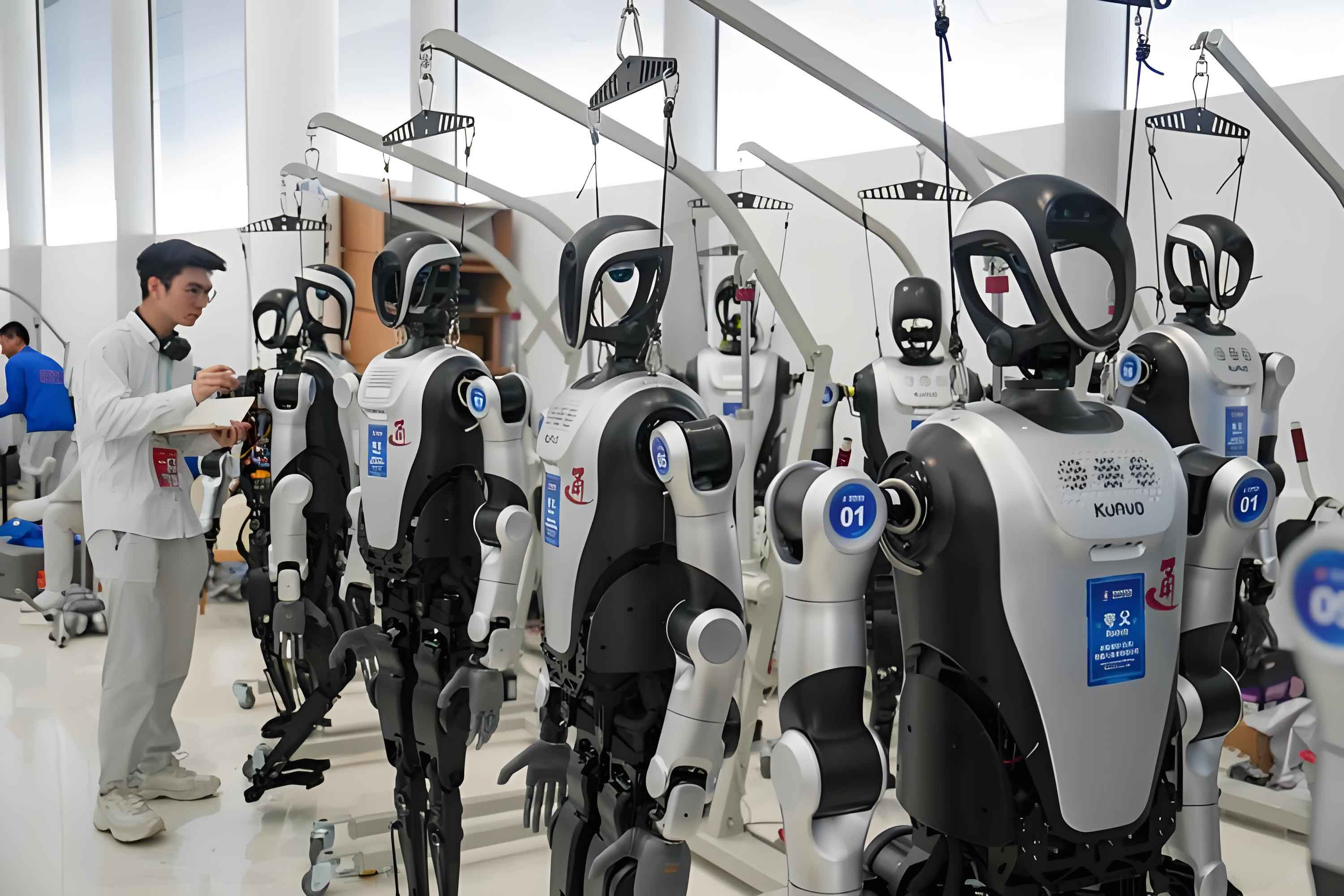
- III. The Humanoid Robot as a Redefinition of the Machine
From the perspective of the three dimensions of embodied intelligence, the humanoid robot becomes more than a technical artifact. It becomes a test case for the claim that body, environment, and interaction are constitutive of intelligence. In recent years, the humanoid robot has emerged as a convergence point for mechanical engineering, cognitive science, and electronic engineering. It is not only a site where embodied intelligence moves from theory to practice but also a philosophical object for examining the nature of intelligence, embodiment, and cognitive generation.
As Merleau-Ponty argued, the body is not a pure physical device. It is a field of meaning generation and a structure through which the subject’s relation to the world appears. This raises a question: can the “body” possessed by a humanoid robot carry an autonomous meaning structure? Or does the humanoid robot implicitly assume continuity between biological intelligence and machine intelligence? To answer this question, it is necessary to examine in what sense the humanoid robot redefines the traditional robot and under what conditions it could truly constitute an embodied existence for artificial intelligence. Such an inquiry touches not only the boundaries of technological development but also the ontological status and future form of artificial systems.
Unlike traditional artificial intelligence based on abstract symbol manipulation, the humanoid robot, empowered by large models, imitates human bodily structure, perception, and interaction capacities. It enters environments designed for humans, such as manufacturing, social services, and special operations, to perform complex tasks and achieve more general and adaptive intelligent performance. By morphology, current mainstream humanoid robots can be divided into three categories. Wheeled humanoid robots mainly use wheeled drive and emphasize tactile sensors and dexterous hand manipulation. Half-body legged humanoid robots emphasize leg movement. Full-body humanoid robots possess four limbs and various perception systems and adapt to multiple complex tasks in open environments. By application scenario and primary function, humanoid robots can be divided into special-operation, industrial, medical, entertainment, public-service, and home-service types.
| Classification Basis | Category | Defining Emphasis |
|---|---|---|
| Morphology | Wheeled humanoid robot | Wheeled drive, tactile sensing, dexterous hand manipulation |
| Morphology | Half-body legged humanoid robot | Leg movement and lower-body locomotion |
| Morphology | Full-body humanoid robot | Four limbs, multiple perception systems, open-environment tasks |
| Application | Special-operation humanoid robot | Tasks in hazardous or specialized settings |
| Application | Industrial humanoid robot | Manufacturing and industrial workflows |
| Application | Medical humanoid robot | Healthcare and medical support |
| Application | Entertainment humanoid robot | Entertainment and interactive experiences |
| Application | Public-service humanoid robot | Service in public or commercial spaces |
| Application | Home-service humanoid robot | Domestic assistance and household interaction |
In 2023, Boston Dynamics introduced an Atlas robot capable of fluid and natural walking, standing up, and 180-degree head and waist rotation. It demonstrated an unprecedented capacity for dynamic bodily balance. In 2024, CloudMinds released Cloud Ginger, representing a high point in current embodied intelligence technology. This humanoid robot, 1.4 meters tall, not only possesses natural-language communication abilities and cross-scenario task execution through a cloud brain but also uses eighteen degrees of freedom in joint control and a real-time monitoring and decision system. It can autonomously plan walking paths in complex environments such as shopping malls and hospitals, avoid dynamic obstacles, and dynamically adjust its behavioral patterns according to user needs. These humanoid robots are no longer machines in the traditional sense. By embedding the latest artificial intelligence technologies into physical entities, they possess coordinated coupling between “brain” and “body” and ultimately interact with the environment through physical action. They are concrete realizations of sensorimotor, situated, and interactive embodiment, and they also redefine the traditional robot.
First, traditional artificial intelligence emphasizes discrete input and central processing mechanisms and ignores how bodily morphology constrains and regulates information processing. A humanoid robot, by contrast, is mainly composed of a “brain,” a “cerebellum,” and a “body.” Through morphological computation, it shows that intelligence is not only a “brain” technology centered on large models. It is also a dynamic regulation process distributed across the body and environmental system. For the humanoid robot, the “body” is the carrier and foundation for realizing all human-like functions. It is responsible for dynamic and precise bodily movement and integrates actuators, chips, sensors, and new materials. Among these, actuators are most central. They include rotary actuators, linear actuators, and end-effectors. Rotary actuators are mainly used at joints such as wrists and knees to perform precise motion control. Linear actuators are often installed in the upper arms, thighs, and elbows to complete extension, push-pull, and other linear movements. End-effectors are mainly used in hands and feet, achieving breakthroughs from traditional grippers to multi-fingered dexterous hands. When Atlas performs jumping, backflips, and dynamic obstacle avoidance, it does not rely on a central processor to precisely calculate every variable. It relies on its mechanical structure to exploit inertia, balance, and feedback. This demonstrates tight coupling between limb morphology and motor function and highlights the capacity of bodily structure itself to process some information.
Second, traditional robots usually complete tasks only in codable and predictable limited situations. The humanoid robot, however, can operate in an open, noisy, uncertain, and ambiguous real world. In 2025, SoftBank Robotics’ humanoid robot Pepper appeared in a shopping mall in Santa Clara, California. Through interaction with customers, it understood their needs and helped them find desired products. Even when a customer said something vague such as “I want to try those shoes,” Pepper could integrate visual input, voice-tone analysis, object recognition, and the present situation to accurately determine which pair of shoes in a display cabinet was meant. This mechanism goes beyond the limits of static semantic networks and pushes semantic understanding from abstract representation detached from context toward context-driven multimodal semantic construction. In addition, when cooperating with humans, Pepper used sensors to perceive environmental changes in real time and combined machine-learning algorithms to dynamically adjust action routes, demonstrating adaptability to application scenarios.
Third, the revolutionary development of the humanoid robot forces a reconsideration of traditional instrumental views of technology and human interaction. Traditional instrumental views of technology presuppose a binary opposition between subject and tool, emphasizing the subject’s domination, control, and transformation of the tool. In traditional human-machine interaction, humans externalize their will into an object through tool use in order to solve problems. Current humanoid robots, however, are no longer cold machines. They are intelligent agents capable of triggering human emotional experience and aesthetic responses through interaction. For example, the social robot Furhat can establish a basic interaction rhythm with humans through high-resolution animation and real-time facial expression responses, and it can realize complex interactive behaviors such as orientation regulation and attention guidance in multi-user situations. This demonstrates the potential of interactive embodiment as a mechanism beyond individual cognition. In such human-robot interaction, human cognitive capacities are not only extended by the presence of an intelligent agent. Action capacities also create new possibilities because of the agent. Moreover, through interaction between human and agent, a fused understanding of the world and the self is formed. Together with intelligent agents, humans create new technological environments and learn, understand, and process relations of mutual penetration and mutual construction with agents.
Through deep embedding of the three dimensions of embodiment, the humanoid robot not only provides a new paradigm of decentralization and interactive generation for artificial intelligence but also fundamentally redefines the concept of the robot. Traditional robots are usually regarded as controllable mechanical agents that rely on preset algorithms to complete tasks in closed systems. The design of the humanoid robot, by contrast, takes embodiment as its core. Its intelligence no longer originates in formal-logical reasoning. It forms in the dynamic interaction between the robot, situations, and others. In other words, the formation of artificial intelligence is no longer merely the result of model computation. It is an embedded, participatory, and collaborative process of generation.
In this sense, the humanoid robot is not merely a technical iteration of the traditional robot. It is a challenge to and reconstruction of its philosophical foundation. It suggests that the body is not merely an executor of thought but a condition for the generation of cognition. The environment is not merely a background for intelligence but a field of cognitive co-construction. The other is not merely an object of interaction but a participant in meaning generation. This redefinition forces further reflection on the ontological status of intelligence and liberates it from an implicit cognitivist framework, bringing it into an embodied ontological horizon.
- IV. Ontological and Phenomenological Questions Raised by the Humanoid Robot
At the same time, the current state of humanoid robot research exposes a series of practical dilemmas in embodied intelligence research. From the perspective of engineering implementation, the humanoid robot still faces high computational costs and technical bottlenecks in motion coordination, context understanding, and multimodal perception. From the perspective of social interaction, it remains difficult to truly embed the robot into complex human emotional experience and ethical structures so that it can form sustained trust and empathy mechanisms with humans. From the perspective of theoretical construction, how to unify phenomenological descriptive analysis with formal modeling of artificial systems remains a major challenge in cognitive science research.
These dilemmas are not accidental. The humanoid robot initiates a profound paradigm shift in intelligence research. Its root is not technical fine-tuning but the reshaping of philosophical and scientific horizons. In this sense, research on the humanoid robot is not only a path toward “more human-like” intelligent technology. It is also a philosophical reflection on questions such as what intelligence is, what the body is, what the relation between humans and the world is, and what risks accompany human-robot interaction.
From a phenomenological perspective, the body is not only a mechanism for realizing cognition. It is also a transcendental structure for meaning generation and world appearance. Although current humanoid robot technology has to a certain extent realized simulation of human motor capacities and perceptual interaction, this functional simulation still cannot touch the pre-reflective structures contained in bodily experience or the intrinsic generative relation between body and world. The humanoid robot may possess formal completeness of the body, but in the coordination of structure and function and in the openness of meaning construction, it remains fundamentally different from human embodied cognition.
This difference in technical realization points not only to difficulties at the engineering level but also to a deeper philosophical problem: whether the “body” of the humanoid robot is sufficient to carry the structural conditions of embodied existence in the phenomenological sense. The humanoid robot may approximate the external form of human intelligence. It may display bionic capacities of a sensorimotor system. It may also approach human intelligence in action planning, situational adaptation, and interaction. Yet morphological approximation cannot guarantee the realization of embodied intelligence. The humanoid robot is therefore not the completed form of embodied intelligence.
- V. Engineering, Social, and Ethical Challenges
The humanoid robot, as a frontier form of embodied intelligence research, has significant practical value and revolutionary meaning. Its philosophical significance, however, does not lie primarily in how much it can copy human embodied intelligence. It lies in how it highlights the theoretical limits of non-embodied cognitive research paradigms and further prompts reflection on the ontological presuppositions of intelligence. As an artificial experimental device at the intersection of phenomenology and engineering, the humanoid robot profoundly displays the irreducible structural tension between body, intelligence, and world. It also calls for sustained ethical vigilance regarding the possibilities of artificial life.
One area of ethical vigilance concerns privacy risk. As the humanoid robot becomes more capable of sensing, interpreting, and interacting in human environments, it may collect and process sensitive information about individuals and social settings. The humanoid robot may operate in homes, hospitals, schools, shopping malls, and workplaces. In these contexts, its sensors and learning systems may blur the boundary between service and surveillance. The humanoid robot therefore requires legal and ethical frameworks that address privacy, consent, data protection, and accountability. The more the humanoid robot is designed to participate in embodied interaction, the more urgent these questions become.
Another area concerns trust and empathy. The humanoid robot can be designed to display emotional consistency, attention, and socially legible behavior. These capacities may improve human-robot interaction. Yet they may also create an illusion of mutual understanding that exceeds the robot’s actual capacities. Humans may attribute intentions, feelings, and moral standing to the humanoid robot. This attribution can be productive in care, education, and service contexts. It can also be misleading if it obscures the differences between functional simulation and lived bodily experience. The humanoid robot may participate in meaning-making, but participation does not automatically equal human-like subjectivity.
A third area concerns labor, agency, and social norms. The humanoid robot is often envisioned as a general-purpose machine that can work in environments built for humans. It may take over dangerous, repetitive, or physically demanding tasks. It may also reshape expectations about service, care, and companionship. The humanoid robot therefore raises questions about responsibility, autonomy, and the distribution of benefits and risks. These questions cannot be answered by engineering alone. They require interdisciplinary dialogue among philosophy, cognitive science, law, ethics, and robotics.
From a theoretical perspective, the humanoid robot also exposes the difficulty of integrating phenomenological description with formal modeling. Phenomenology describes the lived body, pre-reflective intentionality, and the generative relation between body and world. Engineering requires formal representations, control architectures, and measurable performance criteria. The humanoid robot must somehow bridge these two languages. This is not a simple translation problem. It concerns whether the structural conditions of embodiment can be formalized without losing what makes them constitutive of meaning. The humanoid robot is therefore a site where the limits of formalization become visible.
- VI. Conclusion: Embodiment, Meaning, and the Future of the Humanoid Robot
With the transformation of research paradigms, embodiment has become a core issue in contemporary artificial intelligence research. By distinguishing sensorimotor, situated, and interactive dimensions, the analysis attempts to show that intelligence does not originate in abstract computation detached from the body. It is rooted in the dynamic process of continuous coupling between agent and environment. This dynamic process fundamentally depends on the mutual construction among the agent’s capacity for action, perceptual structure, and meaning-making.
The humanoid robot, as an artificial intelligence device with human-like morphological features, highlights the constitutive role of the body in intelligence as it simulates human bodily structure and function. It displays a kind of bionic capacity of the sensorimotor system and approaches the external form of human intelligence in action planning, situational adaptation, and interaction. Yet this morphological approximation still cannot guarantee the realization of embodied intelligence. Although the body of the humanoid robot possesses formal completeness, it remains fundamentally different from human embodied cognition in the coordination of structure and function and in the openness of meaning construction.
This difference in technical realization points not only to engineering difficulties but also to a deeper philosophical question: whether the “body” of the humanoid robot is sufficient to carry the structural conditions of embodied existence in the phenomenological sense. From a phenomenological perspective, the body is not only a mechanism for realizing cognition. It is also a transcendental structure for meaning generation and world appearance. Current humanoid robot technology may simulate human movement and perceptual interaction to a certain degree, but such functional simulation cannot touch the pre-reflective structures contained in bodily experience or the intrinsic generative relation between body and world.
In this sense, the humanoid robot is not the completed form of embodied intelligence. As a frontier form of embodied intelligence research, it has notable practical value and revolutionary significance. Its philosophical meaning, however, does not lie in how much it can replicate human embodied intelligence. It lies in how it exposes the theoretical limitations of non-embodied cognitive research paradigms and prompts further reflection on the ontological presuppositions of intelligence. As an artificial experimental device at the intersection of phenomenology and engineering technology, the humanoid robot profoundly displays the irreducible structural tension between body, intelligence, and world. It also reminds researchers and society to maintain continuous ethical vigilance regarding the possibilities of artificial life.
The future of the humanoid robot will depend not only on advances in actuators, sensors, large models, and control systems. It will also depend on how the field understands embodiment. If the humanoid robot is treated merely as a machine that performs tasks in human form, it may remain an advanced tool. If it is treated as a test of the conditions under which intelligence emerges from body, situation, and interaction, then the humanoid robot becomes a philosophical and scientific probe. It asks whether meaning can be generated without lived bodily experience, whether social understanding can be simulated without intersubjective existence, and whether intelligence can be detached from the world in which it acts. The humanoid robot does not answer these questions by itself. It makes them unavoidable.